
**Topic:** discuss investment material & explain phosphate bonded investment in detail **Reference:** [philips **Format/Marks:** 15 marks Give me a **BDS university-exam-oriented answer** according to the reference, in **very easy language**, following the format/marks I specify. Include **important headings, classifications, tables, examples, mnemonics, flowcharts, and simple hand-drawn-style diagrams** wherever useful, and generate **PNG flowcharts/diagrams** when they would help. End with **⭐ high-yield points, quick revision, likely viva questions, and the most important points to write in the exam**.
Clean educational flowchart titled "CLASSIFICATION OF INVESTMENT MATERIALS" for dental students. Show a top-down hierarchy tree diagram with hand-drawn style on white background. Main box at top: "Investment Materials". Three branches below: 1) "Gypsum Bonded" (silica + gypsum binder) - label "Type I: Inlay/Onlay, Type II: Partial Denture" 2) "Phosphate Bonded" (silica + MgO + NH4H2PO4) - label "High-temp alloys, Metal-Ceramic, Base metal" 3) "Silica Bonded" (silica + ethyl silicate/colloidal silica) - label "High-fusing alloys". Include a small legend box showing "Refractory = Silica | Binder = varies". Use blue for headings, black for text, clear arrows between boxes. Academic/textbook style.
Educational chemistry diagram titled "PHOSPHATE BONDED INVESTMENT - SETTING REACTION" for dental BDS students. Show a clear step-by-step chemical reaction flowchart with hand-drawn style boxes. Include: Box 1: "POWDER: MgO + NH4H2PO4 (ammonium dihydrogen phosphate) + Silica (quartz/cristobalite)" → mixed with → Box 2: "LIQUID: Colloidal silica (SiO2) + Water (or plain water)" → Setting reaction arrow → Box 3: "MgO + NH4H2PO4 → MgNH4PO4 (struvite) - initial setting" → Heating/Burnout arrow → Box 4: "At 260°C: MgNH4PO4 → Mg2P2O7 + NH3 - final strength". Below show a table: Powder/Liquid ratio, W/P ratio 0.13-0.15. Use orange and blue color coding. Include a small note: "Colloidal silica REPLACES water - increases expansion". Simple academic diagram style on white background.
Educational diagram titled "THERMAL EXPANSION CURVE - PHOSPHATE BONDED INVESTMENT" for dental students. Show a line graph with X-axis labeled "Temperature (°C)" from 0 to 700, Y-axis labeled "% Linear Expansion" from 0 to 2.0. Draw two curves: 1) Blue curve labeled "Normal expansion curve" that rises from 0 to about 1.4% at 500°C then slightly drops. 2) Orange curve labeled "With colloidal silica liquid" that rises higher to about 1.8-2.0% at 500°C. Mark key points: "Setting expansion" at room temperature (~0.4%), "Thermal expansion peak" at 500°C. Add small inset box listing: "Total expansion = Setting expansion + Hygroscopic expansion + Thermal expansion". Hand-drawn educational style, clean white background, grid lines visible.
INVESTMENT MATERIAL
Reference: Phillips' Science of Dental Materials | 15 Marks
1. DEFINITION
Investment material is a ceramic material used to form a mold into which molten metal is cast to produce a dental casting (inlay, crown, bridge, partial denture framework).
2. REQUIREMENTS OF AN IDEAL INVESTMENT MATERIAL
| Letter | Requirement |
|---|---|
| S | Sufficient setting time (adequate working time) |
| T | Thermal stability at casting temperature |
| E | Adequate expansion to compensate for metal shrinkage |
| A | Accuracy - reproduce fine details |
| M | Adequate strength (mechanical) during casting |
| F | Easy to fracture (break away) after casting |
| C | Compatible with all alloys; non-reactive |
- Smooth mold surface
- Adequate porosity (allow gas escape)
- Non-toxic, economical
- Low W/P ratio for strength
3. COMPOSITION OF INVESTMENT MATERIALS (General)
INVESTMENT = REFRACTORY FILLER + BINDER
| Component | Function | Example |
|---|---|---|
| Refractory filler (60-65%) | Withstands high temp; thermal expansion | Silica (quartz, cristobalite, tridymite) |
| Binder (25-35%) | Holds the mass together; gives strength | Gypsum / Phosphate / Silicate |
| Modifiers | Control setting, expansion, strength | NaCl, boric acid, carbon |
4. CLASSIFICATION OF INVESTMENT MATERIALS
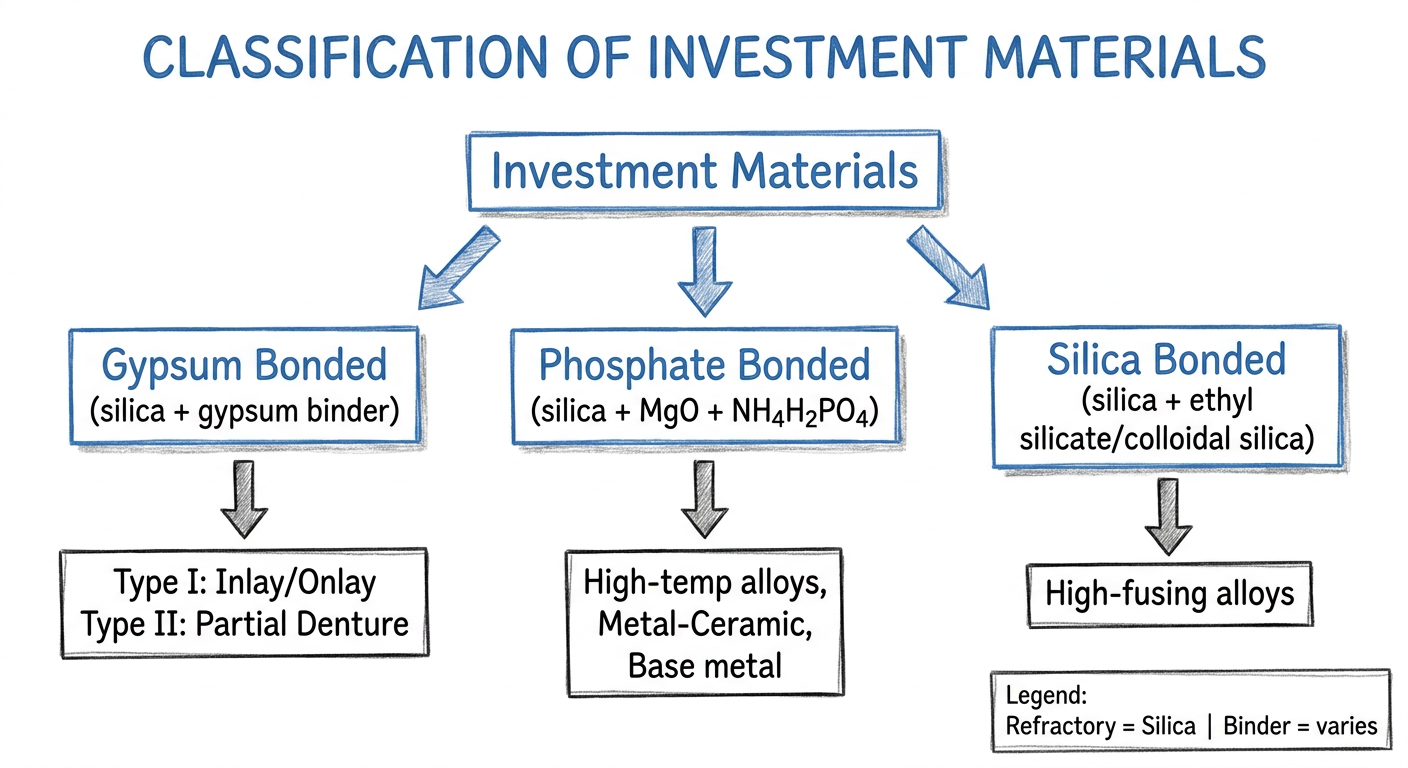
ADA Specification:
| Type | Description | Use |
|---|---|---|
| Type I | Inlay investment (gypsum bonded) | Inlay, onlay, crowns - gold alloys |
| Type II | Casting investment (high temperature) | RPD frameworks, metal-ceramic - base metal |
5. GYPSUM BONDED INVESTMENT (Brief)
- Binder: Calcium sulfate hemihydrate (plaster/stone)
- Refractory: Silica (quartz + cristobalite)
- Max temp: 700°C (above this, gypsum decomposes → SO2 gas contaminates casting)
- Used for: gold inlays, crowns, Type I gold alloys
- Limitation: Cannot be used above 700°C - so CANNOT be used for base metal alloys (which require 1200-1400°C)
6. PHOSPHATE BONDED INVESTMENT (DETAILED)
Definition: An investment material in which the binder is formed by the reaction between metal oxide (MgO) and an acid phosphate (NH₄H₂PO₄), capable of withstanding temperatures up to 1000-1100°C.
6.1 Historical Background
- Introduced by Bauer (1932)
- Became popular for base metal alloys and metal-ceramic (porcelain-fused-to-metal) restorations
- Eliminates the temperature limitation of gypsum bonded investments
6.2 COMPOSITION
| Component | Material | % | Function |
|---|---|---|---|
| POWDER | |||
| Refractory filler | Silica (quartz + cristobalite) | 70-80% | Thermal expansion, refractoriness |
| Metal oxide | Magnesium oxide (MgO) | 10-15% | Reacts with phosphate to form binder |
| Acid phosphate | Ammonium dihydrogen phosphate (NH₄H₂PO₄) | 8-10% | Reacts with MgO to set the investment |
| LIQUID | |||
| Colloidal silica | SiO₂ in water suspension | 20-30% | Increases expansion, improves surface |
| Water | Distilled water | As needed | Medium for mixing |
Key point: The liquid can be colloidal silica (gives MORE expansion) OR plain water (gives LESS expansion). The concentration of colloidal silica determines the amount of expansion.
6.3 SETTING REACTION

MgO + NH₄H₂PO₄ + H₂O → MgNH₄PO₄·6H₂O
(Magnesium oxide + Ammonium dihydrogen phosphate → Struvite)
- Struvite (MgNH₄PO₄·6H₂O) is the initial binder
- This is what gives the investment its initial green strength
MgNH₄PO₄ → Mg₂P₂O₇ + NH₃↑ + H₂O↑
(Struvite → Magnesium pyrophosphate + ammonia + water vapor)
- Mg₂P₂O₇ (Magnesium pyrophosphate) is the true, strong binder
- This gives the investment its final high-temperature strength
Mnemonic for setting reaction: "MgO ATTACKS the Phosphate → Makes STRUVITE (weak) → BURNS to PYROPHOSPHATE (strong)"
6.4 EXPANSION
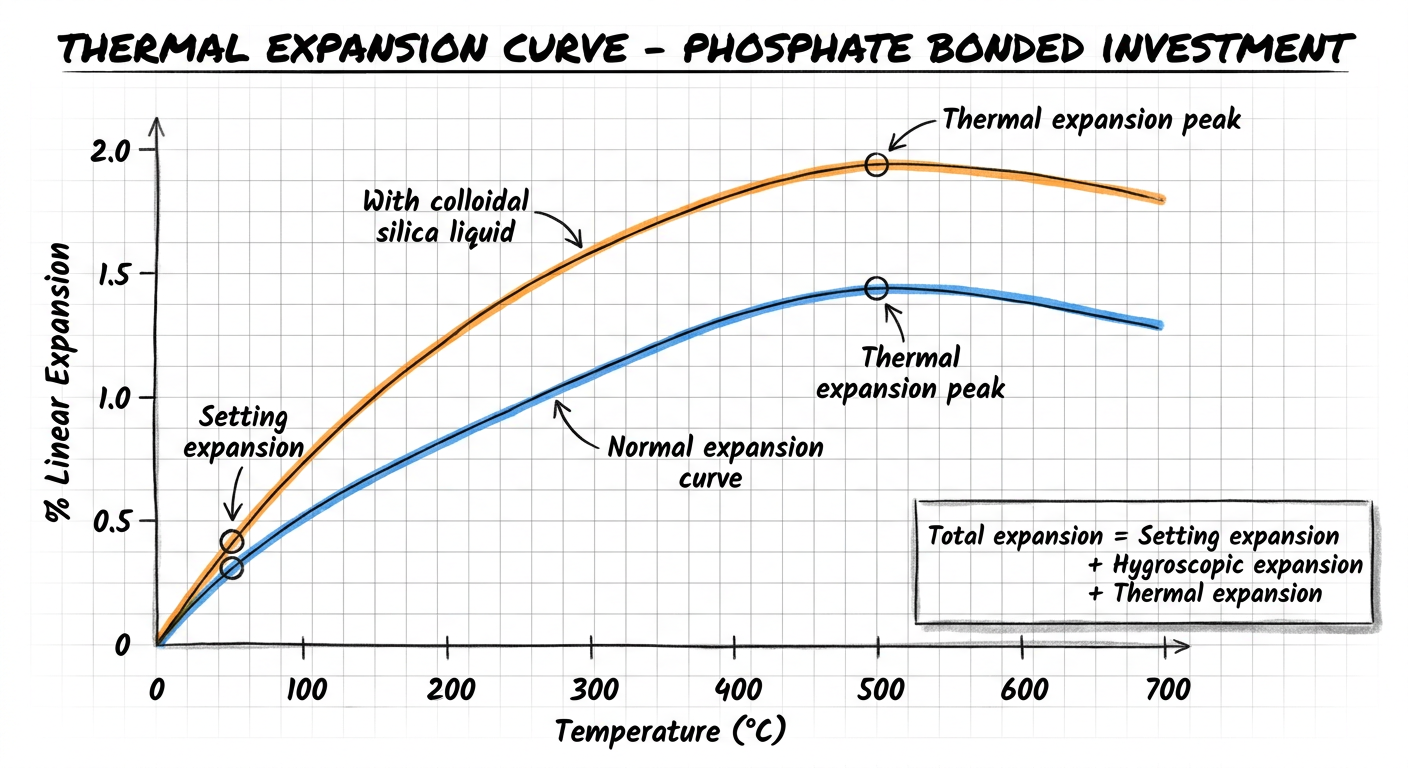
Types of Expansion:
| Type | Mechanism | Value |
|---|---|---|
| Setting expansion | Crystal growth of MgNH₄PO₄ during setting | 0.3-0.6% |
| Thermal expansion | Alpha-beta quartz inversion (573°C), cristobalite inversion (200-270°C) | 0.8-1.6% |
| Total expansion | Setting + Thermal | 1.2-2.2% |
Effect of Colloidal Silica:
- Replacing water with colloidal silica increases total expansion by 0.4-0.6%
- The concentration of colloidal silica can be adjusted (diluted with water) to fine-tune expansion
- More colloidal silica = more expansion = compensates for greater metal shrinkage
Colloidal silica concentration ↑ → Expansion ↑
Colloidal silica concentration ↓ → Expansion ↓
6.5 SILICA INVERSIONS (Why Thermal Expansion Occurs)
Quartz (alpha) → Quartz (beta) at 573°C → SUDDEN expansion
Cristobalite (alpha) → Cristobalite (beta) at 200-270°C → expansion
- Cristobalite gives a sudden, large expansion at lower temperature
- Quartz gives expansion at higher temperature
- The investment uses a mixture of both to get staged, controlled expansion
6.6 W/P RATIO AND CONSISTENCY
| Parameter | Value |
|---|---|
| Liquid/Powder ratio (L/P) | 0.13-0.15 mL/g |
| Mixing time | 30-60 seconds (mechanical vacuum mixing preferred) |
| Working time | ~5-7 minutes |
| Setting time | 10-15 minutes |
| W/P ratio ↑ | → Expansion ↑, Strength ↓ |
| W/P ratio ↓ | → Expansion ↓, Strength ↑ |
Vacuum mixing is essential for phosphate bonded investments to reduce porosity and improve surface detail.
6.7 BURNOUT PROCEDURE
| Temperature | What Happens |
|---|---|
| Room temp | Setting complete (MgNH₄PO₄ formed) |
| 260°C | MgNH₄PO₄ → Mg₂P₂O₇ + NH₃ + H₂O |
| 200-270°C | Cristobalite inversion (expansion) |
| 573°C | Quartz inversion (expansion) |
| 900-1000°C | Maximum burnout temperature; full thermal expansion |
- Place set investment in cold furnace
- Heat slowly to 260°C (hold to let NH₃/H₂O escape)
- Increase to 900-1000°C
- Hold for 30-60 minutes
- Cast immediately at temperature
DO NOT use the slow bench cool + reheat method - can cause cristobalite inversion problems
6.8 SURFACE QUALITY AND MODIFIERS
| Modifier | Effect |
|---|---|
| Boric acid | Reduces thermal expansion; acts as flux |
| Carbon (graphite) | Reduces surface oxidation of mold |
| Wetting agents | Improve flow around wax pattern |
- Vacuum investing
- Using colloidal silica liquid
- Proper L/P ratio
6.9 USES / APPLICATIONS
| Application | Why phosphate bonded? |
|---|---|
| Metal-ceramic (PFM) restorations | High-temp alloys (Au-Pt, Ni-Cr, Co-Cr) require >900°C casting |
| Base metal alloy castings (Ni-Cr, Co-Cr) | Melt at 1200-1400°C |
| Titanium castings | Special phosphate investment needed |
| RPD frameworks | Base metal - high temp needed |
| When large expansion needed | Compensates for greater shrinkage of base metals |
6.10 ADVANTAGES AND DISADVANTAGES
| Advantages | Disadvantages |
|---|---|
| Withstands high temp (1000-1100°C) | More expensive than gypsum bonded |
| Used for base metals and metal-ceramic | Rougher surface finish |
| Greater and adjustable expansion | Cannot be used for high-fusing gold alloys (use silica bonded instead) |
| No sulfur contamination | NH₃ fumes released during burnout (needs ventilation) |
| Colloidal silica allows fine expansion control | Shorter working time |
7. SILICA BONDED INVESTMENT (Brief)
- Binder: Hydrolyzed ethyl silicate or colloidal silica
- Refractory: Silica
- Used for: Highest fusing cobalt-chromium alloys and some titanium systems
- Max temp: 1200°C+
- Rarely used now; expensive; complex preparation
8. COMPARISON TABLE
| Property | Gypsum Bonded | Phosphate Bonded | Silica Bonded |
|---|---|---|---|
| Binder | CaSO₄·½H₂O | MgO + NH₄H₂PO₄ | SiO₂ (hydrolyzed) |
| Max Temp | 700°C | 1000-1100°C | 1200°C+ |
| Alloys used | Type I/II gold | Base metal, PFM | High-fusing Co-Cr |
| Expansion | Lower | Higher (adjustable) | High |
| Liquid | Water | Colloidal silica/water | Ethyl silicate/colloidal silica |
| ADA Spec | Type I | Type II | Type II |
| Cost | Low | Moderate | High |
9. QUICK REVISION - FLOWCHART FORMAT
INVESTMENT MATERIAL
       |
       ├── REFRACTORY (Silica) + BINDER
       |
       ├── TYPES:
       |     Gypsum Bonded → max 700°C → Gold alloys
       |     Phosphate Bonded → max 1000°C → Base metal / PFM ← FOCUS
       |     Silica Bonded → max 1200°C → High-fusing alloys
       |
PHOSPHATE BONDED:
       |
       ├── POWDER: MgO + NH₄H₂PO₄ + Silica
       ├── LIQUID: Colloidal silica (adjusts expansion)
       |
       ├── SETTING: MgO + NH₄H₂PO₄ → MgNH₄PO₄ (struvite) → Mg₂P₂O₇
       |
       ├── EXPANSION: Setting + Thermal (quartz/cristobalite inversions)
       |            Colloidal silica ↑ = Expansion ↑
       |
       └── USED FOR: PFM, RPD, Base metal, Ni-Cr, Co-Cr
⭐ HIGH-YIELD POINTS (Must Write in Exam)
- Phosphate bonded = max temp 1000-1100°C (gypsum bonded = max 700°C)
- Setting reaction: MgO + NH₄H₂PO₄ → Struvite → on heating → Mg₂P₂O₇ (pyrophosphate) - the real binder
- Colloidal silica replaces/dilutes water in the liquid - increasing its concentration increases expansion
- Silica inversions: Quartz at 573°C; Cristobalite at 200-270°C - give thermal expansion
- Total expansion = Setting expansion + Thermal expansion
- Used for: Metal-ceramic restorations, base metal alloys (Ni-Cr, Co-Cr), RPD frameworks
- NH₃ fumes released at 260°C burnout - ventilation needed
- Vacuum mixing is preferred
- Gypsum bonded cannot be used above 700°C because CaSO₄ decomposes releasing SO₂ which contaminates metal
- L/P ratio for phosphate bonded = 0.13-0.15 mL/g
LIKELY VIVA QUESTIONS
| Question | Key Answer |
|---|---|
| What is the binder in phosphate bonded investment? | MgO + NH₄H₂PO₄ (struvite initially, then Mg₂P₂O₇) |
| Why can't we use gypsum bonded above 700°C? | Gypsum decomposes releasing SO₂ → contaminates casting |
| What is the role of colloidal silica? | Increases setting and thermal expansion; allows expansion control |
| What gas is released during burnout of phosphate bonded investment? | Ammonia (NH₃) at ~260°C |
| What is quartz inversion temperature? | 573°C |
| What is cristobalite inversion temperature? | 200-270°C |
| Why is cristobalite added to investment? | To get expansion at lower temperature (useful for lower temp casting) |
| Name the polymorphic forms of silica | Quartz, cristobalite, tridymite (all α and β forms) |
| Which investment for metal-ceramic? | Phosphate bonded investment |
| What happens if W/P ratio is increased? | Expansion increases, strength decreases |
MOST IMPORTANT POINTS TO WRITE IN THE EXAM (Summary Box)
✏️ For 15-mark answer, ensure you cover:
- Definition of investment material
- Requirements (mnemonic S-T-E-A-M-F-C)
- Classification table (3 types with binder, temp, use)
- Phosphate bonded - composition (powder + liquid)
- Setting reaction (both steps - struvite → pyrophosphate)
- Expansion (types + effect of colloidal silica)
- Silica inversions
- Burnout procedure
- Uses/clinical applications
- Advantages and disadvantages
What's Covered in This Answer
- Definition, ideal requirements with mnemonic S-T-E-A-M-F-C
- General composition (refractory filler + binder concept)
- Full classification table with flowchart diagram
- Historical note (Bauer, 1932)
- Detailed composition table (powder + liquid)
- Setting reaction with both steps (struvite → Mg₂P₂O₇) with diagram
- Expansion (setting + thermal) with thermal expansion curve diagram
- Silica inversions (quartz 573°C, cristobalite 200-270°C)
- W/P ratio, burnout steps, modifiers
- Uses, advantages, disadvantages
- Silica bonded (brief), 3-way comparison table
There is a glitch in the answer cant see the full answer
INVESTMENT MATERIAL
Reference: Phillips' Science of Dental Materials | 15 Marks
1. DEFINITION
Investment material is a ceramic/refractory material used to form a mold into which molten metal is cast to produce a dental casting (inlay, crown, bridge, RPD framework).
2. REQUIREMENTS OF AN IDEAL INVESTMENT MATERIAL
| Letter | Requirement |
|---|---|
| S | Sufficient Setting time (adequate working time ~5-7 min) |
| T | Thermal stability at casting temperature |
| E | Adequate Expansion to compensate for metal shrinkage |
| A | Accuracy - reproduce fine surface details |
| M | Adequate Mechanical strength during casting |
| F | Easy to Fracture/break away after casting |
| C | Compatible with alloys; non-reactive with metal |
- Smooth mold surface
- Adequate porosity to allow escape of gases
- Non-toxic, economical
- Sufficient shelf life
3. BASIC COMPOSITION (All Investment Materials)
INVESTMENT MATERIAL = REFRACTORY FILLER + BINDER
| Component | % | Function | Example |
|---|---|---|---|
| Refractory filler | 60-80% | Withstands high temp; provides thermal expansion | Silica (quartz, cristobalite, tridymite) |
| Binder | 25-35% | Holds the mass together; gives strength | Gypsum / Phosphate / Silicate |
| Modifiers | Small % | Control setting time, expansion, surface quality | NaCl, boric acid, carbon/graphite |
4. CLASSIFICATION OF INVESTMENT MATERIALS
Based on Type of Binder:
| Type | Binder | Max Temp | Used For |
|---|---|---|---|
| 1. Gypsum Bonded | Calcium sulfate hemihydrate (CaSO4.1/2H2O) | 700°C | Gold alloys - inlay, crown |
| 2. Phosphate Bonded | MgO + NH4H2PO4 (struvite/pyrophosphate) | 1000-1100°C | Base metal alloys, metal-ceramic (PFM) |
| 3. Silica Bonded | Hydrolyzed ethyl silicate / colloidal silica | 1200°C+ | Highest fusing Co-Cr alloys |
ADA Specification No. 2:
| ADA Type | Description | Use |
|---|---|---|
| Type I | Inlay investment (gypsum bonded) | Inlays, onlays - lower temp gold alloys |
| Type II | Casting investment (high temperature) | RPD frameworks, metal-ceramic - base metals |
5. GYPSUM BONDED INVESTMENT (Brief Overview)
- Binder: Calcium sulfate hemihydrate (plaster or stone)
- Refractory: Silica (quartz + cristobalite)
- Max temperature: 700°C
- Limitation: Above 700°C, gypsum decomposes releasing SO2 gas which contaminates the casting
- Used for: Type I and Type II gold alloy castings only
This major limitation (max 700°C) is why Phosphate Bonded Investment was developed - for alloys requiring 1000-1400°C casting temperatures.
6. PHOSPHATE BONDED INVESTMENT - DETAILED
Definition: An investment material in which the binder is formed by the chemical reaction between magnesium oxide (MgO) and ammonium dihydrogen phosphate (NH4H2PO4), capable of withstanding casting temperatures up to 1000-1100°C.
6.1 Historical Note
- Introduced by Bauer (1932)
- Gained importance with the rise of base metal alloys and metal-ceramic (porcelain-fused-to-metal) restorations
- Replaced gypsum bonded investment for high-temperature applications
6.2 COMPOSITION
POWDER Components:
| Component | Material | Approx % | Function |
|---|---|---|---|
| Refractory filler | Silica - quartz + cristobalite | 70-80% | Thermal expansion; withstands high temp |
| Metal oxide | Magnesium oxide (MgO) | 10-15% | Reacts with phosphate; forms binder |
| Acid phosphate | Ammonium dihydrogen phosphate (NH4H2PO4) | 8-10% | Reacts with MgO to set the mass |
LIQUID Components:
| Component | Material | Function |
|---|---|---|
| Colloidal silica | SiO2 suspended in water (20-40% concentration) | Increases expansion; improves surface |
| Water | Distilled water | Diluent; can replace colloidal silica partially |
Key Clinical Point: The liquid can be either colloidal silica (more expansion) or plain distilled water (less expansion). Diluting colloidal silica with water allows fine-tuning of expansion to match specific alloy shrinkage values.
6.3 SETTING REACTION

Stage 1 - Initial Setting at Room Temperature:
MgO + NH4H2PO4 + H2O → MgNH4PO4 · 6H2O
- Struvite (MgNH4PO4.6H2O) is the initial binder crystal
- Gives the investment its "green strength" - weak initial strength
- The investment hardens and can be handled at this stage
- Setting is exothermic (heat is released)
Stage 2 - Final Setting During Burnout (~260°C):
MgNH4PO4 → Mg2P2O7 + NH3 (gas) + H2O (vapor)
   (Struvite)     (Magnesium pyrophosphate)
- Mg2P2O7 (Magnesium pyrophosphate) is the true, strong binder
- NH3 (ammonia) and water vapor escape as gases - ventilation is essential
- This gives the investment its final high-temperature strength
Mnemonic for Setting: "MgO ATTACKS Phosphate → STRUVITE forms (weak) → BURNS to PYROPHOSPHATE (strong)"
6.4 EXPANSION
A. Setting Expansion
| Feature | Detail |
|---|---|
| Cause | Crystal growth of MgNH4PO4 (struvite) during setting pushes outward |
| Value | 0.3 - 0.6% |
| Influenced by | L/P ratio, concentration of colloidal silica |
B. Thermal Expansion
| Feature | Detail |
|---|---|
| Cause | Silica polymorphic inversions on heating |
| Value | 0.8 - 1.6% |
| Key temperatures | Cristobalite inversion: 200-270°C; Quartz inversion: 573°C |
C. Effect of Colloidal Silica on Expansion:
Colloidal silica concentration INCREASES → Expansion INCREASES
Colloidal silica concentration DECREASES (more water added) → Expansion DECREASES
- This gives the clinician control over the total expansion
- Manufacturer provides colloidal silica at a set concentration
- Can be diluted with distilled water to reduce expansion
- 100% colloidal silica liquid = maximum expansion
- 100% distilled water = minimum expansion
Summary Table - Expansion Values:
| Type of Expansion | Value |
|---|---|
| Setting expansion | 0.3 - 0.6% |
| Thermal expansion | 0.8 - 1.6% |
| Total expansion | 1.2 - 2.2% |
6.5 SILICA POLYMORPHIC INVERSIONS
| Inversion | Temperature | Type | Volume Change |
|---|---|---|---|
| Alpha-quartz → Beta-quartz | 573°C | Sudden, reversible | Expansion ~0.45% |
| Alpha-cristobalite → Beta-cristobalite | 200-270°C | Sudden, reversible | Expansion ~1.0% |
| Quartz → Tridymite | 870°C | Sluggish | Minor |
- Cristobalite gives large expansion at lower temperature (200-270°C) - useful for lower burnout temps
- Quartz gives expansion at higher temperature (573°C)
- Mixture gives staged, controlled, adequate total expansion throughout the burnout temperature range
Important: These inversions are reversible - on cooling, the investment contracts by the same amount. This is why the casting must be done while the mold is still hot (at casting temperature).
6.6 W/P RATIO AND MANIPULATION
| Parameter | Value/Detail |
|---|---|
| Liquid/Powder ratio (L/P) | 0.13 - 0.15 mL/g |
| Mixing method | Mechanical vacuum mixing (preferred) OR hand spatulation |
| Mixing time | 30-60 seconds |
| Working time | 5-7 minutes |
| Setting time | 10-15 minutes |
Effect of Changing L/P Ratio:
| L/P Ratio | Effect on Expansion | Effect on Strength | Effect on Surface |
|---|---|---|---|
| Increased | Expansion increases | Strength decreases | Rougher surface |
| Decreased | Expansion decreases | Strength increases | Smoother surface |
Vacuum mixing is essential for phosphate bonded investment because:
- Reduces air bubbles and porosity
- Improves surface detail reproduction
- Gives more uniform consistency
- Reduces surface roughness of the casting
6.7 BURNOUT PROCEDURE
- Eliminate the wax pattern completely
- Allow full thermal expansion
- Preheat the mold for casting
| Temperature Stage | Duration | What Happens |
|---|---|---|
| Room temp | Setting complete | MgNH4PO4 (struvite) formed - green strength |
| 200-270°C | Hold briefly | Cristobalite inversion - expansion; wax softens |
| 260°C | - | Struvite → Mg2P2O7 + NH3 + H2O; wax burns |
| 573°C | - | Quartz inversion - expansion |
| 900-1000°C | Hold 30-60 min | Full thermal expansion; complete wax elimination |
- Place freshly set investment (ring) in a cold/room-temp furnace
- Heat slowly (avoid rapid temperature rise - cracking risk)
- At 260°C - hold briefly to allow gases to escape
- Increase to 900-1000°C (final burnout temp)
- Hold for 30-60 minutes at final temperature
- Cast immediately while mold is at casting temperature
Never let the mold cool and reheat - the silica inversions reverse on cooling and re-expand on reheating, causing uncontrolled dimensional changes.
6.8 SURFACE QUALITY AND MODIFIERS
| Modifier/Additive | Role |
|---|---|
| Boric acid | Reduces thermal expansion; acts as flux at high temp |
| Carbon/Graphite | Reduces surface oxidation of mold; creates reducing atmosphere |
| Wetting agents | Improve flow of investment around wax pattern |
| Coloring agents | Identify set from unset investment |
- Vacuum investing
- Using colloidal silica liquid (not plain water)
- Proper L/P ratio
- Wetting the wax pattern before investing
6.9 CLINICAL APPLICATIONS / USES
| Application | Reason for Using Phosphate Bonded |
|---|---|
| Metal-ceramic (PFM) restorations | Precious/semi-precious alloys (Au-Pt, Au-Pd) need >950°C casting temp |
| Base metal alloy castings | Ni-Cr, Co-Cr alloys melt at 1200-1400°C |
| Removable partial denture (RPD) frameworks | Co-Cr alloy - high temp required |
| High-strength porcelain-fused crowns | Base metal substructures |
| Implant components | Precision base metal castings |
6.10 ADVANTAGES AND DISADVANTAGES
| Advantages | Disadvantages |
|---|---|
| Withstands very high temp (1000-1100°C) | More expensive than gypsum bonded |
| Used for base metals and metal-ceramic | Rougher surface finish on casting |
| Expansion is adjustable via colloidal silica | NH3 fumes during burnout - needs ventilation |
| No SO2 contamination of metal | Shorter working time than gypsum bonded |
| Can compensate for greater metal shrinkage | Cannot be used for the very highest fusing alloys (>1200°C) - use silica bonded |
| Vacuum mixing improves quality | - |
7. SILICA BONDED INVESTMENT (Brief)
- Binder: Hydrolyzed ethyl silicate OR colloidal silica
- Refractory: Silica
- Max temperature: 1200°C and above
- Used for: Highest fusing cobalt-chromium alloys and some titanium systems
- Rarely used now due to expense and complexity of preparation
- Ethyl silicate liquid is hydrolyzed with HCl before use
8. COMPARISON TABLE - ALL THREE TYPES
| Property | Gypsum Bonded | Phosphate Bonded | Silica Bonded |
|---|---|---|---|
| Binder | CaSO4.1/2H2O | MgO + NH4H2PO4 | SiO2 (hydrolyzed) |
| Refractory | Silica | Silica | Silica |
| Max Temp | 700°C | 1000-1100°C | 1200°C+ |
| Liquid | Water | Colloidal silica / water | Ethyl silicate / colloidal silica |
| Alloys | Type I/II gold | Base metal, PFM alloys | High-fusing Co-Cr |
| ADA Type | Type I | Type II | Type II |
| Expansion | Lower | Higher, adjustable | High |
| Surface finish | Smooth | Moderate | Rougher |
| Cost | Low | Moderate | High |
| SO2 problem? | YES - above 700°C | NO | NO |
9. QUICK REVISION - SUMMARY FLOWCHART
INVESTMENT MATERIAL
       |
       +---- Refractory (Silica) + Binder (varies)
       |
       +---- TYPES:
       |      |
       |      +-- Gypsum Bonded ------> max 700°C --------> Gold alloys
       |      |
       |      +-- PHOSPHATE BONDED --> max 1000-1100°C ---> Base metal / PFM
       |      |                 [FOCUS]
       |      +-- Silica Bonded ------> max 1200°C+ -------> High-fusing Co-Cr
       |
PHOSPHATE BONDED DETAILS:
       |
       +---- POWDER: MgO + NH4H2PO4 + Silica (quartz + cristobalite)
       |
       +---- LIQUID: Colloidal silica (concentration controls expansion)
       |
       +---- SETTING REACTION:
       |      MgO + NH4H2PO4 --> Struvite (green strength)
       |              |
       |              V (at 260°C burnout)
       |         Mg2P2O7 + NH3 gas (true binder - high strength)
       |
       +---- EXPANSION:
       |      Setting expansion (0.3-0.6%)
       |      + Thermal expansion (0.8-1.6%) [quartz 573°C, cristobalite 200-270°C]
       |      = Total expansion (1.2-2.2%)
       |      Colloidal silica conc. UP = Expansion UP
       |
       +---- USED FOR: PFM crowns, RPD, Ni-Cr, Co-Cr alloys
⭐ HIGH-YIELD POINTS (Exam Critical)
- Max temp: Phosphate bonded = 1000-1100°C | Gypsum bonded = 700°C
- Setting reaction - 2 steps:
- Step 1: MgO + NH4H2PO4 → Struvite (MgNH4PO4.6H2O) - weak
- Step 2: Struvite → Mg2P2O7 (pyrophosphate) + NH3 + H2O at 260°C - strong
- Colloidal silica controls expansion - higher concentration = more expansion
- Silica inversions: Quartz at 573°C, Cristobalite at 200-270°C
- Total expansion = Setting + Thermal (no significant hygroscopic in phosphate bonded)
- Gypsum decomposes above 700°C releasing SO2 - contaminates metal
- NH3 fumes at burnout = ventilation needed
- Vacuum mixing preferred - reduces porosity, improves surface
- L/P ratio = 0.13-0.15 mL/g
- Uses: Metal-ceramic (PFM), RPD frameworks, Ni-Cr and Co-Cr alloy castings
LIKELY VIVA QUESTIONS WITH ANSWERS
| Question | Answer |
|---|---|
| What is the binder in phosphate bonded investment? | MgO + NH4H2PO4; initially forms struvite, then Mg2P2O7 on burnout |
| Why can't gypsum bonded be used above 700°C? | Gypsum decomposes releasing SO2 gas which contaminates the metal casting |
| What is the role of colloidal silica? | Controls and increases setting + thermal expansion; improves surface quality |
| What gas is released during burnout? | Ammonia (NH3) at ~260°C |
| What is quartz inversion temperature? | 573°C (alpha to beta quartz) |
| What is cristobalite inversion temperature? | 200-270°C (alpha to beta cristobalite) |
| Why is cristobalite added to investment? | Provides large expansion at lower temperature; supplements quartz expansion |
| Which investment for metal-ceramic restorations? | Phosphate bonded investment |
| What happens if L/P ratio is increased? | Expansion increases, strength decreases |
| What is "green strength"? | Initial weak strength after setting due to struvite formation, before burnout |
| Why is vacuum mixing used? | Reduces air incorporation, porosity; gives smoother surface; uniform consistency |
| What is the final binder in phosphate bonded investment? | Magnesium pyrophosphate (Mg2P2O7) |
MOST IMPORTANT POINTS TO WRITE IN THE EXAM
For a full 15-mark answer, cover ALL these headings:
- Definition of investment material
- Requirements (with mnemonic S-T-E-A-M-F-C)
- Composition (refractory + binder)
- Classification table (3 types - binder, temp, alloy)
- Limitation of gypsum bonded (SO2 above 700°C)
- Phosphate bonded - composition (powder + liquid)
- Setting reaction - BOTH STAGES with chemical equations
- Expansion - types + role of colloidal silica + total expansion value
- Silica inversions (quartz 573°C, cristobalite 200-270°C)
- Burnout procedure (step by step)
- Clinical uses / applications
- Advantages and disadvantages
- Comparison table (all 3 types)
gypsum bonded investment instead of phosphate bonded investment same ques
Clean educational flowchart titled "CLASSIFICATION OF GYPSUM BONDED INVESTMENT" for dental BDS students. Hand-drawn style on white background. Main box at top: "Gypsum Bonded Investment". Two branches: 1) "TYPE I - Inlay Investment" with sub-bullets: "For inlays, onlays", "Low-fusing gold alloys", "Thermal expansion type", "Setting expansion type" 2) "TYPE II - Casting Investment" with sub-bullets: "For crowns, bridges", "High-fusing gold alloys", "More expansion needed". Below both branches, a box: "Both contain: Silica (refractory) + Calcium sulfate hemihydrate (binder)". Blue headings, black text, clear arrows. Academic textbook style.
Educational chemistry diagram titled "GYPSUM BONDED INVESTMENT - SETTING REACTION" for dental BDS students. Show step-by-step in clean boxes with arrows. Box 1: "POWDER: Calcium sulfate hemihydrate (CaSO4 · 1/2 H2O) + Silica (quartz + cristobalite) + Modifiers (NaCl, boric acid, carbon)". Arrow down labeled "Mixed with". Box 2: "LIQUID: Water (distilled)". Arrow down labeled "Setting reaction". Box 3: "CaSO4·1/2H2O + H2O → CaSO4·2H2O (Gypsum/Calcium sulfate dihydrate) - SETS and HARDENS". Arrow down labeled "On heating above 700°C - PROBLEM". Box 4 (in red border): "CaSO4·2H2O → CaSO4 + SO2 gas - CONTAMINATES metal casting - DO NOT USE above 700°C". Use blue for normal steps, red for the problem/limitation box. Clean white background, academic style.