
Bells palsy 10 marks answer
Reading File
Now let me search the medical library for Bell's palsy content in parallel.
Finding Sources
Finding Sources
Excellent sources found. Let me read the most comprehensive sections - Harrison's, Adams & Victor's Neurology, and Scott-Brown's in parallel.
Reading File
Reading File
Reading File
Good data. Let me get more from Harrison's (treatment section) and Adams & Victor's (more clinical details), plus Scott-Brown's Vol 2 which had a longer section.
Reading File
Reading File
Reading File
I now have comprehensive information from Harrison's, Adams & Victor's, and Scott-Brown's. Let me also fetch the MRI image from Harrison's and get the Goldman-Cecil section for completeness.
Loading Image
Reading File
I now have comprehensive information from multiple authoritative sources. Let me compile the full 10-mark answer.
Bell's Palsy
Definition
Bell's palsy is an acute, idiopathic, unilateral lower motor neuron (LMN) paralysis of the facial nerve (CN VII), diagnosed by exclusion after ruling out all identifiable causes. It is the most common disorder of the facial nerve and accounts for approximately 42% of facial paralysis cases in childhood.
- Annual incidence: ~23-25 per 100,000 (lifetime risk of 1 in 60)
- Affects men and women roughly equally; occurs at all ages
- Risk factors: pregnancy (especially 3rd trimester and early postpartum), diabetes mellitus, hypertension
Anatomy Relevant to Bell's Palsy
The facial nerve (CN VII) has a long intratemporal course passing through the narrow facial (Fallopian) canal. Its branches, in sequence, are:
- Greater petrosal nerve - to lacrimal gland (lacrimation)
- Nerve to stapedius - dampens sound vibration
- Chorda tympani - carries taste from anterior 2/3 of tongue and parasympathetic fibres to submandibular/sublingual glands
The narrowest point is the labyrinthine segment at the meatal foramen, where oedematous swelling causes nerve entrapment - the proposed mechanism in Bell's palsy.
Etiology / Pathophysiology
The exact cause is unknown, but the most widely accepted hypothesis is reactivation of latent herpes simplex virus type 1 (HSV-1) in the geniculate ganglion:
- HSV-1 DNA was identified in endoneurial fluid surrounding CN VII in 11/14 surgical cases (Murakami et al., by PCR)
- Varicella-zoster virus (VZV) reactivation accounts for up to one-third of cases (second most common cause)
- Other implicated agents: SARS-CoV-2, HIV (especially at seroconversion), HPV-6
- Pathological nerve examination shows mononuclear cell infiltration and varying degrees of nerve fibre degeneration, consistent with an infectious or immune-mediated mechanism
- Viral reactivation leads to inflammation → oedema → compression of the nerve within the bony canal → ischaemia and axonal injury
Other proposed mechanisms include microcirculatory failure of the vasa nervorum, autoimmune reactions, and ischaemic neuropathy.
Clinical Features
Onset: Acute; ~50% reach maximal paralysis within 48 hours, virtually all within 3-4 days.
Symptoms and signs:
| Feature | Explanation |
|---|---|
| Unilateral facial weakness (all muscles ipsilateral) | LMN lesion involving both upper and lower face |
| Inability to close eye (lagophthalmos) | Orbicularis oculi paralysis |
| Bell's phenomenon | Upward rolling of eyeball on attempted eye closure |
| Flattening of nasolabial fold | Weakness of facial muscles |
| Drooping of mouth corner, inability to whistle/puff cheeks | Buccinator & orbicularis oris paralysis |
| Loss of taste (anterior 2/3 tongue) | Chorda tympani involvement |
| Hyperacusis | Stapedius muscle paralysis |
| Reduced lacrimation | Greater petrosal nerve involvement |
| Retroauricular pain | May precede paralysis by 1-2 days |
| Mild hypoaesthesia of face | Trigeminal branch involvement (small number) |
Key distinction from UMN (central) facial palsy:
In UMN lesions (e.g., stroke), the forehead is spared because upper facial muscles receive bilateral corticobulbar innervation. In Bell's palsy (LMN), the entire ipsilateral face including forehead is paralysed.
Investigations
The diagnosis is clinical in typical cases. The following criteria should be met:
- Typical presentation
- No risk factors for other causes
- No vesicles in external ear canal (rules out Ramsay Hunt syndrome)
- Normal neurological exam apart from CN VII
Investigations when atypical:
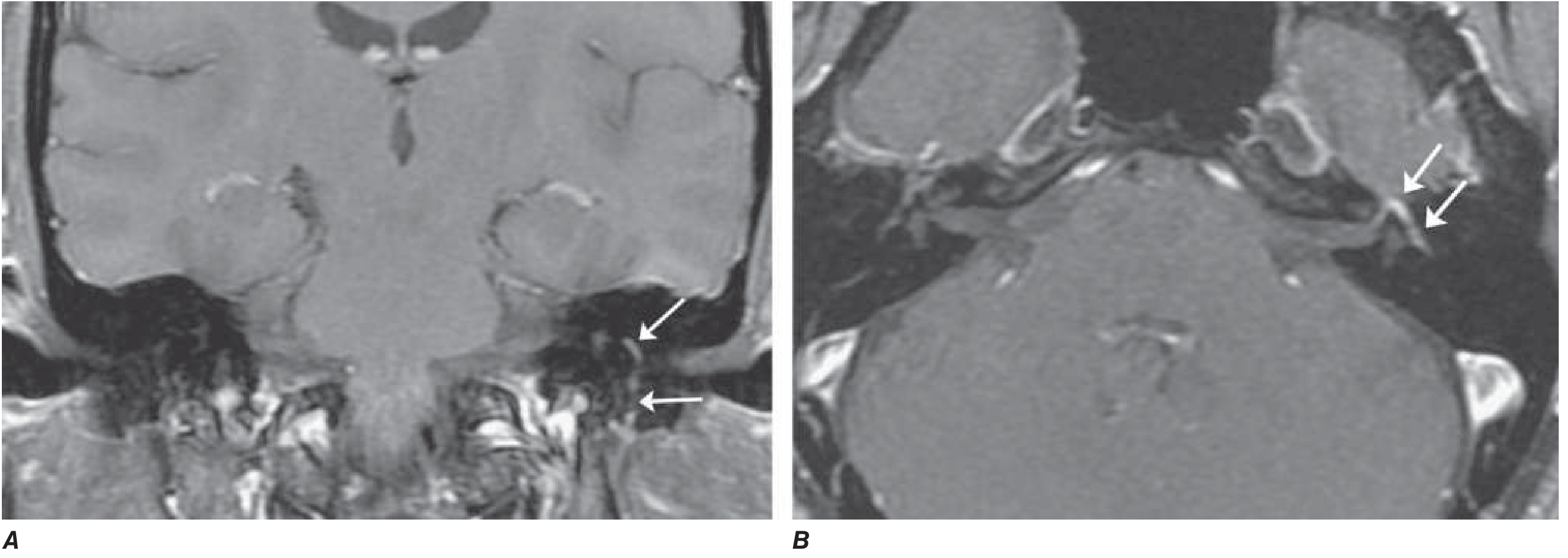
- MRI with gadolinium: Enhancement and swelling of the facial nerve (geniculate ganglion, tympanic, mastoid segments). Smooth linear enhancement without mass lesion is characteristic. (Similar MRI findings may be seen in Lyme disease, sarcoidosis, and perineural spread of malignancy)
- EMG/NCS: If evidence of denervation after 10 days - suggests axonal degeneration, poorer prognosis, recovery may take months and be incomplete
- Blood: ESR/CRP, fasting glucose, Lyme serology, HIV serology, ACE level (sarcoidosis), Borrelia antibody
- Lumbar puncture: if Guillain-Barré syndrome suspected (CSF may show mild lymphocytosis in Bell's palsy itself)
- Audiology: to exclude associated SNHL
Differential Diagnosis
| Condition | Distinguishing Feature |
|---|---|
| Ramsay Hunt Syndrome (VZV) | Vesicles in external auditory canal/pinna; more severe palsy; CN VIII involvement (SNHL, vertigo) |
| Lyme disease | Tick bite/erythema migrans; can be bilateral; positive Borrelia serology; CSF pleocytosis |
| Sarcoidosis | Often bilateral palsy; elevated ACE; hilar lymphadenopathy on CXR |
| Acoustic neuroma | Progressive palsy; associated SNHL |
| Parotid tumour | Slowly progressive; palpable mass |
| Melkersson-Rosenthal syndrome | Recurrent facial palsy + lip/facial oedema + fissured tongue |
| Guillain-Barré syndrome | Bilateral facial palsy + ascending paralysis + CSF albuminocytological dissociation |
| Leprosy | Skin patches; thickened nerves; endemic area |
| Stroke (UMN) | Forehead spared; arm/leg weakness; dysphasia |
Treatment
1. Corticosteroids (First-line)
- Prednisone 60-80 mg/day for 5 days, then tapered over 5 days (Harrison's); or prednisolone 25 mg BD for 10 days (Goldman-Cecil)
- Initiated within 72 hours of onset for maximal benefit
- Increases return of facial function from 63% to 83% at 3 months
- Mechanism: reduces nerve oedema and swelling within the tight facial canal
2. Antiviral Agents
- Valacyclovir 1000 mg/day for 5-7 days or acyclovir 400 mg five times daily for 10 days
- No independent benefit proven over steroids alone in large RCTs
- Combination with steroids may offer modest additional benefit (<7%) especially in severe (complete) palsy
- Should be used if vesicular lesions are present (palate or EAC) to cover possible Ramsay Hunt
3. Eye Care (Essential)
- Artificial tears during the day
- Methylcellulose eye drops
- Paper/surgical tape to close eyelid during sleep (prevents corneal desiccation and exposure keratopathy)
- Moisture chamber spectacles in severe cases
4. Physiotherapy
- Massage of weakened muscles
- Facial exercises to prevent contracture
5. Surgical Decompression
- Not recommended - no proven benefit; may be harmful (Adams & Victor)
6. Botulinum Toxin
- For sequelae such as hemifacial spasm or synkinesis after aberrant regeneration
Prognosis
- ~70-80% recover completely within 1-2 months
- ~85% achieve near-normal function
- Recovery in children is even higher (~90% without treatment)
- Favourable prognostic signs:
- Incomplete paralysis in the first week
- Return of taste in the first week
- Early recovery of some motor function within 5-7 days
- Poor prognostic signs:
- Complete paralysis from onset
- EMG showing denervation after 10 days (axonal degeneration - recovery may take 2 years or longer)
- Marked gadolinium enhancement on MRI
- Recurrence in ~7-8% of cases (mean interval ~10 years)
Complications of Incomplete Recovery
- Synkinesis: Aberrant nerve regeneration causing involuntary co-movements (e.g., "jaw-winking" - eye closure when chewing)
- Crocodile tears (Bogorad syndrome): Tearing while eating, due to aberrant regeneration of parasympathetic fibres to lacrimal gland
- Hemifacial spasm: Late sequela
- Corneal ulceration/blindness: From lagophthalmos if eye care neglected
- Facial contracture: From prolonged denervation
Sources
- Harrison's Principles of Internal Medicine, 22E (2025), p. 3598
- Adams and Victor's Principles of Neurology, 12th Ed., p. 1371-1372
- Goldman-Cecil Medicine International Edition, Block 56
- Scott-Brown's Otorhinolaryngology Head & Neck Surgery, Vol 2, p. 1524
This is a shared conversation. Sign in to Orris to start your own chat.