
Give me 10 marks lAq on meconium aspiration syndrome make this exam ready and simple
I'll get you a complete 10-mark LAQ on Meconium Aspiration Syndrome right away.
Searching sources...
Reading File
Finding Sources
Finding Sources
Reading File
Reading File
Reading File
Finding Sources
I now have comprehensive textbook data. Let me also fetch the CXR image for visual support.
Loading Image
Here is your complete, exam-ready 10-mark LAQ on Meconium Aspiration Syndrome:
MECONIUM ASPIRATION SYNDROME (MAS)
10-Mark Long Answer Question
DEFINITION
Meconium Aspiration Syndrome (MAS) is a clinical diagnosis defined as respiratory distress in a neonate born through meconium-stained amniotic fluid (MSAF), with a characteristic chest X-ray appearance, where symptoms cannot be explained by another cause. Confirmation requires the presence of meconium below the level of the vocal cords.
- Creasy & Resnik's Maternal-Fetal Medicine, p. 1789
INCIDENCE / EPIDEMIOLOGY
| Fact | Value |
|---|---|
| MSAF incidence at delivery | 4% - 22% of all deliveries |
| MAS complicating MSAF | ~1% - 2% of MSAF deliveries |
| More common in | Post-term / post-mature infants (>42 weeks) |
| Need for mechanical ventilation | ~30% of affected infants |
- Intrauterine meconium passage is rare before 36 weeks (immature myenteric plexus)
- Occurs more frequently with post-term gestation
PATHOPHYSIOLOGY
MAS is now understood to be multifactorial - not simply due to airway obstruction alone.
Four Key Mechanisms:
1. Airway Obstruction (Ball-Valve Effect)
- Meconium is a thick, viscous substance that migrates to distal airways
- Complete obstruction → segmental atelectasis
- Partial obstruction → "ball-valve" effect → air trapping and hyperinflation
- Alternating areas of atelectasis and overinflation on CXR
2. Chemical Pneumonitis
- Meconium causes direct chemical irritation of lung parenchyma
- Leads to inflammation, edema, and lung injury
3. Surfactant Inactivation
- Meconium inactivates existing surfactant
- Worsens ventilation-perfusion mismatch and respiratory failure
4. Pulmonary Hypertension (PPHN)
-
Alterations in pulmonary vasculature lead to persistently elevated pulmonary vascular resistance
-
Right-to-left shunting across PDA and foramen ovale worsens hypoxemia
-
PPHN is the most serious complication of MAS
-
Grainger & Allison's Diagnostic Radiology, p. 1765; Creasy & Resnik's Maternal-Fetal Medicine, p. 1789
CLINICAL FEATURES
History / Risk Factors:
- Post-term pregnancy (>42 weeks)
- Non-reassuring fetal heart rate tracings
- Fetal distress / perinatal asphyxia
- MSAF noted at delivery
Clinical Presentation (appear within minutes to hours of birth):
- Respiratory distress: tachypnea, grunting, nasal flaring, subcostal retractions
- Barrel-shaped chest (due to hyperinflation)
- Cyanosis
- Low Apgar scores
- Greenish/yellow staining of skin, nails, umbilical cord (from meconium)
- Diminished or asymmetric breath sounds
Severe Disease hallmarks:
- Need for positive-pressure ventilation
- Presence of pulmonary hypertension
INVESTIGATIONS
1. Chest X-Ray (CXR) - Key Investigation
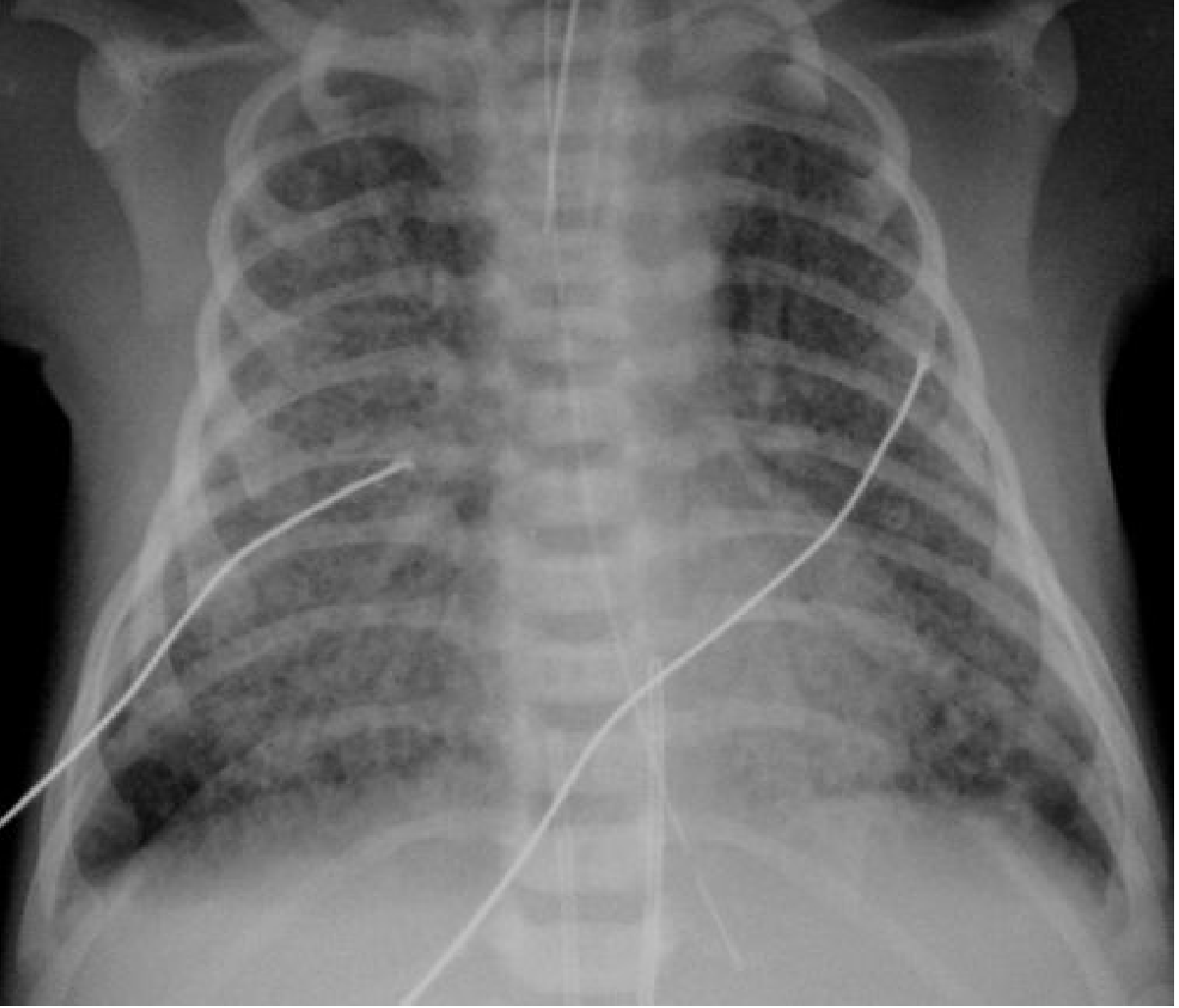
CXR findings in MAS: Bilateral hyperinflation with asymmetrical coarse patchy opacification and small pleural effusion - Grainger & Allison's Diagnostic Radiology
Classic CXR findings:
- Bilateral hyperinflation (flattened diaphragms)
- Coarse, irregular patchy opacities (asymmetrical)
- Areas of atelectasis alternating with overinflation
- Small pleural effusions (may be present)
- Pneumothorax (common complication - air leak)
2. Blood Gas (ABG): Hypoxemia, hypercapnia, metabolic/respiratory acidosis
3. Echocardiography: To assess for PPHN, right heart strain, shunting
4. Blood counts / cultures: To exclude sepsis (neonatal pneumonia can mimic MAS)
COMPLICATIONS
| Complication | Notes |
|---|---|
| Persistent Pulmonary Hypertension (PPHN) | Most serious; right-to-left shunting |
| Pneumothorax / Pneumomediastinum | "Air leak" due to ball-valve trapping |
| Chronic lung disease | Long-term morbidity |
| Developmental delay | In severe cases |
| Death | Mortality improved with modern therapies |
MANAGEMENT
A. Preventive Strategies (Antenatal/Intrapartum)
- Induction of labor at 41 weeks to prevent post-term MSAF (evidence-based; reduces MAS and C-section rates)
- Amnioinfusion - diluting thick meconium did NOT reduce MAS in settings with adequate surveillance (not routinely recommended)
- Routine intrapartum oropharyngeal suctioning - no longer recommended (2004 RCT showed no benefit)
B. Delivery Room Management
Current Guidelines (ILCOR/AAP 2015 and updated):
- Routine endotracheal intubation and suctioning is NO LONGER recommended for either vigorous or depressed infants born through MSAF
- Reason: RCTs showed no difference in MAS incidence, mechanical ventilation need, or mortality with tracheal suctioning
- Delay in positive-pressure ventilation causes more harm than benefit
- Skilled personnel should attend delivery; initiate PPV if infant is depressed
Key Exam Point: The practice of routine tracheal suctioning for all MSAF infants was abandoned after landmark trials (Wiswell 2000, followed by ILCOR 2015 update)
C. NICU Management (Supportive & Targeted)
1. Respiratory Support:
- Supplemental oxygen
- CPAP or mechanical ventilation as needed
- High-frequency oscillatory ventilation (HFOV) for refractory cases
- Avoid high peak inspiratory pressures (risk of air leak)
2. Surfactant Therapy:
- Early exogenous surfactant administration is a useful treatment modality
- Counteracts surfactant inactivation by meconium
3. Management of PPHN (Pulmonary Hypertension):
- Inhaled Nitric Oxide (iNO) - selective pulmonary vasodilator; first-line for PPHN in MAS
- Sildenafil - oral/IV pulmonary vasodilator
- Bosentan - endothelin receptor antagonist
- These agents improve oxygenation and allow less injurious ventilator strategies
4. ECMO (Extracorporeal Membrane Oxygenation):
- Used when conventional treatment fails
- VA-ECMO (veno-arterial): bypasses lungs when PVR is very high; catheter via internal jugular vein + common carotid artery
- VV-ECMO (veno-venous): double-lumen catheter via internal jugular vein; for gas exchange alone
- Allows physiological oxygen saturation while lungs recover
5. Antibiotics and Steroids:
- Selectively used; no demonstrated effectiveness in clinical trials
6. General Supportive Care:
- Maintain normothermia, normoglycemia, blood pressure
- Treat underlying asphyxia
PROGNOSIS
- Mortality has significantly improved with iNO, ECMO, and better neonatal care
- Severe disease associated with: chronic lung disease, air leak, developmental delay
- Incidence of MAS has declined in recent years due to better obstetric surveillance and abandonment of routine tracheal suctioning
QUICK SUMMARY TABLE (Exam-Friendly)
| Feature | Key Point |
|---|---|
| Definition | Respiratory distress in MSAF baby + CXR changes |
| Incidence | 1-2% of MSAF deliveries; more in post-term |
| Pathophysiology | Obstruction + pneumonitis + surfactant inactivation + PPHN |
| Key complication | PPHN (most serious) |
| CXR findings | Hyperinflation + coarse patchy opacities + air leaks |
| Delivery room | NO routine tracheal suction (ILCOR 2015) |
| PPHN treatment | Inhaled Nitric Oxide (first-line) |
| Last resort | ECMO |
Sources: Creasy & Resnik's Maternal-Fetal Medicine (9e); Grainger & Allison's Diagnostic Radiology
This is a shared conversation. Sign in to Orris to start your own chat.