
Role of ramipril in ccf
Ramipril is an ACE inhibitor used in chronic heart failure (CCF) to reduce afterload and preload by blocking angiotensin II formation and aldosterone release. It improves cardiac remodeling, reduces mortality, and slows disease progression. Key evidence comes from the AIRE trial, which showed ramipril reduces mortality in post-MI patients with heart failure. It is typically started at low doses (1.25-2.5 mg/day) and titrated up.
Searching sources...
Reading File
Now I'll search the medical library in parallel for ramipril in CCF/heart failure:
Finding Sources
Finding Sources
Searching PubMed
ramipril heart failure mortality
Now let me read the most relevant sections for detailed content:
Reading File
Finding Sources
Finding Sources
Reading File
Finding Sources
Reading File
Finding Sources
Reading File
Finding Sources
Reading File
I now have enough information for a comprehensive answer. Let me also fetch the AIRE trial Kaplan-Meier image from Braunwald's for illustration:
Loading Image
Here is a comprehensive answer on the role of ramipril in CCF (congestive/chronic cardiac failure):
Role of Ramipril in CCF (Congestive Cardiac Failure)
Classification
Ramipril is a prodrug ACE inhibitor (converted to ramiprilat in the liver) belonging to the class of neurohormonal antagonists used in heart failure with reduced ejection fraction (HFrEF).
Mechanism of Action
ACE inhibitors like ramipril block the enzyme that converts angiotensin I to angiotensin II (and also inhibit breakdown of bradykinin). In CCF, excess angiotensin II drives multiple harmful effects via the AT1 receptor:
| Angiotensin II Effect | Consequence in HF |
|---|---|
| Vasoconstriction | Increased ventricular afterload |
| Myocyte and extracellular matrix hypertrophy | Maladaptive LV remodeling |
| Sympathetic activation | Tachycardia, arrhythmias |
| Aldosterone release | Na+ and water retention, hypokalemia |
| AVP (ADH) release | Further fluid retention |
| Prothrombotic effects | Increased thrombotic risk |
By blocking all of these, ramipril reduces both preload and afterload, halts adverse remodeling, and decreases neurohormonal activation. - Goldman-Cecil Medicine, Chapter on ACE Inhibitors and ARBs
Clinical Benefits
Treatment with an ACE inhibitor (including ramipril), when used alone or added to diuretics and digoxin, produces the following benefits:
- Decreases LV size (reverses remodeling)
- Improves ejection fraction
- Reduces symptoms (dyspnoea, fatigue - improves NYHA class)
- Reduces hospitalizations
- Prolongs survival (reduces all-cause and cardiovascular mortality)
- Reduces risk of MI and possibly atrial fibrillation
These benefits are seen in all patients with LV systolic dysfunction, irrespective of symptoms or etiology. - Goldman-Cecil Medicine
Key Clinical Trial: AIRE (Acute Infarction Ramipril Efficacy)
The landmark AIRE trial (1993) is the pivotal evidence specifically for ramipril in heart failure:
- Population: 1,986 survivors of acute MI with clinical evidence of heart failure
- Drug: Ramipril vs placebo, started 3-10 days post-MI
- Duration: Mean follow-up ~15 months
- Result: Ramipril reduced all-cause mortality by ~27% (p = 0.002)
This trial established that ramipril significantly reduces mortality and morbidity in post-MI patients with heart failure. - Braunwald's Heart Disease; Textbook of Family Medicine 9e
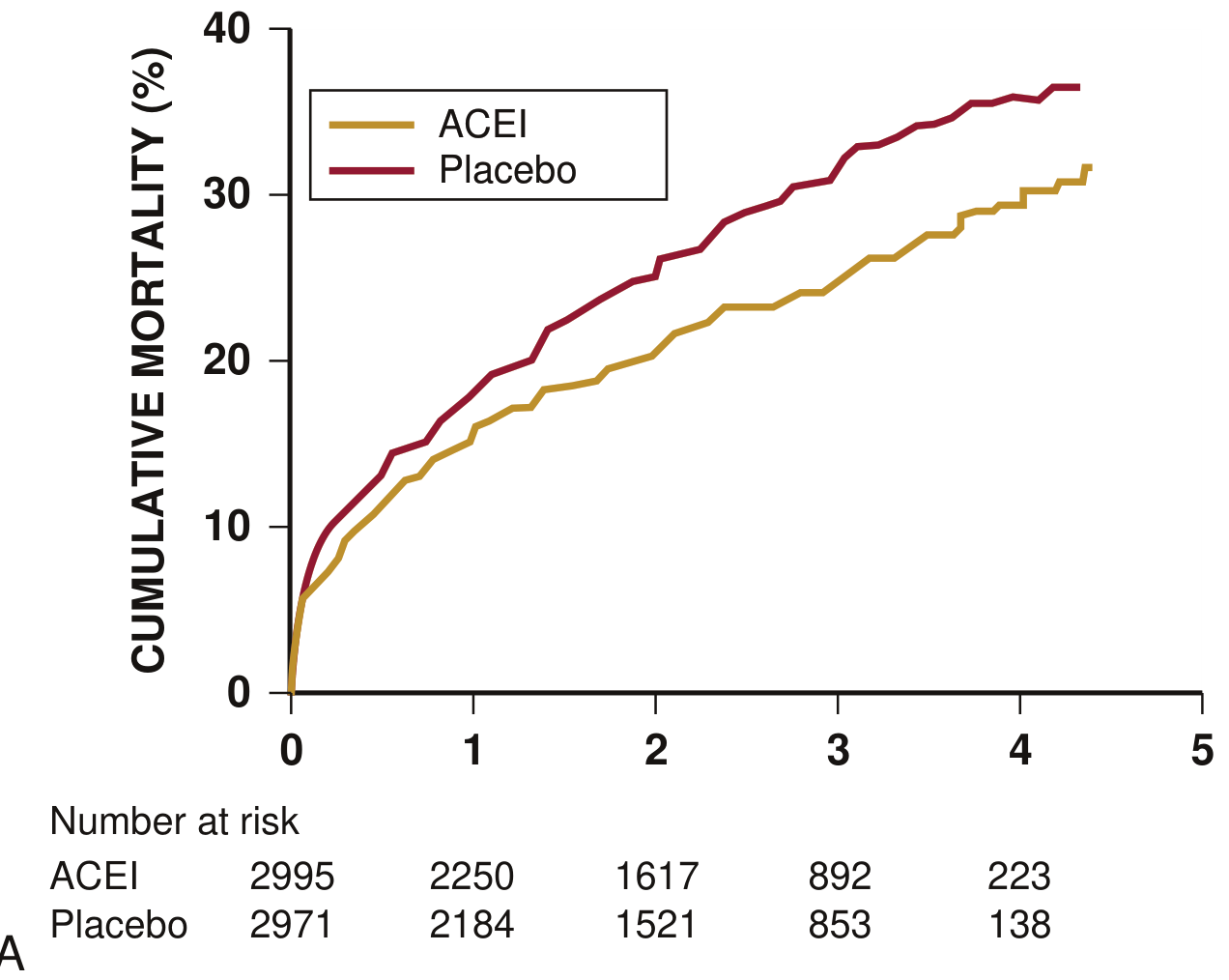
The graph below shows the mortality benefit of ACE inhibitors (including ramipril from the AIRE trial) in post-MI HFrEF patients - the benefit appears early and persists long-term:
Dosing in Heart Failure
From Braunwald's Heart Disease standard dosing table:
| Parameter | Dose |
|---|---|
| Starting dose | 1.25-2.5 mg once daily |
| Target/maximal dose | 10 mg once daily |
The key principle is start low, titrate slowly - monitoring for hypotension, renal dysfunction, and hyperkalemia after each increment. If the patient is edema-free, a diuretic dose reduction can help manage hypotension. - Braunwald's Heart Disease
Place in Current CCF Management
Ramipril (and other ACE inhibitors) are recommended as first-line neurohormonal therapy for HFrEF. However, current guidelines and evidence now prefer sacubitril/valsartan (ARNI) over ACE inhibitors where tolerated, based on the PARADIGM-HF trial showing superior mortality reduction with ARNI vs enalapril. Importantly, the PARADISE-MI trial showed sacubitril/valsartan was not superior to ramipril in post-MI heart failure. - Katzung's Basic and Clinical Pharmacology 16e; Goldman-Cecil Medicine
The current hierarchy is:
- Preferred: Sacubitril/valsartan (ARNI) - replace ACE inhibitor when patient is ready
- If ARNI not tolerated: ACE inhibitor (ramipril, enalapril, lisinopril) - class effect
- If ACE inhibitor not tolerated (cough/angioedema): ARB (valsartan, candesartan)
- ACE inhibitor + ARB combination is contraindicated - more side effects, no added benefit
Adverse Effects Relevant to CCF
| Adverse Effect | Mechanism | Management |
|---|---|---|
| Hypotension | Afterload reduction, especially with high-renin states | Start low dose; reduce diuretics if edema-free |
| Dry cough | Bradykinin accumulation (kinase II inhibition) | Switch to ARB |
| Angioedema | Bradykinin-mediated | Contraindication to further ACE inhibitor use |
| Hyperkalemia | Reduced aldosterone | Monitor electrolytes; caution with MRA co-use |
| Azotemia/renal impairment | Reduced GFR from loss of angiotensin II-mediated efferent vasoconstriction | Usually mild; significant rise in Cr may require dose reduction |
Special caution: Ramipril should be avoided in bilateral renal artery stenosis (risk of acute renal failure), current symptomatic hypotension (SBP <90 mmHg), history of angioedema, and pregnancy. - Goldman-Cecil Medicine
Summary
Ramipril plays a well-established, evidence-based role in CCF. Its main value is:
- Reducing mortality (AIRE trial: ~27% reduction post-MI HF)
- Halting adverse LV remodeling
- Improving symptoms and reducing hospitalizations
- Safe long-term neurohormonal blockade in HFrEF
It remains the ACE inhibitor with the strongest specific evidence in post-MI heart failure. In non-post-MI HFrEF, ACE inhibitors as a class (enalapril has the most placebo-controlled trial data, but all are considered equivalent) are first-line therapy unless ARNI is preferred and available.
Recent evidence note: A 2024 meta-analysis (PMID: 38597935) confirmed that sacubitril/valsartan reduces hospitalizations and CV mortality compared to ACE inhibitors/ARBs in HFrEF, reinforcing the preference for ARNI over ACE inhibitors in eligible patients. Ramipril remains the appropriate standard where ARNI is not tolerated or available.
For 1 mark written
Ramipril in CCF (1 Mark)
Ramipril is an ACE inhibitor used in CCF that blocks conversion of angiotensin I → angiotensin II, thereby reducing:
- Afterload (vasodilation) and preload (reduced aldosterone → less Na/water retention)
- Adverse LV remodeling
- Mortality - proven in the AIRE trial (27% reduction in post-MI heart failure)
Dose: Start 1.25–2.5 mg OD, titrate to 10 mg OD.
This is a shared conversation. Sign in to Orris to start your own chat.