
Clostridium tetani
Reading File
Clostridium tetani is a gram-positive, anaerobic, spore-forming rod that causes tetanus. It produces tetanospasmin, a neurotoxin that blocks inhibitory neurotransmitters (GABA and glycine), leading to spastic paralysis, trismus, and potentially life-threatening respiratory failure.
Searching sources...
Finding Sources
Searching the Web
Clostridium tetani microbiology pathogenesis tetanospasmin mechanism
Now let me read the main textbook sections on C. tetani in parallel:
Reading File
Reading File
Reading File
Now let me read the more detailed block from the Murray Medical Microbiology and the Bailey & Love surgical section:
Reading File
Reading File
Finding Sources
Let me get the remaining clinical content from the Murray textbook and also check for images:
Reading File
Finding Sources
Let me fetch the key clinical images referenced in the text:
Reading File
Finding Sources
I now have comprehensive information from multiple authoritative sources. Let me compile the full answer, including the clinical images.
Loading Image
Loading Image
Here is a full, integrated overview of Clostridium tetani drawn from multiple authoritative medical microbiology textbooks.
Clostridium tetani
Microbiology and Structure
Clostridium tetani is a large (0.5-2 × 2-18 µm), gram-positive, motile, obligately anaerobic, spore-forming rod. The key morphological feature is its terminal, round spore, which gives the organism a classic "drumstick" or "tennis racket" appearance on microscopy. The vegetative cells are extremely oxygen-sensitive, which makes culture difficult; on agar it grows as a spreading film rather than discrete colonies. The bacteria are proteolytic but unable to ferment carbohydrates.
- Medical Microbiology 9e, p. 349
- Quick Compendium of Clinical Pathology 5e
Epidemiology
-
Spores are ubiquitous in soil and in the feces of horses and other animals; they survive in adverse conditions for very long periods.
-
C. tetani transiently colonizes the GI tracts of humans and animals without causing disease.
-
Disease is rare in vaccinated populations (only ~33 cases in the US in 2017), but remains a major cause of death in developing countries, with an estimated >1 million cases worldwide and mortality rates of 30-50%.
-
At least half of all tetanus deaths occur in neonates.
-
Risk is greatest in people with inadequate vaccine-induced immunity; importantly, natural infection does not confer immunity.
-
Medical Microbiology 9e, p. 350
Toxins
C. tetani produces two toxins:
| Toxin | Properties | Significance |
|---|---|---|
| Tetanospasmin | Plasmid-encoded, heat-labile, 150-kDa neurotoxin (A-B type) | Primary virulence factor; causes tetanus |
| Tetanolysin | Oxygen-labile hemolysin, serologically related to streptolysin O | Clinical significance unknown; inhibited by oxygen and serum cholesterol |
The plasmid carrying the tetanospasmin gene is non-conjugative, so a non-toxigenic strain cannot acquire it horizontally.
Mechanism of Action of Tetanospasmin
This is one of the most potent toxins known - extremely small amounts can be lethal.
-
Synthesis: Tetanospasmin is produced during the stationary phase of bacterial growth and released upon cell lysis. The single 150-kDa peptide is cleaved by an endogenous protease into:
- Heavy chain (100 kDa, B subunit) - binding and translocation
- Light chain (50 kDa, A subunit) - enzymatic activity The two chains are held together by a disulfide bond.
-
Binding: The carboxyl-terminal domain of the heavy chain binds polysialoganglioside (sialic acid) receptors and adjacent glycoproteins on the surface of lower motor neurons at the neuromuscular junction.
-
Internalization and retrograde transport: The toxin is internalized in endosomal vesicles and transported retrograde along motor neuron axons to the motor neuron soma in the spinal cord and brainstem.
-
Transcytosis: The toxin then undergoes trans-synaptic spread to the presynaptic terminals of inhibitory interneurons (both glycinergic and GABAergic).
-
Cleavage of synaptobrevin (VAMP2): Within the inhibitory neuron, endosomal acidification causes a conformational change in the heavy chain N-terminus that inserts into the membrane, releasing the light chain into the cytosol. The light chain is a zinc endopeptidase that cleaves synaptobrevin (VAMP2), a SNARE protein required for docking of neurotransmitter vesicles onto the presynaptic membrane.
-
Result: Release of the inhibitory neurotransmitters glycine and GABA is blocked. Motor neurons lose inhibition, causing unregulated excitatory activity → spastic paralysis and uncontrolled muscle spasms.
The toxin binding is irreversible - recovery depends on the formation of new axonal terminals.
- Medical Microbiology 9e, pp. 350-351
- Jawetz, Melnick & Adelberg's Medical Microbiology 28e, p. 194
Contrast with botulinum toxin: Botulinum toxin acts at the same SNARE machinery but stays at the neuromuscular junction and blocks acetylcholine release, causing flaccid paralysis - the opposite effect.
Pathogenesis
C. tetani is non-invasive. Infection remains strictly localized in devitalized tissue (wound, burn, umbilical stump). The organism requires a low oxidation-reduction potential (anaerobic environment), facilitated by:
- Necrotic tissue
- Calcium salts
- Associated pyogenic infections
Disease is almost entirely a toxemia - the volume of infected tissue is small, but the toxin spreads via the bloodstream and nervous system.
Clinical Forms of Tetanus
1. Generalized Tetanus (most common)
- Incubation: Days to weeks; shorter incubation = worse prognosis
- Progression: Trismus (lockjaw, masseter spasm) is the most common presenting sign → risus sardonicus (sardonic smile from sustained facial muscle contraction) → opisthotonos (persistent spasms of the back muscles)
- Any external stimulus can precipitate generalized tetanic spasm
- Autonomic involvement in severe disease: cardiac arrhythmias, fluctuating blood pressure, profound sweating, dehydration
- Patient remains fully conscious; pain can be intense
- Death is typically from respiratory failure
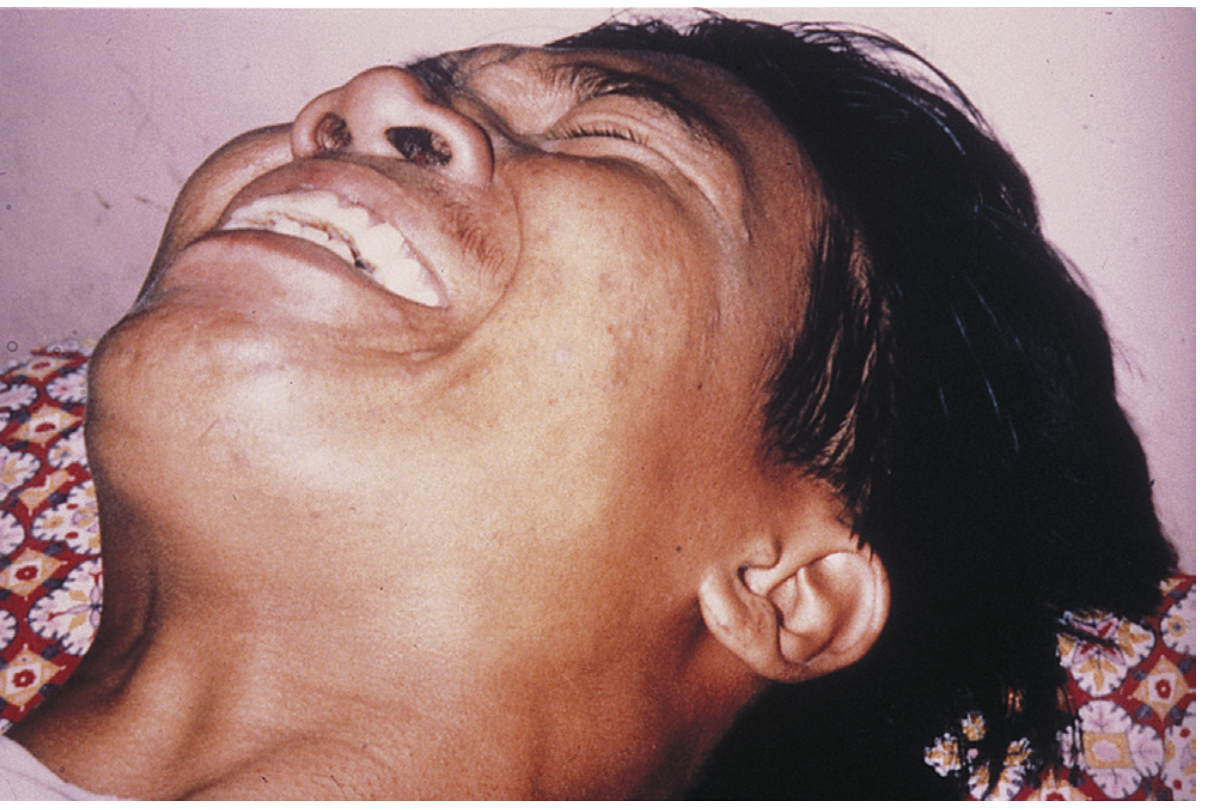
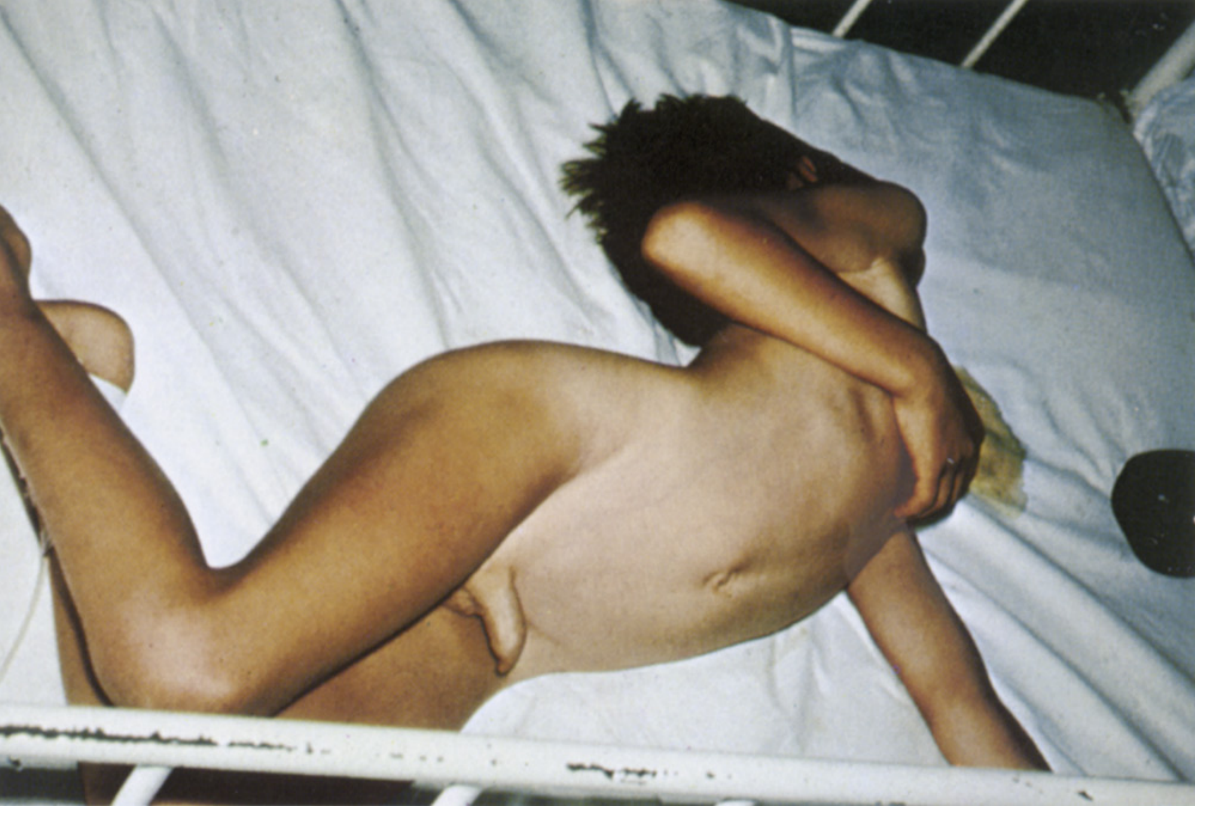
2. Localized Tetanus
- Muscle rigidity confined to the site of primary infection
- Generally better prognosis
3. Cephalic Tetanus
- Primary infection site is the head (e.g., ear infection, facial wound)
- Involves short cranial motor nerves; very poor prognosis
4. Neonatal Tetanus (Tetanus neonatorum)
- Entry via infected umbilical stump (unsterile cord cutting in developing countries)
- Progresses to generalized tetanus
- Mortality >90%; developmental defects in survivors
- Almost exclusively a disease of developing countries
Diagnosis
Diagnosis is clinical - there is no reliable laboratory test.
- Microscopy and culture are insensitive (culture positive in only ~30% of cases)
- Tetanus toxin is not detectable in blood (it binds irreversibly to neurons)
- Antibodies to the toxin are also typically absent
- Differential diagnosis: strychnine poisoning (also blocks glycine receptors, clinically identical)
- Confirmatory test (reference labs only): mouse toxin neutralization assay
Treatment
Treatment must begin promptly - antitoxin is only effective before the toxin binds to nerve tissue.
| Component | Agent | Purpose |
|---|---|---|
| Wound care | Debridement | Remove source of toxin production |
| Antibiotics | Penicillin or metronidazole (preferred) | Kill bacteria, reduce toxin production |
| Passive immunization | Human Tetanus Immunoglobulin (HTIG) 250-500 units IM | Neutralize unbound circulating toxin |
| Active immunization | Tetanus toxoid | Infection does NOT confer immunity |
| Muscle relaxants | Benzodiazepines | Control spasms |
| Supportive | Mechanical ventilation | Manage respiratory failure |
Why prefer metronidazole over penicillin? Penicillin is a GABA antagonist, similar in mechanism to tetanus toxin itself, potentially worsening CNS excitability. Metronidazole avoids this issue and has equivalent antimicrobial activity.
Prevention
- Primary series: 3 doses of tetanus toxoid (as part of DTaP or Td)
- Booster: Every 10 years
- Vaccination is highly effective and the most important preventive measure
- For wound prophylaxis in unvaccinated or incompletely vaccinated individuals: both toxoid and HTIG may be given simultaneously
Summary Table
| Feature | Detail |
|---|---|
| Organism | Gram-positive, anaerobic, spore-forming rod |
| Spore | Terminal, round - "drumstick" / "tennis racket" |
| Toxin | Tetanospasmin (plasmid-encoded, 150 kDa, A-B toxin) |
| Toxin target | VAMP2/synaptobrevin on inhibitory interneurons |
| Neurotransmitters blocked | Glycine + GABA |
| Result | Spastic paralysis |
| Key clinical sign | Trismus → risus sardonicus → opisthotonos |
| Diagnosis | Clinical only |
| Treatment | HTIG + wound debridement + metronidazole + toxoid + benzodiazepines |
| Prevention | DTaP series + 10-year boosters |
Sources: Medical Microbiology 9e (Murray); Jawetz, Melnick & Adelberg's Medical Microbiology 28e; Quick Compendium of Clinical Pathology 5e; Bailey & Love's Surgery 28e; Rosen's Emergency Medicine.
Make FMGE EXAM QUESTION 2026 , 150 QUESTION INCLUDING BIOCHEMISTRY, PHARMACOLOGY,PHYSIOLOGY . WITH EXPLANATION
Asking for Preferences
What format would you like the 150 questions in? · How should the 150 questions be distributed across subjects?
Got it - 150 questions (50 each for Biochemistry, Pharmacology, Physiology), exported as a downloadable PDF.
Reading File
Now I'll write the full Python script to generate the PDF with all 150 questions:
Running Command
mkdir -p /home/daytona/workspace/fmge-2026 && ls /home/daytona/workspace/fmge-2026/
Make FMGE EXAM QUESTION 2026 , 150 QUESTION INCLUDING BIOCHEMISTRY, PHARMACOLOGY,PHYSIOLOGY . WITH EXPLANATION
This is a shared conversation. Sign in to Orris to start your own chat.