
Amino acid anabolic and catabolic pathways
Reading File
Finding Sources
Finding Sources
Finding Sources
Reading File
Finding Sources
Finding Sources
Finding Sources
Finding Sources
Reading File
Reading File
Reading File
Reading File
Reading File
Finding Sources
Reading File
Finding Sources
Reading File
Loading Image
Loading Image
Loading Image
I now have comprehensive information from Harper's Biochemistry, Basic Medical Biochemistry (Lieberman), and Lippincott to write a thorough answer. Let me compose it.
Amino Acid Anabolic and Catabolic Pathways
Amino acid metabolism sits at a crossroads linking protein turnover, energy metabolism, and biosynthesis of countless nitrogen-containing molecules. The same enzymatic machinery (transamination) serves both building up and breaking down, with direction determined by the cell's anabolic/catabolic state.
Overview
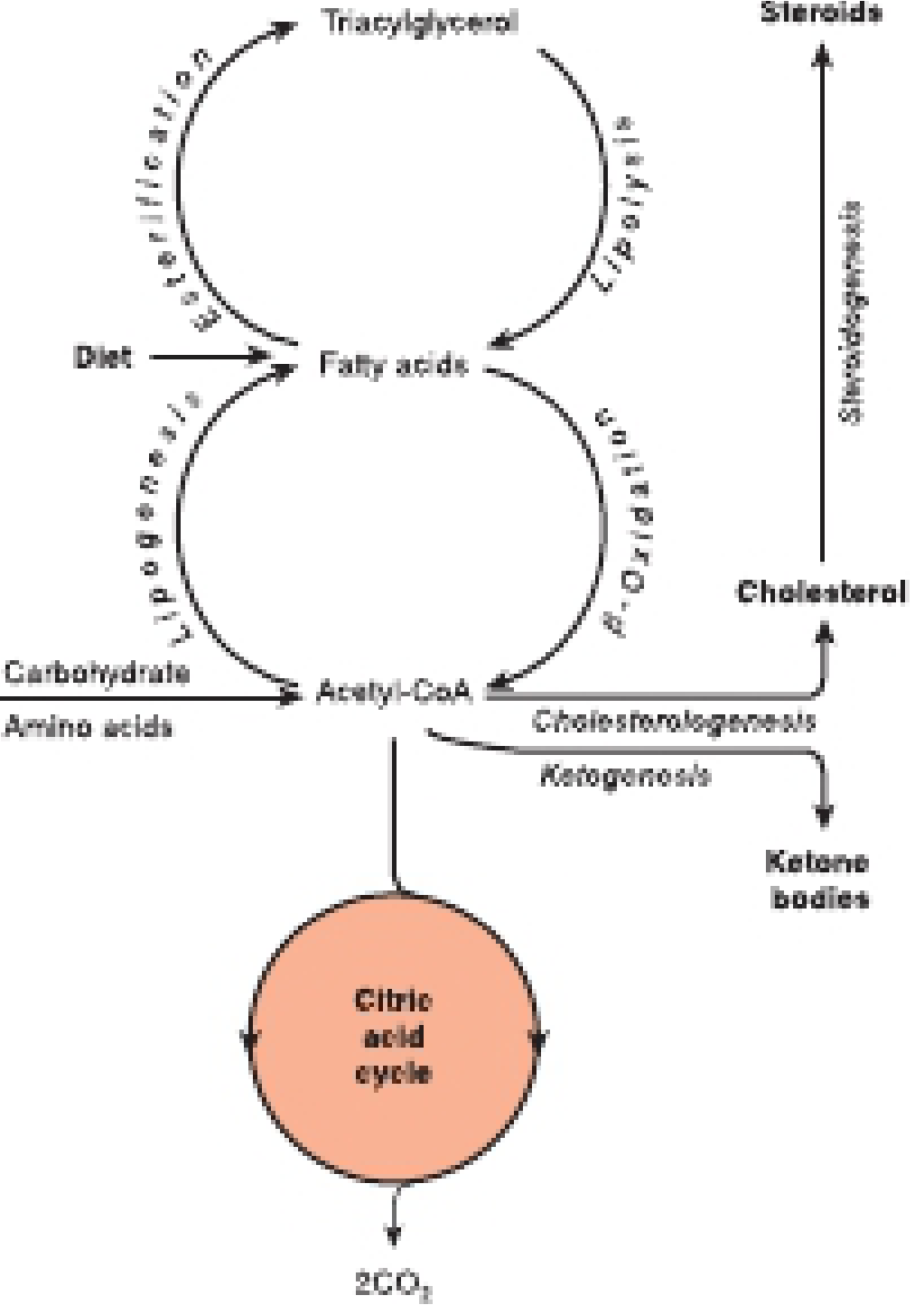
Overview of central metabolic integration - amino acids contribute to acetyl-CoA, the citric acid cycle, fatty acid synthesis, and ketone bodies. (Harper's Illustrated Biochemistry, 32nd ed.)
Amino acids either come from dietary protein (after digestion and absorption via portal vein) or from intracellular protein turnover. Their fate depends on nutritional state: in the absorptive state, surplus amino acids are deaminated and their carbon skeletons used for energy or fat synthesis; in the fasted/catabolic state, muscle protein is broken down to release BCAAs for energy and gluconeogenic precursors.
CATABOLIC PATHWAYS
Step 1 - Transamination (the universal first step)
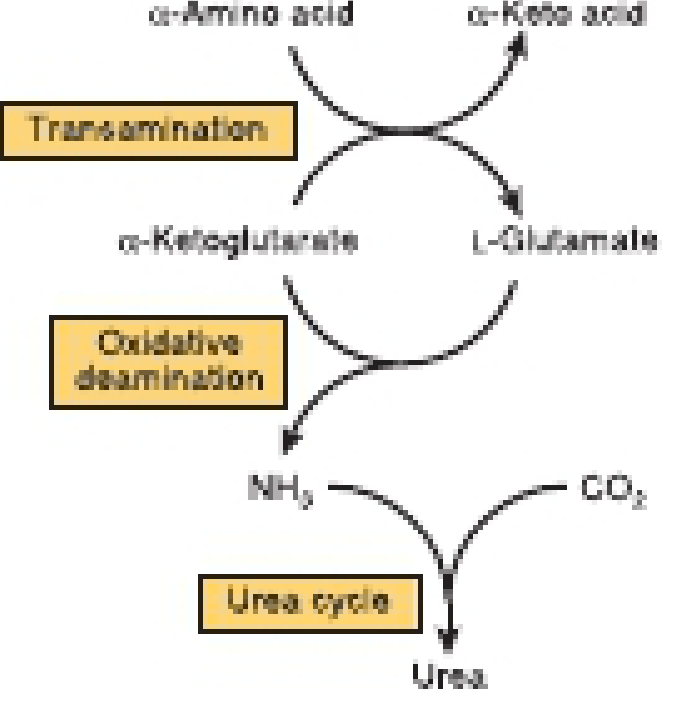
Overall flow of nitrogen in amino acid catabolism. (Harper's Illustrated Biochemistry, 32nd ed.)
Transamination is the entry point into catabolism for most amino acids. The α-amino group is transferred from the amino acid to α-ketoglutarate (α-KG), yielding:
- Glutamate (from α-KG + amino group)
- The corresponding α-keto acid (the de-aminated carbon skeleton)
Enzymes: Aminotransferases (transaminases). The two most clinically important are:
- ALT (alanine aminotransferase) - Alanine + α-KG → Pyruvate + Glutamate
- AST (aspartate aminotransferase) - Aspartate + α-KG → Oxaloacetate + Glutamate
Cofactor: Pyridoxal phosphate (PLP), derived from vitamin B6. PLP forms a Schiff base with the α-amino group and acts as an amino group "carrier" in a ping-pong mechanism.
Exceptions: Lysine and threonine do not undergo transamination (their α-amino groups are removed by other mechanisms).
All α-amino nitrogen is funneled into glutamate, because L-glutamate is the only amino acid that undergoes oxidative deamination at an appreciable rate in mammalian tissues. - Harper's Illustrated Biochemistry, 32nd ed., p. 294
Step 2 - Oxidative Deamination of Glutamate
Glutamate dehydrogenase (GDH) in the mitochondrial matrix:
Glutamate + NAD⁺ (or NADP⁺) → α-Ketoglutarate + NH₄⁺ + NADH
This liberates free ammonia (NH₄⁺). GDH is allosterically activated by ADP (energy deficit) and inhibited by GTP (energy surplus), coupling amino acid catabolism to cellular energy status.
Step 3 - Ammonia Transport
Free NH₃ is toxic (especially to the CNS). Two primary transport mechanisms carry nitrogen from peripheral tissues to the liver:
-
Alanine (glucose-alanine cycle): Muscle pyruvate (from glycolysis) transaminated with glutamate → alanine. Alanine travels to liver, where its amino group is removed → pyruvate (for gluconeogenesis) + ammonia.
-
Glutamine: In peripheral tissues with high amino acid catabolism, glutamate + NH₄⁺ (via glutamine synthetase) → glutamine. Glutamine is the main non-toxic ammonia carrier in blood. In the liver (and gut), glutaminase releases NH₄⁺ from glutamine for urea synthesis or gut fuel. - Basic Medical Biochemistry, 6th ed., p. 1316
Step 4 - The Urea Cycle (Krebs-Henseleit Cycle)
Nitrogen enters the urea cycle as NH₄⁺ and aspartate. The cycle runs partly in mitochondria, partly in the cytosol.
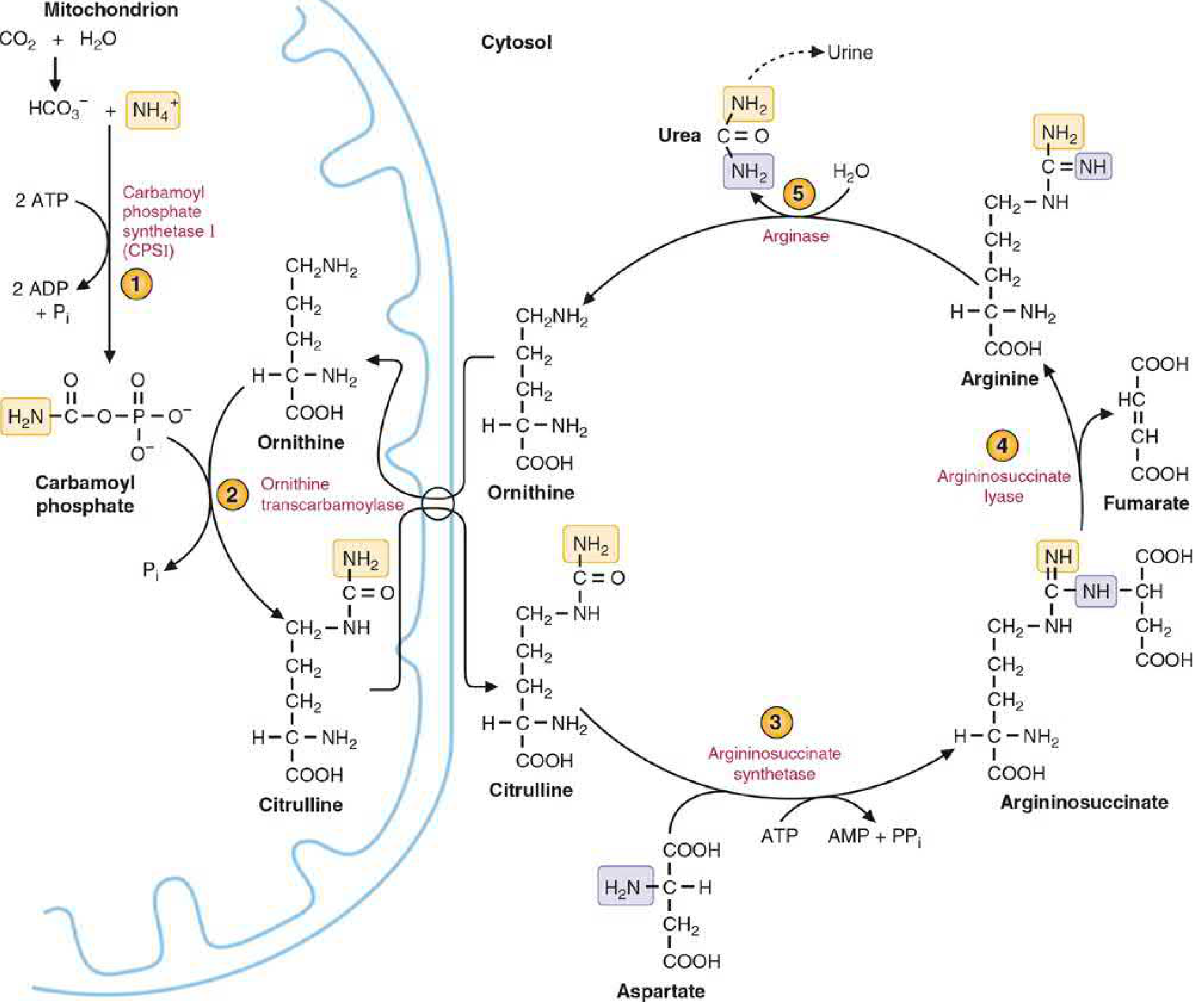
The urea cycle. (Basic Medical Biochemistry, 6th ed.)
| Step | Enzyme | Location | Reaction |
|---|---|---|---|
| 1 | Carbamoyl phosphate synthetase I (CPSI) | Mitochondria | NH₄⁺ + HCO₃⁻ + 2 ATP → Carbamoyl phosphate |
| 2 | Ornithine transcarbamoylase (OTC) | Mitochondria | Ornithine + Carbamoyl-P → Citrulline |
| 3 | Argininosuccinate synthetase | Cytosol | Citrulline + Aspartate + ATP → Argininosuccinate |
| 4 | Argininosuccinate lyase | Cytosol | Argininosuccinate → Arginine + Fumarate |
| 5 | Arginase | Cytosol | Arginine + H₂O → Urea + Ornithine |
Key points:
- Two nitrogens in urea: one from NH₄⁺ (via CPSI), one from aspartate (donated in step 3)
- Ornithine is regenerated and re-enters mitochondria (like oxaloacetate in the TCA cycle)
- Fumarate links the urea cycle to the TCA cycle (fumarate → malate → OAA → aspartate, completing the "aspartate-argininosuccinate shunt")
- Net cost: 4 ATP equivalents per urea produced (3 ATP + 1 ATP hydrolyzed to AMP + PPi)
- CPSI is the rate-limiting enzyme, allosterically activated by N-acetylglutamate
Step 5 - Fate of Carbon Skeletons
After deamination, the residual carbon skeletons are converted to amphibolic intermediates that feed into the TCA cycle, gluconeogenesis, or ketogenesis. Amino acids are classified accordingly:
| Category | Intermediates Formed | Examples |
|---|---|---|
| Glucogenic only | Pyruvate, OAA, α-KG, succinyl-CoA, fumarate | Ala, Asp, Glu, Gly, Cys, Ser, Arg, His, Met, Pro, Thr, Val, Hyp |
| Ketogenic only | Acetyl-CoA or acetoacetyl-CoA | Leucine, Lysine |
| Both | Both of the above | Ile, Phe, Tyr, Trp |
Table derived from Harper's Illustrated Biochemistry, 32nd ed., Table 29-1
Key catabolic pathways by amino acid group:
- Asp, Asn → OAA (via asparaginase + transamination)
- Glu, Gln → α-KG (via glutaminase + GDH)
- Ala, Cys, Ser, Gly, Thr → Pyruvate
- Val, Ile, Met → Succinyl-CoA (require B12)
- Leu → Acetoacetyl-CoA + Acetyl-CoA (purely ketogenic)
- Phe, Tyr → Fumarate + Acetoacetate
- BCAAs (Leu, Ile, Val): The liver has limited capacity to degrade these - they pass to muscle for catabolism via BCAA aminotransferase and branched-chain α-keto acid dehydrogenase (BCKD). - Lippincott Biochemistry, 8th ed., p. 904
ANABOLIC PATHWAYS (Amino Acid Biosynthesis)
Nonessential vs. Essential Amino Acids
Essential (indispensable) amino acids must come from diet - humans lack the biosynthetic enzymes. Mnemonic: PVT TIM HaLL (Phe, Val, Thr, Trp, Ile, Met, His, Arg*, Leu, Lys). *Arg is conditionally essential (needed in growth/stress).
Nonessential amino acids are synthesized from metabolic intermediates, primarily by receiving amino groups via transamination from glutamate.
Core Anabolic Routes
Since transamination is reversible, it is equally a biosynthetic tool:
| Nonessential AA | Precursor | Key Step |
|---|---|---|
| Glutamate | α-KG | GDH (reverse) or transamination |
| Glutamine | Glutamate + NH₄⁺ | Glutamine synthetase (ATP-dependent) |
| Alanine | Pyruvate | ALT (transamination, reverse) |
| Aspartate | OAA | AST (transamination) |
| Asparagine | Aspartate + Gln | Asparagine synthetase (ATP) |
| Serine | 3-Phosphoglycerate (glycolytic intermediate) | Oxidation → transamination → phosphatase |
| Glycine | Serine | Serine hydroxymethyltransferase (requires THF, B6) |
| Cysteine | Serine + Homocysteine (from Met) | Cystathionine β-synthase → cystathionine lyase |
| Tyrosine | Phenylalanine (essential) | Phenylalanine hydroxylase (PAH, requires BH4) |
| Proline | Glutamate → Glutamate-5-semialdehyde | Spontaneous ring closure |
| Arginine | Synthesized in urea cycle intermediates | OTC pathway (insufficient for adults - conditionally essential) |
The general principle: α-keto acids derived from carbohydrate and lipid metabolism serve as carbon backbones; glutamate donates the amino group via transamination. - Harper's Illustrated Biochemistry, 32nd ed., p. 148
Other Anabolic Functions of Amino Acids
Amino acids are precursors for many bioactive molecules:
| Amino Acid | Product |
|---|---|
| Tryptophan | Serotonin, melatonin, NAD⁺, niacin |
| Tyrosine | Dopamine, norepinephrine, epinephrine, T3/T4, melanin |
| Histidine | Histamine |
| Glutamate/Gln | Purines, pyrimidines, GABA (from Glu) |
| Glycine + Succinyl-CoA | Heme |
| Arginine | Nitric oxide (via NOS), creatine, polyamines |
| Methionine | S-adenosylmethionine (SAM) - universal methyl donor |
| Serine | Sphingolipids, phosphatidylserine |
| Cysteine | Glutathione (with Gly + Glu), taurine, coenzyme A |
Integration Summary
DIET (protein)
    ↓ (digestion, absorption via portal vein)
AMINO ACID POOL
    ↙               ↘
CATABOLISM          ANABOLISM
• Transamination     • Protein synthesis
• Deamination (GDH)  • Nonessential AA synthesis (transamination, reverse)
• Urea cycle         • Biosynthesis of: purines, pyrimidines,
• C-skeleton:          neurotransmitters, heme, NO, creatine,
  → TCA cycle          SAM, glutathione, hormones
  → Gluconeogenesis
  → Ketogenesis/FA synthesis
Regulatory checkpoints:
- GDH (mitochondria): ADP activates (catabolism), GTP inhibits (anabolism) - energy sensor
- CPSI (urea cycle): activated by N-acetylglutamate (signals high amino acid load)
- Glutamine synthetase: key anabolic enzyme; regulated by feedback inhibition from multiple end products
- In starvation: urea cycle enzyme expression increases severalfold due to enhanced protein catabolism
Sources:
- Harper's Illustrated Biochemistry, 32nd ed., Chapters 28, 29 (nitrogen metabolism, amino acid catabolism)
- Basic Medical Biochemistry: A Clinical Approach, 6th ed., Chapter 36 (transamination, urea cycle)
- Biochemistry (Lippincott Illustrated Reviews), 8th ed., Chapter 24 (absorptive state amino acid metabolism)
This is a shared conversation. Sign in to Orris to start your own chat.