
upper gi bleed
I'll read the medical library skill first, then search for upper GI bleed content in parallel.
Reading File
Now I'll run parallel searches across the medical library and PubMed simultaneously.
Finding Sources
Searching PubMed
"upper gastrointestinal bleeding" AND management
Excellent sources found. Now I'll read the most authoritative ones in parallel - Sleisenger & Fordtran (gastroenterology reference), Tintinalli (emergency management), and Frameworks for Internal Medicine (clinical approach).
Reading File
Reading File
Reading File
Good content. Let me read more from the Sleisenger (management/endoscopy) and Tintinalli (ED approach) sections, and also fetch the flowchart image.
Reading File
Reading File
Loading Image
I now have rich content from multiple authoritative sources. Let me also fetch the endoscopic stigmata image and read the Sleisenger section on medical management.
Reading File
Loading Image
I now have comprehensive content to compile a thorough answer. Here is the full clinical overview:
Upper Gastrointestinal Bleeding (UGIB)
Definition: UGIB is any GI bleeding originating proximal to the ligament of Treitz - encompassing esophageal, gastric, and duodenal sources.
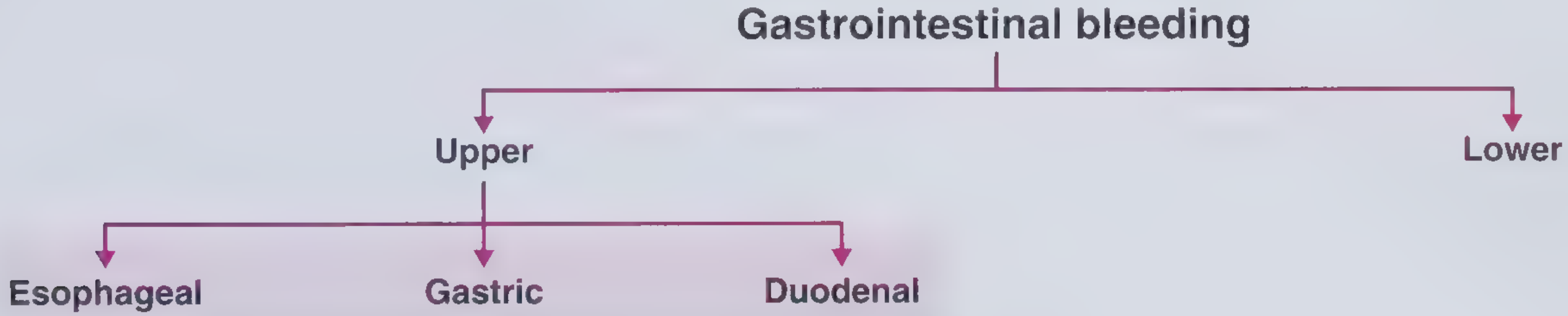
Epidemiology
- Annual incidence: 39-172 per 100,000 in Western countries (varies with H. pylori rates, NSAID use, socioeconomics)
- Overall mortality: 5-10% - unchanged since the 1970s despite advances, largely because more patients are elderly with comorbidities
- Bleeding is self-limited in ~80% without specific therapy; of the remaining 20% who rebleed, mortality rises to 30-40%
Causes (by frequency)
| Cause | Frequency |
|---|---|
| Peptic ulcer (gastric/duodenal) | ~35-40% |
| Esophageal/gastric varices | ~22% |
| Portal hypertension-related lesions | ~5% |
| Esophagitis | ~5% |
| Angioectasia / telangiectasia | ~4% |
| Mallory-Weiss tear | ~4% |
| Dieulafoy lesion | ~3% |
| GI tract neoplasm | ~3% |
| Epistaxis (swallowed blood) | ~2% |
| Erosive gastritis/duodenitis | ~1% |
| No cause found | ~7% |
(Sleisenger & Fordtran's Gastrointestinal and Liver Disease, UCLA CURE Database, n=968)
Key Causes - Clinical Notes
Peptic Ulcer Disease - Most common cause. Associated with H. pylori, NSAIDs, aspirin, and smoking. Bleeding arteries in ulcer bases have a mean diameter of 0.7 mm. ~50% show a protruding vessel, ~50% have an adherent clot over a breached artery wall.
Esophageal/Gastric Varices - Result from portal hypertension, most often from alcoholic cirrhosis in the US. In cirrhotics presenting with UGIB, varices are the cause 59% of the time. In-hospital mortality in cirrhotic patients is essentially double that of non-cirrhotics.
Mallory-Weiss Tear - Longitudinal mucosal tear at the gastroesophageal junction from forceful retching/vomiting. Classic presentation: hematemesis following an episode of heavy retching (alcohol, DKA, chemotherapy). Usually self-limited.
Dieulafoy Lesion - Abnormally large submucosal artery that protrudes through mucosa without primary ulceration. 80-95% located within 6 cm of the GEJ along the lesser curvature of the stomach. Can cause massive, recurrent, unexplained hemorrhage.
Erosive Gastritis/Esophagitis - Common triggers: alcohol, aspirin, NSAIDs, radiation, stress (sepsis, mechanical ventilation). Infectious causes include CMV, HSV, Candida (especially in immunocompromised).
Presentation
| Presentation | Significance |
|---|---|
| Hematemesis (bright red) | Active, brisk bleeding |
| Coffee-ground emesis | Slower/stopped bleeding |
| Melena (black, tarry stool) | As little as 50-100 mL blood from upper GI |
| Hematochezia | Massive UGIB (>1000 mL) - mimics lower GI bleed |
Useful clue: Digested blood is a source of urea - an elevated BUN:creatinine ratio (>20:1) strongly suggests UGIB. Confirm with nasogastric lavage (red blood or coffee-ground aspirate).
Risk Stratification
Pre-Endoscopy Scoring Tools
Glasgow-Blatchford Score (GBS) - Uses: BUN, hemoglobin, systolic BP, HR, syncope, melena, liver disease, heart failure. Best for identifying patients who need clinical intervention. A GBS of 0-1 identifies very low-risk patients who can be managed outpatient.
AIMS65 Score - Five variables:
- Albumin < 3.0 g/dL
- INR > 1.5
- Altered mental status
- Systolic BP < 90 mmHg
- Age > 65
Score < 2 = lower risk of mortality and shorter hospital stay.
Clinical Rockall Score (pre-endoscopy) - Age, shock, comorbidities.
High-Risk Features
| Very Low Risk | High Risk |
|---|---|
| Age < 60 | Advanced age |
| No major comorbidities | Significant comorbidities |
| No red hematemesis | Red hematemesis |
| Hemodynamically stable | Hemodynamically unstable |
| Normal labs | Abnormal labs (low Hgb, elevated INR, elevated BUN) |
| Negative NG aspirate | Red blood on NG aspirate |
(Tintinalli's Emergency Medicine)
Initial Management
Resuscitation (ABC First)
- Two large-bore IVs; type & crossmatch
- Massive transfusion protocol (MTP) if large blood product need anticipated
- Transfusion threshold: Hgb ≤ 7 g/dL in most patients; ≤ 9 g/dL in elderly or those with comorbidities (e.g., coronary artery disease)
- Correct coagulopathy if INR elevated or platelets < 50,000
- Airway: intubation of hemodynamically unstable UGIB patients is high-risk - aggressively resuscitate before intubation, use reduced induction agent doses
Medical Therapy
| Drug | Dose | Indication |
|---|---|---|
| Omeprazole (PPI) | 80 mg IV bolus, then 8 mg/h infusion | Peptic ulcer bleeding |
| Octreotide | 50 mcg IV bolus, then 25-50 mcg/h infusion | Variceal bleeding |
| Antibiotics (ciprofloxacin 400 mg IV or ceftriaxone 1 g IV) | Standard dosing | Cirrhosis with UGIB (reduces bacterial translocation, mortality) |
| Tranexamic acid | Controversial - recent meta-analysis shows no clear benefit in UGIB |
High-dose PPI after endoscopic hemostasis reduces rebleeding risk for peptic ulcer; effect lasts 72 hours (main rebleeding risk period).
Endoscopy
Timing: Upper endoscopy (EGD) within 24 hours after adequate resuscitation for most patients with overt UGIB. Urgent endoscopy (< 12 hours) for actively unstable patients.
Forrest Classification (Peptic Ulcer Stigmata)
| Class | Finding | Rebleeding Risk (untreated) | Endoscopic Tx Needed? |
|---|---|---|---|
| Ia | Active spurting | ~90% | Yes |
| Ib | Active oozing | ~10-20% | Yes (if other stigmata) |
| IIa | Non-bleeding visible vessel (NBVV) | ~50% | Yes |
| IIb | Adherent clot | ~33% | Yes (clot removal + treat) |
| IIc | Flat pigmented spot | ~5-10% | No |
| III | Clean base | ~1-2% | No |
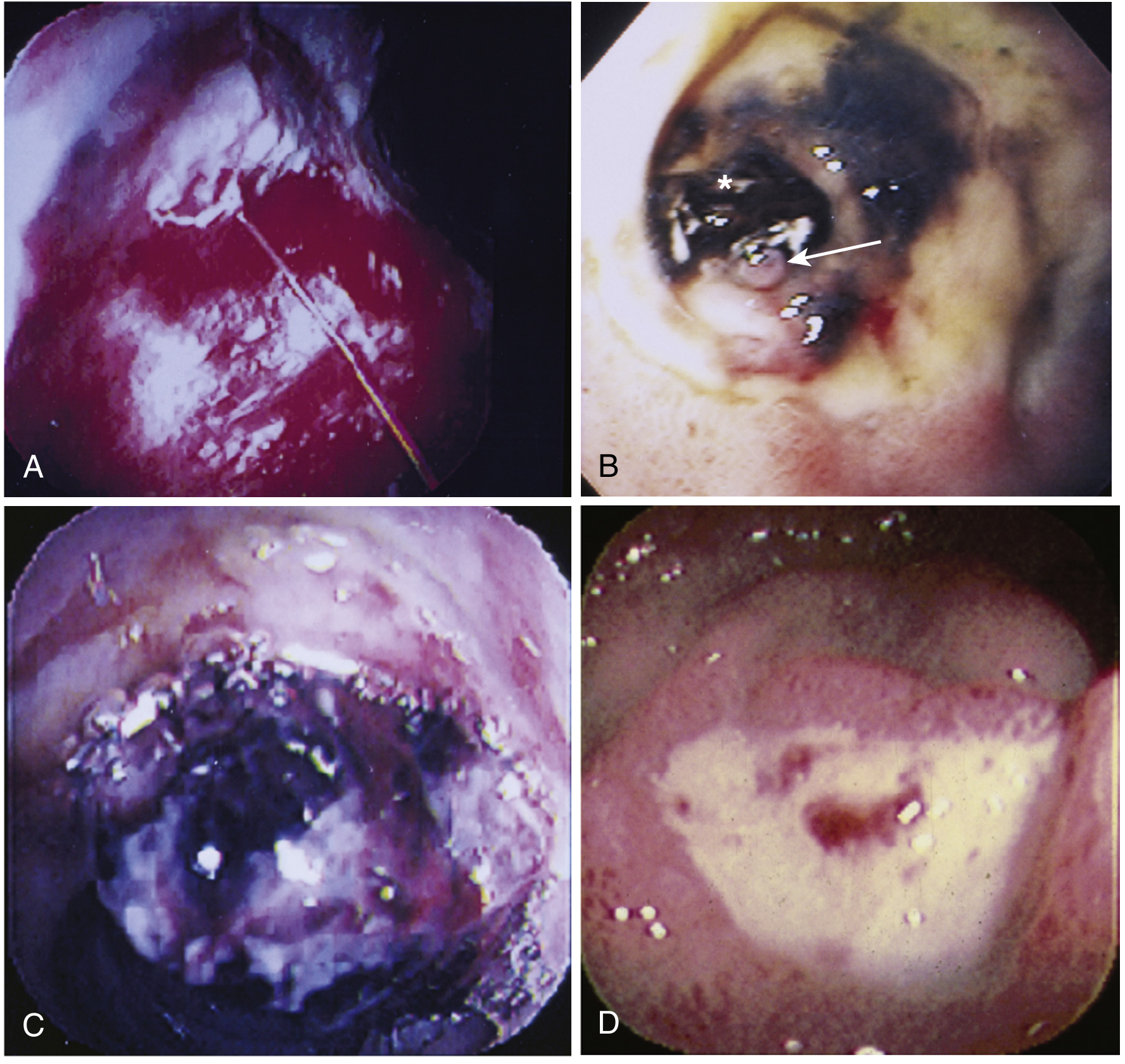
Endoscopic stigmata of recent peptic ulcer hemorrhage - Sleisenger & Fordtran's
Endoscopic Hemostasis Techniques
- Injection therapy: Epinephrine (1:20,000) in 4 quadrants around bleeding site (0.5-1 mL aliquots)
- Thermal/contact coagulation: Multipolar electrocoagulation probe (10 Fr), thermocoagulation - firm pressure, low power (12-15 W), 10-second pulses
- Mechanical: Hemoclips placed across vessel/NBVV; over-the-scope clips (OTSC) for refractory cases
- Non-contact: Argon plasma coagulation (APC), laser
- Combination therapy (injection + thermal or clips) reduces rebleeding to ~15% vs. ~30% with monotherapy alone
(Sleisenger & Fordtran's Gastrointestinal and Liver Disease)
Variceal Bleeding - Special Management
- Octreotide infusion (reduces portal pressure) - start immediately
- Antibiotics mandatory in all cirrhotics with UGIB (ciprofloxacin or ceftriaxone) - proven to reduce mortality
- Endoscopic variceal band ligation (EVL) - treatment of choice for esophageal varices
- Sclerotherapy - alternative
- Balloon tamponade (Sengstaken-Blakemore or Minnesota tube) - temporary bridge in refractory hemorrhage
- TIPS (Transjugular Intrahepatic Portosystemic Shunt) - for refractory variceal bleeding unresponsive to endoscopic + pharmacologic therapy
- Beta-blocker prophylaxis (propranolol/nadolol) + EVL for secondary prevention
When Endoscopy Fails - Salvage Options
- Repeat endoscopy - for recurrent bleeding after initial hemostasis
- Angiography with transcatheter arterial embolization (TAE) - for high surgical risk patients
- Surgery - oversewing of ulcer base, antrectomy, or gastrectomy. Reserved for those failing endoscopic/angiographic therapy
Recent Evidence (2024-2026)
- Tranexamic acid (TXA): A 2025 meta-analysis (PMID 40029534) found no clear benefit for TXA in acute GI bleeding - not currently recommended as routine adjunct
- Over-the-scope clips (OTSC): A 2025 systematic review/meta-analysis (PMID 39500365) shows OTSCs are superior to standard clips for refractory or recurrent nonvariceal UGIB, particularly for Forrest Ia/IIa lesions in fibrotic ulcer beds
Sources: Sleisenger & Fordtran's Gastrointestinal and Liver Disease (9780323609623) | Tintinalli's Emergency Medicine (9781260019933) | Frameworks for Internal Medicine (9781496359308) | PubMed 40029534, 39500365
This is a shared conversation. Sign in to Orris to start your own chat.