
Squint workup
Reading File
Reading File
Finding Sources
Finding Sources
Searching PubMed
"strabismus"[MeSH Terms] AND "diagnosis"
Finding Sources
Reading File
Reading File
Reading File
Reading File
Reading File
Reading File
Searching Images
cover test strabismus results esotropia exotropia
Reading File
Squint (strabismus) workup
1. History
- Onset and course: Congenital or infantile means under 6 months. Later onset in esotropia makes an accommodative component more likely. Sudden onset, especially with diplopia, suggests a paretic or neurological cause.
- Pattern: Constant or intermittent, and which eye. Intermittent squint implies some binocularity. Equal alternation suggests symmetrical acuity. Ask whether it is worse for near or distance, or when tired or unwell.
- Symptoms: Diplopia, head turn or tilt, asthenopia, closing one eye, and any visual or psychosocial impact. In adults, find out exactly what problem the squint is causing, because this drives treatment decisions. Spurious complaints can mask embarrassment about appearance.
- Background:
- Birth history: gestation, birth weight, perinatal problems.
- Development: cerebral palsy, Down syndrome, delay.
- Family history of squint, amblyopia or high refractive error.
- Previous glasses, patching, prisms or surgery, and compliance.
- In adults: trauma, diabetes, hypertension, thyroid disease, neurological disease.
- Photographs: Old photos help date the onset.
(Kanski's Clinical Ophthalmology 10th, "Ophthalmic history", pp. 733-734)
2. Examination
Inspection
- Compare with family photos and look at facial asymmetry.
- Check the head posture.
- Look for epicanthic folds, which cause pseudostrabismus.
- Check for ptosis, proptosis and nystagmus.
Visual acuity (amblyopia screen)
- Preverbal children: Check fixation and following, and look for a fixation preference.
- Strong objection to occlusion of one eye suggests poorer vision in the other eye.
- In a manifest squint, occlude the dominant eye. If fixation returns immediately to the uncovered eye, acuity in the squinting eye is probably impaired. If fixation holds through a blink, acuity is probably good.
- Use preferential looking tests where available.
- Older children: Use matching or optotype charts (tumbling E, HOTV, Snellen) with firm occlusion to prevent peeking.
- Acuity alone under-refers amblyopia and undiagnosed strabismus, so add a stereo test. (Textbook of Family Medicine 9e, p. 359; Kanski's, pp. 733-734)
Measuring the deviation
| Test | Purpose |
|---|---|
| Hirschberg (pen torch at arm's length) | Rough objective estimate of manifest angle. Good for young or uncooperative patients and for excluding pseudostrabismus. Reflex at the pupil border is about 15Δ (about 10-15°). At mid-iris it is about 30Δ (about 15-20°). At the limbus it is about 45Δ (about 40°). |
| Krimsky | Prisms placed in front of the fixing eye until the corneal reflexes are symmetrical. |
| Cover test | Detects tropia. Cover the fixing eye and watch the other eye. No movement means orthotropia, or the covered eye is the deviating one. Adduction means exotropia. Abduction means esotropia. Downward movement means hypertropia. Upward movement means hypotropia. |
| Uncover test | Detects phoria. Watch the covered eye as the cover comes off. Adduction recovery means exophoria. Abduction means esophoria. Note the speed and smoothness of recovery, which reflects fusional strength. |
| Alternate cover test | Dissociates the eyes and shows the total deviation (tropia plus phoria). Do it only after the cover-uncover test. |
| Prism cover test | Quantifies the angle. Place the prism with its apex towards the deviation: base-out for esotropia, base-down for right hypertropia. Measure at distance, near and in the 8 gaze positions. In intermittent exotropia, also measure at far distance. |
Use an accommodative target, not a light, for cover testing. Repeat at near and distance, with and without glasses. (Kanski's, pp. 741-743)
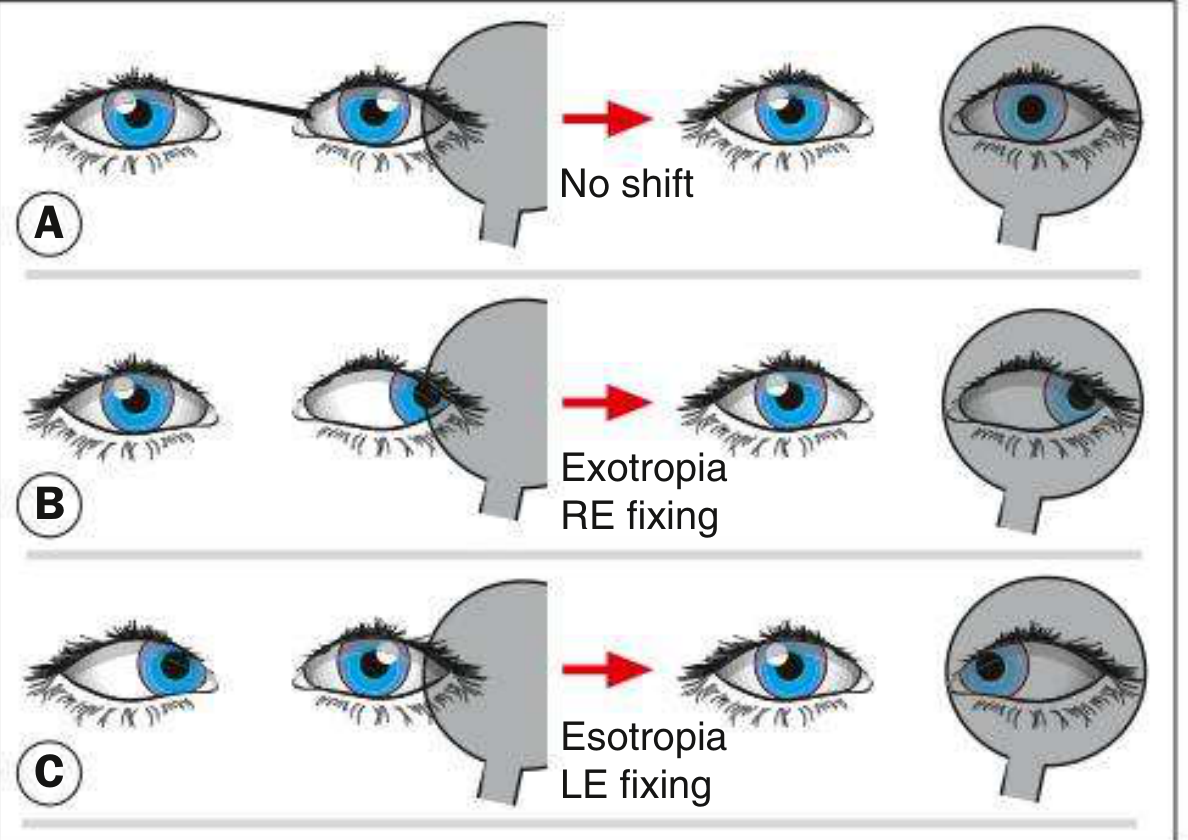
Ocular motility
- Ductions and versions: Test in all 9 positions of gaze. Classify the squint as comitant (angle varies by 5Δ or less across gaze) or incomitant.
- Infantile esotropia: Cross-fixation in side gaze mimics bilateral sixth nerve palsy. Demonstrate abduction with the doll's head manoeuvre or by rotating the child.
- Incomitant squint: Check for paresis or restriction.
- Use the Parks-Bielschowsky three-step test for vertical diplopia.
- Consider forced duction testing.
- Hess or Lees chart if available.
- Convergence: Test the near point of convergence.
- Special patterns: Look for A and V patterns, DVD, and overaction of the oblique muscles.
Binocular function (sensory testing)
- Worth 4-dot: Four lights means binocular single vision (BSV), or harmonious abnormal retinal correspondence (ARC) if a squint is present. Two red lights means right suppression. Three green lights means left suppression. Five lights means diplopia.
- Bagolini striated glasses: An oblique cross means BSV, or harmonious ARC if a squint is present.
- 4Δ base-out prism test: Detects microtropia and central suppression. The eye does not re-fixate when the prism is placed over the affected eye.
- Stereopsis: Titmus, TNO, Lang or random dot tests.
- Synoptophore: Grades binocular function and measures the angle of anomaly in ARC.
- Interpretation: Always note whether a manifest squint is present when interpreting these tests. (Kanski's, pp. 736-740)
Refraction and fundus
- Cycloplegic refraction is mandatory in children. Use cyclopentolate, or atropine in young children and esotropes.
- Hyperopia causes accommodative esotropia. Anisometropia causes amblyopia.
- Dilated fundus exam: Exclude retinoblastoma, optic nerve hypoplasia, a macular scar, cataract and other media opacities. A new squint in a child with leukocoria or a poor red reflex is a red flag.
- Do a red reflex (Bruckner) test in all children.
- Anterior segment exam as well.
3. Red flags needing urgent or neuroimaging workup
- Sudden-onset squint or diplopia in an adult or older child, especially with pain, pupil involvement, ptosis, proptosis or other cranial nerve signs.
- Incomitant deviation with an abnormal head posture.
- Papilloedema or headache.
- Leukocoria or an abnormal red reflex.
- Loss of previously good control.
- Look for causes of sixth, fourth and third nerve palsies. Check blood pressure, glucose, thyroid function, and consider myasthenia and giant cell arteritis if the patient is over 50. In the neurology textbooks, adult-onset esotropia needs consideration of acquired causes. (Bradley and Daroff's, Ch. 18; Harrison's, Diplopia)
4. Differential by presentation
- Infant, large stable angle: Early-onset (infantile) esotropia, under 6 months, no significant refractive error. Large angle, over 30Δ, with alternating fixation.
- Toddler, intermittent or variable esotropia: Accommodative esotropia (refractive, non-refractive or mixed).
- Distance exotropia in a child: Intermittent exotropia.
- Squint after vision loss in one eye: Sensory strabismus.
- Limited ductions: Duane syndrome, Brown syndrome, thyroid eye disease, blowout fracture.
- Apparent squint but straight on cover test: Pseudostrabismus.
5. Quick summary
- History: onset, pattern, symptoms, family history, development.
- Acuity or fixation preference (rule out amblyopia).
- Hirschberg, then cover/uncover, then alternate and prism cover tests.
- Motility, comitance, A and V patterns.
- Sensory tests: Worth 4-dot, Bagolini, stereo.
- Cycloplegic refraction and dilated fundus exam.
- Investigate further for incomitant, acquired or neurological squint.
Several 2025 systematic reviews of AI and digital strabismus screening exist (Yang et al., Hartness et al., Rajavi et al.). They don't change the clinical workup above, which remains the standard.
Tell me if you want a specific type worked up in detail, such as paralytic squint or accommodative esotropia, or the management and surgery plan.
This is a shared conversation. Sign in to Orris to start your own chat.