
Facial skeleton all with image leveling diagram and points with tricks
Reading File
Finding Sources
Finding Sources
Searching the Web
facial skeleton bones labeled diagram anatomy mnemonics tricks
Reading File
Finding Sources
Reading Web Page
facial skeleton bones labeled diagram anatomy mnemonic tricks
Finding Sources
Finding Sources
Reading File
Finding Sources
Loading Image
Reading File
Loading Image
Reading File
I now have everything needed for a comprehensive answer. Let me compile it all together.
Facial Skeleton - Complete Anatomy with Diagrams & Memory Tricks
Overview
The skull has 22 bones total:
- 8 cranial bones (neurocranium - protects brain)
- 14 facial bones (viscerocranium - forms the face)
Key trick: Cranial bones = mostly single bones, with only 2 pairs (parietal, temporal). Facial bones = mostly pairs, with only 2 single bones (vomer, mandible).
Diagram 1 - Anterior (Front) View
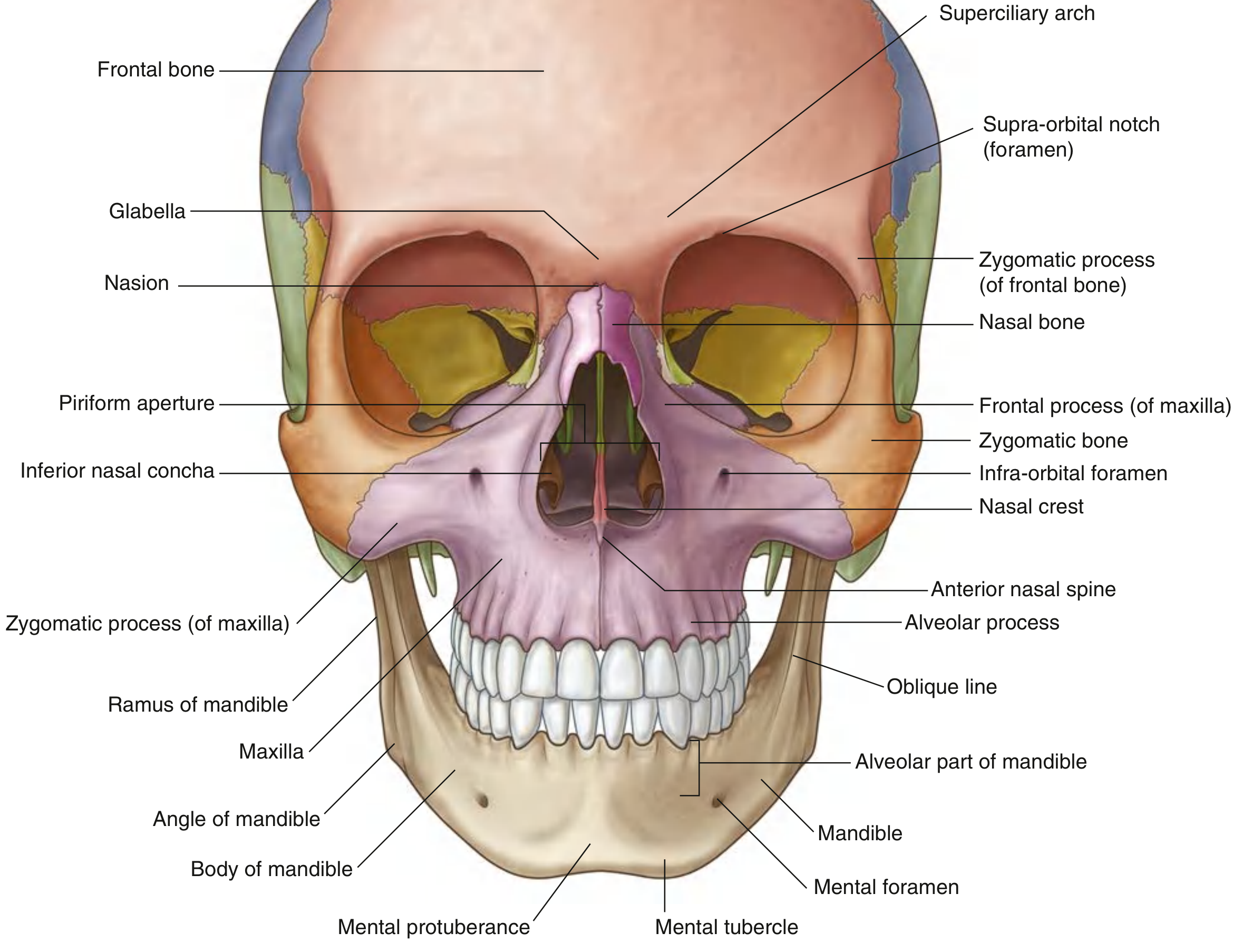
Gray's Anatomy for Students - Anterior View of the Skull with labeled facial bones, foramina, and landmarks
Diagram 2 - Lateral (Side) View
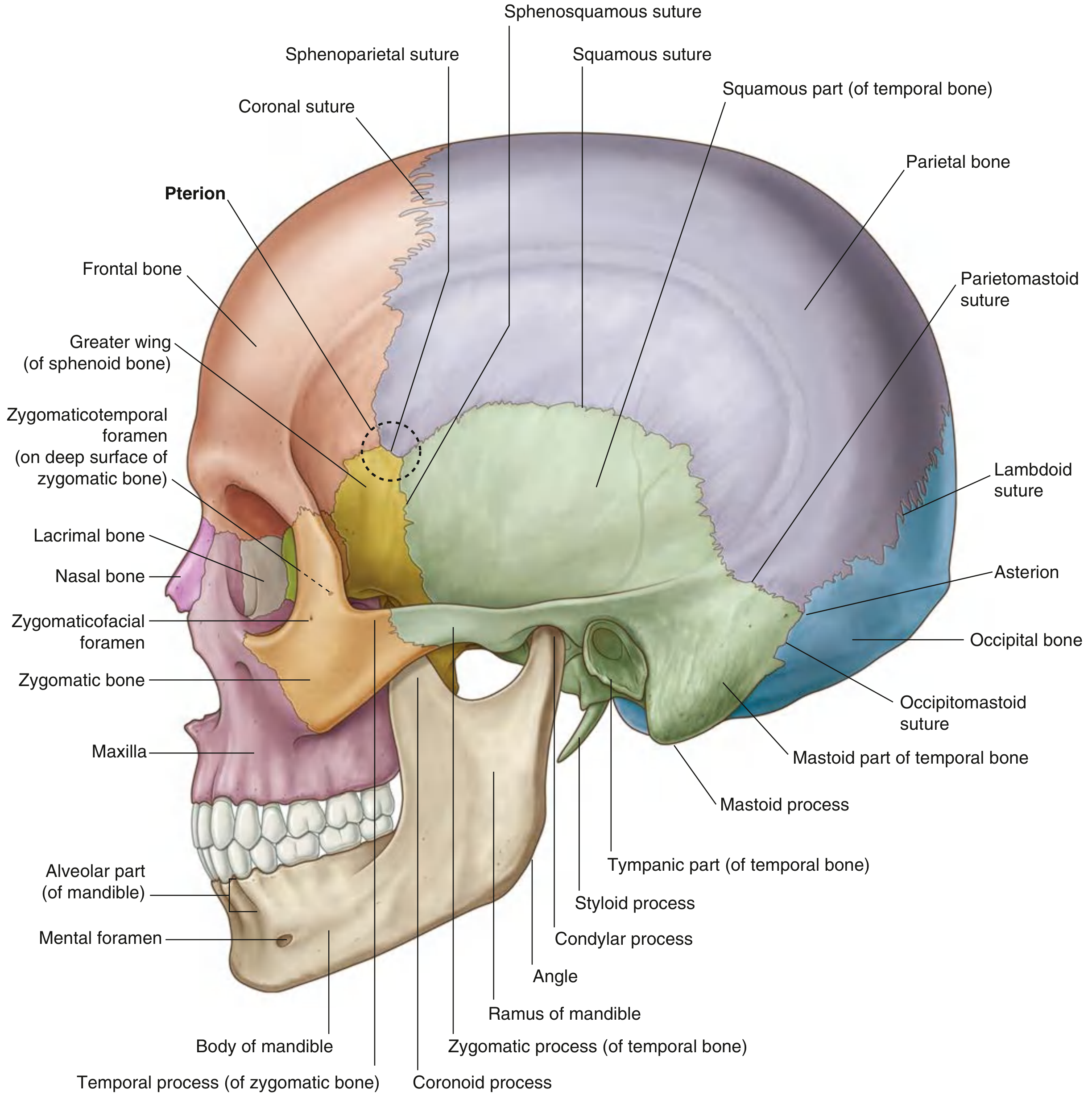
Gray's Anatomy for Students - Lateral View of the Skull showing the zygomatic arch, mandible, temporal bone relationships, and sutures
The 14 Facial Bones
Master Mnemonic
"My Mandible Chews Nine Very Large Zucchini Pizzas"
| Letter | Bone | Count |
|---|---|---|
| My | Maxilla | 2 (paired) |
| Mandible | Mandible | 1 (single) |
| Chews | Conchae (Inferior Nasal) | 2 (paired) |
| Nine | Nasal bones | 2 (paired) |
| Very | Vomer | 1 (single) |
| Large | Lacrimal bones | 2 (paired) |
| Zucchini | Zygomatic bones | 2 (paired) |
| Pizzas | Palatine bones | 2 (paired) |
Total: 14 facial bones
Each Bone - Key Points & Tricks
1. Maxilla (×2) - "The Maximum Bone"
- Trick: Maxilla = Maximum part of the face - articulates with almost ALL other facial bones
- Forms: upper jaw (alveolar process with teeth), hard palate (anterior part), inferior + medial orbital rim, floor of nasal cavity, and anterior nasal floor
- Key landmark: Infra-orbital foramen (just below the orbit) - transmits infra-orbital nerve & vessels
- Processes: frontal, zygomatic, palatine, and alveolar
- The two maxillae meet at the midline to form the intermaxillary suture
2. Mandible (×1) - "The Moving Jaw"
- Trick: The mandible is the ONLY moveable bone of the skull (aside from the ossicles)
- Parts: Body (horizontal) + Ramus (vertical) - meet at the angle of mandible
- Body divides into: base (lower) + alveolar part (upper, holds teeth)
- Key landmark: Mental foramen - midway between upper alveolar border and lower base border - transmits mental nerve & vessels
- Mental protuberance at midline = "chin"
- Ramus has two processes going upward:
- Coronoid process - attachment for temporalis muscle
- Condylar process - articulates with temporal bone (TMJ)
3. Inferior Nasal Conchae (×2) - "The Shelves"
- Trick: "Concha" = shell-shaped; Inferior = lowest of the 3 conchae
- The only conchae that are separate facial bones (superior + middle conchae = parts of ethmoid)
- Function: warm, humidify, and filter inhaled air (increase surface area)
- Visible through the piriform aperture (pear-shaped nasal opening) in the anterior skull view
4. Nasal Bones (×2) - "The Bridge Bones"
- Trick: Easiest bones to find - they literally form the bridge of your nose
- Articulate with each other midline, with frontal bone superiorly, and with frontal process of maxilla laterally
- The junction of nasal bones + frontal bone = nasion (the FNS - frontonasal suture center)
- Inferiorly, they bound the top of the piriform aperture
5. Vomer (×1) - "The Ploughshare"
- Trick: "Vomer" is Latin for ploughshare - it looks like one
- Forms the posteroinferior part of the bony nasal septum
- Articulates with: ethmoid bone (perpendicular plate), sphenoid, palatine, and maxillae
- The nasal septum = vomer (bone) + perpendicular plate of ethmoid (bone) + septal cartilage
6. Lacrimal Bones (×2) - "The Tear Bones"
- Trick: Lacrimal = Latin for tears (lacrima). These are the tiniest bones in the skull
- Located on the medial wall of each orbit
- Contain the lacrimal groove (lacrimal fossa) which holds the lacrimal sac - tear drainage system
- The nasolacrimal duct runs from here down into the nasal cavity
7. Zygomatic Bones (×2) - "The Cheekbones"
- Trick: Zygoma = Greek for yoke (connects things). Forms the cheek prominence
- Forms: lateral orbital rim + lateral orbital floor, and contributes to the zygomatic arch
- Zygomatic arch = temporal process of zygomatic bone + zygomatic process of temporal bone
- Key foramina: Zygomaticofacial foramen (lateral surface), Zygomaticotemporal foramen (deep surface)
- Clinically: most commonly fractured facial bone after nasal bones
8. Palatine Bones (×2) - "The L-Shaped Bones"
- Trick: L-shaped bones that are mostly hidden behind the maxilla (deep position)
- Form: posterior third of hard palate (horizontal plate) + posterior lateral nasal wall (perpendicular plate)
- Also contribute to the floor of the orbit and the walls of the pterygopalatine fossa
- Key foramina: Greater palatine foramen (greater palatine nerve/vessels) + Lesser palatine foramen (lesser palatine nerves)
The 8 Cranial Bones (for context)
"Ethan's Fried Spanish Pasta Tempted Octavia"
| Letter | Bone | Count |
|---|---|---|
| Ethan's | Ethmoid | 1 |
| Fried | Frontal | 1 |
| Spanish | Sphenoid | 1 |
| Pasta | Parietal | 2 |
| Tempted | Temporal | 2 |
| Octavia | Occipital | 1 |
Key Foramina of the Facial Skeleton
| Foramen | Location | Structures |
|---|---|---|
| Supra-orbital foramen | Frontal bone, superior orbital rim | Supra-orbital nerve + vessels |
| Infra-orbital foramen | Maxilla, below orbital rim | Infra-orbital nerve + vessels |
| Mental foramen | Mandible, lateral body | Mental nerve + vessels |
| Zygomaticofacial foramen | Lateral surface, zygomatic bone | Zygomaticofacial nerve |
| Greater palatine foramen | Palatine bone, hard palate | Greater palatine nerve + vessels |
Trick for foramina alignment: The supra-orbital, infra-orbital, and mental foramina are all roughly aligned vertically on each side of the face - useful in clinical practice and for identifying structures in imaging.
Key Landmarks Summary
| Landmark | Bone | Trick |
|---|---|---|
| Glabella | Frontal | Smooth depression between the eyebrows |
| Nasion | Frontonasal junction | The little dip at the top of the nose bridge |
| Piriform aperture | Nasal bones + Maxilla | Pear-shaped anterior nasal opening |
| Anterior nasal spine | Maxilla | Sharp bony projection at base of nasal opening |
| Mental protuberance | Mandible | The chin prominence |
| Angle of mandible | Mandible | Where body meets ramus |
| Pterion | Junction of frontal, parietal, sphenoid, temporal | "H"-shaped region on lateral skull - thinnest bone, overlies middle meningeal artery |
| Asterion | Junction of parietal, occipital, temporal | Posterior counterpart of pterion |
Quick Recall Card
14 FACIAL BONES
━━━━━━━━━━━━━━━━━━━━━━━━━━━━━━
SINGLE (2): Vomer, Mandible
PAIRED (6 pairs = 12):
• Maxilla • Nasal
• Zygomatic • Lacrimal
• Palatine • Inf. Nasal Concha
━━━━━━━━━━━━━━━━━━━━━━━━━━━━━━
MNEMONIC: My Mandible Chews Nine Very Large Zucchini Pizzas
Source: Gray's Anatomy for Students (Gray's Anatomy for Students), Anterior & Lateral View diagrams
This is a shared conversation. Sign in to Orris to start your own chat.