
Renal angimyolipoma
Reading File
Renal angiomyolipoma (AML) is a benign mesenchymal tumor of the kidney composed of blood vessels, smooth muscle, and fat. It is the most common benign renal tumor and is associated with tuberous sclerosis complex (TSC). Now searching the medical library for comprehensive coverage.
Searching sources...
Finding Sources
Searching PubMed
renal angiomyolipoma management
Good - I have multiple sources. Let me read the most detailed ones in parallel.
Reading File
Reading File
Reading File
Now let me read the full Campbell-Walsh section for management/treatment details and the Smith & Tanagho section:
Reading File
Reading File
Reading File
Now let me get the full management section from Campbell-Walsh:
Reading File
Loading Image
I now have comprehensive information. Let me compile a detailed, well-organized answer.
Renal Angiomyolipoma (AML)
Definition and Classification
Angiomyolipoma is a benign mesenchymal neoplasm of the kidney composed of three elements: dysmorphic blood vessels, smooth muscle (spindle cells), and mature adipose tissue. It is classified as a PEComa (perivascular epithelioid cell tumor) and represents 1-2% of renal tumors. It can be:
-
Sporadic - most common form, predominantly in women, peak incidence 4th-5th decade
-
Syndrome-associated - tuberous sclerosis complex (TSC), lymphangioleiomyomatosis (LAM)
-
Campbell-Walsh-Wein Urology, p. 2294
Epidemiology
| Feature | Detail |
|---|---|
| General population prevalence | ~0.13% |
| Female:Male ratio | Strongly female predominant |
| Peak age (sporadic) | 4th-5th decade |
| TSC association | 55-90% of TSC patients have AML |
| TSC presentation | Earlier than sporadic cases |
Pathophysiology and Genetics
In TSC-associated AML:
- Mutations in TSC1 (hamartin, chromosome 9q34) or TSC2 (tuberin, chromosome 16p13)
- Inheritance: autosomal dominant, variable penetrance; sporadic mutations are common
- Hamartin-tuberin dimer normally inhibits mTOR - loss of function leads to unregulated mTOR activation
- Downstream: uncontrolled protein synthesis, cellular proliferation, and angiogenesis
This mTOR pathway activation is the rationale for mTOR inhibitor therapy.
In LAM (lymphangioleiomyomatosis): Also involves TSC1/TSC2 mutations; predominantly affects women; associated with cystic lung lesions, lymphangioleiomyomas, and chylous effusions.
Histopathology
- Tumors are well-circumscribed with a tan, pink, or yellow cut surface (depending on fat content)
- Composed of thick-walled eccentric blood vessels, smooth muscle spindle cells, and mature adipocytes (no atypia in classic form)
- Immunohistochemistry: Spindle cells have melanocytic features - positive for HMB-45 and Melan-A (key markers)
- AMLs also strongly express estrogen receptor-beta, progesterone receptor, and androgen receptor - explains the female preponderance postpuberty
Epithelioid AML - important variant:
-
Minimal fat, abundance of epithelioid cells
-
Frequent atypia, mitotic figures, and necrosis
-
Metastatic potential - reported in ~1/3 of cases (sporadic and TSC-associated)
-
Should be considered potentially malignant
-
Campbell-Walsh-Wein Urology, p. 2305-2307
Clinical Presentation
- Most are asymptomatic - incidentally detected on imaging
- Wunderlich syndrome (spontaneous retroperitoneal hemorrhage) - historically up to 15% of patients; AML is the most common cause of spontaneous retroperitoneal hemorrhage
- Flank/loin pain, flank mass, hematuria
- Pregnancy is a risk factor for hemorrhage (due to hormonal receptor positivity)
Diagnosis and Imaging
CT (Gold Standard)
- Intralesional fat density of -15 to -20 Hounsfield units (HU) on non-contrast series is diagnostic
- Cutoff of -10 HU gives a c-index of 0.83
- Fat on CT = definitive diagnosis - no biopsy needed
Ultrasound
- Hyperechoic (bright echogenic) mass - due to high fat content
- Less reliable; RCC can also appear hyperechoic
- Subcentimeter echogenic lesions are usually clinically insignificant
MRI
- AML follows signal intensity of intraabdominal fat on all sequences
- Loses signal on fat-saturated sequences
- India ink artifact on out-of-phase sequences at fat-water interface is diagnostic
- Non-fat components enhance avidly
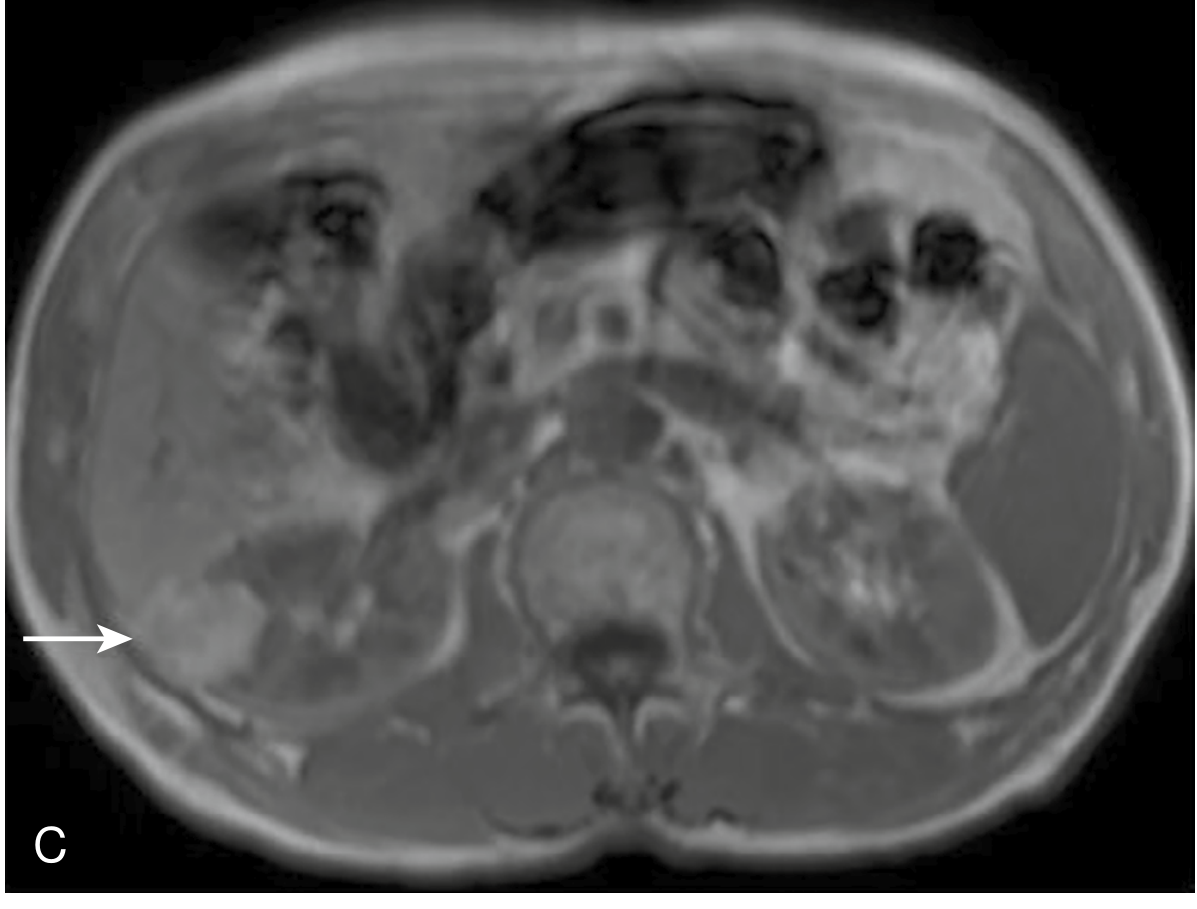
Fat-poor AML (~4%) - cannot be distinguished from RCC on imaging; requires biopsy or surgery.
- National Kidney Foundation Primer on Kidney Diseases, p. 77; Bailey and Love's Surgery, p. 1503
Management
Management is guided by tumor size, symptoms, hemorrhage risk, and pregnancy status, with the overarching goal of renal function preservation.
Observation (Watchful Waiting)
- Tumors < 4 cm in asymptomatic patients can be followed with surveillance CT or MRI
- The traditional 4 cm cutoff for intervention has recently been questioned - some advocate individualized assessment
Selective Renal Angioembolization (SAE)
- Treatment of choice for acute hemorrhage
- Also used prophylactically for high-risk lesions (classically >4 cm)
- Technique: transfemoral/transradial approach, superselective catheterization of feeding vessels
- Embolics: ethanol + ethiodized oil (7:3 ratio) - ethanol provides permanent occlusion; ethiodized oil is radiopaque for monitoring
- Freedom from surgical intervention at 5 years: 94% after SAE
- Recurrence of hemorrhage: ~10-15%, managed by repeat embolization
- A short-term tapered prednisone course may reduce post-embolization syndrome (PES)
- A 2025 systematic review (PMID: 40165158) confirms safety and efficacy of SAE
Nephron-Sparing Surgery (Partial Nephrectomy)
- Preferred surgical option when intervention is needed
- Preferred over radical nephrectomy to preserve renal function
- Robot-assisted approaches are increasingly used; a 2025 meta-analysis (PMID: 41372556) compared robot-assisted vs. laparoscopic partial nephrectomy
mTOR Inhibitors
- Everolimus and sirolimus - indicated for larger, multifocal AMLs in TSC and LAM patients
- Target the dysregulated mTOR pathway
- Shown to reduce tumor size; excellent response rates in TSC-associated AML
- Everolimus is FDA-approved specifically for this indication
Summary Decision Framework
| Scenario | Management |
|---|---|
| AML < 4 cm, asymptomatic | Observation + surveillance imaging |
| AML > 4 cm, asymptomatic | Consider prophylactic SAE or surgery |
| Acute hemorrhage | Selective angioembolization |
| TSC/LAM with multiple/large AMLs | Everolimus (mTOR inhibitor) |
| Pregnancy with AML | Higher hemorrhage risk; individualize management |
- Campbell-Walsh-Wein Urology, p. 2378-2382; Bailey and Love's Surgery, p. 1503
Key Points Summary
- Benign PEComa - composed of blood vessels, smooth muscle, and fat; sporadic or TSC/LAM-associated
- TSC link - TSC1/TSC2 mutations -> loss of mTOR inhibition -> uncontrolled cell growth
- Diagnosis by imaging - macroscopic fat on CT (-15 to -20 HU) is pathognomonic
- Fat-poor AML (~4%) mimics RCC - requires biopsy
- Epithelioid AML - aggressive variant with malignant potential; HMB-45 positive
- Hemorrhage risk increases with size; AML is the leading cause of spontaneous retroperitoneal hemorrhage (Wunderlich syndrome)
- Angioembolization for acute bleeding; everolimus for TSC-associated multifocal disease
- 4 cm threshold has traditionally guided intervention, though now subject to individualized assessment
Recent evidence note: Two 2025 systematic reviews confirm the role of SAE in AML management [PMID: 40165158] and support robot-assisted partial nephrectomy as a viable surgical option [PMID: 41372556]. Neither appears to fundamentally alter established guidelines from textbook evidence.
This is a shared conversation. Sign in to Orris to start your own chat.