
Write a short note on microscopic hypochromic anaemia based upon robbins
Microscopic Hypochromic Anaemia - Based on Robbins
Definition
Causes of Hypochromic Microcytic Anaemia
| Cause | Mechanism |
|---|---|
| Iron deficiency anaemia | Insufficient iron for haem synthesis |
| Anaemia of chronic inflammation | Hepcidin-mediated iron sequestration |
| Thalassaemias (alpha & beta) | Defective globin chain synthesis |
| Sideroblastic anaemia | Impaired haem synthesis despite adequate iron |
Iron Deficiency Anaemia - The Prototype
Etiology
- Chronic blood loss - the most important cause in higher-resource countries. Sources include the gastrointestinal tract (peptic ulcers, colon cancer, hemorrhoids) and the female genital tract (menorrhagia, metrorrhagia).
- Dietary lack / low bioavailability - most common in lower-resource countries where diets are predominantly vegetarian. Heme iron (from meat) is ~20% absorbable vs. only 1-2% for non-heme iron. Even in high-resource settings, infants fed exclusively on milk, the impoverished, and the elderly are at risk.
- Increased demand - pregnancy and infancy are the key examples worldwide.
- Malabsorption - celiac disease, gastritis, or post-gastrectomy states.
Stages of Iron Depletion
- Depletion of iron stores - serum ferritin falls; stainable iron disappears from bone marrow macrophages on Prussian blue stain. No anaemia yet.
- Iron-deficient erythropoiesis - serum iron falls; serum transferrin (total iron-binding capacity, TIBC) rises; transferrin saturation drops below 15%.
- Iron deficiency anaemia - haemoglobin synthesis is inadequate; microcytic, hypochromic anaemia appears on peripheral smear.
Morphology (Microscopic Features)
- Microcytosis - red cells are smaller than normal (MCV < 80 fL)
- Hypochromia - the zone of central pallor is enlarged; in established deficiency, haemoglobin is confined to a narrow peripheral rim (normal central pallor = ~1/3 of cell diameter; in IDA the pallor is > 1/3)
- Poikilocytosis - "pencil cells" (small, elongated red cells) are characteristically seen
- Anisocytosis - variation in red cell size
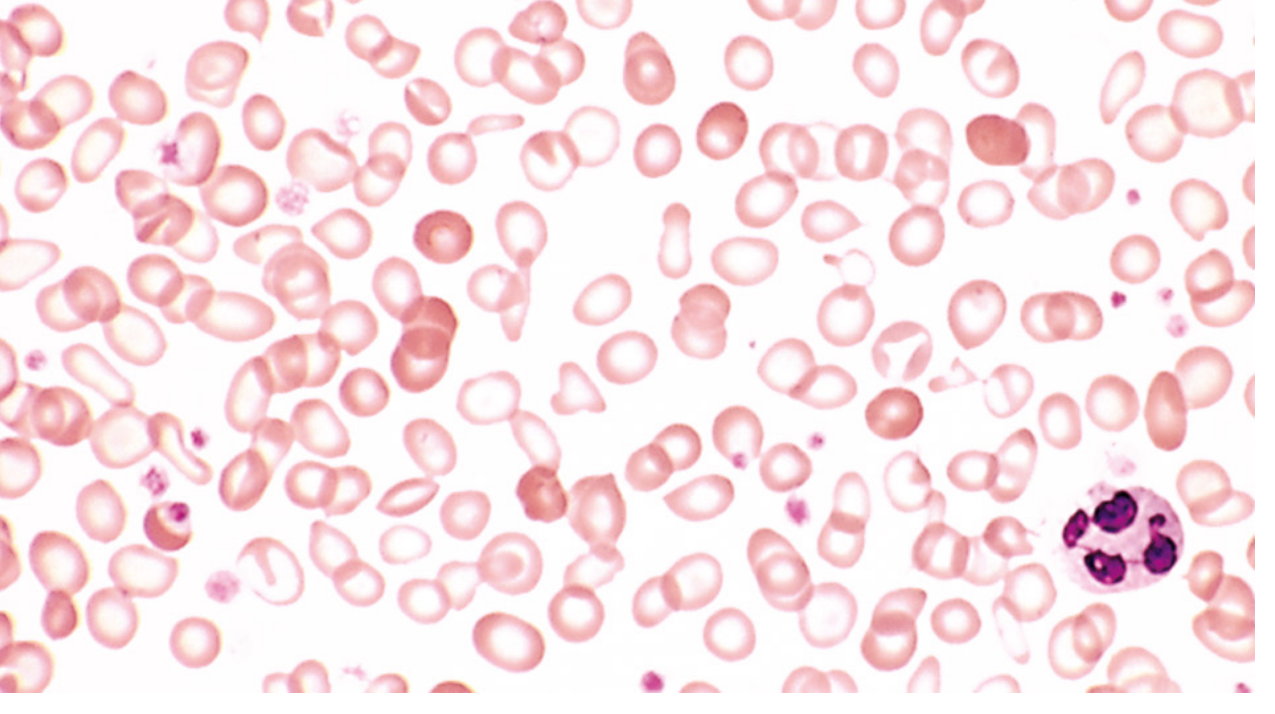
- Mild to moderate increase in erythroid progenitors (hyperplasia)
- Absent stainable iron in macrophages on Prussian blue stain - a diagnostically significant finding
Laboratory Findings
| Parameter | Finding in IDA |
|---|---|
| Haemoglobin / Haematocrit | Decreased |
| MCV, MCH, MCHC | Decreased (microcytic, hypochromic) |
| Serum iron | Low |
| Serum ferritin | Low (< 12 µg/L) |
| Total iron-binding capacity (TIBC) | Elevated |
| Transferrin saturation | Reduced (< 15%) |
| Serum hepcidin | Low (iron deficiency inhibits hepcidin synthesis) |
| Reticulocyte count | Low or normal (blunted marrow response) |
| Platelet count | Often elevated (for unclear reasons) |
| Erythropoietin | Elevated, but marrow response is blunted |
Clinical Features
- General: weakness, listlessness, pallor, fatigue
- Nails: koilonychia (spoon-shaped nails), thinning, flattening
- Neurological/behavioural: pica (craving for non-foodstuffs such as clay, dirt, ice - the latter called pagophagia)
- Tongue/mucosa: atrophic glossitis, alopecia, atrophic changes in gastric mucosa
- Rare triad - Plummer-Vinson syndrome: microcytic hypochromic anaemia + atrophic glossitis + oesophageal webs
Key Concept
"In well-nourished persons, microcytic hypochromic anaemia is not a disease but rather a symptom of another underlying disorder - e.g., colon cancer leading to chronic blood loss." - Robbins & Kumar, Basic Pathology
Anaemia of Chronic Inflammation (Differential)
- Inhibits ferroportin in macrophages - trapping iron in storage
- Starves erythroid precursors of iron despite high total body iron stores
- Also directly suppresses erythropoietin production
Prepare a flashcard for iron Deficiency anaemia according to the text above
Medical flashcard for Iron Deficiency Anaemia (IDA) based on Robbins Pathology. The flashcard should have a clean, professional medical study card layout with two sides shown side by side or as a single detailed card. FRONT of card: Title: "Iron Deficiency Anaemia (IDA)" Subtitle: "Robbins Pathology" A small icon of red blood cells (hypochromic/pale) BACK of card (main content), organized in clearly labeled sections: DEFINITION: Most common nutritional disorder worldwide. Failure of adequate Hb synthesis due to iron deficiency. CAUSES (4): 1. Chronic blood loss (GI tract, female genital tract) — commonest in high-resource countries 2. Dietary lack / low bioavailability — commonest in low-resource countries 3. Increased demand (pregnancy, infancy) 4. Malabsorption (celiac, post-gastrectomy) STAGES: 1. Depleted iron stores → ↓ ferritin, absent Prussian blue stain 2. Iron-deficient erythropoiesis → ↓ serum iron, ↑ TIBC 3. IDA → microcytic, hypochromic anaemia MORPHOLOGY (Peripheral Smear): • Microcytosis (MCV < 80 fL) • Hypochromia (enlarged central pallor — narrow peripheral Hb rim) • "Pencil cells" (elongated poikilocytes) • Anisocytosis Bone marrow: ↑ erythroid progenitors, absent stainable iron (Prussian blue) LAB FINDINGS: ↓ Hb, MCV, MCH, MCHC | ↓ Serum iron | ↓ Ferritin (<12 µg/L) | ↑ TIBC | Transferrin sat. <15% | ↓ Hepcidin | Platelets often ↑ CLINICAL FEATURES: • Weakness, pallor, fatigue • Koilonychia, alopecia • Pica / Pagophagia • Plummer-Vinson syndrome (IDA + glossitis + oesophageal webs) KEY CONCEPT: "In well-nourished persons, microcytic hypochromic anaemia is a SYMPTOM, not a disease — always look for an underlying cause (e.g., colon cancer)." IDA vs Anaemia of Chronic Inflammation: IDA: ↓ Ferritin, ↑ TIBC, ↓ Hepcidin ACI: ↑ Ferritin, ↓ TIBC, ↑ Hepcidin Design: white background, navy blue header, color-coded sections (blue for causes, green for morphology, orange for labs, red for clinical), clean sans-serif font, medical academic style.
??
Medical study flashcard for Iron Deficiency Anaemia (IDA) based on Robbins Pathology. Single detailed card layout, professional medical academic style, white background, navy blue header bar at top. HEADER (navy blue bar): "IRON DEFICIENCY ANAEMIA" | subtitle: "Robbins Pathology" Content organized in color-coded sections below: [BLUE section] CAUSES 1. Chronic blood loss - GI tract / female genital tract (commonest in high-resource countries) 2. Dietary lack / low bioavailability (commonest in low-resource countries) 3. Increased demand - pregnancy, infancy 4. Malabsorption - celiac disease, post-gastrectomy [PURPLE section] STAGES OF IRON DEPLETION Stage 1: Depleted stores → decreased ferritin, absent Prussian blue stain in marrow Stage 2: Iron-deficient erythropoiesis → decreased serum iron, increased TIBC Stage 3: IDA → microcytic hypochromic anaemia on smear [GREEN section] MORPHOLOGY Peripheral smear: Microcytosis (MCV <80), Hypochromia (enlarged central pallor, narrow Hb rim), Pencil cells, Anisocytosis Bone marrow: Increased erythroid progenitors; absent stainable iron on Prussian blue stain [ORANGE section] LAB FINDINGS Decreased: Hb, MCV, MCH, MCHC, Serum iron, Ferritin (<12 µg/L), Hepcidin, Transferrin saturation (<15%) Increased: TIBC (transferrin), Platelets (often), Erythropoietin [RED section] CLINICAL FEATURES Weakness, pallor, fatigue | Koilonychia, alopecia | Pica / Pagophagia (craving non-food) Plummer-Vinson Syndrome: IDA + atrophic glossitis + oesophageal webs [YELLOW section] IDA vs ANAEMIA OF CHRONIC INFLAMMATION IDA: Ferritin LOW, TIBC HIGH, Hepcidin LOW ACI: Ferritin HIGH, TIBC LOW, Hepcidin HIGH [GREY box at bottom] KEY PEARL: "Microcytic hypochromic anaemia in a well-nourished adult is a SYMPTOM, not a disease. Always investigate for underlying cause." - Robbins
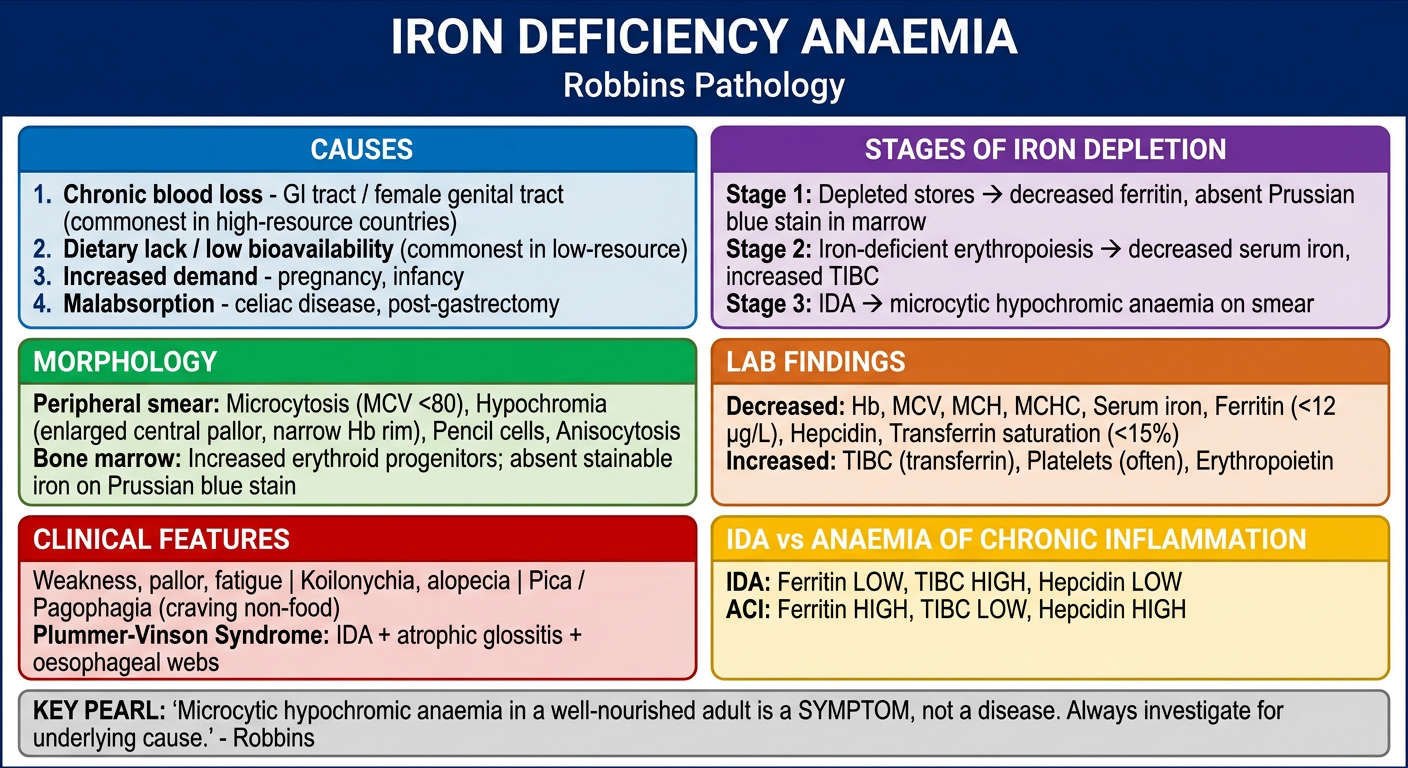
- Causes (4 categories)
- Stages of iron depletion (stores → erythropoiesis → anaemia)
- Morphology - peripheral smear and bone marrow findings
- Lab findings with the arrows for quick recall
- Clinical features including Plummer-Vinson syndrome
- IDA vs Anaemia of Chronic Inflammation comparison
- The Robbins key pearl at the bottom