
Anatomy of hand
Reading File
Searching sources...
Finding Sources
Finding Sources
Finding Sources
Reading File
Reading File
Finding Sources
Reading File
Reading File
Reading File
Reading File
Loading Image
Loading Image
Loading Image
Finding Sources
Reading File
Reading File
Loading Image
Now I have comprehensive content from Schwartz's Principles of Surgery and the THIEME Atlas of Anatomy. Let me compile the full answer.
Anatomy of the Hand
Sources: Schwartz's Principles of Surgery, 11th Ed.; THIEME Atlas of Anatomy (General Anatomy & Musculoskeletal System)
1. Orientation and Terminology
Because the hand can rotate in space, standard anatomical directional terms are modified:
- Palmar (volar) - anterior surface of the hand in anatomic position
- Dorsal - posterior surface
- Radial / Ulnar - used instead of lateral/medial (do not change with rotation)
- Pronation - rotation bringing palm down; Supination - palm up
- Abduction/Adduction of fingers - movement away from or toward the middle finger
2. Bones
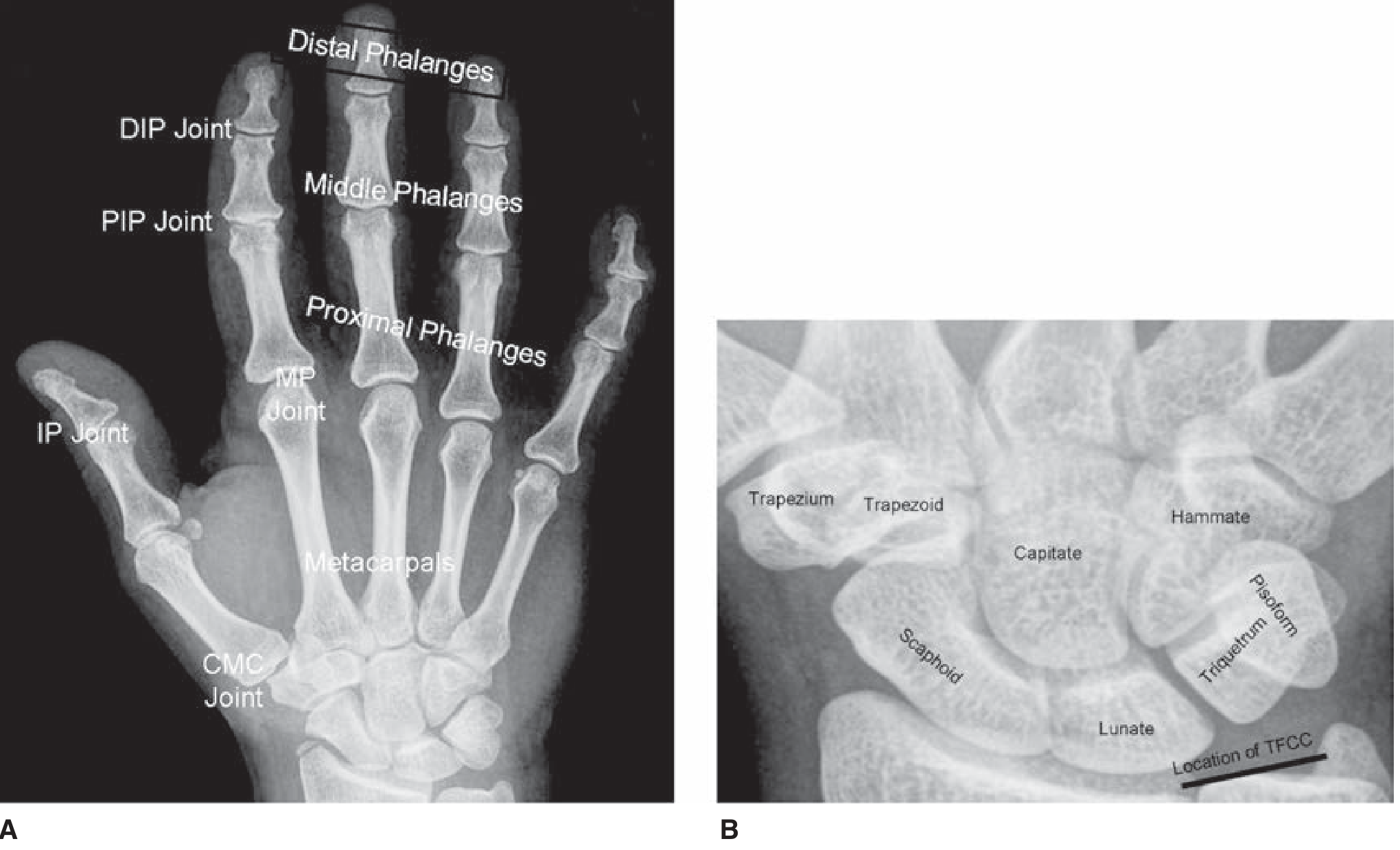
The hand contains 19 bones arranged in 5 rays (thumb = ray 1, to small finger = ray 5).
Metacarpals
Five metacarpals form the visible palm. Each articulates proximally at the carpometacarpal (CMC) joint and distally at the metacarpophalangeal (MP) joint.
Phalanges
- Fingers (index, middle, ring, small): proximal phalanx + middle phalanx + distal phalanx
- Thumb: proximal phalanx + distal phalanx only (no middle phalanx)
Joints and Their Motion Ranges
| Joint | Normal Motion |
|---|---|
| MP (fingers) | 0-90° flexion + active abduction/adduction |
| MP (thumb) | Primarily flexion-extension arc |
| PIP | 0-95° (most important joint for finger mobility) |
| DIP | 0-90° (flexion-extension only) |
| Thumb IP | Flexion-extension; range highly variable |
Wrist (Carpal) Bones
Two rows of 8 carpal bones:
- Proximal row: Scaphoid, Lunate, Triquetrum, Pisiform
- Distal row: Trapezium, Trapezoid, Capitate, Hamate
3. Muscles
Extrinsic Muscles (originate in the forearm, act on the hand)
Flexors (all innervated by median nerve except ring/small FDP → ulnar nerve):
| Muscle | Insertion | Primary Action |
|---|---|---|
| Flexor Digitorum Superficialis (FDS) | Base of middle phalanx of each finger | Flexes PIP joint |
| Flexor Digitorum Profundus (FDP) | Base of distal phalanx of each finger | Flexes DIP joint |
| Flexor Pollicis Longus (FPL) | Base of distal phalanx of thumb | Flexes thumb IP joint |
Extensors (all innervated by Posterior Interosseous Nerve - PIN, branch of radial nerve):
| Muscle | Insertion/Action |
|---|---|
| Extensor Digitorum Communis (EDC) | Into sagittal hood → extends MP joints of fingers |
| Extensor Carpi Radialis Longus (ECRL) | Dorsal base of index metacarpal; radial deviation |
| Extensor Carpi Radialis Brevis (ECRB) | Dorsal base of middle metacarpal |
| Extensor Carpi Ulnaris (ECU) | Dorsal base of small finger metacarpal; ulnar deviation |
| Extensor Indicis Proprius (EIP) | Independent index finger extension |
| Extensor Digiti Quinti (EDQ) | Independent small finger extension |
| Abductor Pollicis Longus (APL) | Thumb metacarpal base |
| Extensor Pollicis Brevis (EPB) | Thumb proximal phalanx |
| Extensor Pollicis Longus (EPL) | Thumb distal phalanx |
Intrinsic Muscles (originate and act within the hand)
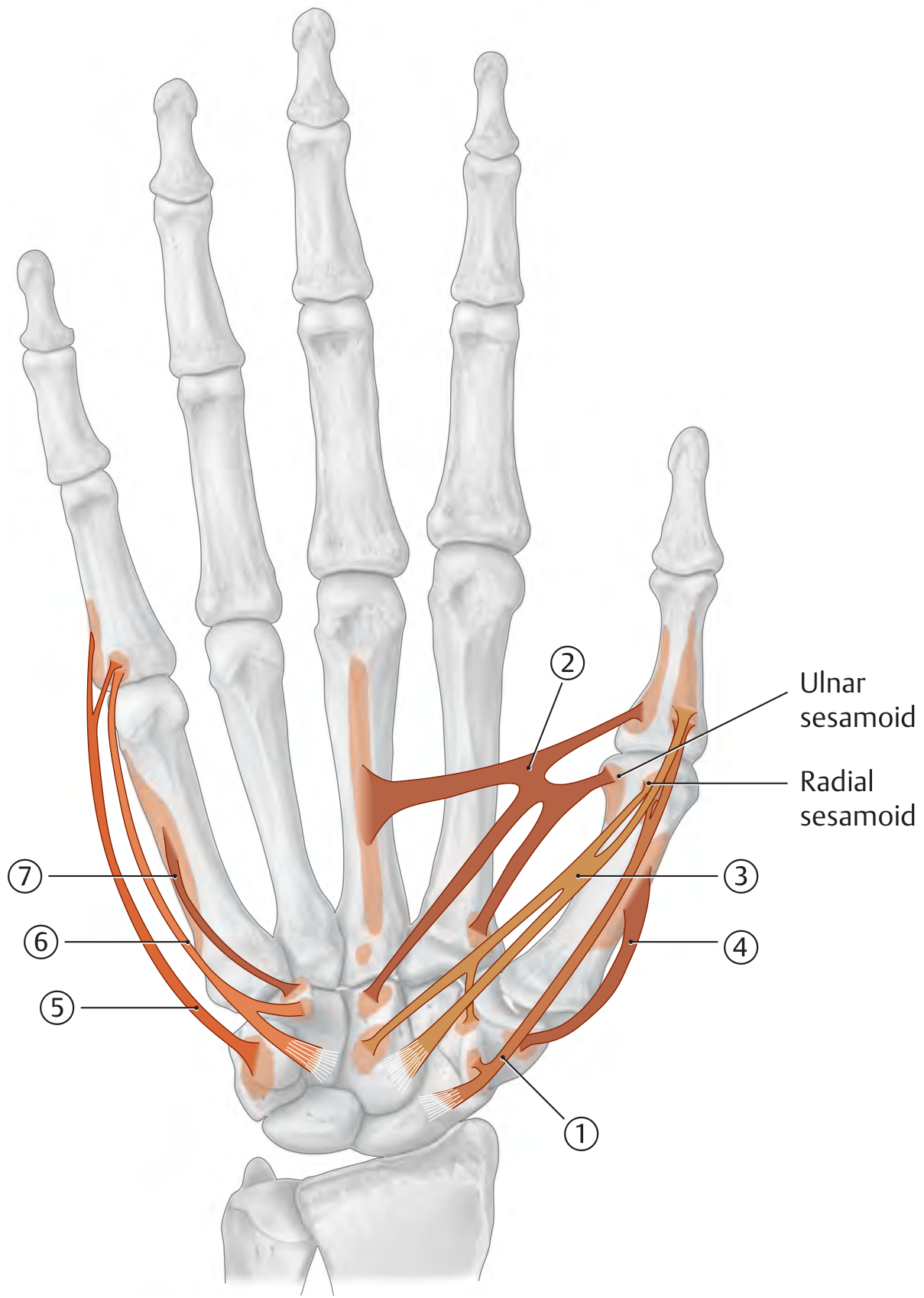
Thenar Muscles (median nerve, C8-T1 - except adductor pollicis and deep head FPB)
| Muscle | Origin | Insertion | Action | Nerve |
|---|---|---|---|---|
| Abductor Pollicis Brevis (APB) | Scaphoid, trapezium, flexor retinaculum | Base of proximal phalanx of thumb (radial sesamoid) | Thumb abduction | Median |
| Flexor Pollicis Brevis (FPB) - superficial head | Flexor retinaculum | Base of proximal phalanx (radial sesamoid) | CMC flexion, opposition; MCP flexion | Median |
| Flexor Pollicis Brevis (FPB) - deep head | Capitate, trapezium | Base of proximal phalanx (radial sesamoid) | As above | Ulnar |
| Opponens Pollicis (OP) | Trapezium | Radial border of 1st metacarpal | CMC opposition | Median |
| Adductor Pollicis | Transverse head: 3rd metacarpal; Oblique head: capitate + 2nd/3rd metacarpal bases | Base of proximal phalanx (ulnar sesamoid) | Thumb adduction; MCP flexion | Ulnar |
Hypothenar Muscles (all ulnar nerve, C8-T1)
| Muscle | Origin | Insertion | Action |
|---|---|---|---|
| Abductor Digiti Minimi (ADM) | Pisiform | Ulnar base of proximal phalanx of small finger | Small finger abduction |
| Flexor Digiti Minimi Brevis (FDMB) | Hook of hamate, flexor retinaculum | Base of proximal phalanx of 5th digit | MCP flexion |
| Opponens Digiti Minimi (ODM) | Hook of hamate, flexor retinaculum | Ulnar border of 5th metacarpal | Draws small finger across palm (opposition) |
Lumbricals and Interossei
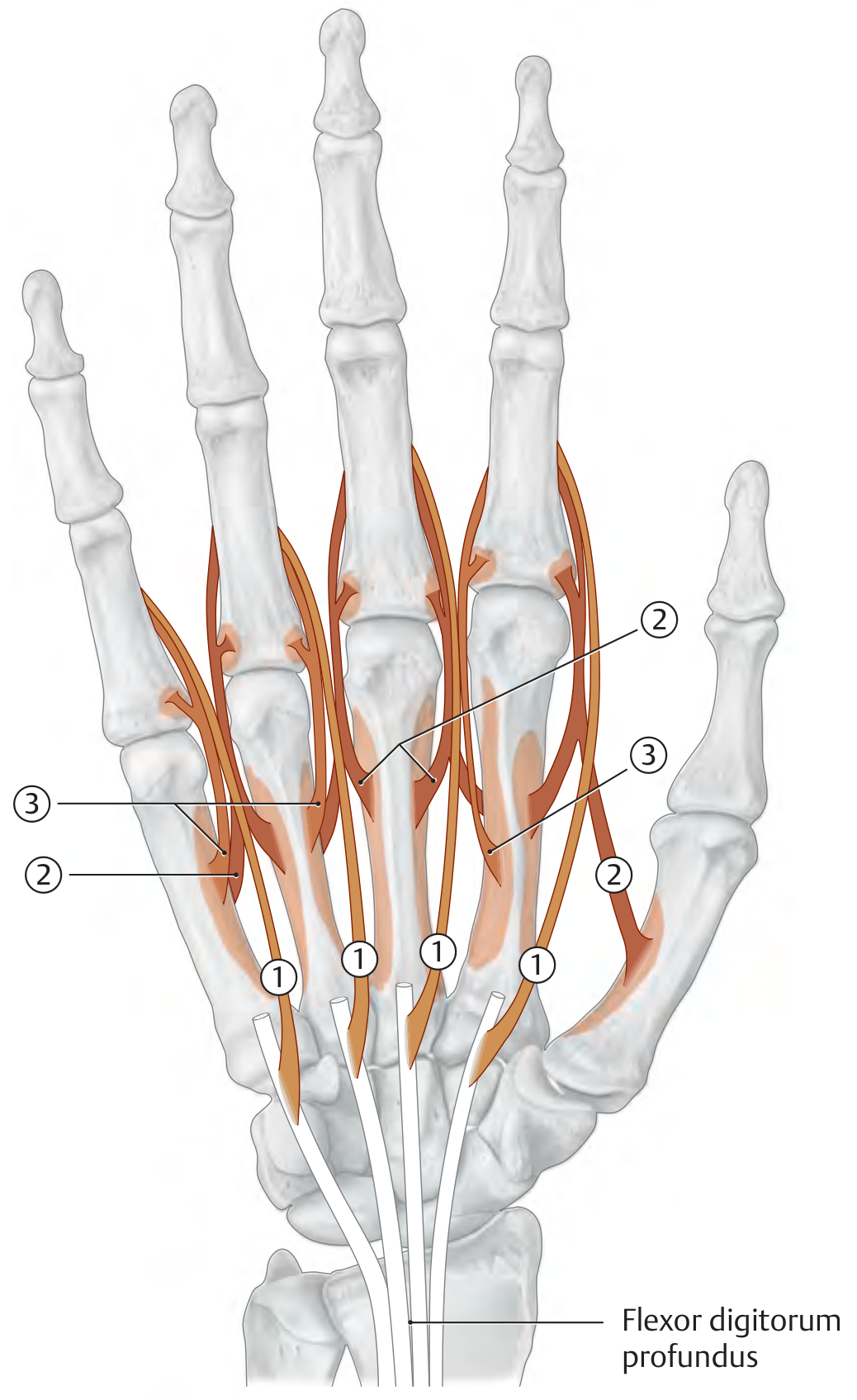
Lumbricals (4 total) - unique in that they originate from a tendon (FDP):
- Origin: Radial sides of FDP tendons in the palm
- Insertion: Dorsal digital expansion of each finger
- Action: Flex MP joints + Extend IP joints
- Innervation: 1st and 2nd lumbricals = Median nerve; 3rd and 4th = Ulnar nerve
Dorsal Interossei (4) - originate between adjacent metacarpals:
- Action: MP flexion + IP extension + ABduction of fingers (DAB = Dorsal ABduct)
- Innervation: Ulnar nerve (C8, T1)
Palmar Interossei (3) - adduct the fingers:
- Action: MP flexion + IP extension + ADduction of fingers (PAD = Palmar ADduct)
- Innervation: Ulnar nerve (C8, T1)
4. Tendons and Pulleys
The flexor tendons are held close to the bones by a pulley system that converts tendon excursion into joint motion.
-
Flexor Retinaculum (Transverse Carpal Ligament): Attaches to scaphoid tubercle + trapezium (radial) and hook of hamate + pisiform (ulnar). Forms the roof of the carpal tunnel, through which pass FDS, FDP, FPL tendons, and the median nerve.
-
Extensor Retinaculum: Divided into 6 compartments on the dorsal wrist:
- APL + EPB
- ECRL + ECRB
- EPL
- EIP + EDC
- EDQ
- ECU (over ulnar aspect of distal ulna)
-
Annular Pulleys (A1-A5) and Cruciate Pulleys (C1-C3) in each finger: The A2 and A4 pulleys are the most critical - they prevent bowstringing. The thumb has its own A1 and A2 pulleys.
5. Vasculature
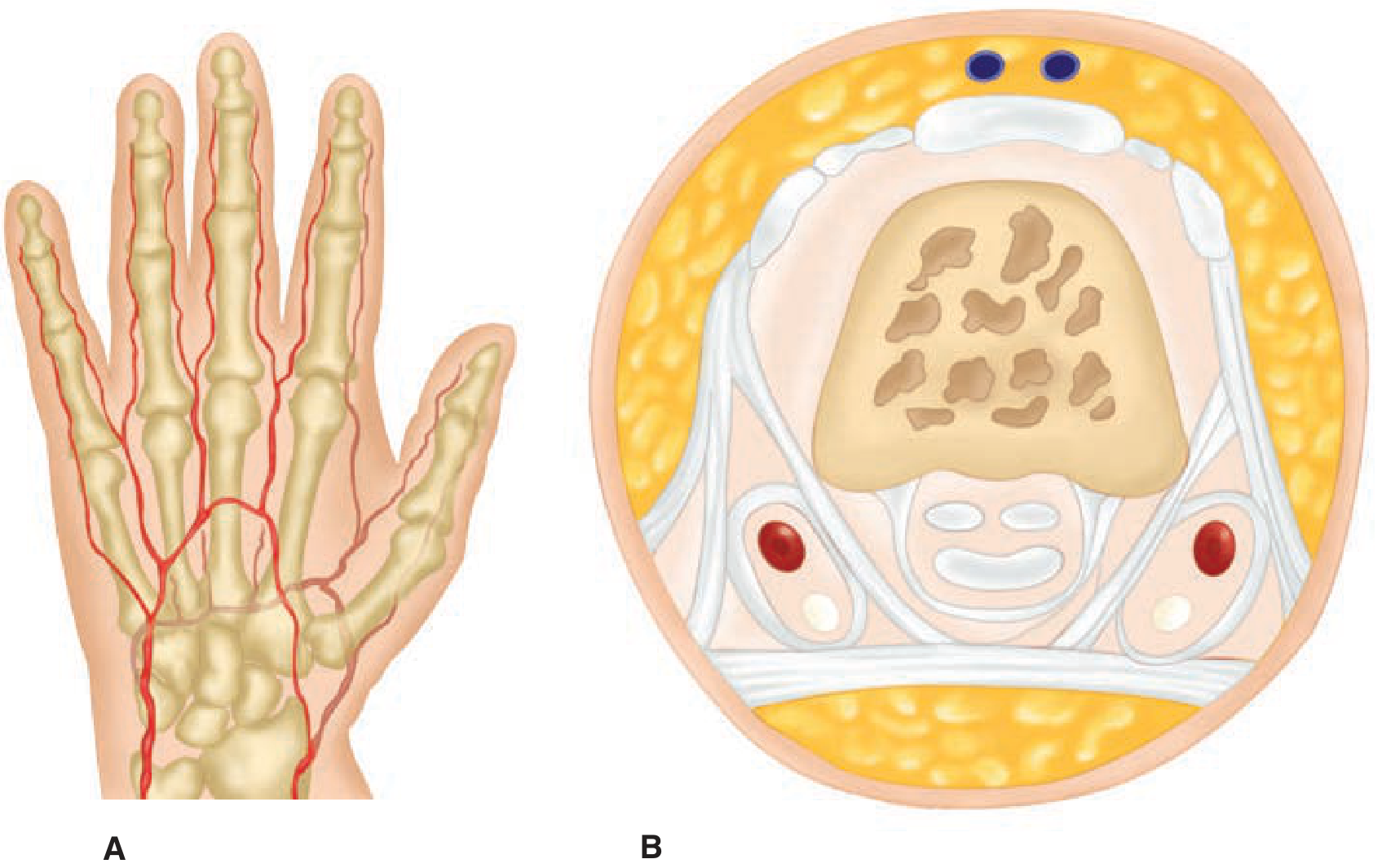
Two major arteries supply the hand:
Radial Artery:
- Travels under brachioradialis in forearm, becomes palpable at wrist radial to FCR
- At wrist level splits into:
- Smaller superficial branch → contributes to superficial palmar arch
- Larger branch → passes through anatomic snuffbox, through 1st web space → forms deep palmar arch
Ulnar Artery:
- Travels deep to FCU in forearm
- Passes through Guyon's canal (between hamate and pisiform, superficial to transverse carpal ligament)
- Larger superficial branch → superficial palmar arch (dominant arch)
- Deeper branch → contributes to deep palmar arch
Key fact: In 97% of patients, at least one arch is intact, allowing the entire hand to survive on a single vessel.
Digital Arteries:
- Each digit receives a radial and ulnar proper digital artery
- They travel lateral to bones/tendons, just palmar to the midaxis of the digit, dorsal to the digital nerves
6. Nerves
Three principal nerves innervate the hand:
Median Nerve (C5-T1)
- Enters hand through the carpal tunnel (deep to flexor retinaculum)
- Palmar cutaneous branch - exits proximal to carpal tunnel; supplies thenar skin (NOT affected by carpal tunnel syndrome)
- Motor (LOAF muscles): Lumbricals 1 & 2, Opponens pollicis, Abductor pollicis brevis, Flexor pollicis brevis (superficial head)
- Sensory: Palmar surface of thumb, index, middle, and radial half of ring finger; dorsal tips of same digits
Ulnar Nerve (C8-T1)
- Enters hand through Guyon's canal (superficial to flexor retinaculum - NOT affected by carpal tunnel syndrome)
- Motor: All hypothenar muscles; interossei; lumbricals 3 & 4; adductor pollicis; FPB deep head
- Sensory: Small finger + ulnar half of ring finger (palmar and dorsal)
Radial Nerve (C5-T1)
- Purely sensory in the hand (the PIN supplies all extrinsic extensors before reaching the hand)
- Superficial radial nerve: Dorsal skin over thumb, index, middle fingers, and radial half of ring finger (dorsum only, not the fingertips)
7. Spaces and Fascial Compartments
The hand has several distinct fascial spaces important in infection and surgery:
- Thenar space - deep to thenar muscles, radial to the flexor tendons
- Midpalmar space - ulnar side of the palm
- Parona's space - in the forearm, between FDP and pronator quadratus
- Flexor tendon sheaths of each digit - closed synovial sheaths; infection here (tenosynovitis) can spread proximally
Summary - "MEDIAN vs. ULNAR at a Glance"
| Function | Nerve |
|---|---|
| "OK sign" pinch (FPL + FDP index) | Median (AIN branch) |
| Thenar eminence bulk | Median |
| Hypothenar eminence bulk | Ulnar |
| All interossei | Ulnar |
| Adductor pollicis | Ulnar |
| Froment's sign (adductor weakness) | Ulnar |
| Carpal tunnel symptoms | Median |
| Guyon's canal symptoms | Ulnar |
Schwartz's Principles of Surgery, 11th Ed., Chapter 44, p. 1953-1962; THIEME Atlas of Anatomy - General Anatomy and Musculoskeletal System, Sections 2.13-2.14, p. 338-342
This is a shared conversation. Sign in to Orris to start your own chat.