
I want you to generate an infographic image on Parkinson's disease with its introduction, classification of drugs used in it, mechanism of action, uses and adverse effects
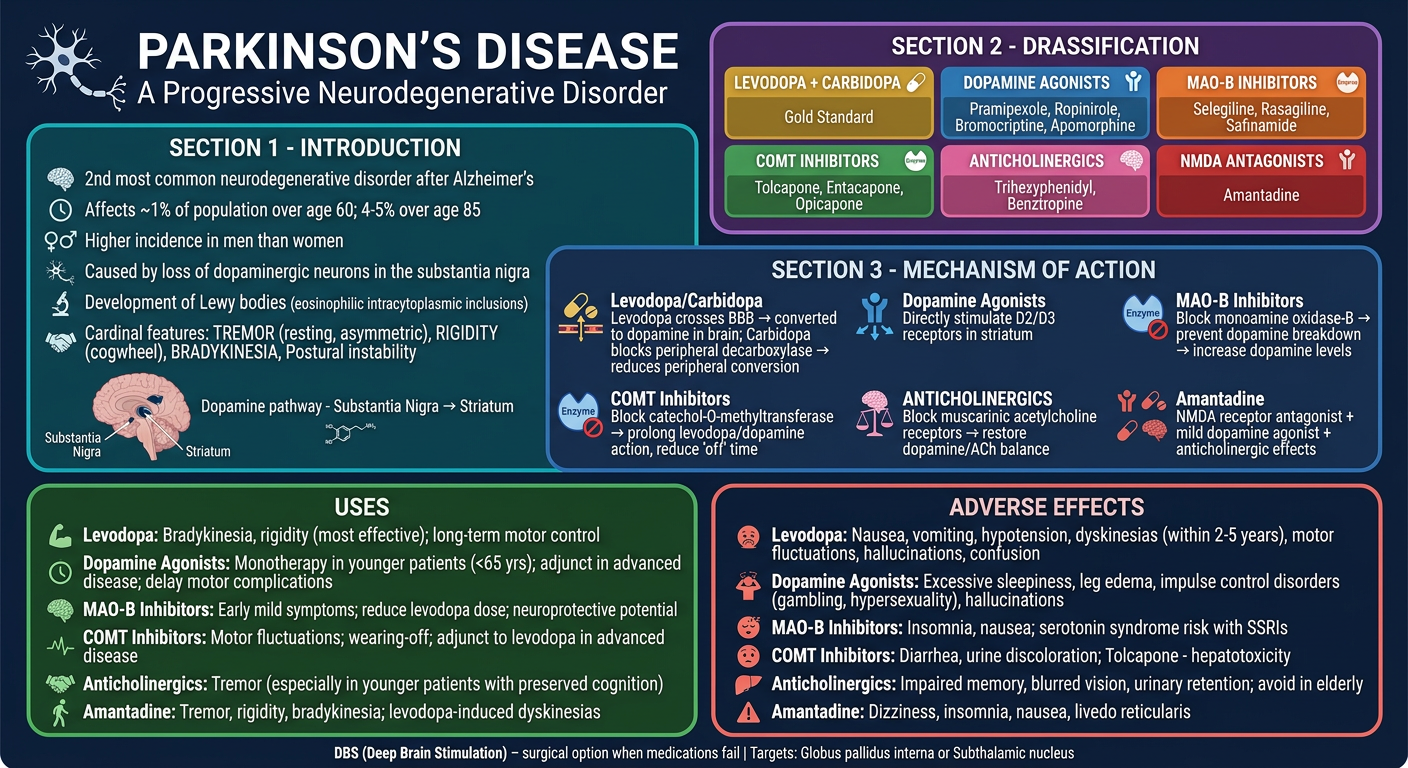
A detailed medical infographic on Parkinson's Disease with the following sections clearly organized on a dark navy blue background with vibrant color-coded panels: TITLE at top: "PARKINSON'S DISEASE" in bold white text with a brain neuron icon, subtitle: "A Progressive Neurodegenerative Disorder" SECTION 1 - INTRODUCTION (teal/cyan panel): - 2nd most common neurodegenerative disorder after Alzheimer's - Affects ~1% of population over age 60; 4-5% over age 85 - Higher incidence in men than women - Caused by loss of dopaminergic neurons in the substantia nigra - Development of Lewy bodies (eosinophilic intracytoplasmic inclusions) - Cardinal features: TREMOR (resting, asymmetric), RIGIDITY (cogwheel), BRADYKINESIA, Postural instability - Small diagram: Dopamine pathway - Substantia Nigra → Striatum SECTION 2 - DRUG CLASSIFICATION (purple panel, using a color-coded table/chart): 6 drug classes in colored boxes: 1. LEVODOPA + CARBIDOPA (gold) - "Gold Standard" 2. DOPAMINE AGONISTS (blue) - Pramipexole, Ropinirole, Bromocriptine, Apomorphine 3. MAO-B INHIBITORS (orange) - Selegiline, Rasagiline, Safinamide 4. COMT INHIBITORS (green) - Tolcapone, Entacapone, Opicapone 5. ANTICHOLINERGICS (pink) - Trihexyphenidyl, Benztropine 6. NMDA ANTAGONISTS (red) - Amantadine SECTION 3 - MECHANISM OF ACTION (dark blue panel with icons): - Levodopa/Carbidopa: Levodopa crosses BBB → converted to dopamine in brain; Carbidopa blocks peripheral decarboxylase → reduces peripheral conversion - Dopamine Agonists: Directly stimulate D2/D3 receptors in striatum - MAO-B Inhibitors: Block monoamine oxidase-B → prevent dopamine breakdown → increase dopamine levels - COMT Inhibitors: Block catechol-O-methyltransferase → prolong levodopa/dopamine action, reduce "off" time - Anticholinergics: Block muscarinic acetylcholine receptors → restore dopamine/ACh balance - Amantadine: NMDA receptor antagonist + mild dopamine agonist + anticholinergic effects SECTION 4 - USES (green panel): - Levodopa: Bradykinesia, rigidity (most effective); long-term motor control - Dopamine Agonists: Monotherapy in younger patients (<65 yrs); adjunct in advanced disease; delay motor complications - MAO-B Inhibitors: Early mild symptoms; reduce levodopa dose; neuroprotective potential - COMT Inhibitors: Motor fluctuations; wearing-off; adjunct to levodopa in advanced disease - Anticholinergics: Tremor (especially in younger patients with preserved cognition) - Amantadine: Tremor, rigidity, bradykinesia; levodopa-induced dyskinesias SECTION 5 - ADVERSE EFFECTS (red/coral panel with warning icons): - Levodopa: Nausea, vomiting, hypotension, dyskinesias (within 2-5 years), motor fluctuations, hallucinations, confusion - Dopamine Agonists: Excessive sleepiness, leg edema, impulse control disorders (gambling, hypersexuality), hallucinations - MAO-B Inhibitors: Insomnia, nausea; serotonin syndrome risk with SSRIs - COMT Inhibitors: Diarrhea, urine discoloration; Tolcapone - hepatotoxicity - Anticholinergics: Impaired memory, blurred vision, urinary retention; avoid in elderly - Amantadine: Dizziness, insomnia, nausea, livedo reticularis FOOTER: Small note "DBS (Deep Brain Stimulation) - surgical option when medications fail | Targets: Globus pallidus interna or Subthalamic nucleus" Design: Clean professional medical infographic style, each section in clearly labeled colored boxes, icons for each drug class, organized flow, readable fonts, white text on colored backgrounds, medical illustrations of brain/neurons
-
Introduction - Epidemiology, pathophysiology (dopaminergic neuron loss in substantia nigra, Lewy bodies), and the 4 cardinal features (tremor, rigidity, bradykinesia, postural instability)
-
Drug Classification - 6 color-coded classes: Levodopa/Carbidopa, Dopamine Agonists, MAO-B Inhibitors, COMT Inhibitors, Anticholinergics, and NMDA Antagonists
-
Mechanism of Action - Each drug class with its specific mechanism (BBB crossing, receptor binding, enzyme inhibition, etc.)
-
Uses - Specific indications per drug class, including when to prefer one over another (e.g., dopamine agonists in patients under 65, levodopa for rapid control)
-
Adverse Effects - Key side effects per class, including the serious ones (levodopa dyskinesias, dopamine agonist impulse control disorders, tolcapone hepatotoxicity)