
All the tubules which gets connected to tetses anatomy
I'll look up the tubules connected to the testes from the medical library.
Searching sources...
Reading File
Finding Sources
Finding Sources
Finding Sources
Reading File
Reading File
Finding Sources
Reading File
Reading File
Now I have excellent, detailed information from multiple authoritative textbooks. Let me also fetch the anatomical diagram for visual clarity.
Loading Image
Here is a complete, textbook-based answer on all the tubules/ducts connected to the testes:
Tubules Connected to the Testes
The testes are connected to a series of tubules and ducts that form the excurrent duct system, carrying spermatozoa from the seminiferous tubules outward. These are arranged in order from inside the testis outward:
1. Seminiferous Tubules (Origin point)
- Located within the testicular lobules
- Lined by spermatogenic epithelium (Sertoli cells + germ cells)
- Where sperm are actually produced (spermatogenesis)
- Arranged as long coiled loops that converge at the mediastinum testis
2. Straight Tubules (Tubuli Recti)
- Located at the periphery of the mediastinum testis
- Short transitional segments connecting seminiferous tubules to the rete testis
- Proximal portion: lined only by Sertoli cells; distal portion: simple cuboidal epithelium
- Function: convey sperm into the rete testis
3. Rete Testis
- Located within the mediastinum testis (the fibrous core of the testis)
- An interconnected network of anastomosing channels
- Lined by simple cuboidal epithelium with microvilli and single cilia
- Function: acts as a collecting channel for sperm from all seminiferous tubules
- Developmentally: forms from the branching and anastomosing gonadal cords that extend into the medulla
4. Efferent Ductules (Ductuli Efferentes)
- Approximately 15-20 efferent ductules connect the rete testis to the head of the epididymis
- Lined by a characteristic alternating epithelium: patches of non-ciliated simple cuboidal (absorptive) cells alternating with simple columnar ciliated cells - this gives a scalloped/irregular luminal profile on histology
- Surrounded by a thin circular layer of smooth muscle
- Each efferent ductule is ~20 cm long and coils to form a conical lobule at the head of the epididymis
- Function: absorb most of the fluid secreted by the seminiferous tubules and convey sperm into the epididymis
- Embryological origin: derived from mesonephric (Wolffian) tubules
5. Duct of the Epididymis (Ductus Epididymidis)
- A single, highly coiled duct forming the head, body, and tail of the epididymis
- Lined by pseudostratified columnar epithelium with long stereocilia (microvilli) and small basal cells
- Surrounded by circular smooth muscle (increases in thickness toward the tail)
- Function: sperm maturation and storage - sperm acquire motility here before ejaculation
Summary Table
| Structure | Location | Epithelium | Function |
|---|---|---|---|
| Seminiferous tubules | Testicular lobules | Spermatogenic (Sertoli + germ cells) | Produce sperm |
| Straight tubules (tubuli recti) | Periphery of mediastinum | Sertoli cells → simple cuboidal | Convey sperm to rete testis |
| Rete testis | Mediastinum testis | Simple cuboidal with microvilli/cilia | Collect sperm from all tubules |
| Efferent ductules (~15-20) | Rete testis to epididymis head | Alternating ciliated columnar + cuboidal | Absorb fluid; convey sperm |
| Duct of epididymis | Head, body, tail of epididymis | Pseudostratified columnar + stereocilia | Sperm maturation and storage |
Anatomical Diagram
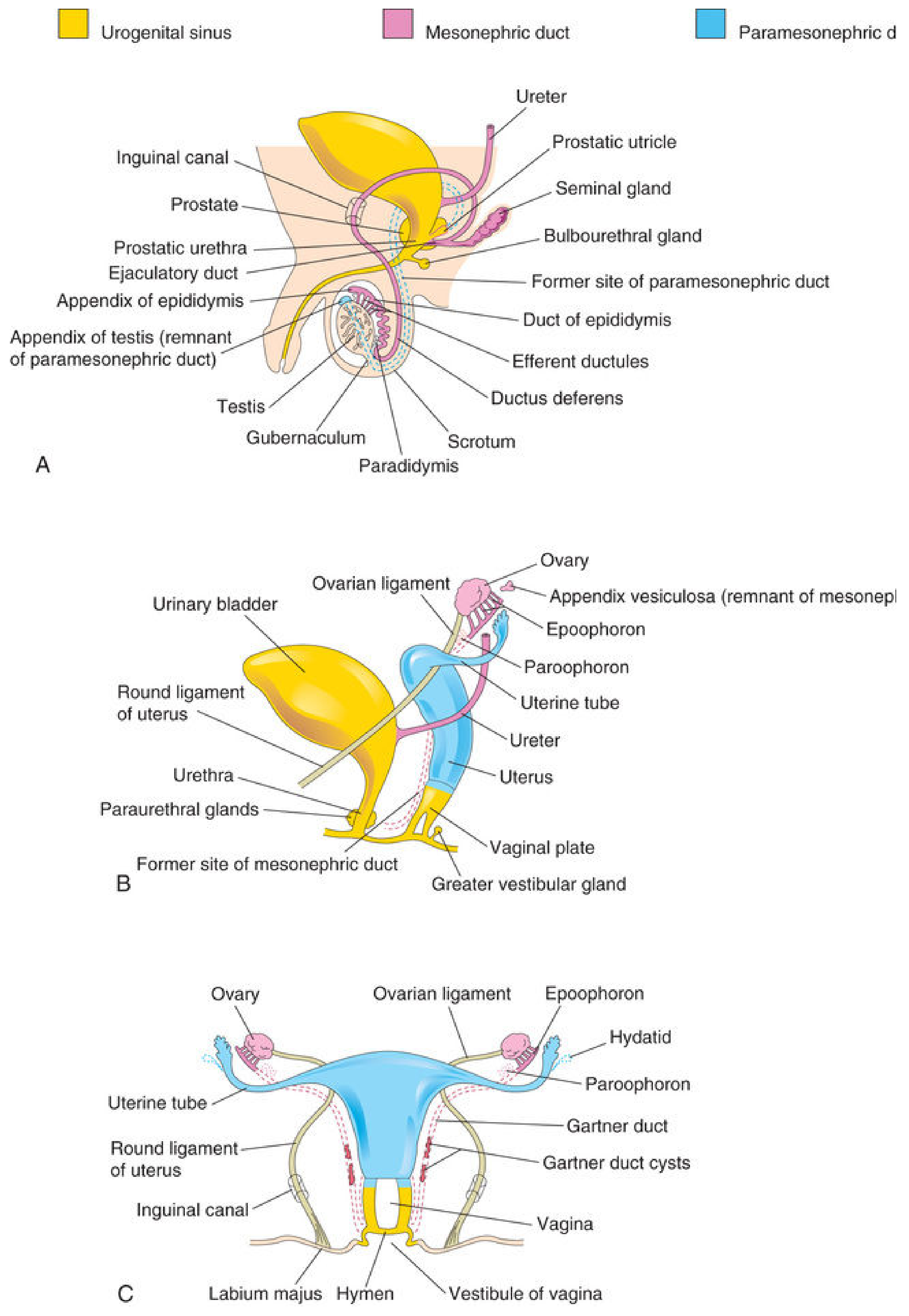
The diagram above (Fig 12.32A from The Developing Human) shows the efferent ductules, duct of epididymis, ductus deferens, and ejaculatory duct as the full excurrent pathway from the testis.
Key Developmental Point
The rete testis becomes continuous with 15-20 mesonephric tubules that transform into the efferent ductules, which then connect with the mesonephric (Wolffian) duct to become the duct of the epididymis. - The Developing Human: Clinically Oriented Embryology, p. 725-726
The full sequence is:
Seminiferous tubules → Tubuli recti → Rete testis → Efferent ductules → Duct of epididymis → Ductus deferens → Ejaculatory duct → Urethra
- Junqueira's Basic Histology, 17e, p. 1074
- Histology: A Text and Atlas, p. 2164
This is a shared conversation. Sign in to Orris to start your own chat.