
Kengen water
KenGen water business Kenya 2026
KenGen water business geothermal steam bottled water Kenya
KenGen and Water - Overview
1. Hydropower and Water Management
2. Geothermal Water Resources (Olkaria)
- Geothermal steam - for process heating
- Geothermal brine - for industrial applications
- Raw water - available to industrial users
- The water/raw water supply at the Green Energy Park?
- KenGen's hydropower dam water management?
- KenGen's geothermal brine/steam water by-products?
- Something else entirely?
Kengenwater of energis is it really beneficial to patient and are the teatment claims real ?
Kangen water Enagic health benefits claims evidence
alkaline ionized water health benefits
https://www.frontiersin.org/journals/medicine/articles/10.33…
alkaline water electrolyzed reduced water clinical trial
What Is Kangen Water?
The Claims vs. The Evidence
Claims that have SOME limited support:
| Claim | Evidence Status |
|---|---|
| Helps with acid reflux / heartburn | Modest support - bicarbonate-rich alkaline water reduced heartburn episodes in a few small trials |
| Improves GI symptoms (IBS, dyspepsia) | Limited support - one small RCT showed improved IBS-D symptoms after 8 weeks |
| Minor hydration improvements | Weak/preliminary - some small studies hint at marginal improvements in hydration markers |
| Slight effect on urinary pH / bone markers | Inconsistent - some signals in small studies, not confirmed in large trials |
Claims that are NOT supported by evidence:
- Cures or prevents cancer - No clinical evidence. The body tightly regulates blood pH regardless of what you drink; you cannot "alkalinize" your blood through diet or water.
- Anti-aging / slows aging - No robust human evidence. Mouse studies exist but are far from translatable.
- Boosts immunity - Not supported by clinical trials.
- Detoxifies the body - No scientific basis. Your liver and kidneys handle detoxification.
- Treats diabetes, heart disease, or chronic illness - No credible evidence.
- Systemic alkalinization - Physiologically implausible. Your blood pH is maintained at 7.35-7.45 by the lungs and kidneys, no matter what you drink.
What Experts and Institutions Say
- Mayo Clinic: "More research is needed to prove these claims... not enough evidence to support the health claims made by users and sellers."
- Healthline (medically reviewed): "Medical experts warn against believing all the marketing claims."
- Arthritis Foundation: Calls it "miracle or marketing?"
- The 2026 Frontiers in Medicine review (the most current scientific review available) states: "Claims regarding systemic alkalinization, immune enhancement, cancer prevention, or anti-aging effects remain unsupported."
Safety Concerns
- Generally safe for healthy adults in the short term
- Kidney disease patients should avoid without medical supervision
- Long-term use may alter gut acidity, affect nutrient absorption, and potentially affect kidney function
- The machines cost $1,500-$6,000+ and are often sold through multi-level marketing (MLM) networks - a significant red flag for health product credibility
Bottom Line
What to do at home in case of emergency 1 heart attack 2 cardiac arrest 3 breathlessness
home emergency first aid heart attack cardiac arrest breathlessness guidelines 2025
🚨 Home Emergency First Aid Guide
First rule for ALL three emergencies: Call emergency services (ambulance) IMMEDIATELY. Do not wait to see if the person "gets better."
1. HEART ATTACK (Myocardial Infarction)
Warning Signs
- Chest pain/pressure/tightness (may radiate to left arm, jaw, neck, or back)
- Sweating, nausea, vomiting
- Shortness of breath
- Feeling of doom or severe anxiety
- In women/diabetics: may be "silent" - just fatigue, nausea, or breathlessness
What To Do
- Call emergency services immediately (don't drive them yourself unless no ambulance is available)
- Sit the person down - semi-reclined position (sitting up slightly), resting comfortably. Do NOT let them walk around.
- Loosen tight clothing - collar, belt, tie
- Give Aspirin 300-325 mg - ask them to chew it (not swallow whole), UNLESS they are allergic to aspirin or have been told not to take it. This helps dissolve the clot.
- Keep them calm - reassure them, reduce anxiety
- Do NOT give food or water
- If they become unconscious and stop breathing normally - they have progressed to cardiac arrest - move to Section 2 below
- Stay with them until the ambulance arrives and monitor their condition
What NOT to Do
- Do NOT let them exert themselves
- Do NOT give nitroglycerin unless it was prescribed specifically for them
- Do NOT leave them alone
2. CARDIAC ARREST
What To Do - The Chain: CHECK - CALL - CPR
- Tap shoulders firmly and shout: "Are you okay?"
- If no response - look for normal breathing (chest rise). Gasping is NOT normal breathing.
- Call emergency services immediately
- If others are present, shout: "You - call an ambulance! You - get an AED (defibrillator) if available!"
- Put the phone on speaker mode so the dispatcher can guide you
- Lay the person flat on their back on a firm surface (floor, not a soft bed)
- Kneel beside them at chest level
- Place the heel of one hand on the centre of the chest (lower half of the breastbone)
- Place your other hand on top, fingers interlaced
- Keep arms straight, lean directly over them
- Push down hard and fast:
- Depth: at least 5 cm (2 inches) in adults
- Rate: 100-120 compressions per minute (to the beat of "Stayin' Alive")
- Allow the chest to fully recoil between compressions
- Do not stop - minimize any pauses
- Give 30 compressions : 2 rescue breaths - tilt head back, lift chin, pinch nose, seal your mouth over theirs and breathe until chest rises
- Continue 30:2 cycle
- Hands-only CPR is still highly effective - just keep doing chest compressions continuously without stopping. Per 2025 guidelines, compression-only CPR by lay bystanders is associated with improved survival compared to doing nothing.
- Switch it on - it will give you voice instructions
- Apply pads as shown on the diagrams
- Follow ALL instructions - it will tell you when to stand clear and when to shock
- Resume CPR immediately after each shock
- The person wakes up and breathes normally
- Ambulance/professional help arrives and takes over
- You are physically unable to continue
3. BREATHLESSNESS (Acute Difficulty Breathing)
General Steps for Any Breathlessness
- Call emergency services if breathing is severe, worsening, or the person is turning blue (lips/fingertips)
- Sit the person upright - "tripod position" works well: sitting forward, hands on knees. Never lay them flat - this worsens breathlessness
- Loosen tight clothing - collar, belt, bra strap
- Stay calm and encourage slow breathing - panic worsens breathlessness significantly
- Open windows - fresh air and good ventilation help
If Known Asthma:
- Give their reliever inhaler (usually blue - salbutamol) immediately
- They can take up to 10 puffs, one puff at a time, every 30-60 seconds through a spacer if available
- If no improvement in 5-10 minutes, call emergency services and repeat
If Known COPD:
- Give reliever inhaler as prescribed
- Encourage pursed-lip breathing (breathe in through nose, out slowly through pursed lips)
- Call for help if no improvement
If Suspected Allergic Reaction (Anaphylaxis - with hives, swelling of throat/face):
- Use an Adrenaline auto-injector (EpiPen) if available and prescribed
- Call emergency services immediately
- Lay them flat with legs raised (unless this worsens breathing - then keep sitting up)
If Choking (sudden onset, cannot speak, clutching throat):
- Adult/child: 5 firm back blows between shoulder blades, then 5 abdominal thrusts (Heimlich manoeuvre) - repeat until object is dislodged or emergency services arrive
- Infant: 5 back blows then 5 chest thrusts (NOT abdominal)
Signs to Call Emergency Services Immediately:
- Lips or fingertips turning blue
- Cannot speak in full sentences
- Breathing rate over 30 per minute
- Gasping, noisy, or silent breathing
- Worsening despite inhaler use
- First-ever episode with unknown cause
Quick Reference Summary
| Emergency | Person Conscious? | Call Ambulance | Key Action |
|---|---|---|---|
| Heart Attack | YES | Immediately | Sit down, chew aspirin, keep calm |
| Cardiac Arrest | NO (not breathing) | Immediately | Start chest compressions NOW |
| Breathlessness | YES (usually) | If severe/worsening | Sit upright, use inhaler if available |
Keep emergency numbers saved on your phone. Consider taking a basic first aid/CPR course - it takes 2 hours and could save a life.
Create a printable first aid wallet card with CPR steps
A printable first aid wallet card, credit card size (3.5 x 2 inches), with a clean professional medical design. Front side shows CPR steps: bold red header "CPR - SAVE A LIFE", then numbered steps: 1. CHECK - Tap shoulders, shout "Are you okay?", 2. CALL - Dial emergency number, speaker mode, 3. COMPRESS - Centre of chest, push hard 5cm deep, 100-120/min. Bottom shows "Hands-Only CPR is OK!" and a small heart icon. Back side shows: Heart Attack signs (chest pain, sweating, left arm pain, give aspirin 300mg chew), and Breathlessness (sit upright, use inhaler, call if lips turn blue). Clean white background with red and navy blue text, medical cross symbol, small icons for each step. Professional print-ready layout with crop marks.
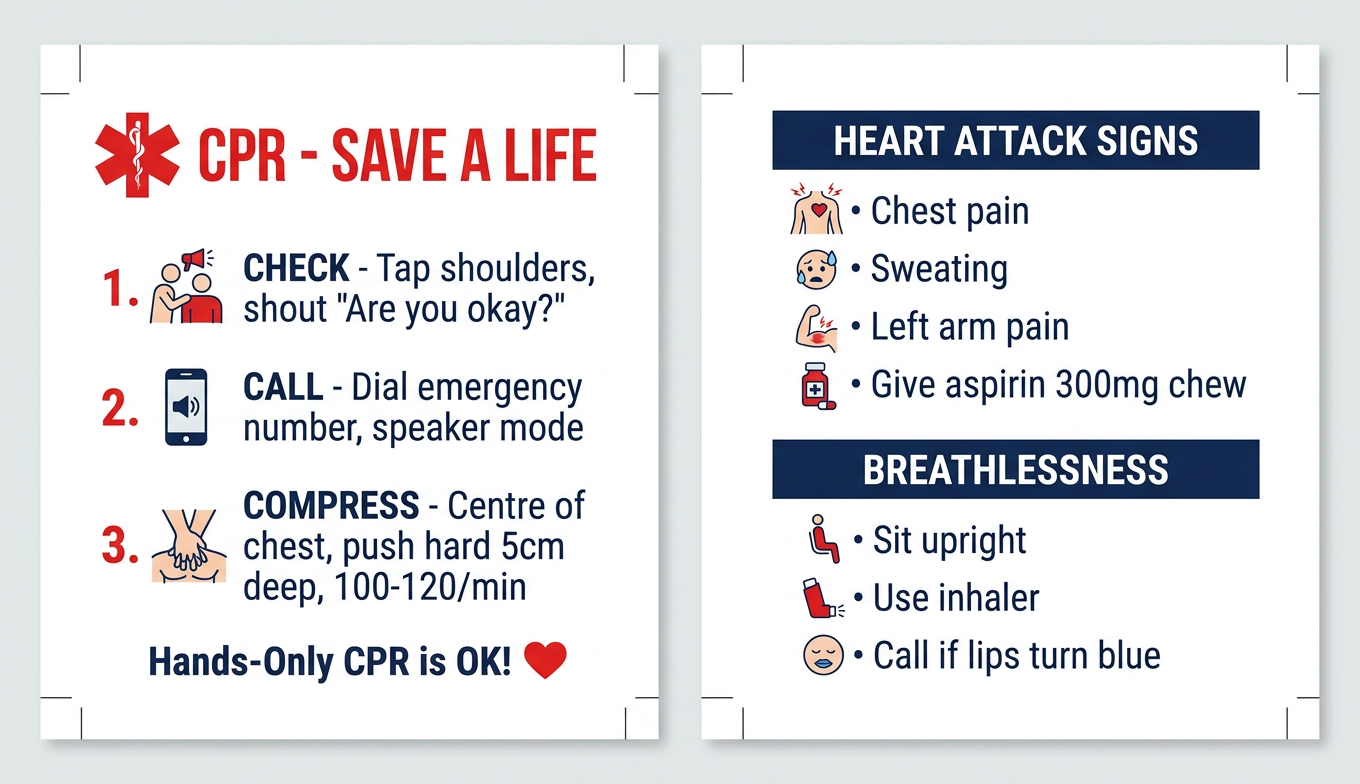
- Print at actual size (set your printer to 100%, no scaling) on card stock or thick paper
- Cut along the crop marks
- Laminate for durability (most print shops do this cheaply)
- Keep one in your wallet, stick one on your fridge, and share with family
- CPR steps - Check, Call, Compress (30 compressions : 2 breaths, or hands-only)
- Heart attack signs - chest pain, sweating, jaw/arm pain + chew aspirin 300mg
- Breathlessness - sit upright, use inhaler, call if lips turn blue
I have a patient age approx 52 Dibetic hypertensive One day he came with something bite on arm approx 5-7 days back with rash and redness i gave tab avil and tab dexona Redness didnt decreased and itching continued Today complained of fever and dizziness
insect bite cellulitis diabetic patient fever management antibiotic 2024
Clinical Assessment
Working Diagnosis: Secondary Infected Insect Bite → Cellulitis with Systemic Involvement
Why the Initial Treatment Did Not Work
| Drug Given | Role | Problem |
|---|---|---|
| Tab Avil (Pheniramine - antihistamine) | Allergic reaction only | No antibacterial action |
| Tab Dexona (Dexamethasone - steroid) | Reduces inflammation | Dangerous in this patient - steroids suppress immunity, mask infection signs, and significantly worsen blood sugar in a diabetic |
Red Flags in This Patient - Act Urgently
- Fever = systemic spread of infection (bacteremia possible)
- Dizziness = could be from fever/sepsis OR blood pressure instability (hypertensive + on medications) OR uncontrolled blood sugar (steroids raise glucose sharply)
- 5-7 days of worsening redness = infection has been progressing, not resolving
- Diabetic = impaired immunity, poor wound healing, higher risk of deep tissue spread and necrotizing infection
- Steroid given = will have raised blood sugar and masked immune response
Urgent Things to Do NOW
1. Assess Severity Immediately
- Temperature - if >38.5°C, suspect systemic infection
- Blood pressure - dizziness may indicate hypotension (early sepsis) or hypertensive crisis
- Blood sugar (RBS/GRBS) - dexona will have spiked it significantly
- Look at the wound carefully:
- Is the redness spreading? (Mark the border with a pen to track)
- Any blistering, black/blue discoloration, or skin breakdown?
- Any pus, fluctuance (abscess)?
- Any red streaks moving up the arm? (lymphangitis - needs IV antibiotics urgently)
- Foul smell? Crepitus (crackling under skin)? - Rule out necrotizing fasciitis - surgical emergency
2. Investigations Needed
| Test | Why |
|---|---|
| CBC with differential | WBC raised = bacterial infection; neutrophilia confirms |
| Blood sugar (fasting + PP or random) | Steroid-induced hyperglycemia |
| Blood culture (2 sets) | If febrile - rule out bacteremia |
| CRP / ESR | Markers of bacterial inflammation |
| Wound swab culture | Identify organism and sensitivity |
| Urea, creatinine | Baseline renal function before antibiotics (diabetic kidneys) |
| Blood pressure monitoring | Hypertension management |
Treatment - Start Antibiotics NOW
- Staphylococcus aureus (including MRSA possible)
- Beta-haemolytic Streptococcus (Group A or B)
- Mixed organisms possible given the duration
Oral regimen (if patient is stable, no IV access, fever is mild):
- Tab Amoxicillin-Clavulanate (Co-amoxiclav) 625 mg three times daily x 7-10 days
- Covers Staph, Strep, and anaerobes
- OR Tab Cefalexin 500 mg four times daily (if no allergy)
- Add Tab Metronidazole 400 mg TDS if any suspicion of deep/anaerobic infection
If fever is high (>38.5°C), patient looks unwell, or BP is low - Refer/Admit for IV antibiotics:
- IV Amoxicillin-Clavulanate or IV Cefazolin
- If MRSA suspected: add IV Vancomycin or oral TMP-SMX (Co-trimoxazole)
Stop the Steroid (Dexona):
- Do NOT continue dexamethasone - it will worsen the infection and blood sugar
- If given for more than a few days, taper rather than stop abruptly
Blood Sugar Management
- Check RBS immediately - steroids may have pushed it to 250-400 mg/dL
- Adjust the diabetic medications accordingly
- Ensure he is adequately hydrated (fever + dizziness + high sugar = dehydration risk)
When to Refer to Hospital Immediately
- Fever >39°C or rigors (shaking chills)
- BP drop / hypotension / confusion
- Spreading redness beyond a marked border within hours
- Black/blue skin, blistering, crepitus - necrotizing fasciitis
- Red streaks running up the arm - lymphangitis
- Not responding to oral antibiotics in 48-72 hours
- Blood sugar uncontrolled >400 mg/dL
- Signs of sepsis: fast heart rate, rapid breathing, altered consciousness
Summary Plan
1. Stop Dexona immediately
2. Check vitals: BP, Temp, RBS NOW
3. Mark redness border with pen - reassess in 6-12 hours
4. Start Co-amoxiclav 625mg TDS x 10 days
5. Blood tests: CBC, CRP, RBS, wound swab
6. Review in 48 hours - if not improving, admit for IV antibiotics
7. Manage blood sugar - it will be elevated from steroid
8. Watch for necrotizing fasciitis / sepsis signs - refer emergency if present
Important note: Dizziness in this patient needs to be taken seriously. It could be early sepsis, postural hypotension from dehydration/fever, or steroid-altered blood sugar. Please assess blood pressure lying and standing, and blood sugar before assuming it is benign.