
Long notes on HIV with TB
Reading File
Reading File
Finding Sources
Finding Sources
Searching PubMed
"HIV"[MeSH Terms] AND "Tuberculosis"[MeSH Terms]
Searching the Web
WHO guidelines HIV-associated tuberculosis ART timing dolutegravir rifampicin TB preventive treatment 2025
Let me read the key textbook sections.
Reading File
Reading File
Reading File
Reading File
Reading File
Searching Images
chest radiograph tuberculosis in HIV patient atypical presentation
Reading File
Reading File
Finding Sources
Reading File
Reading File
HIV-TB Co-infection: Long Notes
1. Overview and epidemiology
- TB is the leading cause of death among people living with HIV (PLHIV). It is the opportunistic infection that most often kills HIV-positive people, although it is preventable and curable. - Park's Textbook of Preventive and Social Medicine, p. 235 and p. 404
- The two infections drive each other. HIV destroys CD4 cell immunity and speeds TB progression. TB in turn worsens HIV disease. TB treatment alone does not meaningfully raise CD4 counts or lower viral load without ART. - Park's, p. 235
- Lifetime risk of reactivation: about 10% in an immunocompetent person over their lifetime. With HIV, a similar 10% risk applies per year. - Park's, p. 234
- Co-infected people are 25-30 times more likely to develop TB disease than people with TB infection alone. - Park's, p. 234
- Recent systematic reviews and meta-analyses published in 2025 on global HIV-TB prevalence and HIV-HBV-TB triple infection (PMIDs 41205521, 41422178) look at burden. They do not change the management points below.
Four ways HIV and TB interact (Park's)
- Reactivation of latent TB, which is the commonest mechanism.
- Rapid progression of new (primary) infection to active disease.
- Recurrence, by relapse or reinfection, after earlier cure.
- Community effect: more infectious cases, more transmission, more deaths, and added stigma.
2. Pathogenesis (brief)
- HIV depletes CD4+ T cells and impairs macrophage function. Granulomas form poorly, and IFN-gamma and TNF-alpha responses are weaker. Bacilli then multiply and disseminate.
- TB-driven immune activation increases HIV replication in the lung and other sites. This is general knowledge and is not taken from the retrieved texts.
3. Clinical features depend on CD4 count
Early HIV (CD4 high): the picture resembles reactivation TB in an immunocompetent person, usually limited to the lungs. Advanced HIV (low CD4): the picture resembles primary TB, often disseminated or extrapulmonary. - Murray & Nadel's Textbook of Respiratory Medicine, p. 2846
| Feature | CD4 ≥350/μL | CD4 <200-350/μL |
|---|---|---|
| Extrapulmonary TB | 10-15% | >50% |
| Radiographic zones | Upper | Middle and lower |
| Cavitation | Common | Uncommon |
| Hilar/mediastinal adenopathy | Uncommon | Common |
| Miliary pattern | Uncommon | Common |
| Pleural effusion | Uncommon | Rare |
Source: Murray & Nadel's, Table 123.1, p. 2846.
- With profound CD4 depletion, the chest X-ray may also be normal.
- Common extrapulmonary sites are cervical, supraclavicular and axillary lymph nodes, bone marrow, genitourinary tract, CNS (meningitis, tuberculoma), liver, pleura, pericardium and abdomen.
- Presenting symptoms are fever, night sweats, weight loss and cough. These may be non-specific, and cough may be absent.
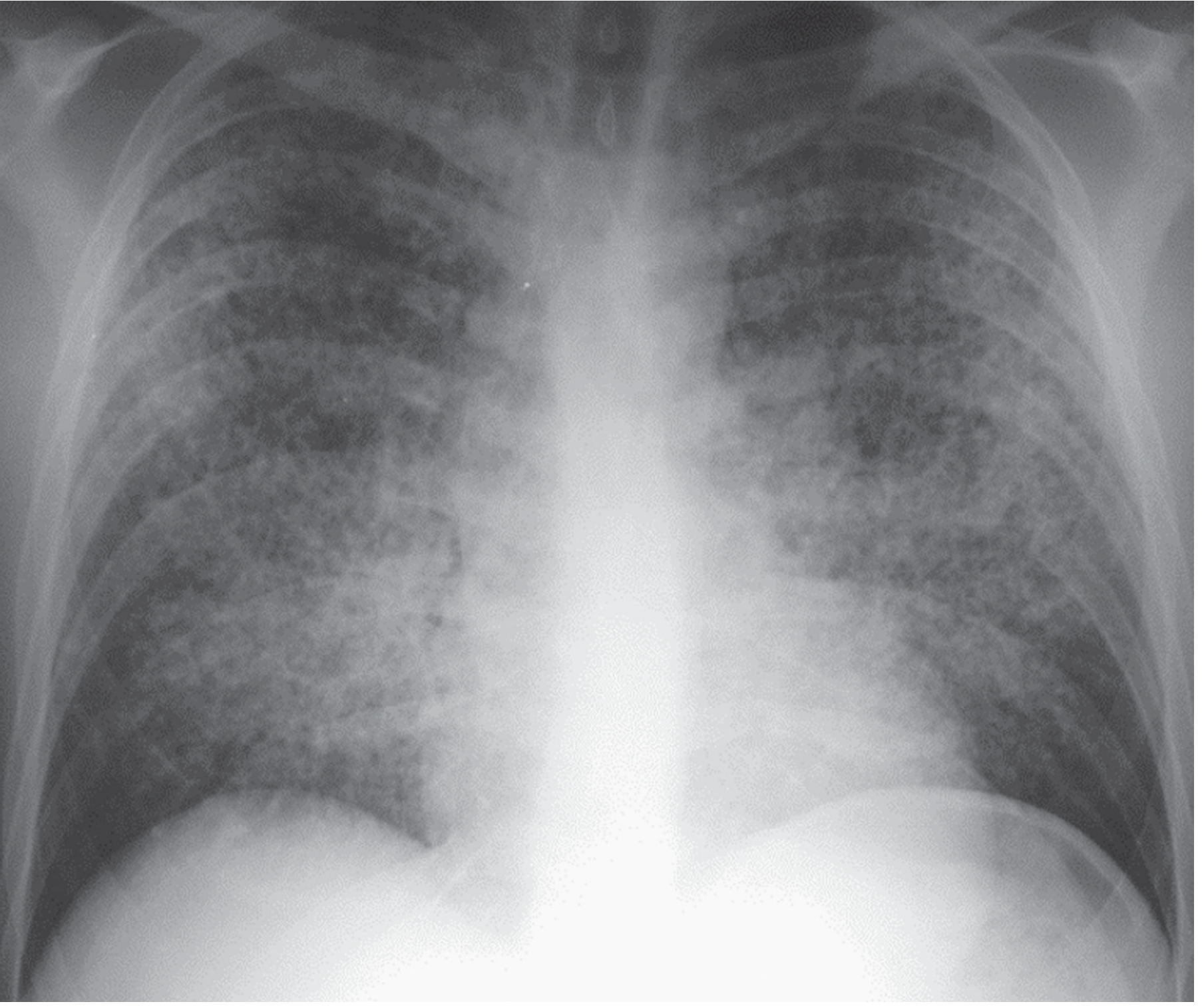
Frontal chest radiograph of an HIV-infected patient with a low CD4 count. It shows numerous bilateral, randomly distributed small nodules (miliary TB).
4. Diagnosis
Screening of PLHIV (India NTEP/NACP):
- Screen for TB at every visit. Park's describes a four-symptom screen: current cough, weight loss, fever or night sweats, in place of cough alone. A symptom of any duration should prompt a work-up.
- Offer upfront CBNAAT (Xpert MTB/RIF) to presumptive cases. Xpert should be the initial test rather than smear microscopy. - Park's, p. 235 and p. 404
Why diagnosis is harder in advanced HIV (Park's, p. 235):
- Smear-negative pulmonary TB is more frequent, so culture may be needed.
- The tuberculin skin test gives more false negatives, because it depends on an intact immune response.
- The chest X-ray is atypical (see section 3).
Investigations to consider:
- Sputum for Xpert, smear and culture with drug susceptibility testing (DST).
- Extrapulmonary samples: lymph node FNAC, pleural, pericardial, CSF or ascitic fluid, plus ADA where useful.
- Urine lipoarabinomannan (LF-LAM) in very ill or low-CD4 patients. This is a WHO-endorsed point-of-care test. It comes from outside the textbooks, so confirm current local use.
- Blood culture for mycobacteria in advanced disease.
- Abdominal ultrasound, looking for abdominal nodes and splenic lesions.
- Test all TB patients for HIV, and check CD4 and viral load once HIV is confirmed. - Cecil: "All persons with TB should be tested for HIV."
- Test all presumptive drug-resistant TB (DR-TB) cases for HIV, and make sure culture and DST are available to them. - Park's
5. Treatment
5.1 Anti-TB regimen
- Use the standard 6-month daily regimen (2HRZE + 4HR). It is equally effective in HIV-positive and HIV-negative patients with drug-susceptible TB. - Harrison's 22e
- Never use intermittent (thrice-weekly or less) regimens. Highly intermittent rifamycin regimens cause failure and relapse with rifampicin-resistant organisms, especially at CD4 <100. - Harrison's
- If the patient cannot receive ART, extending the continuation phase by 3 months can be considered. Cecil recommends a 7-month continuation phase (9 months total) for HIV patients not taking ART. - Harrison's 22e; Cecil Medicine
- A longer continuation phase (7-10 months) is also used for cavitary disease with positive culture at 2 months, and for TB meningitis or bone, joint or spine TB. - Cecil
- The 4-month rifapentine-moxifloxacin regimen (2HPMZ/2HPM) can be used in PLHIV with CD4 >100/μL. - Harrison's
- In India, the ART medical officer classifies the patient (rifampicin-sensitive, status unknown, or clinically diagnosed) and starts daily fixed-dose-combination ATT at the ART centre. - Park's
5.2 When to start ART
All HIV-positive TB patients are candidates for ART, regardless of CD4 count. Do not delay ART until TB treatment is finished. Start ATT first, then ART once ATT is tolerated. - Harrison's; Park's
| Situation | Timing of ART |
|---|---|
| CD4 <50/μL | As soon as possible, within 2 weeks of starting ATT |
| CD4 ≥50/μL | Within 2-8 weeks. WHO now recommends within 2 weeks regardless of CD4 for drug-susceptible TB. |
| TB meningitis / CNS TB | Delay (see note below) |
| Drug-resistant TB | ART for all, as early as possible, within 8 weeks |
| Pregnancy | As early as feasible |
- Early ART reduces mortality by 34-68% in RCTs, with the best results at CD4 <50. - Harrison's
- The mortality benefit outweighs the higher risk of IRIS at low CD4. - Cecil
- TB meningitis: immediate ART causes more severe adverse events. The textbooks differ on how long to delay.
- Harrison's says to delay 8 weeks.
- Cecil says a 2-week delay.
- The WHO TB/HIV guidance suggests waiting at least 4 weeks and starting within 8 weeks.
- I recommend following the current WHO or national guideline for this group.
5.3 Choice of ART with rifampicin
Rifampicin is a strong inducer of CYP3A4 and P-glycoprotein. It lowers levels of protease inhibitors, some NNRTIs and some integrase inhibitors. - Harrison's
| ART component | Practical approach |
|---|---|
| Dolutegravir (DTG) | Give 50 mg twice daily while on rifampicin, and for 2 weeks after rifampicin stops. Harrison's says double the standard dose. |
| Raltegravir | Double dose. |
| Efavirenz (EFV) | Valid alternative. Cecil notes no dose adjustment of rifampicin is needed. |
| Bictegravir, cabotegravir, elvitegravir | Not recommended with rifampicin. |
| Ritonavir-boosted PIs | Avoid with rifampicin. If unavoidable, use rifabutin at half dose. Poor adherence risks low rifabutin levels and rifamycin resistance. |
| Tenofovir alafenamide (TAF) | Not recommended with rifampicin or rifabutin. - Cecil |
| Rifabutin | Weaker enzyme inducer, so it is a substitute for rifampicin. Cecil describes standard-dose rifabutin with DTG, TDF and FTC. |
Backbone: two NRTIs plus an integrase inhibitor or NNRTI. A two-drug regimen (one NRTI plus an integrase inhibitor) is also considered in recent guidelines. - Harrison's
5.4 Supportive treatment
- Co-trimoxazole preventive therapy for all HIV-infected TB patients, regardless of CD4. - Park's, p. 235 and p. 404
- Pyridoxine with isoniazid (general practice) to prevent neuropathy.
- Monitor liver function. Hepatotoxicity can come from ATT, NVP, EFV or co-trimoxazole, and the cause is hard to separate. Stop and re-challenge sequentially if it occurs.
- Adverse reactions to ATT are often more pronounced in PLWH. - Harrison's
5.5 Drug-resistant TB
- Treatment is the same as in HIV-negative patients, but it is harder and adverse events are more common. Close monitoring is needed for adherence and for early detection of adverse events. - Park's
- Give ART to all HIV-DR-TB patients regardless of CD4. Seek expert consultation.
6. Immune reconstitution inflammatory syndrome (IRIS)
- Definition: a temporary worsening of symptoms, signs or radiographic findings of TB after treatment begins, caused by immune restoration. It usually occurs 2-8 weeks after ART initiation. - Park's, p. 236; Cecil
- Two forms:
- Paradoxical: known TB worsens after starting ART.
- Unmasking: undiagnosed TB becomes clinically evident after ART begins. - Cecil
- Features: high fever, enlarging or tender lymph nodes, expanding intrathoracic lesions, worsening chest X-ray findings, pleural effusion, and CNS signs in TB meningitis.
- Risk factors: low CD4 (<50), a high bacillary load, disseminated disease, and a short interval between ATT and ART.
- Diagnosis: a diagnosis of exclusion. Rule out TB treatment failure, drug-resistant TB, another opportunistic infection and drug reaction before labelling it IRIS. - Park's
- Management:
- Continue both ATT and ART.
- Give NSAIDs for mild cases.
- Give prednisone 1-2 mg/kg for 1-2 weeks, then taper for severe reactions. - Park's, p. 236
- Drain large collections if they cause compression.
- Lung function declines after ART initiation may be a respiratory manifestation of IRIS. - Murray & Nadel's references
7. Prevention: the "3 I's" and TB preventive therapy
- Intensified case finding (ICF) at every contact.
- Isoniazid preventive therapy (IPT) or other TB preventive treatment, after excluding active TB.
- Infection control in health facilities and congregate settings.
- IPT protects against reactivation of latent infection and also against reinfection after exposure to an open case. It does not increase the risk of later INH-resistant TB. - Park's, p. 236
- IPT plus ART together can reduce TB risk in PLHIV by up to 97%. - Park's, p. 404
- Children living with HIV who have completed TB treatment should receive an additional 6 months of INH. - Park's
- Children living with HIV who are over 12 months old, unlikely to have active TB and have no TB contact should receive 6 months of IPT at 10 mg/kg/day. - Park's
- For TB preventive therapy options, I used the US NIH guidelines and the NSTC/NTCA LTBI guide:
- 6H (WHO standard).
- 3HP (weekly isoniazid plus rifapentine for 3 months). It was as safe and effective as 9H in PLHIV in the PREVENT TB trial. The NIH panel recommends DTG 50 mg once daily with 3HP.
- 1HP (daily for 1 month), now listed as an alternative.
- 3HR (3 months of isoniazid plus rifampicin).
- Always check for drug interactions between rifamycins and the ART regimen.
- Empiric TB treatment of HIV patients with low CD4 (<100) and no evidence of TB is not better than screening and targeted treatment, and causes more side effects. - Cecil
8. Special situations
- Pregnancy: start ART early. Efavirenz and DTG regimens are used, with rifampicin-based ATT, as in non-pregnant adults. Give pyridoxine.
- Children: same principles, with weight-band dosing. Pay extra attention to screening and to IPT after TB treatment.
- Hepatitis B or C co-infection: the combination of ATT and ART raises liver risk, so monitor LFTs closely.
- Renal impairment: adjust doses of tenofovir and some TB drugs.
9. Quick revision points for exams
- TB is the commonest cause of death in PLHIV.
- The relative risk of TB with HIV is 25-30 times, and the annual risk of reactivation is about 10%.
- Screen with the four-symptom review (cough, fever, weight loss, night sweats), and use CBNAAT first.
- Low CD4 gives atypical radiographs (lower zone, miliary, adenopathy, or normal), more extrapulmonary disease and more smear-negative disease.
- Treat with daily ATT, never intermittent. The duration is 6 months, longer in CNS, bone or spine TB.
- Start ATT first, then ART within 2 weeks if CD4 <50 and within 2-8 weeks otherwise. Delay ART in TB meningitis.
- With rifampicin, give DTG twice daily or EFV. Avoid PIs, bictegravir, cabotegravir and TAF.
- Give co-trimoxazole to all HIV-TB patients.
- IRIS appears 2-8 weeks after ART. It is a diagnosis of exclusion, treated with prednisone 1-2 mg/kg.
- Prevention: ICF, IPT/TPT, infection control, plus ART.
Sources: Park's Textbook of Preventive and Social Medicine; Harrison's Principles of Internal Medicine 22e; Goldman-Cecil Medicine; Murray & Nadel's Textbook of Respiratory Medicine; WHO and NIH guidance (web). TB meningitis timing, TPT regimens, TB-LAM and some ART interaction details are updated frequently, so check the current national or WHO guideline before applying them to patient care.
If you want a more exam-style version (a one-page flowchart, MCQs, or a Word or PPT file), tell me which format.
This is a shared conversation. Sign in to Orris to start your own chat.