
Hypermedia gravidarum
"hyperemesis gravidarum"[MeSH Terms]
hyperemesis gravidarum nausea vomiting pregnancy management
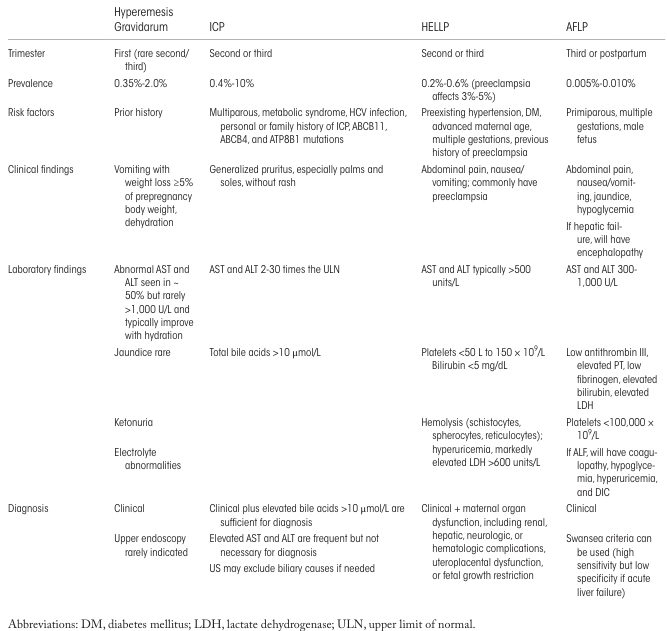
<table><thead><tr><th>Trimester</th><th>Hyperemesis Gravidarum</th><th>ICP</th><th>HELLP</th><th>AFLP</th></tr></thead><tbody><tr><td>Trimester</td><td>First (rare second/ third)</td><td>Second or third</td><td>Second or third</td><td>Third or postpartum</td></tr><tr><td>Prevalence</td><td>0.35%-2.0%</td><td>0.4%-10%</td><td>0.2%-0.6% (preeclampsia affects 3%-5%)</td><td>0.005%-0.010%</td></tr><tr><td>Risk factors</td><td>Prior history</td><td>Multiparous, metabolic syndrome, HCV infection, personal or family history of ICP, ABCB11, ABCB4, and ATP8B1 mutations</td><td>Preexisting hypertension, DM, advanced maternal age, multiple gestations, previous history of preeclampsia</td><td>Primiparous, multiple gestations, male fetus</td></tr><tr><td>Clinical findings</td><td>Vomiting with weight loss ≥5% of prepregnancy body weight, dehydration</td><td>Generalized pruritus, especially palms and soles, without rash</td><td>Abdominal pain, nausea/ vomiting; commonly have preeclampsia</td><td>Abdominal pain, nausea/vomiting, jaundice, hypoglycemia If hepatic failure, will have encephalopathy</td></tr><tr><td>Laboratory findings</td><td>Abnormal AST and ALT seen in ~50% but rarely >1,000 U/L and typically improve with hydration Jaundice rare</td><td>AST and ALT 2-30 times the ULN Total bile acids >10 μmol/L</td><td>AST and ALT typically >500 units/L Platelets <50 L to 150 x 10^9/L Bilirubin <5 mg/dL Hemolysis (schistocytes, spherocytes, reticulocytes); hyperuricemia, markedly elevated LDH >600 units/L</td><td>AST and ALT 300-1,000 U/L Low antithrombin III, elevated PT, low fibrinogen, elevated bilirubin, elevated LDH Platelets <100,000 x 10^9/L If ALF, will have coagulopathy, hypoglycemia, hyperammonemia, and DIC</td></tr><tr><td>Diagnosis</td><td>Clinical Upper endoscopy rarely indicated</td><td>Clinical plus elevated bile acids >10 μmol/L are sufficient for diagnosis Elevated AST and ALT are frequent but not necessary for diagnosis US may exclude biliary causes if needed</td><td>Clinical + maternal organ dysfunction, including renal, hepatic, neurologic, or hematologic complications, uteroplacental dysfunction, or fetal growth restriction</td><td>Clinical Swansea criteria can be used (high sensitivity but low specificity if acute liver failure)</td></tr></tbody></table> Abbreviations: DM, diabetes mellitus; LDH, lactate dehydrogenase; ULN, upper limit of normal.
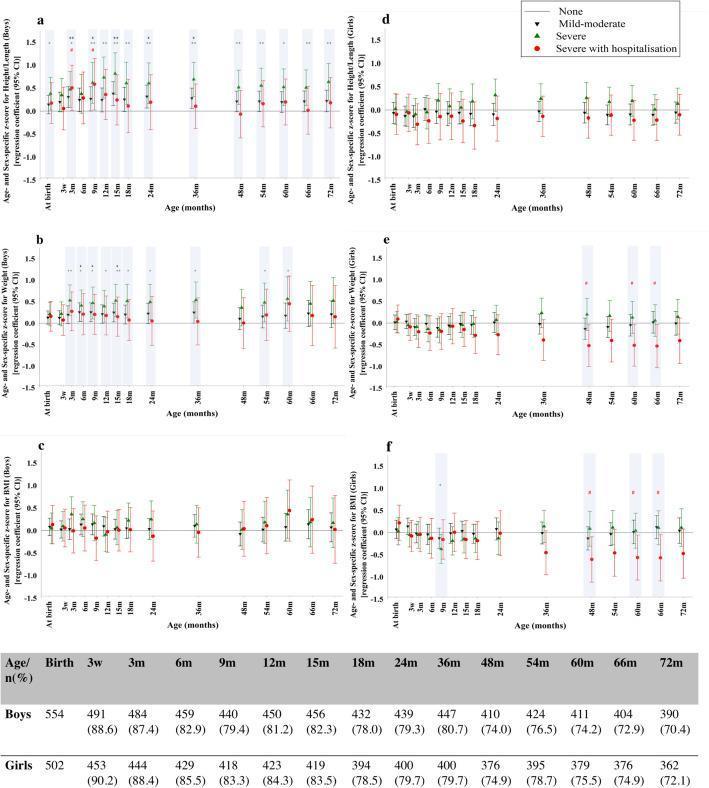
This figure presents a multi-panel comparison chart illustrating the longitudinal association between maternal nausea and vomiting of pregnancy (NVP) severity and offspring anthropometric development from birth to 72 months. The data is displayed across six forest-style scatter plots organized by sex (Boys: 1a-c; Girls: 1d-f) and outcome measure (Length/Height, Weight, and BMI). The x-axis represents age in months, and the y-axis shows the adjusted regression coefficient in z-scores with 95% confidence intervals (CI). Three NVP severity groups are compared against a 'No NVP' reference (baseline 0): mild-moderate (black inverted triangle), severe (green triangle), and severe with hospitalization (red dot). Statistically significant periods are highlighted with light grey shading. In boys, maternal severe NVP is associated with increased length and weight z-scores early in development. Conversely, girls of mothers with severe NVP with hospitalization show a trend toward lower weight and BMI z-scores in later childhood (48–72 months). A table at the bottom provides longitudinal sample sizes and retention percentages for both sexes.
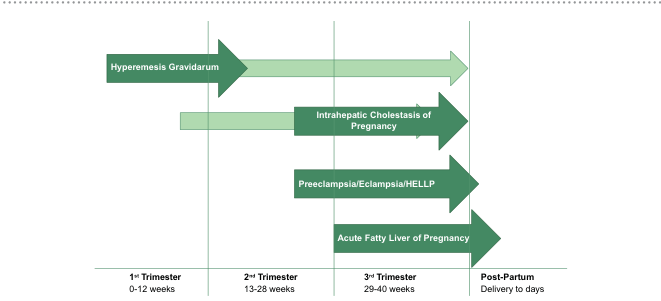
Summary : This timeline chart illustrates the typical onset and duration of four major liver-related complications during pregnancy: Hyperemesis Gravidarum, Intrahepatic Cholestasis of Pregnancy, Preeclampsia/Eclampsia/HELLP, and Acute Fatty Liver of Pregnancy, mapped across the trimesters and into the post-partum period. timeline chart: Scope & Reference : • Time axis spans from 1st Trimester (0–12 weeks), 2nd Trimester (13–28 weeks), 3rd Trimester (29–40 weeks), to Post-Partum (delivery to days). • Each complication is represented by a horizontal arrow indicating its typical period of occurrence. Keys & Annotations : • Hyperemesis Gravidarum: Arrow starts in 1st Trimester and extends through 2nd and 3rd Trimesters. • Intrahepatic Cholestasis of Pregnancy: Arrow begins in 2nd Trimester and continues through 3rd Trimester, ending at delivery. • Preeclampsia/Eclampsia/HELLP: Arrow starts in 3rd Trimester and ends at delivery. • Acute Fatty Liver of Pregnancy: Arrow starts in 3rd Trimester and extends into the Post-Partum period. Ordering : • Arrows are stacked vertically, each labeled with the condition name. • The timeline is segmented by vertical lines marking the start of each trimester and the post-partum period. Analysis : • Hyperemesis Gravidarum is the earliest and longest-lasting condition, potentially spanning all trimesters. • Intrahepatic Cholestasis of Pregnancy and Preeclampsia/Eclampsia/HELLP are concentrated in later trimesters, with the latter two peaking near delivery. • Acute Fatty Liver of Pregnancy is the latest onset, often extending into the immediate post-partum period. • The chart visually distinguishes the temporal risk windows for each condition, aiding clinical awareness of when to monitor for specific complications.
Hyperemesis Gravidarum
Definition
- Weight loss >5% of pre-pregnancy body weight
- Ketonuria (reflecting starvation metabolism)
- Dehydration, electrolyte disturbances, and acid-base imbalances
- Nutritional deficiency requiring medical intervention
Epidemiology
| Parameter | Details |
|---|---|
| Incidence | ~0.5-2% of pregnancies |
| Onset | Weeks 4-6 of gestation |
| Peak | Weeks 8-12 |
| Resolution | Usually by week 20; but ~10-20% persist until delivery |
| Recurrence | 15-19% risk in subsequent pregnancies |
- Young, nulliparous, non-Caucasian women
- Multiple gestation (higher HCG)
- Singleton female fetus
- Gestational trophoblastic disease
- Fetal trisomy 21 or hydrops fetalis
- Gestational trophoblastic disease
- Women with hyperthyroidism, psychiatric disorders, diabetes, or GI disorders
Pathophysiology
-
Human chorionic gonadotropin (HCG): Symptoms worsen during peak HCG concentrations (weeks 8-12). Conditions with elevated HCG (multiple gestation, trophoblastic disease) increase incidence. The alpha-subunit of HCG has TSH-like activity, suppressing endogenous TSH and causing a slight rise in free T4.
-
Estrogen: Elevated concentrations (as in obesity) are associated with HG. Estrogen and progesterone alter gastric motility and slow GI transit time.
-
GI dysmotility: Slowed gastric emptying contributes to persistent nausea and vomiting.
-
Helicobacter pylori: Two meta-analyses confirm an increased risk of HG with H. pylori infection. Eradication has been shown to reduce vomiting in some patients.
-
Genetic predisposition: Familial clusters suggest a heritable component.
-
Psychosocial factors: Stress and psychosocial dysfunction may amplify or trigger symptoms.
-
Gut hormones: Ghrelin and leptin alterations have also been implicated.
- Sleisenger and Fordtran's, p. 654; Rosen's Emergency Medicine, p. 3364
Clinical Features
- Severe persistent nausea and vomiting - triggered by olfactory, auditory, and visual stimuli
- Dry mouth, sialorrhea (ptyalism/hypersalivation), hyperolfaction, altered taste
- Pyrosis, hematemesis (in severe cases)
- Weight loss, weakness
- Dry mucous membranes
- Poor skin turgor
- Hypotension, tachycardia
- Signs of muscle wasting (in prolonged disease)
Laboratory Findings
| Test | Typical Finding |
|---|---|
| Urine | Ketonuria, elevated specific gravity |
| Electrolytes | Hypokalemia, hyponatremia |
| Acid-base | Contraction alkalosis, elevated anion gap |
| Liver enzymes | Mildly elevated AST/ALT (25-50% of cases; rarely >1,000 U/L) |
| Bilirubin | Mild elevation in some; jaundice rare |
| Amylase | Elevated in ~25% (from excess salivary gland stimulation) |
| TFTs | Abnormal in ~2/3 of patients (transient gestational thyrotoxicosis - suppressed TSH, elevated free T4) |
| Renal function | May be abnormal in severe disease |
- Rosen's Emergency Medicine, p. 3364; Creasy & Resnik's, p. 1564
Complications
- Wernicke encephalopathy (thiamine/B1 deficiency - severe, potentially fatal)
- Korsakoff psychosis
- Central pontine myelinolysis (from rapid correction of hyponatremia)
- Mallory-Weiss tears (with upper GI bleeding)
- Boerhaave syndrome (esophageal rupture)
- Spontaneous pneumomediastinum
- Retinal hemorrhage
- Depression, PTSD during pregnancy and postpartum
-
Low birth weight
-
Small for gestational age (SGA)
-
Prematurity
-
Low 5-minute Apgar scores
-
Sleisenger and Fordtran's, p. 655; Creasy & Resnik's, p. 1564
Management
Step 1: Non-pharmacologic Measures
- Multiple small meals; avoid empty stomach
- High-carbohydrate diet
- Separate solid and liquid intake
- Avoid offensive/triggering odors
- Rest
Step 2: Fluid Resuscitation (Hospital Admission Indications: hypotension, tachycardia, ketosis, weight loss, muscle wasting)
- 2 L of Ringer's Lactate over 3-5 hours, adjusted to maintain urine output >100 mL/h
- Add potassium for hypokalemia; magnesium and ionized calcium monitoring
- Thiamine 100 mg IV must be given before any dextrose infusion to prevent Wernicke encephalopathy
- After ketones clear, transition to oral intake; hyponatremia corrected slowly to avoid central pontine myelinolysis
Step 3: Antiemetics (Stepwise)
| Drug | Class | Notes |
|---|---|---|
| Pyridoxine (Vit B6) ± doxylamine (Diclegis) | First-line | Good safety profile |
| Ginger | Complementary | Beneficial, safe |
| Metoclopramide | Dopamine antagonist | Widely used, safe |
| Prochlorperazine / Chlorpromazine | Phenothiazines | Effective; used for moderate-severe |
| Ondansetron | 5-HT3 antagonist | For non-responders; supported by controlled trial data |
| Promethazine | Antihistamine/phenothiazine | Effective but sedating |
Step 4: Refractory Disease - Corticosteroids
- Methylprednisolone 16 mg PO/IV every 8 hours x 3 days, followed by a 2-week taper
- Reduces hospital readmission vs. promethazine alone
- Avoid in first trimester (organogenesis): weak association with facial clefting (~1-2 cases per 1,000 treated women)
- Transdermal clonidine or oral mirtazapine - proposed options with limited data
Step 5: Nutritional Support
-
Enteral feeding via nasogastric or nasoenteric tube preferred over TPN
-
Total parenteral nutrition (TPN): Last resort; high complication rate:
- Infusion catheter sepsis: ~25%
- Venous thrombosis: ~3%
- Peripherally inserted central catheter (PICC) overall complication rate: ~50%
- Centrally placed lines have higher morbidity (50%) vs. peripheral lines (9%)
-
Creasy & Resnik's, p. 1565; Rosen's Emergency Medicine, p. 3364
Differential Diagnosis
- Peptic ulcer disease / gastritis
- Pancreatitis
- Appendicitis
- Hepatitis / cholecystitis
- Intrahepatic cholestasis of pregnancy
- HELLP syndrome / acute fatty liver of pregnancy (if later in pregnancy)
- Urinary tract infection / pyelonephritis
- Hyperthyroidism (primary)
- CNS disease
Timing in Pregnancy Context
Recent Evidence (2025)
- A 2025 systematic review and meta-analysis (PMID 41064209) evaluated the neutrophil-to-lymphocyte ratio (NLR) as a laboratory marker in HG - an emerging inflammatory biomarker.
- A 2025 systematic review (PMID 40750873) highlights the significant economic costs of NVP and HG, underscoring the need for early effective management.
- A 2025 meta-analysis (PMID 40886158) examined the association between first-trimester maternal serum PAPP-A levels and HG, contributing to understanding of placental/hormonal mechanisms.
Key Clinical Pearls
- Always give IV thiamine before dextrose - prevents Wernicke encephalopathy.
- Correct hyponatremia slowly - rapid correction risks central pontine myelinolysis.
- Transient gestational hyperthyroidism in HG does not require antithyroid treatment.
- Check and treat H. pylori if suspected - may reduce vomiting.
- TPN is a last resort due to high complication rates; prefer enteral nutrition whenever possible.
- HG has significant psychological impact - screen for depression and PTSD.
- Poor maternal weight gain is linked to SGA babies, preterm birth, and low Apgar scores.