

1000158047.jpg
Explain the topics
I can see the image contains a list of molecular biology topics. Let me explain each one in detail.
Reading File
Now let me search the medical library for all these topics in parallel.
Finding Sources
Finding Sources
Finding Sources
Finding Sources
Finding Sources
Finding Sources
Good - I found relevant sections. Let me read them in parallel.
Reading File
Finding Sources
Finding Sources
Excellent! Now let me read the central dogma and RNA splicing sections in parallel.
Reading File
Reading File
Reading File
Now let me fetch the key diagram image and also read the DNA replication section.
Loading Image
Finding Sources
Reading File
I now have all the content needed. Let me compile a comprehensive explanation of all five topics.
Topics in Molecular Biology: Central Dogma and Gene Expression
1. Central Dogma of Molecular Biology
The central dogma describes the fundamental flow of genetic information in living cells:
DNA → RNA → Protein
Genomic DNA, stored in the cell nucleus, directs the synthesis and sequence of RNA. RNA then directs the synthesis and sequence of polypeptides (proteins). Specific proteins are also involved in the synthesis and metabolism of both DNA and RNA, making these three molecules deeply intertwined.
- The nucleus and cytoplasm are separated by a nuclear membrane (eukaryotic feature), so information must be actively transferred from nucleus to cytoplasm.
- RNA serves as the molecular link between the DNA code of genes and the amino acid code of proteins.
- RNA differs from DNA in using ribose instead of deoxyribose sugar, and uracil (U) replaces thymine (T).
- RNA typically exists as a single-stranded molecule.
Source: Thompson & Thompson Genetics and Genomics in Medicine, 9th ed.
2. The Replication of DNA
DNA replication is a semiconservative process - each strand of the parent double helix serves as a template for a new daughter strand. The two resulting molecules each contain one original strand and one newly synthesized strand, with identical base sequences.
Key steps and players:
| Step | What Happens |
|---|---|
| Origin of replication | Replication begins at specific origin sequences (chromosomal DNA has many origins, operating simultaneously) |
| Helicase | Unwinds and separates the double helix strands - energetically unfavorable without these enzymes |
| RNA primer | A short RNA primer is synthesized first, as DNA polymerase needs a free 3'-OH end to start |
| DNA Polymerase III | Synthesizes new DNA in the 5' to 3' direction only |
| Leading strand | Synthesized continuously in the 5'→3' direction |
| Lagging strand | Synthesized discontinuously as Okazaki fragments (in the opposite direction) |
| DNA Polymerase I | Excises the RNA primer and replaces it with DNA |
| DNA Ligase | Joins the DNA fragments together |
Because DNA polymerase can only work 5' to 3', only one strand (leading strand) copies continuously. The other (lagging strand) is built in short fragments that are later joined.
Source: Henry's Clinical Diagnosis and Management by Laboratory Methods
3. Molecular Mechanisms of DNA Transcription
Transcription is the process of synthesizing an RNA copy from a DNA template.
Key mechanisms:
- RNA Polymerase II transcribes protein-coding genes, initiating at the transcriptional start site (located in the 5' UTR).
- Synthesis proceeds 5' to 3' on the RNA, using the antisense (noncoding) DNA strand (read 3'→5') as the template.
- The sense (coding) strand of DNA has the same sequence as the RNA (with T replaced by U).
- Transcription continues through both introns (non-coding) and exons (coding), beyond the eventual 3' end of the mature mRNA.
Post-transcriptional processing (all in the nucleus):
- 5' cap - A chemical cap is added to the 5' end of the RNA, protecting it.
- Cleavage of the 3' end at a specific downstream site (guided by the AAUAAA sequence).
- PolyA tail - A poly(A) tail is added to the 3' end, increasing mRNA stability.
- RNA splicing (see below).
The fully processed mRNA is then exported to the cytoplasm for translation.
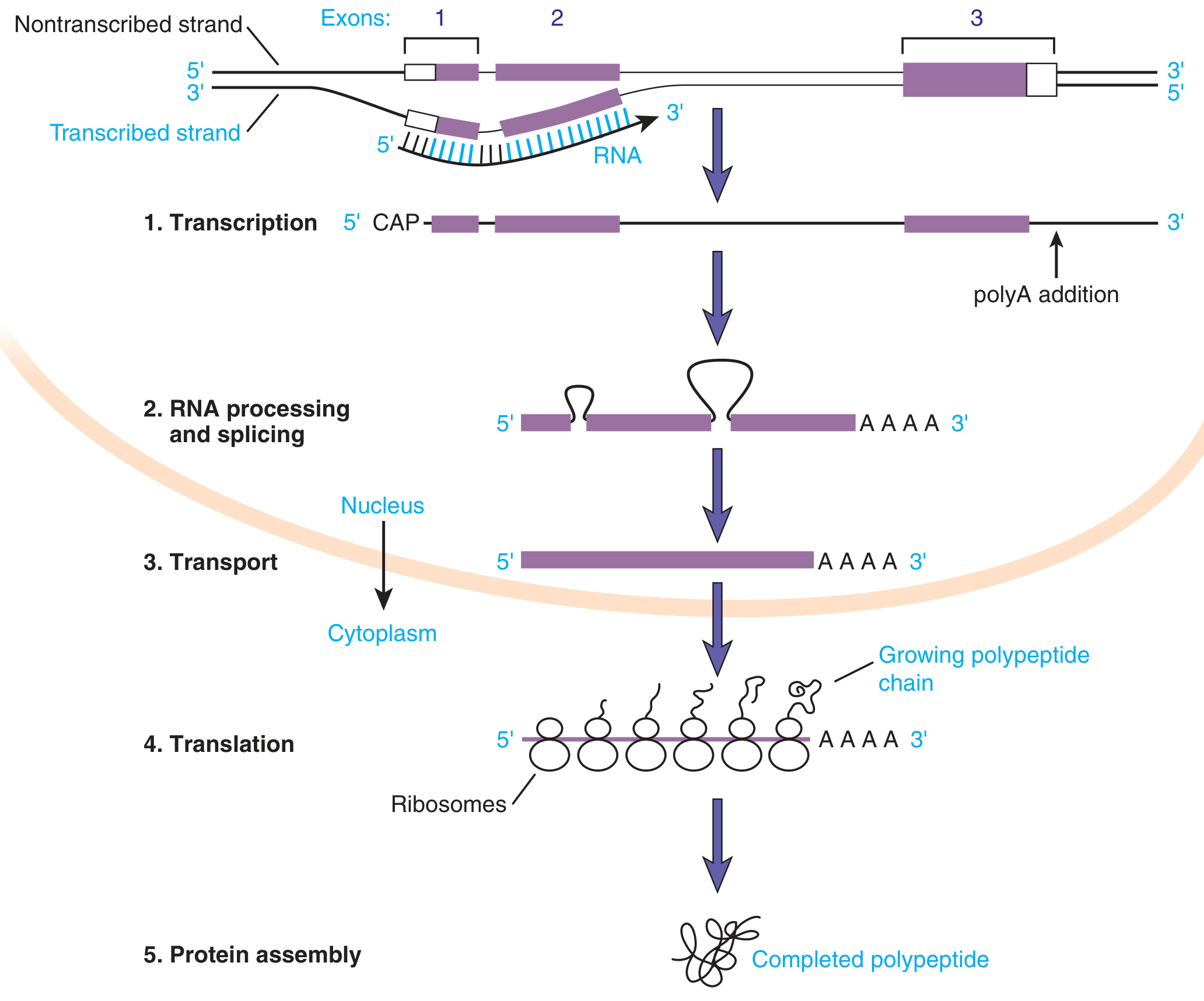
Source: Thompson & Thompson Genetics and Genomics in Medicine, 9th ed.
4. RNA Splicing
The primary RNA transcript contains both introns (non-coding intervening sequences) and exons (coding sequences). RNA splicing removes the introns and joins the exons together to form the mature mRNA.
Mechanism:
- Splice sites are defined by conserved sequences at the boundaries of introns:
- 5' splice site: contains the invariant GT (GU in RNA) dinucleotide at the start of the intron.
- 3' splice site: contains the invariant AG dinucleotide just before the exon-intron boundary.
- Splicing is highly precise - about 95% of β-globin transcripts are accurately spliced.
- The splice sites are independent of the reading frame; an intron may even split a codon.
Clinical importance:
- Variants (mutations) in the conserved GT or AG dinucleotides always eliminate normal splicing, reducing the amount of functional mRNA. This is a major mechanism in diseases like β-thalassemia.
Alternative Splicing:
- Most human genes can follow multiple splicing pathways, producing several different mRNAs from a single gene.
- This greatly expands the protein diversity of the genome beyond its ~20,000 protein-coding genes.
- Alternative splicing is especially prevalent in the brain, where it contributes to functional diversity during development.
Source: Thompson & Thompson Genetics and Genomics in Medicine, 9th ed.
5. Genetic Code
The genetic code is the set of rules by which nucleotide sequences in mRNA are translated into amino acid sequences in proteins.
Key features:
| Feature | Detail |
|---|---|
| Codon | A set of 3 adjacent mRNA bases that specifies one amino acid |
| Total codons | 4³ = 64 possible triplet combinations |
| Amino acids coded | Only 20 amino acids, so most have more than one codon |
| Degeneracy | The code is "degenerate" - multiple codons can specify the same amino acid (e.g., Leucine and Arginine each have 6 codons) |
| Unique codons | Only Methionine (AUG) and Tryptophan (UGG) have a single codon each |
| Start codon | AUG (Methionine) - also signals the start of translation |
| Stop codons | UAA, UAG, UGA - signal termination of translation (no amino acid added) |
The code is also nearly universal - almost all living organisms use the same genetic code, which is powerful evidence for a common evolutionary origin.
6. DNA Translation
Translation is the process of converting the mRNA sequence into a protein (polypeptide chain). It takes place in the cytoplasm on structures called ribosomes.
Key molecules:
- mRNA - carries the genetic message from the nucleus to the ribosome.
- tRNA (transfer RNA) - 70-100 nucleotides long; each tRNA is specific for one amino acid and carries it to the ribosome. The tRNA anticodon pairs with the mRNA codon by complementary base pairing.
- Ribosomes - macromolecular complexes made of rRNA (18S and 28S rRNA genes) and several dozen ribosomal proteins. They provide the physical platform for translation.
Stages of translation:
- Initiation - Ribosome assembles at the AUG start codon on the mRNA.
- Elongation - tRNAs bring amino acids to the ribosome one by one, matching codons. A peptide bond forms between each new amino acid and the growing chain.
- Termination - A stop codon (UAA, UAG, or UGA) is reached; release factors cause the ribosome to dissociate and the polypeptide is released.
- Protein assembly/folding - The completed polypeptide folds into its functional 3D structure.
Multiple ribosomes can translate a single mRNA simultaneously (forming a polysome), greatly increasing the rate of protein production.
Summary Flow
DNA (nucleus)
   ↓  Replication → copies of DNA
   ↓  Transcription → primary RNA transcript
   ↓  RNA Processing (capping, splicing, polyadenylation)
   ↓  mRNA exported to cytoplasm
   ↓  Translation (ribosome + tRNA + Genetic Code)
Protein (cytoplasm)
These five topics together form the complete molecular basis of how hereditary information stored in DNA is expressed as functional proteins - the molecular machinery of life. - Thompson & Thompson Genetics and Genomics in Medicine, 9th ed.
This is a shared conversation. Sign in to Orris to start your own chat.