
Clatherin
I'll look up clathrin (the correct spelling) from the medical library right away.
Searching sources...
Reading File
Finding Sources
Searching the Web
clathrin coated vesicles endocytosis mechanism cell biology
Now let me read the key textbook sections for detailed content:
Reading File
Reading File
Reading File
I now have rich textbook content. Let me fetch the triskelion diagram referenced in Ganong's:
Finding Sources
Reading File
Reading File
Reading File
I now have comprehensive content from multiple authoritative textbooks. Let me fetch the key diagram:
Loading Image
Here is a thorough overview of clathrin (note the correct spelling) from multiple authoritative textbooks:
Clathrin
What Is Clathrin?
Clathrin is a cytoplasmic coat protein that plays a central role in receptor-mediated endocytosis and intracellular vesicle trafficking. It does not bind membranes directly, but instead assembles around budding membrane regions to help shape, select cargo for, and pinch off transport vesicles.
Structure: The Triskelion
The fundamental structural unit of clathrin is the triskelion - a three-legged, pinwheel-like structure:
- Three clathrin heavy chains (each ~190 kDa) and three light chains radiate from a central hub
- A triskelion is not planar - it resembles three adjoining edges of a tetrahedron
- Multiple triskelions interlock to form a geodesic dome-shaped cage composed of a lattice of hexagons and pentagons
- Each triskelion constitutes one vertex in this lattice
- Medical Physiology (Boron & Boulpaep), p. 58
- Ganong's Review of Medical Physiology, 26th Ed.
Clathrin-Mediated Endocytosis: Step-by-Step
The diagram below (from Histology: A Text and Atlas) illustrates the full cycle:
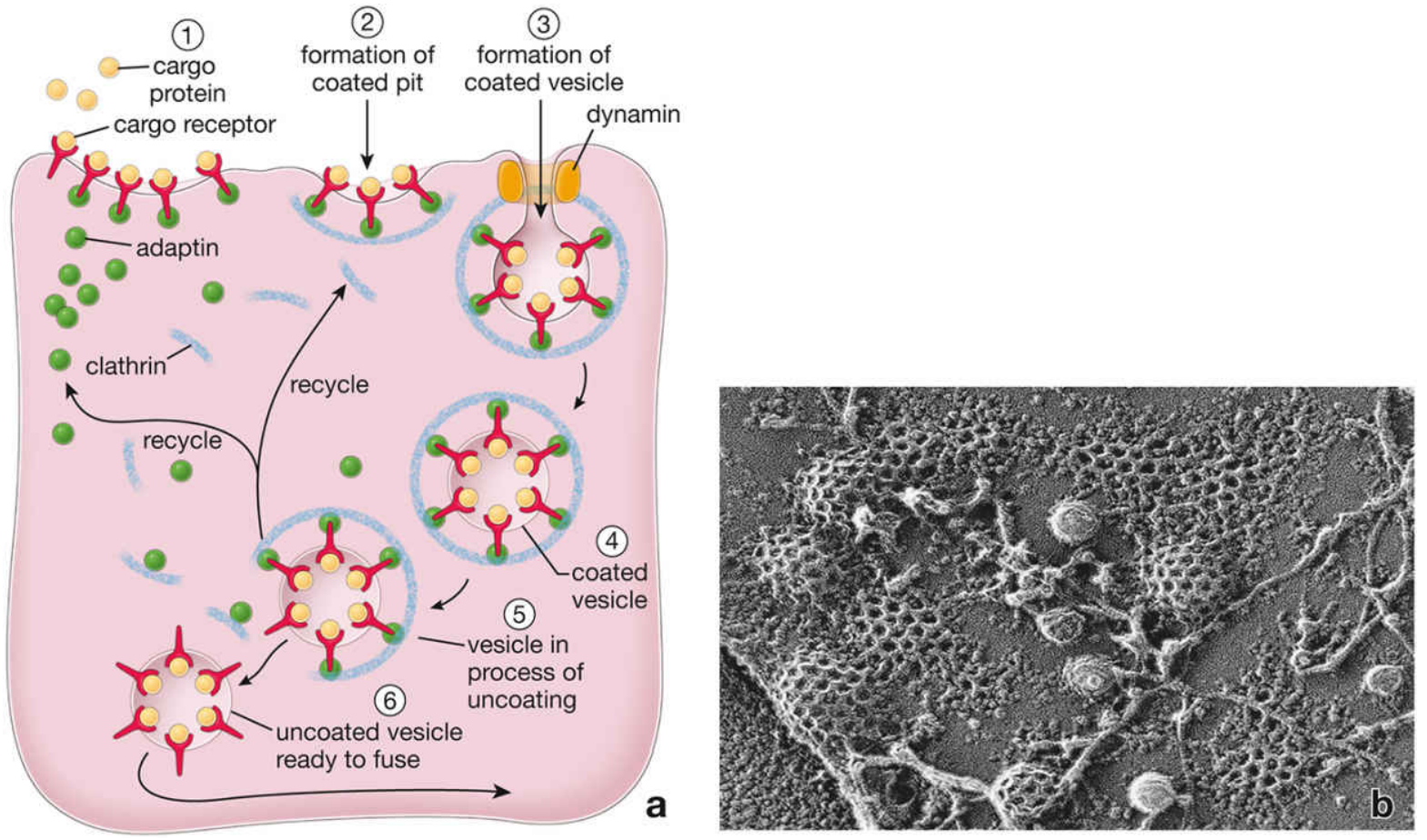
The process proceeds in 6 key steps:
| Step | Event |
|---|---|
| 1 | Cargo receptors on the plasma membrane bind their specific extracellular cargo proteins |
| 2 | Adaptor proteins (adaptins, AP180) link cargo receptor tails to clathrin triskelions, forming a coated pit |
| 3 | Triskelions assemble spontaneously into a cage that deforms the membrane into an invagination; dynamin (a GTPase) forms a collar around the neck |
| 4 | Dynamin hydrolyzes GTP to sever the neck - a complete clathrin-coated vesicle buds off |
| 5 | The clathrin coat is stripped off using ATP-hydrolyzing uncoating enzymes (including auxilin and Hsc70) |
| 6 | The uncoated vesicle is now free to fuse with its target organelle; recycled clathrin reforms new coated pits |
- Histology: A Text and Atlas, 8th Ed.
- Ganong's Review of Medical Physiology, 26th Ed.
- Medical Physiology (Boron & Boulpaep)
Adaptor Proteins (Adaptins)
Clathrin does not bind membrane proteins directly. Adaptor proteins are the intermediary:
- They link the cytosolic tails of transmembrane cargo receptors to the clathrin scaffold
- Different adaptins confer specificity for different cargo
- AP-1 clathrin coats: vesicles from trans-Golgi to lysosomes
- AP-2 clathrin coats: endocytotic vesicles from plasma membrane to endosomes
- AP180: involved in clathrin assembly in synaptic vesicle recycling
- Ganong's Review of Medical Physiology, 26th Ed., p. COATS & VESICLE TRANSPORT section
- Histology: A Text and Atlas, 8th Ed.
Types of Clathrin Vesicles and Their Destinations
| Location | Adaptor | Destination |
|---|---|---|
| Plasma membrane | AP-2 | Early endosomes |
| Trans-Golgi network (TGN) | AP-1 | Lysosomes |
| Post-Golgi locations | Various | PM, TGN, endosomes |
Compare with non-clathrin coat proteins:
- COPI: intra-Golgi transport + retrograde Golgi to ER
- COPII: anterograde ER to Golgi
- Harper's Illustrated Biochemistry, 32nd Ed.
Examples of Cargo Internalized by Clathrin
Clathrin-mediated endocytosis is responsible for internalizing:
- LDL (low-density lipoprotein) via LDL receptors
- Nerve growth factor (NGF)
- Transferrin and its receptor
- Synaptic vesicle membrane components (critical for neurotransmission recycling)
- EGFR and many other growth factor receptors
- MT1-MMP (matrix metalloproteinase - relevant in rheumatology/ECM degradation)
- PICALM (clathrin assembly protein implicated in Alzheimer's disease)
- Ganong's Review of Medical Physiology, 26th Ed.
- Eric Kandel: Principles of Neural Science, 6th Ed.
- Henry's Clinical Diagnosis and Management by Laboratory Methods
Fate of Internalized Vesicles
After the clathrin coat falls off, the uncoated vesicle fuses with an early endosome. From there:
- Recycling pathway: a new vesicle buds back to return receptors/cargo to the plasma membrane
- Degradation pathway: the early endosome matures into a late endosome and fuses with a lysosome, where lysosomal proteases degrade the contents
This endosome-lysosome pathway is how LDL is broken down to release cholesterol, and how pathogens or toxins that hijack this pathway gain intracellular access.
Clathrin vs. Caveolae-Mediated Endocytosis
| Feature | Clathrin-mediated | Caveolae-mediated |
|---|---|---|
| Coat protein | Clathrin | Caveolin |
| Vesicle surface | Spiky (electron-dense) | Smooth, flask-shaped |
| Speed | Faster | Slower |
| Actin requirement | Independent | Independent |
| Main function | Receptor internalization | Cholesterol regulation, transcytosis |
| Cells | Ubiquitous | Prominent in endothelial cells |
- Ganong's Review of Medical Physiology, 26th Ed.
Clathrin in Synaptic Vesicle Recycling
In neurons, after synaptic vesicle exocytosis, clathrin-mediated endocytosis is the classic pathway for recycling vesicle membrane. A second, ultrafast clathrin-independent endocytosis has also been described - occurring just 50 ms after exocytosis, 200 times faster than the classical pathway, and occurring just outside the active zone.
- Principles of Neural Science (Kandel), 6th Ed.
Clinical Relevance
- LDL receptor pathway: Familial hypercholesterolemia results from defective LDL receptor recycling through clathrin-coated pits
- Alzheimer's disease: PICALM (a clathrin adaptor protein) is reduced in AD brains and regulates clathrin-dependent internalization
- Pathogen entry: Many viruses (influenza, SARS-CoV-2) and bacterial toxins hijack clathrin-mediated endocytosis to enter cells
- Synaptic dysfunction: Disruption of clathrin-mediated vesicle recycling impairs neurotransmitter release
This is a shared conversation. Sign in to Orris to start your own chat.