
Explain the concept of pathophysiology and clinical diagnosis
The query has medical/clinical terminology, so I need to read the medical library skill first.
Quick answer: Pathophysiology is the study of how disease processes alter normal physiological function - it bridges basic science and clinical medicine. Clinical diagnosis is the process of identifying a disease in a patient using history, physical examination, and investigations. Together, they form the foundation of all clinical reasoning.
Searching sources...
Reading File
Now let me search the medical library for both topics in parallel.
Finding Sources
Finding Sources
Now let me read the most relevant sections in parallel - from Pye's Surgical Handicraft for pathophysiology, and from Schwartz's Principles of Surgery for clinical diagnosis, plus do a deeper FTS search on core concepts.
Reading File
Reading File
Finding Sources
Finding Sources
Let me read the neurology textbook on clinical diagnosis and get foundational pathophysiology content from Robbins Pathology.
Reading File
Finding Sources
Finding Sources
Excellent - found the "Symptom to Diagnosis" textbook which is perfect. Let me read those key sections.
Reading File
Finding Sources
Reading File
Finding Sources
Reading File
Searching the Web
pathophysiology definition concept clinical significance medical education
I now have rich content from multiple authoritative sources. Let me also fetch the clinical reasoning diagram to include visually.
Loading Image
I now have everything needed for a thorough, well-sourced answer. Let me compose the full response.
Pathophysiology and Clinical Diagnosis
Part 1: Pathophysiology
Definition
Pathophysiology (also called physiopathology) is the branch of medicine sitting at the intersection of pathology and physiology. It studies the disordered physiological processes that cause, result from, or are otherwise associated with a disease or injury.
- Physiology describes the normal mechanisms operating within a living organism.
- Pathology describes the abnormal or undesired structural and chemical changes observed during a disease state.
- Pathophysiology explains why and how those changes happen - the functional alterations occurring within an individual due to disease.
In short: pathology describes what goes wrong; pathophysiology explains how it goes wrong.
Core Components
1. Etiology
Etiology is the study of the causes or reasons for disease. It identifies the causal factors that, acting together, provoke a particular disease or injury. Causes can be:
- Genetic (inherited mutations, chromosomal abnormalities)
- Infectious (bacteria, viruses, fungi, parasites)
- Environmental (toxins, radiation, trauma)
- Immunological (autoimmune processes)
- Idiopathic (unknown cause)
2. Pathogenesis
Pathogenesis describes how etiological factors alter physiological function and lead to the development of clinical manifestations. It is the mechanism by which a cause produces a disease. For example:
- In a head injury, the primary mechanical damage triggers secondary brain swelling; as intracranial volume increases beyond the skull's capacity, intracranial pressure (ICP) rises, causing cellular hypoxia, worsening oedema, and a self-amplifying cascade that becomes life-threatening - Pye's Surgical Handicraft, 22nd Ed.
- In heart failure, reduced cardiac output triggers compensatory neurohormonal activation (RAAS, sympathetic nervous system), which initially maintains perfusion but eventually accelerates myocardial damage.
3. Clinical Manifestations (Signs and Symptoms)
The end result of pathogenesis is the signs and symptoms the patient presents with. Understanding pathogenesis allows clinicians to predict clinical progression and select the most appropriate interventions.
Why Pathophysiology Matters
Pathophysiology acts as the bridge between basic science (anatomy, physiology, biochemistry, molecular biology) and clinical medicine. Without it:
- A clinician might treat symptoms without understanding their origin.
- Drug selection would be empirical rather than mechanism-based.
- Complications would be harder to anticipate.
For example, knowing that sepsis pathophysiology involves immune dysregulation, coagulopathy, and endothelial injury explains why sepsis patients develop multi-organ failure and guides targeted interventions (fluids, vasopressors, antibiotics, source control).
Key Principle: Individual Variability
A cardinal feature of pathophysiology is that individuals vary significantly from "classic" presentations. Each person's body reacts differently to the same disease process depending on age, genetics, comorbidities, and immunological state. This variability is what makes the diagnostic process complex - and is exactly why clinical reasoning skills are needed alongside mechanistic knowledge.
Part 2: Clinical Diagnosis
Definition
Clinical diagnosis is the process of identifying a disease or condition in a specific patient. It combines data gathered from the patient's history, physical examination, and investigations to arrive at a conclusion about what is causing the patient's symptoms.
The Diagnostic Process (Clinical Reasoning)
The diagnostic process - also called clinical reasoning - is not linear guessing. According to Symptom to Diagnosis: An Evidence-Based Guide, 4th Ed., errors in reasoning account for 17% of all adverse events, so a structured approach is essential. Diagnostic errors can result from:
- Faulty knowledge
- Faulty data gathering
- Faulty information processing
The model below illustrates the full clinical reasoning pathway:
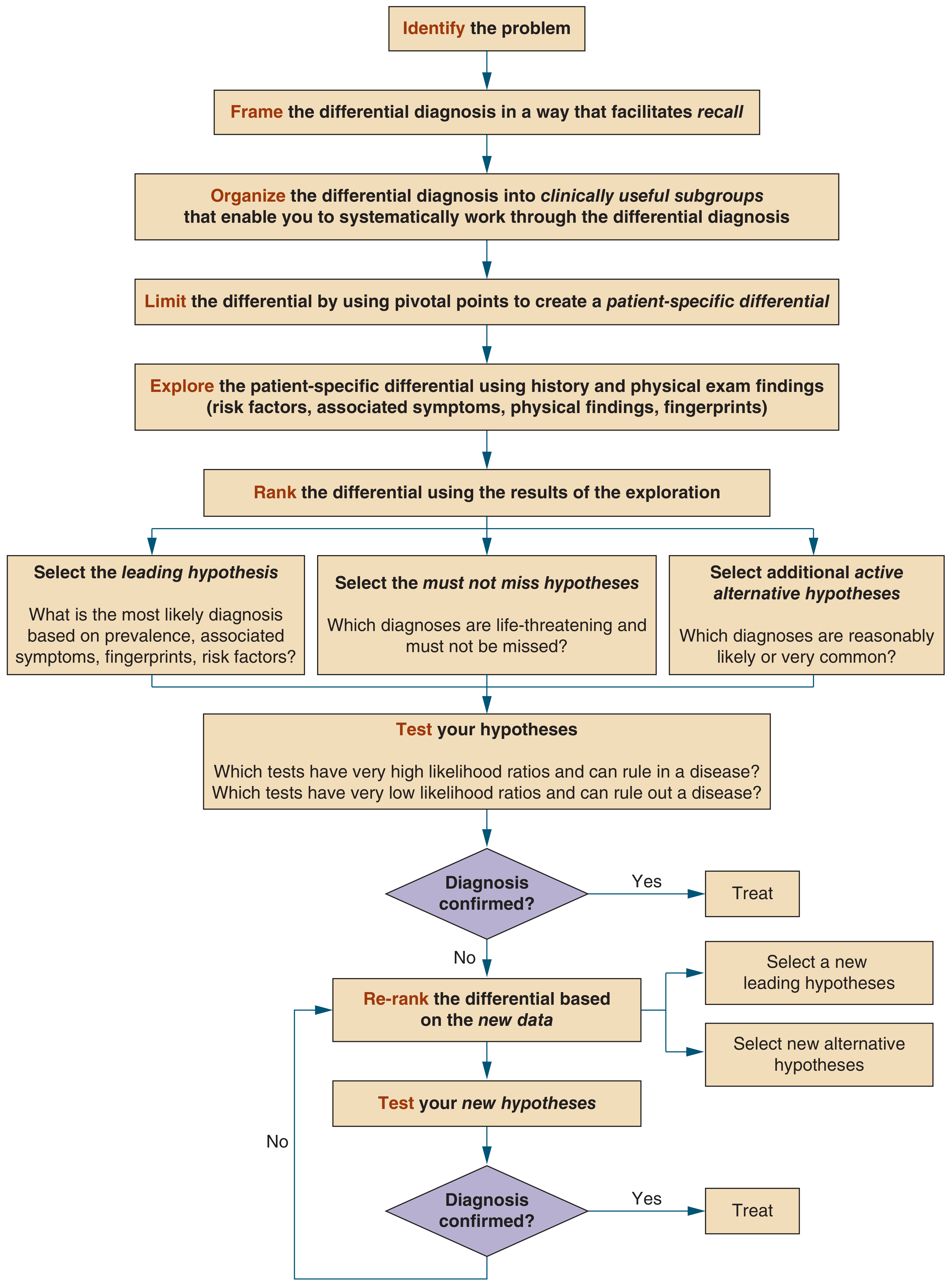
The 9-Step Clinical Reasoning Model
Step 1: Identify the Problem
Build a complete problem list from the chief complaint, acute symptoms, physical findings, lab abnormalities, and active chronic conditions. Group related problems together (e.g., chest pain + shortness of breath). Be precise - "I'm tired" may mean fatigue, dyspnea, or muscle weakness.
Step 2: Frame the Differential Diagnosis
Organize possible diagnoses into subgroups that aid recall. Frameworks can be anatomic, organ-system-based, physiological, or based on pivotal points - opposing descriptors that contrast clinical characteristics (e.g., unilateral vs bilateral edema; old vs new headache). Pivotal points are the backbone of logical diagnostic algorithms.
Step 3: Organize the Differential Diagnosis
Structure the differential into clinically useful subgroups that allow systematic work-through. This step only needs to be done once per clinical problem type - experienced clinicians build a repertoire over time.
Step 4: Limit the Differential Diagnosis
Extract pivotal points from the individual patient's history and exam to narrow the large general differential to a patient-specific, focused list. This step must be done for every patient encounter.
Step 5: Explore Possible Diagnoses Using History and Physical Exam Findings
Look for clinical clues - risk factors, symptom character, physical signs. Focus on positive findings: 65% of positive findings have a specificity >80%, and one-third carry an LR+ >5. Pathognomonic or "fingerprint" (FP) findings strongly indicate a specific diagnosis. At the same time, do not be falsely reassured by absent "classic" features - only 21% of negative findings have a sensitivity >80%.
Step 6: Rank the Differential Diagnosis
Rank using three simultaneous approaches:
- Probabilistic - most likely diagnoses first (based on pretest probability)
- Prognostic - most serious/life-threatening diagnoses must not be missed
- Pragmatic - most treatable conditions considered early
This produces three categories: a leading hypothesis, must-not-miss hypotheses, and active alternative hypotheses.
Step 7: Test Your Hypotheses
Order investigations targeted at proving or disproving specific hypotheses - not as a "fishing expedition." As Bradley and Daroff's Neurology in Clinical Practice states, tests ordered without a clinical hypothesis are likely to generate irrelevant abnormalities that add confusion rather than clarity. Tests should be selected based on their likelihood ratios (LR+ to rule in, LR- to rule out).
Step 8: Re-rank the Differential Based on New Data
Eliminating one diagnosis is not sufficient - you must also determine the actual cause. When new data conflict with your hypothesis, go back to the full differential. Premature closure - stopping too soon - is one of the most common diagnostic errors.
Step 9: Make the Diagnosis and Treat (or Repeat)
If the diagnosis is confirmed, proceed to treatment. If not, cycle back and re-rank with new hypotheses.
Two Reasoning Systems
Clinicians use two cognitive modes simultaneously:
| System | Type | Basis | When predominant |
|---|---|---|---|
| System 1 | Rapid, intuitive | Pattern recognition; matching to illness scripts | Experienced clinician + straightforward case |
| System 2 | Slow, analytic | Explicit logical analysis | Complex case or less experienced clinician |
Both systems blend in practice. Awareness of this helps clinicians recognize when to slow down and apply System 2 analysis.
Common Diagnostic Biases to Avoid
From Symptom to Diagnosis, 4th Ed.:
| Bias | Description |
|---|---|
| Availability | Considering easily remembered diagnoses more likely regardless of actual prevalence |
| Base rate neglect | Pursuing rare "zebra" diagnoses before common ones |
| Representativeness | Ignoring atypical features inconsistent with the favored diagnosis |
| Confirmation bias | Seeking data to confirm rather than refute the initial hypothesis |
| Premature closure | Stopping the diagnostic process too early |
The Role of Investigations
Investigations extend clinical diagnosis beyond the bedside. As Bradley and Daroff's Neurology in Clinical Practice notes, they should be directed to "prove or disprove the hypothesis that a certain disease is responsible." Key investigation categories include:
- Laboratory tests - bloods, urinalysis, CSF, cultures, serology, genetic testing, autoantibody panels
- Imaging - X-ray, ultrasound, CT, MRI, PET/SPECT
- Physiological tests - ECG, spirometry, nerve conduction studies, audiometry
- Histopathology - biopsy and tissue analysis
Results can also monitor response to treatment (e.g., ESR falling with corticosteroid therapy in giant cell arteritis confirms disease control).
How Pathophysiology and Clinical Diagnosis Connect
These two concepts are inseparable in clinical practice:
- Pathophysiology explains symptoms - knowing why a disease causes what it causes lets you predict what the patient will report and what signs to look for on examination.
- Pathophysiology guides test selection - if you understand the mechanism, you know which biomarkers or imaging findings will be abnormal.
- Pathophysiology informs treatment - targeting the underlying mechanism produces better outcomes than symptom suppression alone.
- Clinical diagnosis tests pathophysiology - when a patient's presentation does not fit the expected pattern, it often reveals a variant mechanism or complicating comorbidity.
Together they form the foundation of all clinical medicine: understand how disease disrupts normal function (pathophysiology), then use structured reasoning to identify which disease is present in this specific patient (clinical diagnosis).
Sources:
- Symptom to Diagnosis: An Evidence-Based Guide, 4th Ed., pp. 14-17 (The Diagnostic Process, Clinical Reasoning Model)
- Bradley and Daroff's Neurology in Clinical Practice, pp. 427-429 (Role of Ancillary Tests)
- Pye's Surgical Handicraft, 22nd Ed., p. 212 (Pathophysiology of Head Injury)
- Wikipedia - Pathophysiology (historical context)
- BasicMedical Key - Introduction to Pathophysiology (etiology and pathogenesis framework)
This is a shared conversation. Sign in to Orris to start your own chat.