

Go through with this algorithm & make a simpler version of this keeping all the important points
Hypothermia Management - Simplified Algorithm
FIRST: Scene Safety
STEP 1: Assess the Patient
Normal mental status?
├── YES → NOT HYPOTHERMIC → No action needed
└── NO ↓

Shivering?
├── NO → Shivering but functioning?
│         ├── YES → MILD (35-32°C)
│         └── NO  → MILD (35-32°C)
└── YES ↓

Still shivering?
├── YES → MODERATE (32-28°C)
└── NO ↓

Conscious?
├── YES → MODERATE (32-28°C)
└── NO ↓

Signs of life / rhythm on ECG?
├── YES → SEVERE/PROFOUND (<28°C)
└── NO ↓

Lethal injury? Chest too stiff? Avalanche >35 min + airway blocked?
├── YES → DEATH - Do not resuscitate
└── NO → SEVERE/PROFOUND (<28°C) + CPR
STEP 2: Treat by Category
🟡 NOT HYPOTHERMIC (>35°C / Cold Stressed)
- Reduce heat loss, increase heat production
🟠 MILD (35-32°C)
- Insulate + vapor barrier, seek shelter
- Remove wet clothing only with shelter
- Measure temperature
- Passive warming + calorie support for shivering
- No standing/walking for 30 min
- Active warming is beneficial
🔴 MODERATE (32-28°C)
- Apply heat to upper torso (chest, axilla, back) - heat pads, forced air
- IV/IO access; saline boluses (40-42°C)
- IV/IO glucose
- Monitor continuously
- No standing or walking
🆘 SEVERE/PROFOUND (<28°C)
- Intubate or use supraglottic airway
- Lower anesthetic/paralytic drug doses; extend dosing intervals
- Ventilate at half the normal rate (with advanced airway)
- Supplemental O₂ (especially >2500m)
- Naso/orogastric tube if intubated
- Compressions at normal rate
- If <30°C: 1 shock max (VT/VF); warm 1-2°C before more shocks
- No vasopressors until ≥30°C (increase interval 30-35°C)
- CPR may be paused/intermittent if needed for evacuation
- No temperature cut-off for CPR
- Stop CPR if potassium >12
- Consider transcutaneous pacing if bradycardic + hypotensive
STEP 3: Transport
| Condition | Destination |
|---|---|
| Uninjured, alert, shivering | May not need hospital |
| Trauma patient | Trauma center (active rewarming) |
| Asphyxiated | Closest hospital |
| Hemodynamically stable | Closest hospital |
| Unstable / Severe | Hospital with ICU + ECMO (ECC) capabilities |
Create a quick reference image of this simplified algorithm
A clean medical quick reference card for hypothermia management algorithm on a white background. Title at top: "HYPOTHERMIA MANAGEMENT - QUICK REFERENCE" in bold dark blue. Section 1 - SCENE SAFETY (red banner): "Handle gently. Keep horizontal. Stabilize injuries." Section 2 - ASSESSMENT FLOWCHART (left side, vertical flow with arrows): Box: "Normal mental status?" → YES → "NOT HYPOTHERMIC - No action" ↓ NO Box: "Shivering? Functioning?" → YES → "MILD 35-32°C" (yellow) ↓ NO Box: "Still shivering? Conscious?" → YES → "MODERATE 32-28°C" (orange) ↓ NO Box: "Signs of life / ECG rhythm?" → YES → "SEVERE <28°C" (red) ↓ NO Box: "Lethal injury? Chest stiff? Avalanche >35min?" → YES → "DEATH - DNR" (dark gray) ↓ NO → "SEVERE <28°C + CPR" (red) Section 3 - TREATMENT BOXES (right side, color coded): YELLOW BOX - MILD (35-32°C): Insulate + vapor barrier | Remove wet clothes (with shelter only) | Passive warming + calories | No standing/walking 30 min ORANGE BOX - MODERATE (32-28°C): + Heat to chest/axilla/back | IV/IO access + warm saline | IV/IO glucose | No standing/walking RED BOX - SEVERE (<28°C): + Intubate/supraglottic airway | Ventilate at HALF normal rate | Halve drug doses | Supplemental O2 | CPR if no signs of life | 1 shock max if <30°C | No vasopressors until 30°C | STOP CPR if K+ >12 Section 4 - TRANSPORT TABLE (bottom, blue): Uninjured/shivering → May not need hospital | Trauma → Trauma center | Unstable/Severe → ICU + ECMO hospital Footer: "Keep horizontal. Continue rewarming. Warm vehicle to 24°C" Clean sans-serif font, color-coded severity system, medical infographic style, easy to read at a glance
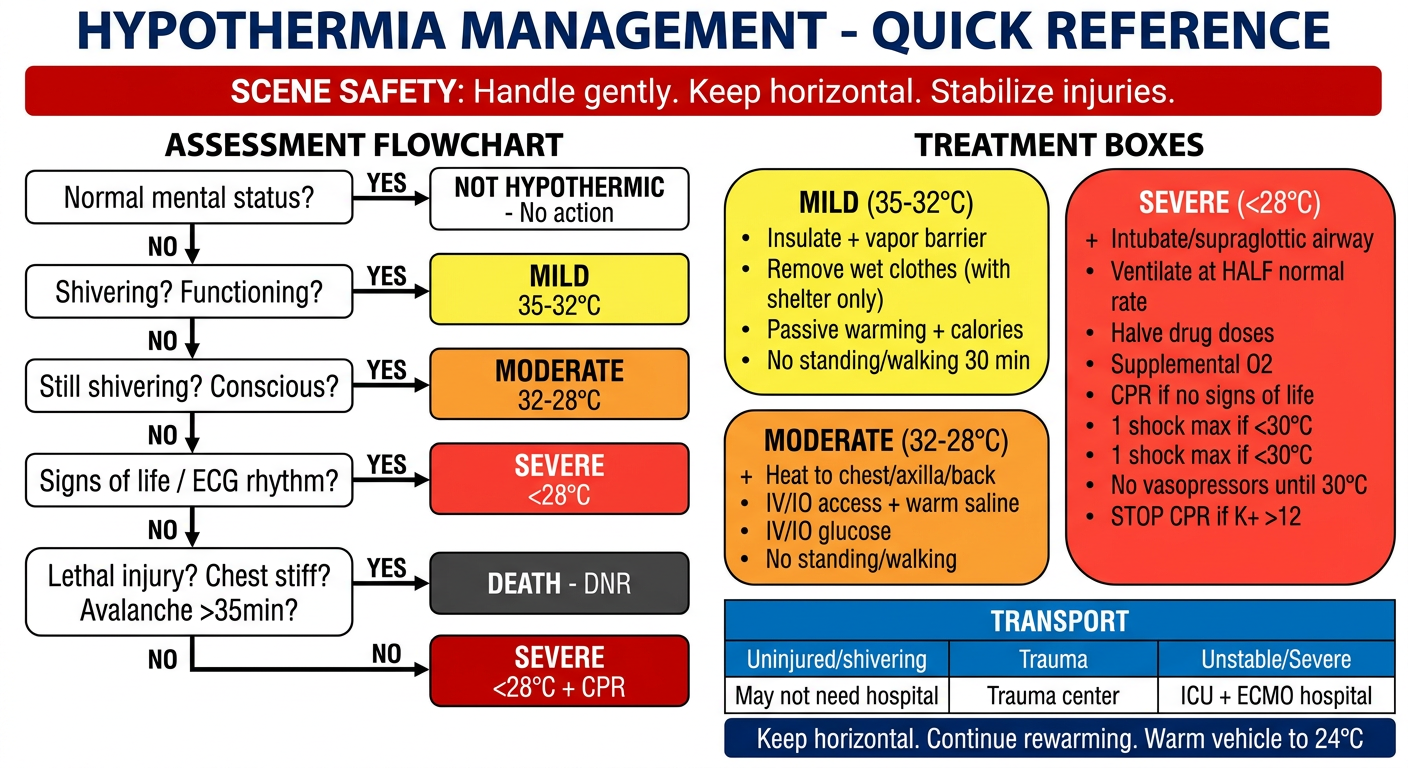
- Red banner at the top for scene safety
- Assessment flowchart on the left with yes/no decision points
- Color-coded treatment boxes (yellow → orange → red) by severity
- Transport guidance at the bottom