
The major hormones regulating obesity are:
Reading File
Now let me search the library in parallel for hormones related to obesity regulation.
Finding Sources
Finding Sources
Finding Sources
Finding Sources
Reading File
Finding Sources
Reading File
Excellent content found. Let me now pull the dedicated sections from Robbins Pathology and Harrison's on obesity hormones, and fetch the key diagram.
Reading File
Reading File
Loading Image
I now have comprehensive information from multiple authoritative textbooks. Let me compile the full answer.
Major Hormones Regulating Obesity
Obesity is fundamentally a disorder of energy regulation. The regulation of energy balance has three components: (1) afferent hormonal signals, (2) the hypothalamic integration center, and (3) efferent signals controlling energy balance. - Robbins, Cotran & Kumar Pathologic Basis of Disease
The key hormonal regulators are:
1. Leptin (THE central regulator)
- Source: Adipose tissue
- Mechanism: Secretion is proportional to fat mass. Binds receptors in the arcuate nucleus of the hypothalamus, decreasing appetite and increasing energy expenditure by:
- Stimulating POMC/CART neurons (anorexigenic - suppress food intake)
- Inhibiting NPY/AgRP neurons (orexigenic - stimulate food intake)
- In obesity: Leptin levels are chronically elevated but the brain becomes leptin resistant - the response to rising leptin is blunted, while falling leptin (during weight loss) is a powerful hunger stimulus. This asymmetry explains why diets fail and weight rebounds.
- Key concept: Leptin acts as an adipostat - it regulates both short-term (post-meal satiety lasting hours) and long-term (body fat set-point) food intake.
-
- Harrison's Principles of Internal Medicine 22E (2025)
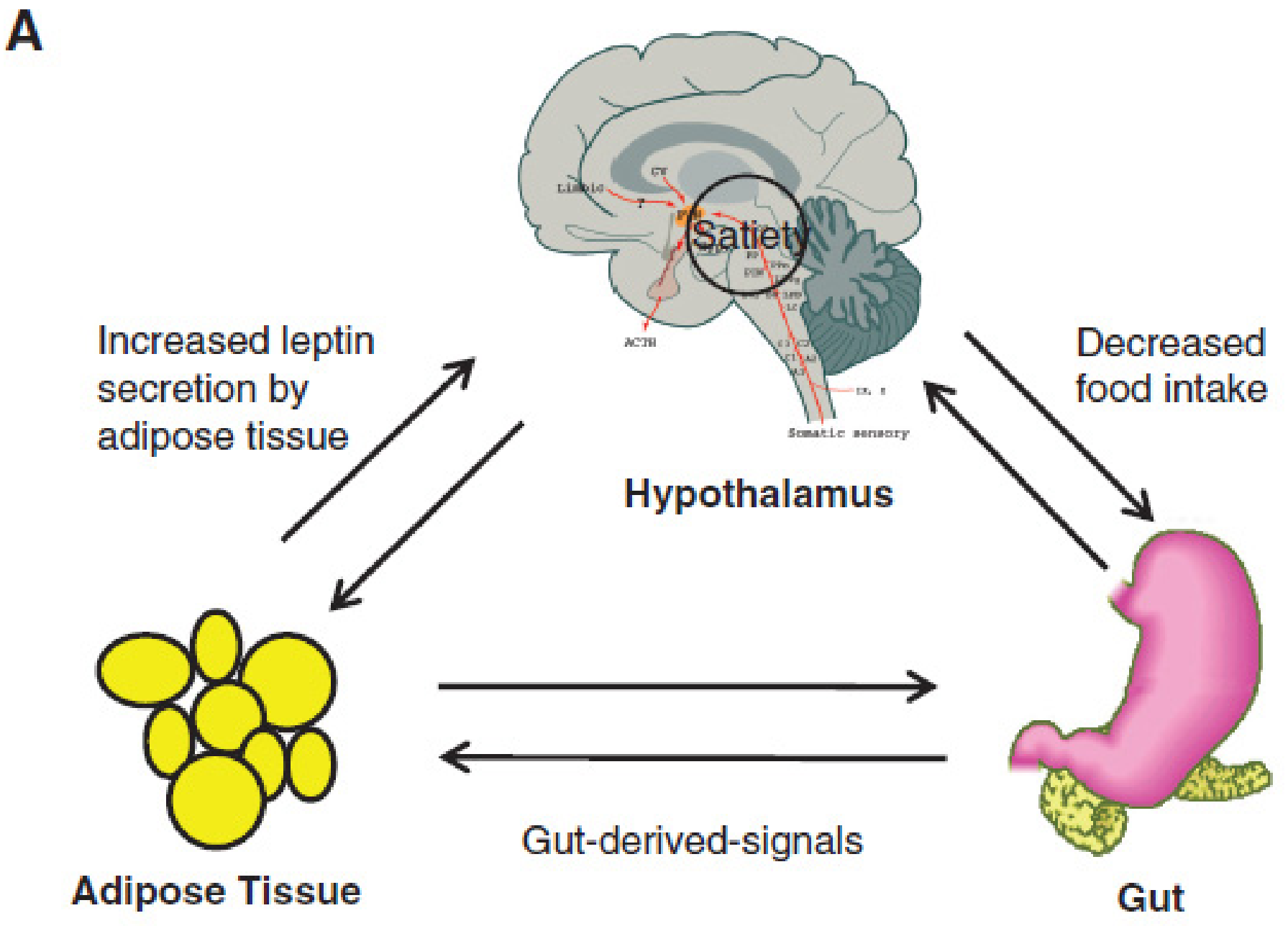
2. Ghrelin ("The Hunger Hormone")
- Source: Stomach (primarily), intestine, hypothalamus, pancreas
- Active form: Acyl-ghrelin (the orexigenic form)
- Mechanism: Acts via G-protein coupled receptors widely distributed in hypothalamus, pituitary, pancreas, and gut. Activates NPY/AgRP neurons to stimulate appetite.
- Pattern:
- Levels rise with fasting, weight loss, and caloric restriction
- Levels fall after feeding and in obese subjects
- IV administration induces hunger and increases oral intake
- Therapeutic relevance: Ghrelin antibodies and receptor antagonists are under investigation as anti-obesity agents.
-
- Mulholland & Greenfield's Surgery: Scientific Principles and Practice, 7e
3. Insulin
- Source: Pancreatic β-cells
- Role in obesity: A key afferent signal to the hypothalamus. Acts as both an anorexigenic signal (suppressing appetite at the hypothalamus) and a major driver of fat storage. In obesity, insulin resistance develops, creating a vicious cycle - more insulin is secreted, promoting further fat deposition.
-
- Robbins, Cotran & Kumar Pathologic Basis of Disease
4. GLP-1 and GIP (Incretins)
- Source: Enteroendocrine cells of the intestine (L-cells produce GLP-1; K-cells produce GIP)
- Mechanism:
- Stimulate insulin secretion from pancreatic β-cells (incretin effect)
- GLP-1 also reduces appetite by acting on hypothalamic receptors and slowing gastric emptying
- Clinical importance: GLP-1 receptor agonists (e.g., semaglutide, liraglutide) and dual GLP-1/GIP agonists (tirzepatide) are among the most effective current anti-obesity drugs, with proven benefits also in heart failure and renal disease.
-
- Robbins, Cotran & Kumar Pathologic Basis of Disease
5. Peptide YY (PYY)
- Source: L-cells of the ileum and colon (released post-meal)
- Mechanism: An anorexigenic gut hormone that suppresses appetite by acting on the arcuate nucleus. Levels are lower in obese individuals.
6. Adiponectin
- Source: Adipose tissue
- Role: An anti-obesity adipokine. Increases insulin sensitivity, stimulates fatty acid oxidation, and has anti-inflammatory effects. Levels are paradoxically decreased in obesity despite excess adipose tissue - this contributes to insulin resistance and metabolic syndrome.
-
- Mulholland & Greenfield's Surgery; Histology: A Text and Atlas
7. Neuropeptide Y (NPY) and AgRP - Hypothalamic Mediators
- These are not peripheral hormones but are critical central mediators within the arcuate nucleus:
- NPY/AgRP neurons: Orexigenic - stimulate food intake, reduce energy expenditure
- POMC/CART neurons: Anorexigenic - suppress food intake, increase energy expenditure
- All peripheral hormones ultimately act through these two neuronal populations.
-
- Mulholland & Greenfield's Surgery, 7e
8. Other Adipokines and Gut Peptides
| Hormone | Source | Effect on Appetite |
|---|---|---|
| Visfatin | Adipose tissue | Insulin-mimetic |
| Apelin | Adipose tissue | Orexigenic |
| Lipocalin | Adipose tissue | Metabolic regulation |
| Nesfatin-1 | Stomach | Anorexigenic |
| Oxyntomodulin | Gut | Anorexigenic |
| Pancreatic polypeptide | Pancreas | Anorexigenic |
| Cholecystokinin (CCK) | Duodenum | Anorexigenic (satiety) |
| Amylin | Pancreatic β-cells | Anorexigenic |
| Glucagon | Pancreatic α-cells | Anorexigenic |
-
- Mulholland & Greenfield's Surgery, 7e
Summary: Hormonal Imbalance in Obesity
| Hormone | In Obesity | Net Effect |
|---|---|---|
| Leptin | High, but resistance develops | Appetite not suppressed |
| Ghrelin | Reduced (partially compensatory) | Some appetite suppression |
| Insulin | High (resistance develops) | Promotes fat storage |
| GLP-1/GIP | Reduced response | Less satiety |
| PYY | Lower levels | Increased appetite |
| Adiponectin | Low (paradoxically) | Insulin resistance |
The core problem in common obesity is not a single hormone deficiency but a failure of the entire feedback system - particularly leptin resistance at the hypothalamic level - which prevents rising fat stores from triggering adequate appetite suppression.
This is a shared conversation. Sign in to Orris to start your own chat.