
Classify CNS Depressants, symptoms and treatment of ethyl alcohol and methyl alcohol poisoning. This is question asked in essay of forensic medicine University paper for 15 marks So provide me the answer in detail in flowchart, highlight important points for my writing
CNS Depressants - Classification, Ethyl Alcohol & Methyl Alcohol Poisoning
PART 1: CLASSIFICATION OF CNS DEPRESSANTS
╔══════════════════════════════════════════════════════════════════╗
║              CNS DEPRESSANTS — CLASSIFICATION                   ║
╚══════════════════════════════════════════════════════════════════╝
                              │
        ┌─────────────────────┼──────────────────────┐
        ▼                     ▼                      ▼
 ┌─────────────┐     ┌──────────────────┐    ┌────────────────┐
 │  ALCOHOLS   │     │ SEDATIVE-HYPNOTI-│    │  MISCELLANEOUS │
 │             │     │ CS & ANXIOLYTICS │    │                │
 │• Ethyl alc. │     │                  │    │• Antihistamines│
 │• Methyl alc.│     │• Barbiturates    │    │• Antipsychotic │
 │• Isopropyl  │     │  (Phenobarb,     │    │  drugs         │
 │  alcohol    │     │  Amylobarbitone) │    │• Antiepileptics│
 │• Ethylene   │     │• Benzodiazepines │    │• Anesthetic    │
 │  glycol     │     │  (Diazepam,      │    │  agents        │
 └─────────────┘     │  Lorazepam)      │    │• Carbon        │
                     │• Non-BZD hypnot. │    │  monoxide      │
                     │  (Chloral        │    │• Opioids/       │
                     │  hydrate,        │    │  Narcotics     │
                     │  Paraldehyde)    │    │  (Morphine,    │
                     │• Bromides        │    │  Heroin,       │
                     └──────────────────┘    │  Codeine)      │
                                             └────────────────┘
KEY POINT: Alcohol causes "irregularly descending CNS depression" - higher centres (cortex) are depressed first, followed by midbrain → thalamus → spinal cord → medulla. Recovery occurs in reverse order.
PART 2: ETHYL ALCOHOL (ETHANOL) POISONING
Properties & Fatal Dose
| Parameter | Details |
|---|---|
| Chemical | C₂H₅OH - a colourless liquid |
| Fatal dose | ~400 mg% (400 mg/100 mL) blood alcohol concentration |
| Fatal period | 8-10 hours; death if coma > 5 hours |
| Absorption | Rapid from GI tract; 90% oxidized in liver |
| Excretion | 5% in urine, 5% in breath, traces in sweat |
SYMPTOMS FLOWCHART - THREE STAGES
╔══════════════════════════════════════════════════════╗
║        ETHYL ALCOHOL — STAGES OF INTOXICATION       ║
╚══════════════════════════════════════════════════════╝

   Blood Alcohol 50-150 mg%
         │
         ▼
┌─────────────────────────────────────────────────────┐
│  STAGE 1: EXCITEMENT (Release Phenomenon)           │◄── ⭐ IMPORTANT
│  ► Feeling of well-being, euphoria                  │
│  ► Increased self-confidence, garrulousness         │
│  ► Impaired judgment and recklessness               │
│  ► Heightened sexual desire but reduced performance │
│  ► Reduced visual acuity                            │
│  ► Altered time/space orientation, sleepiness       │
│  ► Impaired memory & mental concentration           │
└─────────────────────────────────────────────────────┘
                          │
                          │ Blood Alcohol 150-250 mg%
                          ▼
┌─────────────────────────────────────────────────────┐
│  STAGE 2: INCO-ORDINATION                           │◄── ⭐ IMPORTANT
│  ► Affected sense perception & skilled movements    │
│  ► Irritable, quarrelsome, gay, sleepy              │
│  ► Clumsiness of fine movements                     │
│  ► Slurred speech, tremors of fingers               │
│  ► Nausea, vomiting                                 │
│  ► Pulse raised, face flushed                       │
│  ► Senses of touch/smell/hearing diminished         │
│  ► Pupils dilated (positive light reflex = hopeful) │
│  ► Alcoholic Gaze Nystagmus (AGN) - present in ~10%│
└─────────────────────────────────────────────────────┘
                          │
                          │ Blood Alcohol > 250 mg%
                          ▼
┌─────────────────────────────────────────────────────┐
│  STAGE 3: COMA                                      │◄── ⭐ IMPORTANT
│  ► Motor & sensory cells deeply affected            │
│  ► Markedly slurred speech, staggering gait         │
│  ► Stertorous (snoring) breathing                   │
│  ► Rapid pulse, subnormal temperature               │
│  ► PUPILS CONSTRICTED                               │
│  ► McEwan's Sign: pupils dilate on painful stimuli  │◄── 🔴 HIGH YIELD
│    then return slowly to contracted state           │
│  ► Recovery in 8-10 hrs OR death from asphyxia     │
│    (respiratory paralysis if coma > 5 hours)        │
└─────────────────────────────────────────────────────┘
🔴 McEwan's Sign = In coma stage, pupils constrict at rest but dilate on painful stimuli and return slowly to contracted state. This is pathognomonic of alcohol coma.
TREATMENT OF ETHYL ALCOHOL POISONING
╔══════════════════════════════════════════════════════╗
║      TREATMENT — ETHYL ALCOHOL POISONING            ║
╚══════════════════════════════════════════════════════╝
                          │
          ┌───────────────┼───────────────┐
          ▼               ▼               ▼
  ┌──────────────┐ ┌─────────────┐ ┌────────────────┐
  │  IMMEDIATE   │ │  SUPPORTIVE │ │   SPECIFIC     │
  │   MEASURES   │ │   THERAPY   │ │   MEASURES     │
  │              │ │             │ │                │
  │• Gastric     │ │• Maintain   │ │• Glucose IV    │
  │  lavage with │ │  airway &   │ │  (hypoglycemia │
  │  warm water  │ │  position   │ │  prevention)   │
  │• Remove from │ │  (lateral   │ │• Thiamine/     │
  │  cold        │ │  decubitus  │ │  Vitamin B1 IV │
  │  environment │ │  to avoid   │ │• Diazepam for  │
  │• Rest &      │ │  aspiration)│ │  agitation     │
  │  warmth      │ │• IV fluids  │ │• NO EMETICS    │
  │              │ │  (saline/   │ │  (risk of      │
  │              │ │  dextrose)  │ │  aspiration)   │
  └──────────────┘ └─────────────┘ └────────────────┘

  ⚠️ NOTE: NO specific antidote for ethyl alcohol
  ⚠️ Treatment is SYMPTOMATIC & SUPPORTIVE
PART 3: METHYL ALCOHOL (METHANOL) POISONING
Properties & Fatal Dose
| Parameter | Details |
|---|---|
| Chemical | CH₃OH - Wood spirit / wood alcohol |
| Appearance | Colourless, spirit-like odour |
| Uses | Industrial solvent, antifreeze, paint remover, adulterant in illicit liquor |
| Fatal dose | 100-125 mL (Dikshit); 60-240 mL (Parikh); 15 mL causes blindness |
| Fatal period | 24-36 hours (may be delayed up to 3-4 days) |
| Route of toxicity | Ingestion, inhalation, skin absorption |
MECHANISM OF ACTION FLOWCHART
╔══════════════════════════════════════════════════════════════╗
║          METHANOL METABOLISM & MECHANISM OF TOXICITY        ║
╚══════════════════════════════════════════════════════════════╝

  METHANOL (CH₃OH)
        │
        │ [Alcohol dehydrogenase - SLOW metabolism]
        ▼
  FORMALDEHYDE (HCHO)          ◄── ⭐ Damages RETINAL cells
        │                           (Primary damage: ganglion cells)
        │
        ▼
  FORMIC ACID (HCOOH)          ◄── ⭐ Inhibits cytochrome oxidase
        │                           → Histotoxic hypoxia
        │
        ├─────────────────────────────────────────────────►
        │                                                  │
        ▼                                                  ▼
  METABOLIC ACIDOSIS                            OPTIC NERVE ATROPHY
  (Anion gap metabolic acidosis)                PERMANENT BLINDNESS
  + Large amounts of lactic acid

  ⭐ Concentrates maximally in: VITREOUS BODY & OPTIC NERVE
  ⭐ Cumulative poison (slow excretion = builds up in blood)
  ⭐ Ethyl alcohol COMPETES with methanol for alcohol dehydrogenase
     → Blocks conversion to toxic metabolites (BASIS OF TREATMENT)
SYMPTOMS OF METHYL ALCOHOL POISONING
╔══════════════════════════════════════════════════════════════╗
║        METHYL ALCOHOL — SYMPTOMS & SIGNS                    ║
╚══════════════════════════════════════════════════════════════╝

  ONSET: Usually delayed 12-24 hours (may appear within 1 hour)
  (Latent period due to slow metabolism)
                        │
          ┌─────────────┼──────────────────┐
          ▼             ▼                  ▼
  ┌──────────────┐ ┌──────────────┐ ┌──────────────────────┐
  │   EARLY      │ │   GI/SYSTEMIC│ │   OCULAR (HALLMARK)  │
  │  SYMPTOMS    │ │   SYMPTOMS   │ │                      │
  │              │ │              │ │◄─ MOST DANGEROUS ───►│
  │• Headache    │ │• Nausea,     │ │                      │
  │• Dizziness   │ │  vomiting    │ │• Concentric diminu-  │
  │• Vertigo     │ │• Severe      │ │  tion of visual field│
  │• Weakness    │ │  epigastric  │ │• Photophobia         │
  │              │ │  pain        │ │• Blurred vision      │
  └──────────────┘ │• Pancreatitis│ │• Optic neuritis      │
                   │  (raised     │ │• Partial/TOTAL       │
                   │  amylase)    │ │  BLINDNESS           │
                   │• Dyspnoea &  │ │• Optic disc oedema   │
                   │  cyanosis    │ │• Optic nerve atrophy │
                   │• Cold sweats │ └──────────────────────┘
                   │• Depressed   │
                   │  cardiac     │
                   │  action      │
                   └──────────────┘
                        │
                        ▼
         LATE/SEVERE STAGE (ACIDOSIS DOMINANT)
  ┌─────────────────────────────────────────────────────┐
  │• Kussmaul breathing (deep, laboured)               │◄── ⭐ KEY SIGN
  │• Bradycardia                                        │
  │• Delirium and COMA (may last 2-3 days)              │
  │• Subnormal temperature                              │
  │• Urine: strongly acidic, contains albumin,          │
  │         acetone, formic acid                        │
  │• Convulsions (terminal event in fatal cases)        │
  │• Death from RESPIRATORY FAILURE                     │
  └─────────────────────────────────────────────────────┘

  🔴 DIAGNOSTIC FINDING: Intestinal contraction (bowel wall
     narrowed, resembling thick pipe with very narrow lumen)
     Affects small/large bowel or both — PATHOGNOMONIC of
     methanol poisoning
TREATMENT OF METHYL ALCOHOL POISONING
╔══════════════════════════════════════════════════════════════╗
║         TREATMENT — METHYL ALCOHOL POISONING                ║
╚══════════════════════════════════════════════════════════════╝

  PRINCIPLE: Correction of acidosis is the MAINSTAY of treatment

           ┌──────────────────────────────────────────┐
           │         STEP-BY-STEP TREATMENT            │
           └──────────────────────────────────────────┘

  STEP 1 — PREVENT ABSORPTION
  ┌──────────────────────────────────────────────────────┐
  │  • Gastric lavage with 4-5% Sodium Bicarbonate       │◄── ⭐ KEY
  │    solution in warm water                            │
  │  • Leave 500 mL of this solution in stomach          │
  │  • Whole bowel irrigation (if facilities permit)     │
  └──────────────────────────────────────────────────────┘
                          │
                          ▼
  STEP 2 — CORRECT ACIDOSIS (MOST IMPORTANT)
  ┌──────────────────────────────────────────────────────┐
  │  • Sodium bicarbonate 1.2 gm orally every 15 min     │◄── ⭐ KEY
  │    (or via stomach tube if unconscious)              │
  │  • Continue till plasma bicarbonate > 20 mEq/L       │
  │    or until hypokalemia occurs                       │
  │  • Alternative: 50 gm NaHCO₃ in 1 litre 5% Dextrose │
  │    given IV                                          │
  │  • Oral NaHCO₃: 2 gm (½ tsp) in 250 mL water        │
  │    every 2 hours to maintain neutral/alkaline urine  │
  └──────────────────────────────────────────────────────┘
                          │
                          ▼
  STEP 3 — SPECIFIC ANTIDOTE
  ┌──────────────────────────────────────────────────────┐
  │  ⭐⭐ ETHYL ALCOHOL as COMPETITIVE ANTAGONIST ⭐⭐    │◄── 🔴 HIGH YIELD
  │                                                      │
  │  • Ethyl alcohol 50% — 60 mL INITIALLY (oral)        │
  │  • Then 10-15 mL/hour subsequently for 4-6 DAYS      │
  │  • Ethyl alcohol (80° proof brandy) — 1 mL/kg body   │
  │    weight every 4-6 hours (alternative dosing)       │
  │                                                      │
  │  MECHANISM: Ethanol competes with methanol for        │
  │  alcohol dehydrogenase enzyme → BLOCKS conversion    │
  │  of methanol to formaldehyde & formic acid           │
  │  → methanol excreted unchanged via kidneys/lungs     │
  └──────────────────────────────────────────────────────┘
                          │
                          ▼
  STEP 4 — SUPPORTIVE MEASURES
  ┌──────────────────────────────────────────────────────┐
  │  • IV fluids: 5% Dextrose saline + Molar sodium      │
  │    lactate (promotes diuresis)                       │
  │  • Renal dialysis / Haemodialysis                    │◄── ⭐ KEY
  │    (if severe, remove methanol directly)             │
  │  • Oxygen inhalation + Artificial respiration        │
  │  • Stimulants and steroids                           │
  │  • Barbiturates to control convulsions               │
  │  • Fomepizole (4-MP) — ADH inhibitor (modern Rx)    │
  └──────────────────────────────────────────────────────┘
🔴 ANTIDOTE: Ethyl alcohol (50%) is the specific antidote for methanol poisoning. It acts as a competitive inhibitor of alcohol dehydrogenase, blocking formation of toxic metabolites.
COMPARISON TABLE: ETHYL vs METHYL ALCOHOL
| Feature | Ethyl Alcohol | Methyl Alcohol |
|---|---|---|
| Chemical formula | C₂H₅OH | CH₃OH |
| Common name | Grain spirit, ethanol | Wood spirit, methanol |
| Toxic metabolites | Acetaldehyde, Acetic acid (less toxic) | Formaldehyde, Formic acid (highly toxic) |
| Fatal dose | ~400 mg% BAC | 100-125 mL |
| Fatal period | 8-10 hours | 24-36 hours |
| Symptom onset | Rapid | Delayed 12-24 hours |
| Eye involvement | Minimal (reduced acuity) | BLINDNESS (hallmark) |
| Acidosis | Mild | Severe metabolic acidosis |
| Kussmaul breathing | Absent | Present |
| McEwan's sign | Present (coma stage) | Not described |
| Antidote | None specific | Ethyl alcohol / Fomepizole |
| Dialysis | Not usually needed | Often required |
| Medicolegal | Homicidal possible | Always accidental/mass poisoning |
POSTMORTEM FINDINGS — METHYL ALCOHOL
  EXTERNAL:
  • Cyanosis, smell of alcohol from body

  INTERNAL:
  ┌────────────────────────────────────────────────────┐
  │• Stomach & intestines: HYPERAEMIC, congested,      │
  │  patchy submucous HAEMORRHAGES                     │
  │• Fat NECROSIS in peritoneum                        │
  │• Brain & meninges: CONGESTED and OEDEMATOUS        │
  │• Lungs & Kidneys: congested and oedematous         │
  │• Pancreas: NECROSIS and HAEMORRHAGE                │
  │• EYES (characteristic):                            │
  │  - Degenerative changes in corneal epithelium      │
  │  - Retinal oedema of optic disc                    │
  │  - OPTIC NERVE ATROPHY                             │◄── ⭐ KEY
  │• Intestinal contraction (pathognomonic)            │◄── 🔴 HIGH YIELD
  └────────────────────────────────────────────────────┘
MEDICOLEGAL ASPECTS
- Poisoning may be accidental, homicidal, or suicidal
- Used as a defence plea in criminal cases
- Drunkenness defined by British Medical Council 1927
- ALWAYS ACCIDENTAL - mass poisoning from adulterated illicit liquor
- Used inadvertently when ethyl alcohol not available
- Classic Indian cases: consumption of "So/Ox" (shellac + ethyl + methyl alcohol) or "Khopadi" (cheap country liquor adulterated with methyl alcohol and French polish)
- Fetal tissue is extremely sensitive - dangerous even at low doses
📝 WRITING TIP FOR 15-MARK ESSAY: Structure your answer as: (1) Brief intro on CNS depressants classification, (2) Ethyl alcohol - properties, stages of intoxication with BAC levels, McEwan's sign, treatment, (3) Methyl alcohol - mode of action emphasizing formaldehyde/formic acid metabolites, eye involvement as hallmark, treatment with ethyl alcohol as antidote, (4) Comparison table. Always mention McEwan's sign, intestinal contraction, and ethanol as antidote - these are the highest yield exam points.
Okay can u provide the answer in a attractive manner with flowchart from narayan Reddy latest edition
🧠 CNS Depressants — Classification, Ethyl & Methyl Alcohol Poisoning
📖 Source: KS Narayan Reddy — Essentials of Forensic Medicine & Toxicology, 36th Edition (2026)
🔷 PART 1 — CLASSIFICATION OF CNS DEPRESSANTS
Definition (Narayan Reddy): "Substances or liquids which produce euphoria, wellbeing by inhibition of civilized higher centers in brain, thereby causing primitive uninhibited actions, followed by cerebral depression."
╔══════════════════════════════════════════════════════════════════════╗
║                    CNS DEPRESSANTS                                  ║
╚══════════════════════════════════════════════════════════════════════╝
                              │
     ┌────────────────────────┼─────────────────────────┐
     ▼                        ▼                         ▼
┌──────────────┐     ┌─────────────────────┐     ┌────────────────────┐
│   ALCOHOLS   │     │  SEDATIVE-HYPNOTICS │     │    NARCOTICS /     │
│              │     │  & ANXIOLYTICS      │     │    OPIOIDS         │
│ • Ethyl alc. │     │                     │     │                    │
│ • Methyl alc.│     │ • Barbiturates      │     │ • Morphine         │
│ • Chloral    │     │ • Benzodiazepines   │     │ • Heroin           │
│   hydrate    │     │ • Paraldehyde       │     │ • Codeine          │
│ • Isopropyl  │     │ • Bromides          │     │ • Opium            │
│   alcohol    │     │ • Non-BZD agents    │     │ • Methadone        │
│ • Ethylene   │     │   (Chloral hydrate) │     │                    │
│   glycol     │     │                     │     └────────────────────┘
└──────────────┘     └─────────────────────┘
                              │
                    ┌─────────┴──────────┐
                    ▼                    ▼
          ┌──────────────────┐  ┌─────────────────────┐
          │   GASEOUS CNS    │  │    MISCELLANEOUS     │
          │   DEPRESSANTS    │  │                      │
          │                  │  │ • Antipsychotics     │
          │ • Carbon         │  │ • Antihistamines     │
          │   monoxide       │  │ • Antiepileptics     │
          │ • Carbon         │  │ • General anesthetic │
          │   dioxide        │  │   agents             │
          │ • Hydrogen       │  │ • Tranquilizers      │
          │   sulphide       │  │ • Hallucinogens      │
          └──────────────────┘  └─────────────────────┘
⭐ KEY POINT: Narayan Reddy specifically lists: "Ethyl alcohol, methyl alcohol, chloral hydrate" as classic CNS depressants under the alcohols group.
🔶 PART 2 — ETHYL ALCOHOL (ETHANOL) POISONING
🔬 Properties at a Glance
| Feature | Details |
|---|---|
| Appearance | Transparent, volatile, colourless, non-fuming watery liquid |
| Odour | Characteristic alcoholic odour |
| Source | Fermentation & distillation of sugar, grains, jaggery, cane |
| Fatal dose | BAC > 500 mg% (adults: 5-8 g/kg body weight) |
| Fatal period | 12-24 hours |
| BAC falls by | 15 mg% per hour (metabolic clearance rate) |
🌡️ STAGES OF ACUTE ALCOHOL INTOXICATION — FLOWCHART
╔══════════════════════════════════════════════════════════════════════╗
║        ETHYL ALCOHOL — STAGES OF INTOXICATION (Narayan Reddy)      ║
╚══════════════════════════════════════════════════════════════════════╝

   BAC < 50 mg%
        │
        ▼
┌───────────────────────────────────────────────────────────────────┐
│  STAGE 0: SOBRIETY / INEBRIATION                                  │
│  • Mild euphoria                                                  │
│  • Easy socialization                                             │
│  • High boasting speech, altered gait                            │
└───────────────────────────────────────────────────────────────────┘
                               │
                     BAC 50–100 mg%
                               │
                               ▼
┌───────────────────────────────────────────────────────────────────┐
│  STAGE 1: EUPHORIA ⭐                                             │
│  • Decreased attention span & cognitive functions                │
│  • Inhibitions released → feeling of wellbeing                   │
│  • ↑ Self-confidence, talkativeness, sociability                 │
│  • Nausea, dizziness, palpitations                               │
│  • Flushed red face, subconjunctival suffusion (red eyes)        │◄── 🔴 KEY
│  • Salivation, dilated pupils                                    │
└───────────────────────────────────────────────────────────────────┘
                               │
                    BAC 100–150 mg%
                               │
                               ▼
┌───────────────────────────────────────────────────────────────────┐
│  STAGE 2: EXCITEMENT / INCO-ORDINATION ⭐⭐                       │
│  • Lack of control over muscular movements                       │
│  • In-coordination, lack of self-control                         │
│  • SLURRED SPEECH                                                │◄── 🔴 KEY
│  • Delirious, sleepiness, disorderly behaviour                   │
│  • Abusive broken language                                       │
│  • ALCOHOLIC GAZE NYSTAGMUS (AGN)                                │◄── 🔴 KEY
└───────────────────────────────────────────────────────────────────┘
                               │
                     BAC > 150 mg%
                               │
                               ▼
┌───────────────────────────────────────────────────────────────────┐
│  STAGE 3: COMA ⭐⭐⭐                                              │
│  • Decreased response to painful stimuli                         │
│  • Laboured breathing (stertorous)                               │
│  • PUPILLARY CONSTRICTION                                        │◄── 🔴 KEY
│  • Brisk reflexes early → loss of consciousness later            │
│  • Deep sleep for 4–6 hours, then person recovers               │
│                                                                   │
│  ★ McEWAN'S SIGN: Slap on temple → pupil DILATES                │◄──🔴 HIGH YIELD
│    then CONTRACTS again                                          │
│  • Deep coma rare; alcohol alone usually does NOT kill           │
│  • Death only if: asphyxia + comorbidities + cold exposure       │
└───────────────────────────────────────────────────────────────────┘
                               │
                     BAC > 500 mg%
                               │
                               ▼
┌───────────────────────────────────────────────────────────────────┐
│  DEATH 💀                                                         │
│  Cause of death:                                                  │
│  (1) Depression of respiratory centre (BAC > 500 mg%)           │
│  (2) Asphyxia — inhalation of food bolus (café coronary)        │
└───────────────────────────────────────────────────────────────────┘
💊 TREATMENT OF ETHYL ALCOHOL POISONING
╔══════════════════════════════════════════════════════════════════╗
║         TREATMENT — ETHYL ALCOHOL (Narayan Reddy 36th Ed.)     ║
╚══════════════════════════════════════════════════════════════════╝

   ┌─────────────────────────────────────────────────────────┐
   │  (1) AIRWAY — Maintain airway, PREVENT ASPIRATION      │◄── ⭐ FIRST STEP
   │      Place in LATERAL POSITION                         │
   └─────────────────────────────────────────────────────────┘
                              │
                              ▼
   ┌─────────────────────────────────────────────────────────┐
   │  (2) MONITOR — Watch renal functions in deep coma       │
   └─────────────────────────────────────────────────────────┘
                              │
                              ▼
   ┌─────────────────────────────────────────────────────────┐
   │  (3) FLUMAZENIL — Consider for patients with            │◄── ⭐ NEW (36th Ed.)
   │      hepatic encephalopathy                             │
   └─────────────────────────────────────────────────────────┘
                              │
                              ▼
   ┌─────────────────────────────────────────────────────────┐
   │  (4) VITAMIN B SUPPLEMENTATION — Alcoholic addicts     │◄── ⭐ IMPORTANT
   │      have Vitamin B deficiency; supplement them         │
   │      (Thiamine/B1 to prevent Wernicke's)               │
   └─────────────────────────────────────────────────────────┘
                              │
                              ▼
   ⚠️  NO SPECIFIC ANTIDOTE — Treatment is SYMPTOMATIC
🔬 Autopsy Findings (Ethyl Alcohol)
  ┌─────────────────────────────────────────────────────────────┐
  │  EXTERNAL: Suffused red conjunctiva                         │
  │  INTERNAL:                                                  │
  │  • Signs of asphyxia                                       │
  │  • Alcoholic fruity odour from body cavities & stomach     │◄── ⭐ KEY
  │  • Stomach mucosa congestion                               │
  └─────────────────────────────────────────────────────────────┘
🔴 PART 3 — METHYL ALCOHOL (METHANOL) POISONING
🔬 Properties at a Glance
| Feature | Details |
|---|---|
| Synonyms | Wood alcohol, wood naphthol, pyroxilic acid, Columbian spirit, mono hydroxy methane |
| Formula | CH₃OH |
| Appearance | Colourless, highly polar, flammable liquid — faint sweetish odour, bitter taste |
| Fatal dose | 15-250 mL (average 70-100 mL); as little as 15 mL causes blindness |
| Routes of toxicity | Ingestion, Inhalation, Parenteral |
🏭 Uses (Source: Narayan Reddy)
  Carburetor cleaner (20%) | Antifreeze (10-50%) | Denatured spirit (5-10%)
  Embalming fluid (20%) | Leather dyes (30%) | Varnish/shellac
  Paint remover | Windshield cleaner | Solvent (cholesterol, streptomycin,
  vitamins, hormones manufacturing)
⚗️ MECHANISM OF ACTION — FLOWCHART
╔══════════════════════════════════════════════════════════════════════╗
║         METHANOL — MECHANISM OF TOXICITY (Narayan Reddy)           ║
╚══════════════════════════════════════════════════════════════════════╝

  METHANOL ingested / inhaled / absorbed through skin
              │
              │  Peak blood level by 30–60 minutes
              │  [Absorbed from GI tract, inhalation, parenteral]
              ▼
  ┌────────────────────────────────────────────────────────┐
  │          LIVER — Alcohol Dehydrogenase (ADH)           │
  │          [SLOW metabolism — stays in blood up to 1 WK] │
  └────────────────────────────────────────────────────────┘
              │
              ▼
  ┌─────────────────────┐
  │   FORMALDEHYDE      │ ──────────────────────►  RETINAL DAMAGE
  │   (Highly TOXIC)    │                          (ganglion cell damage
  └─────────────────────┘                           → optic atrophy)
              │
              ▼
  ┌─────────────────────┐
  │    FORMIC ACID      │ ──────────────────────►  Inhibits cytochrome
  │   (Highly TOXIC)    │                          oxidase → histotoxic
  └─────────────────────┘                          hypoxia
              │
              ▼
  ┌─────────────────────────────────────────────────────────┐
  │       SEVERE METABOLIC ACIDOSIS (High Anion Gap)        │◄── ⭐ KEY
  │   + Accumulation of lactic acid & other organic acids   │
  │   + Neurological symptoms                               │
  └─────────────────────────────────────────────────────────┘

  ★ CRUCIAL: Metabolic acidosis is DELAYED by 18–24 hours
  ★ Methanol concentrates in VITREOUS BODY & OPTIC NERVE
  ★ Unmetabolized methanol detectable in blood up to 1 WEEK
🤒 SYMPTOMS & SIGNS — FLOWCHART
╔══════════════════════════════════════════════════════════════════════╗
║       METHYL ALCOHOL — SIGNS & SYMPTOMS (Narayan Reddy 36th Ed.)   ║
╚══════════════════════════════════════════════════════════════════════╝

   INGESTION
       │
       │◄── LATENT PERIOD (18–24 hours — acidosis builds up)
       ▼
  ┌───────────────────────────────────────────────────────────────┐
  │  EARLY SYMPTOMS                                               │
  │  • Vertigo, Headache, Neck stiffness                         │
  │  • Vomiting, Abdominal pain                                  │
  │  • General malaise, dizziness, neuritis                      │
  └───────────────────────────────────────────────────────────────┘
                              │
                              ▼
  ┌───────────────────────────────────────────────────────────────┐
  │  OCULAR SYMPTOMS ⭐⭐⭐ (HALLMARK OF METHANOL POISONING)      │◄── 🔴 HIGH YIELD
  │                                                               │
  │  • Ocular neuritis → BLURRED VISION → DIMMED VISION          │
  │  • Retrobulbar degeneration of retina                        │
  │  • Optic atrophy → BLINDNESS (PERMANENT)                     │
  │  • 15 mL → causes blindness                                  │
  │                                                               │
  │  On Fundoscopy: Retrobulbar oedema, hyperaemia               │◄── ⭐ KEY
  └───────────────────────────────────────────────────────────────┘
                              │
                              ▼
  ┌───────────────────────────────────────────────────────────────┐
  │  SYSTEMIC SYMPTOMS                                            │
  │  • Metabolic acidosis (delayed 18–24 hours)                  │◄── ⭐ KEY
  │  • Renal failure + multi-organ failure                       │
  │  • Tachycardia, Hypertension                                 │
  │  • CONVULSIONS → COMA                                        │
  └───────────────────────────────────────────────────────────────┘
                              │
                              ▼
  ┌───────────────────────────────────────────────────────────────┐
  │  IF SURVIVED — RESIDUAL EFFECTS ⭐ (NEW in 36th Ed.)         │◄── 🔴 UNIQUE POINT
  │  • Putamen nuclear damage                                    │
  │  • Residual EXTRAPYRAMIDAL MOVEMENT DISORDER                 │
  └───────────────────────────────────────────────────────────────┘
                              │
                              ▼
                          DEATH 💀
               (Respiratory failure / multi-organ failure)
🩺 DIAGNOSIS (Narayan Reddy 36th Ed.)
  ┌──────────────────────────────────────────────────────────────┐
  │  LABORATORY DIAGNOSIS                                        │
  │  (1) HIGH ANION GAP                                         │◄── ⭐
  │  (2) Elevated OSMOLAL GAP                                   │◄── ⭐
  │  (3) Blood METHANOL level                                   │
  │  (4) Detectable FORMIC ACID in blood                        │
  │  (5) CT/MRI: Evidence of BASAL GANGLIA degeneration         │◄── ⭐ NEW
  │  (6) FUNDOSCOPY: Retrobulbar oedema, hyperaemia             │
  │  (7) Optical Coherence Tomography (OCT)                     │◄── ⭐ LATEST
  └──────────────────────────────────────────────────────────────┘
💊 TREATMENT OF METHYL ALCOHOL POISONING — FLOWCHART
╔══════════════════════════════════════════════════════════════════════╗
║      TREATMENT — METHANOL POISONING (Narayan Reddy 36th Ed.)       ║
╚══════════════════════════════════════════════════════════════════════╝

  STEP 1 — DECONTAMINATION
  ┌────────────────────────────────────────────────────────────┐
  │  Gastric lavage with SODIUM BICARBONATE solution           │◄── ⭐
  └────────────────────────────────────────────────────────────┘
                             │
                             ▼
  STEP 2 — SPECIFIC ANTIDOTE ⭐⭐⭐
  ┌────────────────────────────────────────────────────────────┐
  │  ETHANOL (specific antidote)                               │◄── 🔴 HIGH YIELD
  │                                                            │
  │  MECHANISM: Both ethanol & methanol compete for ADH        │
  │  enzyme — but ETHANOL has HIGHER AFFINITY to ADH           │
  │  → Methanol cannot be metabolized to toxic products        │
  │  → Methanol excreted unchanged                             │
  │                                                            │
  │  DOSE: Whisky / Gin / Vodka — 2.5 mg/kg = ~175 mL         │◄── ⭐ SPECIFIC DOSE
  └────────────────────────────────────────────────────────────┘
                             │
                             ▼
  STEP 3 — ENHANCED ELIMINATION
  ┌────────────────────────────────────────────────────────────┐
  │  HAEMODIALYSIS — MOST EFFECTIVE method                     │◄── 🔴 HIGH YIELD
  │  (removes both methanol AND formaldehyde directly)         │
  └────────────────────────────────────────────────────────────┘
                             │
                             ▼
  STEP 4 — ADJUVANT THERAPY
  ┌────────────────────────────────────────────────────────────┐
  │  FOLINIC ACID (Leucovorin) — 1-2 mg/kg IV                 │◄── ⭐ NEW (36th Ed.)
  │  • Essential in almost ALL cases                           │
  │  • Enhances formate metabolism → CO₂ + H₂O               │
  └────────────────────────────────────────────────────────────┘
                             │
                             ▼
  STEP 5 — SUPPORTIVE CARE
  ┌────────────────────────────────────────────────────────────┐
  │  • Correct metabolic acidosis (IV NaHCO₃)                 │
  │  • Oxygen + artificial respiration                        │
  │  • IV fluids for multi-organ support                      │
  │  • Anticonvulsants for seizures                           │
  └────────────────────────────────────────────────────────────┘
🔴 ANTIDOTE SUMMARY: Ethanol (whisky/gin/vodka ~175 mL / 2.5 mg/kg) because it has higher affinity for alcohol dehydrogenase than methanol — blocks formation of formaldehyde and formic acid.
📊 COMPARISON TABLE: ETHYL vs METHYL ALCOHOL
| Feature | Ethyl Alcohol | Methyl Alcohol |
|---|---|---|
| Formula | C₂H₅OH | CH₃OH |
| Synonyms | Grain spirit, ethanol | Wood alcohol, Columbian spirit |
| Metabolism | → Acetaldehyde → Acetic acid | → Formaldehyde → Formic acid |
| Metabolic speed | Moderate (15 mg%/hr) | SLOW (up to 1 week in blood) |
| Fatal dose | BAC > 500 mg% | 15-250 mL (15 mL = blindness) |
| Fatal period | 12-24 hours | 24-36 hours (delayed) |
| Symptom onset | Rapid | Delayed 18-24 hours |
| Eye involvement | Minimal | BLINDNESS (hallmark) |
| Acidosis | Mild | Severe (high anion gap) |
| McEwan's sign | Present (coma stage) | Not specific |
| Residual effects | None significant | Extrapyramidal disorder |
| Antidote | None specific | Ethanol + Folinic acid |
| Haemodialysis | Rarely needed | Most effective Rx |
| Cause of death | Respiratory depression/asphyxia | Respiratory failure + MOF |
| Medicolegal | Accidental/Homicidal/Suicidal | Always ACCIDENTAL / Mass tragedy |
🔴 MEDICOLEGAL ASPECTS (Narayan Reddy)
- (1) Accidental poisoning is most common - in indigenous methylated spirits
- (2) Intentional adulteration of ethyl alcohol with methyl alcohol leads to mass deaths → called "LIQUOR TRAGEDIES" in media
- (3) Nail polish removers, paints used as solvent/substance abuse among adolescents is not rare
- Doctor under influence of alcohol causing patient death = punishable under Section 106 BNS, Act 45 of 2023 (Narayan Reddy 36th Ed.)
🧪 PRESERVATION OF VISCERA
  Ethyl Alcohol poisoning:
  → Postmortem blood → screwcap bottle (frozen) → RFSL for BAC estimation
  → CSF, any body fluid also suitable
  → Liver, brain, lungs, heart, kidney for histopathology

  Methyl Alcohol poisoning:
  → Routine viscera in SATURATED COMMON SALT SOLUTION         ◄── ⭐ KEY
  → (NOT in rectified spirit — as that contains ethyl alcohol,
     which would contaminate the specimen)
✏️ EXAM WRITING STRATEGY — 15 Marks
  INTRODUCTION (1 mark)     → Define CNS depressants, classification
  CNS CLASSIFICATION (2 marks) → Groups with examples
  ETHYL ALCOHOL (4 marks)   → Properties → Stages (3 stages with BAC levels)
                               → McEwan's sign → Fatal dose → Treatment
  METHYL ALCOHOL (5 marks)  → Properties → MOA (ADH → Formaldehyde →
                               Formic acid) → Symptoms (BLINDNESS as
                               hallmark) → Diagnosis → Treatment
                               (Ethanol antidote + Haemodialysis +
                               Folinic acid)
  COMPARISON TABLE (2 marks) → At least 6-8 points compared
  MEDICOLEGAL (1 mark)      → Liquor tragedies, viscera preservation
🔴 3 MUST-WRITE POINTS that fetch marks:
- McEwan's sign - pupil dilates then contracts on painful stimulation in ethanol coma
- Ethanol as antidote for methanol (higher ADH affinity, dose: 2.5 mg/kg ~175 mL)
- Haemodialysis = most effective method in methanol poisoning (Narayan Reddy 36th Ed.)
Create a visual infographic poster on alcohol poisoning stages and McEwan's sign
Medical education infographic poster titled "Alcohol Poisoning: Stages of Intoxication & McEwan's Sign" for forensic medicine students. Clean, professional medical poster with dark navy blue background. Layout from top to bottom: HEADER: Bold white title "ALCOHOL POISONING" with subtitle "Stages of Intoxication & McEwan's Sign" in gold. Small label "Forensic Medicine | KS Narayan Reddy 36th Ed." in small text. MAIN CONTENT - Four colored stage boxes arranged vertically with arrows between them: STAGE 0 - GREEN box: "SOBRIETY / INEBRIATION" - BAC < 50 mg% - bullet points: Mild euphoria, Easy socialization, Boasting speech, Altered gait STAGE 1 - YELLOW/AMBER box: "EUPHORIA" - BAC 50-100 mg% - bullet points: Feeling of wellbeing, ↑ Self-confidence & talkativeness, Flushed red face, Subconjunctival suffusion (red eyes), Dilated pupils, Nausea, dizziness STAGE 2 - ORANGE box: "EXCITEMENT / INCO-ORDINATION" - BAC 100-150 mg% - bullet points: Slurred speech, Muscular inco-ordination, Alcoholic Gaze Nystagmus (AGN), Disorderly behaviour, Delirious, sleepy STAGE 3 - RED box: "COMA" - BAC > 150-500 mg% - bullet points: Loss of consciousness, Laboured breathing, Pupillary CONSTRICTION, Decreased pain response, Deep sleep 4-6 hours DEATH - BLACK box with skull icon: BAC > 500 mg% - "Respiratory centre depression / Asphyxia" RIGHT SIDE PANEL - Special highlighted section in bright blue/purple box: "★ McEWAN'S SIGN" in large gold bold text Diagram showing: Eye icon → "Painful stimulus (slap on temple)" → Eye icon with large pupil → "Pupil DILATES" → Arrow → Eye icon with small pupil → "Then slowly CONTRACTS again" Text below: "Seen in Stage of COMA | Pathognomonic of Alcohol Intoxication" BOTTOM BANNER - Three small boxes: Box 1 RED: "Fatal Dose: BAC > 500 mg%" Box 2 ORANGE: "Fatal Period: 12-24 hours" Box 3 GREEN: "BAC clears at 15 mg%/hour" Overall style: Clean medical infographic, bright colors, clear typography, professional forensic medicine educational poster with icons and arrows connecting stages
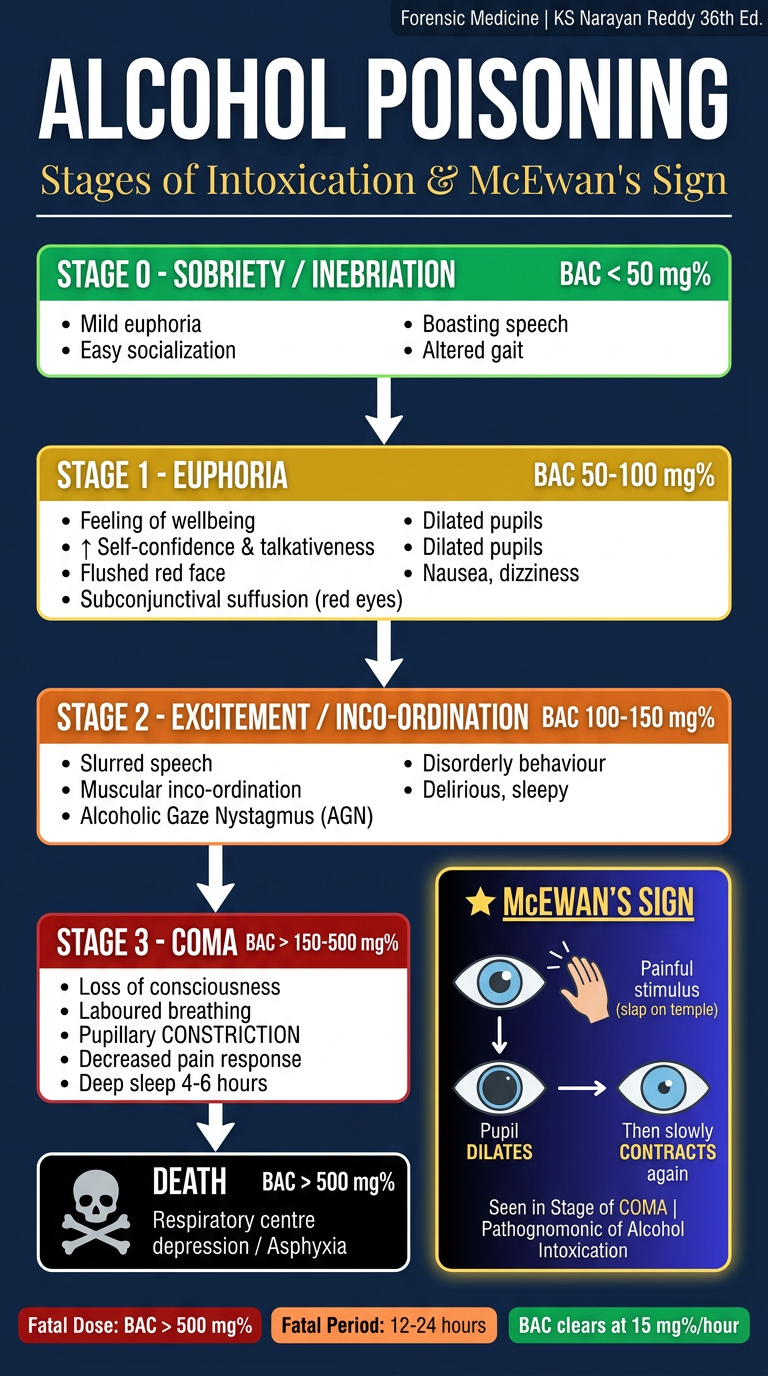
- 4 color-coded stages (Green → Yellow → Orange → Red) with BAC levels for each
- McEwan's Sign highlighted in a dedicated panel showing the pupil dilation-contraction sequence
- Fatal dose, fatal period, and BAC clearance rate in the bottom banner