
from Guyton and Hall textbook of medical physiology, 4th South Asia edition, write a 5-mark short note on menstrual Cycle-phase
Reading File
Finding Sources
Finding Sources
Finding Sources
Finding Sources
Finding Sources
Finding Sources
Reading File
Reading File
Reading File
Reading File
Finding Sources
Reading File
Loading Image
I now have all the content needed from Guyton and Hall. Let me compile the comprehensive 5-mark short note.
Menstrual Cycle - Phases
(Guyton and Hall Textbook of Medical Physiology, 4th South Asia Edition)
Introduction
The female monthly sexual cycle (commonly called the menstrual cycle) refers to the rhythmic, cyclical changes in ovarian hormone secretion and corresponding changes in the ovaries and uterus. The average duration is 28 days (range: 20-45 days). It has two interrelated components:
- The ovarian cycle (follicular and luteal phases)
- The endometrial (uterine) cycle (proliferative, secretory, and menstrual phases)
- Guyton and Hall Textbook of Medical Physiology, Ch. 82
Phases of the Menstrual Cycle
The endometrial cycle operates through three stages:
- Proliferation of the uterine endometrium
- Development of secretory changes in the endometrium
- Desquamation of the endometrium (menstruation)
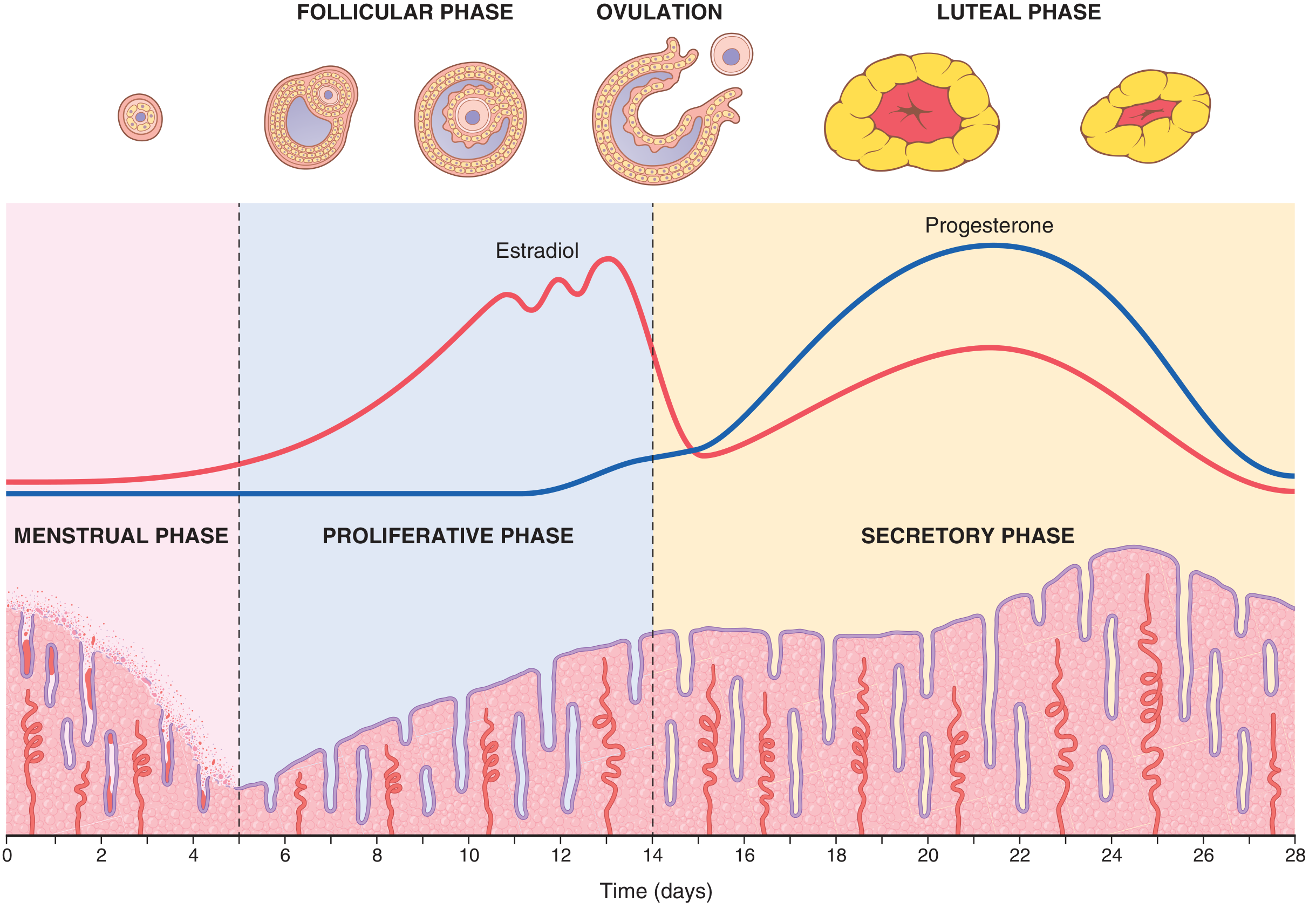
1. Menstrual Phase (Days 1-5)
Menstruation begins when the corpus luteum degenerates (in the absence of fertilization), causing a sharp fall in both estrogen and progesterone. This withdrawal of hormonal support leads to:
- Vascular spasm in the superficial endometrial arteries
- Necrosis and desquamation of the endometrium
- Discharge of approximately 40 ml of blood mixed with endometrial debris over 3-5 days
The deeper basal layer of the endometrium (stratum basalis) is preserved - this serves as the regenerative source for the next cycle.
2. Proliferative Phase / Estrogen Phase (Days 5-14)
This phase runs concurrently with the follicular phase of the ovarian cycle and is driven by rising estrogen secreted by the growing follicles.
- After menstruation, only a thin layer of endometrial stroma remains; epithelial cells are left only in the deeper glands and crypts
- Under estrogen influence, stromal and epithelial cells proliferate rapidly
- The endometrial surface is re-epithelialized within 4-7 days after menstruation begins
- During the next week and a half, the endometrium increases greatly in thickness due to: increasing numbers of stromal cells, progressive growth of endometrial glands, and new blood vessel formation (angiogenesis)
- At the time of ovulation (Day 14), the endometrium reaches a thickness of 3-5 mm
- The endometrial glands (especially cervical) secrete thin, stringy mucus that aligns along the cervical canal to form channels guiding sperm toward the uterus
3. Secretory Phase / Progestational Phase (Days 15-28)
This phase corresponds to the luteal phase of the ovarian cycle and is driven by progesterone + estrogen secreted by the corpus luteum.
- Estrogen causes slight additional cellular proliferation
- Progesterone causes:
- Marked swelling of the endometrium
- Increased tortuosity (coiling) of endometrial glands
- Accumulation of secretory substances in glandular epithelial cells
- Large lipid and glycogen deposits in stromal cells
- Highly tortuous, engorged blood vessels (spiral arteries)
- At the peak (approximately Day 21 - one week after ovulation), endometrial thickness reaches 5-6 mm
Purpose: To create a highly secretory, nutrient-rich endometrium suitable for implantation of a fertilized ovum. The uterine secretions ("uterine milk") nourish the early dividing ovum from the time it enters the uterine cavity (Days 17-18) until implantation (Days 21-23).
If fertilization does not occur, the corpus luteum degenerates around Day 26-28, estrogen and progesterone fall sharply, and the cycle restarts with menstruation.
Summary Table
| Phase | Days | Dominant Hormone | Endometrial Thickness | Key Events |
|---|---|---|---|---|
| Menstrual | 1-5 | Low E & P | Shedding | Desquamation, bleeding |
| Proliferative | 5-14 | Estradiol (rising) | 3-5 mm | Re-epithelialization, gland growth |
| Secretory | 15-28 | Progesterone + Estrogen | 5-6 mm | Gland tortuosity, glycogen/lipid deposits, implantation prep |
Source: Guyton AJ, Hall JE. Textbook of Medical Physiology, 4th South Asia Edition. Chapter 82: Female Physiology Before Pregnancy and Female Hormones - Monthly Endometrial Cycle and Menstruation (pp. 1022-1023).
This is a shared conversation. Sign in to Orris to start your own chat.