
Fess Ent surgery
Reading File
Finding Sources
Finding Sources
Searching PubMed
"endoscopic sinus surgery" AND "chronic rhinosinusitis"
Reading File
Reading File
Reading File
Reading File
Searching Images
endoscopic sinus surgery uncinectomy maxillary antrostomy ethmoidectomy steps
Functional Endoscopic Sinus Surgery (FESS)
What it is
FESS restores sinus ventilation and mucociliary clearance. It does this by opening the natural drainage pathways, mainly the ostiomeatal complex (OMC), and not by stripping mucosa. Cummings describes the goal as removing irreversibly diseased mucosa and bone, preserving normal tissue, and judiciously widening the true natural ostia. Bony septations should be removed. Aggressive mucosal removal causes scarring and failure, and uninvolved sinuses should be left alone (Cummings Otolaryngology Head and Neck Surgery, p. 876-877).
"Full-house" FESS means complete sphenoethmoidectomy plus Draf IIA frontal sinusotomy (same source).
Brief history
- The Caldwell-Luc operation was the main treatment for chronic rhinosinusitis (CRS) into the early 20th century.
- Hopkins rod endoscopes arrived in the 1950s.
- Messerklinger described the OMC's role in rhinosinusitis. Stammberger popularised the technique, and Kennedy introduced it to the US in 1985 (Cummings).
Indications
- CRS (with or without polyps) that has failed maximal medical therapy. Candidates should generally have had optimal medical therapy first (Cummings).
- Complications of sinusitis, such as orbital or intracranial extension.
- Allergic fungal rhinosinusitis, mucoceles, and antrochoanal polyp.
- Endoscopic access for other sinonasal disease: CSF leak repair, orbital or optic nerve decompression, DCR, pituitary and skull base surgery, and tumours.
Preoperative work-up
- Predictors of poorer outcome: smoking, asthma, aspirin sensitivity, allergy, immunodeficiency and depression (Cummings).
- Examination: anterior rhinoscopy for septal deviation or nasal valve collapse, plus systematic nasal endoscopy.
- A CT of the sinuses is mandatory. Review the landmarks on the day of surgery (K J Lee's Essential Otolaryngology, p. 616):
- skull base height, slope and symmetry
- anterior ethmoid artery position
- lamina papyracea integrity
- uncinate process attachment
- Onodi and Haller cells
- frontal recess anatomy
Operative steps
Messerklinger (anterior to posterior) (K J Lee's):
- Uncinectomy, which opens the infundibulum.
- Ethmoid bulla removal, which exposes the frontal recess and ethmoid roof.
- Remaining anterior ethmoid cells, then the basal lamella of the middle turbinate, then posterior ethmoidectomy.
- Sphenoidotomy through the sphenoid ostium.
- Middle meatal antrostomy, using a 30° scope to find the natural maxillary ostium.
Wigand (posterior to anterior) (K J Lee's): start with the low posterior ethmoid cells to the face of the sphenoid. Open the sphenoid to identify the skull base, then work forward along the ethmoid roof.
Most surgeons also add:
- Image guidance for revision or complex anatomy. Scott-Brown's mentions using it routinely for allergic fungal rhinosinusitis.
- Topical and infiltrated vasoconstrictors, and a microdebrider.
Team safety check (K J Lee's):
- Topical epinephrine is stained and labelled, and injectable anaesthetic is left unstained.
- Cautery and haemostatic agents are in the room.
- A culture swab is available.
Complications
Major complications listed by Cummings are:
- CSF leak
- blindness
- diplopia
- internal carotid artery injury
- death
From general knowledge, not retrieved from the library text, the other common ones are:
- Orbital haematoma, from anterior ethmoid artery injury or lamina papyracea breach. It needs urgent decompression (lateral canthotomy and cantholysis).
- Medial rectus injury.
- Nasolacrimal duct injury.
- Synechiae.
- Bleeding.
Postoperative care and failure
- Care includes saline irrigation, topical steroids, and endoscopic debridement as needed. Absorbable packing is often used.
- Causes of failure (Cummings key points):
- lateralised middle turbinate
- missed maxillary ostium
- maxillary ostium stenosis
- frontal recess scarring
- residual ethmoid cells
- adhesions
- Outcome: ESS significantly improves overall and disease-specific quality of life (Cummings).
Paediatric note
- Adenoidectomy with or without sinus washout comes first for refractory CRS in children.
- A meta-analysis found FESS has an 88% success rate in children, with a low complication rate (Cummings, p. 3789).
- The conservative approach is polyp or concha bullosa removal, anterior ethmoidectomy and maxillary antrostomy.
- The common causes of failure in children are adhesions (57%) and maxillary ostium stenosis or a missed ostium (52%).
- FESS is preferred as the primary surgery in cystic fibrosis, nasal polyposis, antrochoanal polyp and allergic fungal sinusitis.
Recent evidence
My PubMed search for recent systematic reviews found nothing that contradicts the textbooks. Three new reviews may be worth reading:
- PMID 41136564: a 2026 systematic review of systematic reviews on the efficacy of ESS for CRS.
- PMID 41212426: a 2025 network meta-analysis on how much mucosa to remove in CRS with polyps.
- PMID 39249643: a 2024 meta-analysis on the extent of ESS.
I only saw their titles, not their findings. I did not find a usable image for this topic.
Tell me what you need next, such as exam notes, surgical anatomy (OMC, frontal recess, Kaplan or Lund-Mackay), Draf frontal procedures, or complication management. I can go deeper on any of these.
Septoplasty
Finding Sources
Searching PubMed
"septoplasty"[MeSH Terms]
Searching Images
septoplasty Killian incision septal flap elevation cartilage resection
Reading File
Reading File
Reading File
Reading File
Reading File
Reading File
Septoplasty
Septoplasty straightens a deviated septum while preserving the septal skeleton. Scott-Brown's stresses reconstruction over excision. Resecting the body of the septum (submucosal resection, SMR) is a different, more limited operation (Scott-Brown's Otorhinolaryngology Head & Neck Surgery Vol 1, p. 1185-1187).
Indications
- Symptomatic nasal obstruction from septal deviation, after the contribution of the mucosa and turbinates has been assessed.
- Improvement with topical decongestant points to a mucosal or turbinate component.
- Obstruction that alternates sides suggests the nasal cycle.
- Obstruction when lying on one side suggests turbinate engorgement on the dependent side, or lateral wall (nasal valve) collapse on the other.
- Recurrent epistaxis or headache from a septal spur or contact point.
- Access for other surgery: FESS, skull base or pituitary surgery, CPAP tolerance, and rhinoplasty.
Key anatomy: the L-strut
- Keep an L-strut of at least 10 mm width for structural support. The rest of the bony and cartilaginous septum can be used as graft material.
- If the L-strut is not involved, SMR of the offending segment is enough.
- Most deviations involve the caudal and dorsal L-strut, so septoplasty techniques are needed.
Incisions
- Killian incision: about 1 cm cephalad to the caudal septal edge, where the perichondrium is less adherent and the flap lifts more easily. It is used for SMR, where the L-strut is not addressed.
- Hemitransfixion: at the caudal septal edge and gives access to the whole septum including the caudal strut.
- Partial: when the posterior septum does not need to be reached.
- Full: for the whole caudal arm of the L-strut.
- Extended: for access to the nasal floor.
- Other approaches:
- Endoscopic septoplasty for cephalic or isolated deformities, for revisions, with sinus surgery, and for teaching.
- External (open) approach for dorsal L-strut deformity and complex reconstruction.
Technique
- Raise the mucoperichondrial flap in the correct subperichondrial plane. This causes little or no bleeding.
- Caudally the perichondrium is adherent, so score to find the plane.
- A Pennington elevator helps, and the flap can be raised from the cephalic end back to front.
- Usually only the concave-side flap is raised. This keeps the opposite mucosa intact and lowers perforation risk.
- Raise both flaps for S-shaped deformities or when sutures are placed in the mucosal envelope.
- Free the deviated part from its cartilaginous and bony attachments (the osseocartilaginous junction). Fracture the bony deviation into the midline or excise it conservatively, since bone is valuable graft material.
- Correct the deformity with four groups of techniques, used alone or together:
- Cutting:
- Scoring the concave side.
- Splinting the scored segment against a batten graft, which is more predictable.
- Excising excess caudal cartilage (swinging-door technique) and suturing the septum to the anterior nasal spine with 4-0 PDS.
- Grafting.
- Suturing.
- Relocating.
- Cutting:
- Close the flap, usually with a quilting suture. Add splints or packing as needed.
Extracorporeal septoplasty is for severely fractured or deformed septa. The septum is removed in one piece and either re-oriented (a new L-strut from a straight part) or reconstructed. It is then refixed to the anterior nasal spine and the upper lateral cartilages (Scott-Brown's, p. 1189).
Complications (Cummings Otolaryngology Head and Neck Surgery, p. 3406)
- The most common is persistent nasal obstruction, often from a retained posterior septal spur when only cartilage is resected.
- Septal haematoma, which is more likely if a quilting stitch is not used.
- Septal perforation, from unrepaired contiguous mucoperichondrial tears or failure to re-skeletonise the mucoperichondrial envelope.
- Nasal shape change from over-resecting the caudal septum or losing dorsal support (tip ptosis, saddle nose).
- Bleeding, especially with concurrent inferior turbinate resection. Mild oozing early on is expected.
- Synechiae between the septum and the turbinate or lateral wall, especially after traumatic suturing with straight needles.
- Infection, which is rare. Rhinorrhoea may persist for a few months.
Paediatric septoplasty (Scott-Brown's)
- Surgery as early as age 6 gives good long-term results. Delay may affect nasal and facial growth.
- Resect cartilage conservatively and avoid disrupting the endochondral ossification plates.
- Re-insert any excised segment after remodelling.
- For unilateral blockage, it is wise to delay definitive surgery to the late teens or early adulthood.
Recent evidence
These recent reviews (titles only, not read in detail) may update the textbooks:
- PMID 39230606: a 2025 meta-analysis of RCTs comparing septoplasty with non-surgical management.
- PMID 37991145: a 2024 systematic review of long-term outcomes of septoplasty with or without turbinoplasty.
- PMID 39572690: a 2024 meta-analysis of septoplasty in patients with deviated septum and allergic rhinitis.
Nothing in the titles contradicts the textbook approach. I did not find an indexed image for this search, though Scott-Brown's has a diagram of the septal incisions (Figure 103.4).
Next I can cover septal haematoma and perforation management, septorhinoplasty, or turbinate surgery. Tell me which.
Septhoplasty Ent surgery
Reading File
Reading File
Loading Image
Finding Sources
Septoplasty: exam-style summary
This adds to my last answer: the incision diagram, more on practical points, and turbinate surgery.
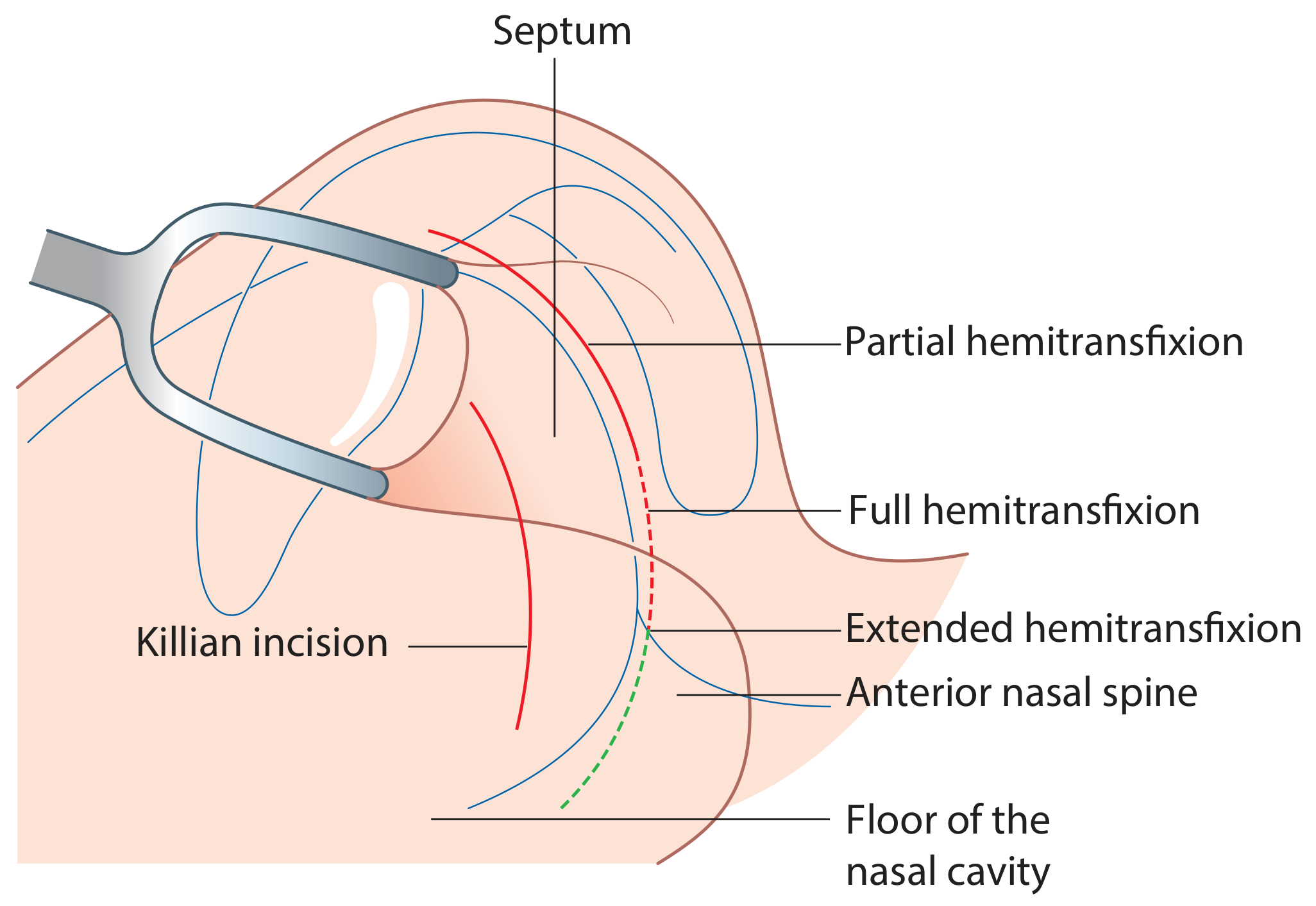
Septal incisions: Killian, partial hemitransfixion, full hemitransfixion, and extended hemitransfixion (to the nasal floor). Source: Scott-Brown's Vol 1, Fig 103.4.
One-line definition
Septoplasty corrects a deviated nasal septum by reconstruction, preserving the septal skeleton. It is not a bulk removal like submucosal resection (SMR).
Core points
- Treat the patient, not the picture. Some patients with large deviations have few complaints, and some with minor deviations complain the most. Match the symptoms to the findings before operating (Cummings Otolaryngology Head and Neck Surgery, p. 3095).
- L-strut. Preserve at least 10 mm of dorsal and caudal strut.
- Incision choice.
- Killian is for SMR and posterior deviations, where the L-strut is not touched.
- Hemitransfixion is for caudal and L-strut problems.
- Flaps.
- Raise the concave-side flap only, to protect against perforation.
- Raise both flaps for S-shaped or caudal deformities.
- Cummings' best-practice summary also stresses choosing the right starting incision, freeing bilateral flaps for caudal deflections, and avoiding mucosal tears.
- Correction methods. Cutting, grafting, suturing and relocating.
- Closure. Quilting sutures instead of splints or packing are favoured (Cummings, p. 548). Tintinalli's notes there is no evidence for prophylactic antibiotics after septoplasty with anterior packing.
Septoplasty with turbinate reduction
Compensatory inferior turbinate enlargement is often seen on the side opposite the deviation (Scott-Brown's, p. 1191).
- It may be due to both bone and mucosal thickening, which favours submucosal conchal resection or turbinoplasty.
- A study found benefit from unilateral submucous reduction at 6 months.
- Not all studies support doing it at the same time, and most septal surgery is done without it with satisfactory results.
- Adding it increases the risk of bleeding and adhesions.
Other indications
- Access to a bleeding point behind a prominent septal deviation or vomero-palatine spur in epistaxis (Scott-Brown's).
- Addition to FESS when the deviation is symptomatic, or when it makes surgery or postoperative endoscopy and debridement easier. Treating an asymptomatic deviation is debatable (Cummings).
History (frequently asked)
- Asch's closed reduction used forceps and was abandoned because relief was short lived.
- Krieg's mucosal resection removed cartilage with its mucosa. It caused large perforations and crusting.
- The modern approach is conservative and reconstructive.
Dressings
External splints are applied after external septoplasty and nasal valve surgery. Internal splints are optional (Scott-Brown's, p. 1210).
Quick viva answers
- Commonest complication: persistent obstruction, often from a missed posterior septal spur.
- Cause of septal perforation: unrepaired opposing mucosal tears, or failure to re-skeletonise the mucoperichondrial envelope.
- Cause of saddle nose or tip ptosis: over-resection of the caudal or dorsal septum.
- How to prevent haematoma: quilting suture, splints, or packing.
- Earliest age for septoplasty: about 6 years, but conservatively, and it is better delayed if the blockage is unilateral.
Recent evidence
The 2024 to 2025 systematic reviews I found cover septoplasty versus non-surgical care (PMID 39230606), long-term outcomes with or without turbinoplasty (PMID 37991145), and septoplasty in allergic rhinitis (PMID 39572690). I only read the titles, not the full papers.
If you meant septorhinoplasty, or want a particular format (viva questions, MCQs, or a one-page revision sheet), tell me which and I'll write it.
This is a shared conversation. Sign in to Orris to start your own chat.