
Describe classification of joints with suitable example of each. 5 marks
Reading File
Finding Sources
Finding Sources
Finding Sources
Finding Sources
Gray's Anatomy for Students is the ideal source. Let me read the relevant section.
Reading File
Finding Sources
Reading File
I now have all the content needed. Let me fetch the key diagrams to include in the answer.
Loading Image
Loading Image
Loading Image
I have all the content needed for a thorough 5-mark answer. Here is the complete classification:
Classification of Joints
Joints (articulations) are sites where two or more skeletal elements come together. They are classified into two broad categories based on whether a cavity is present, and further subdivided structurally and functionally.
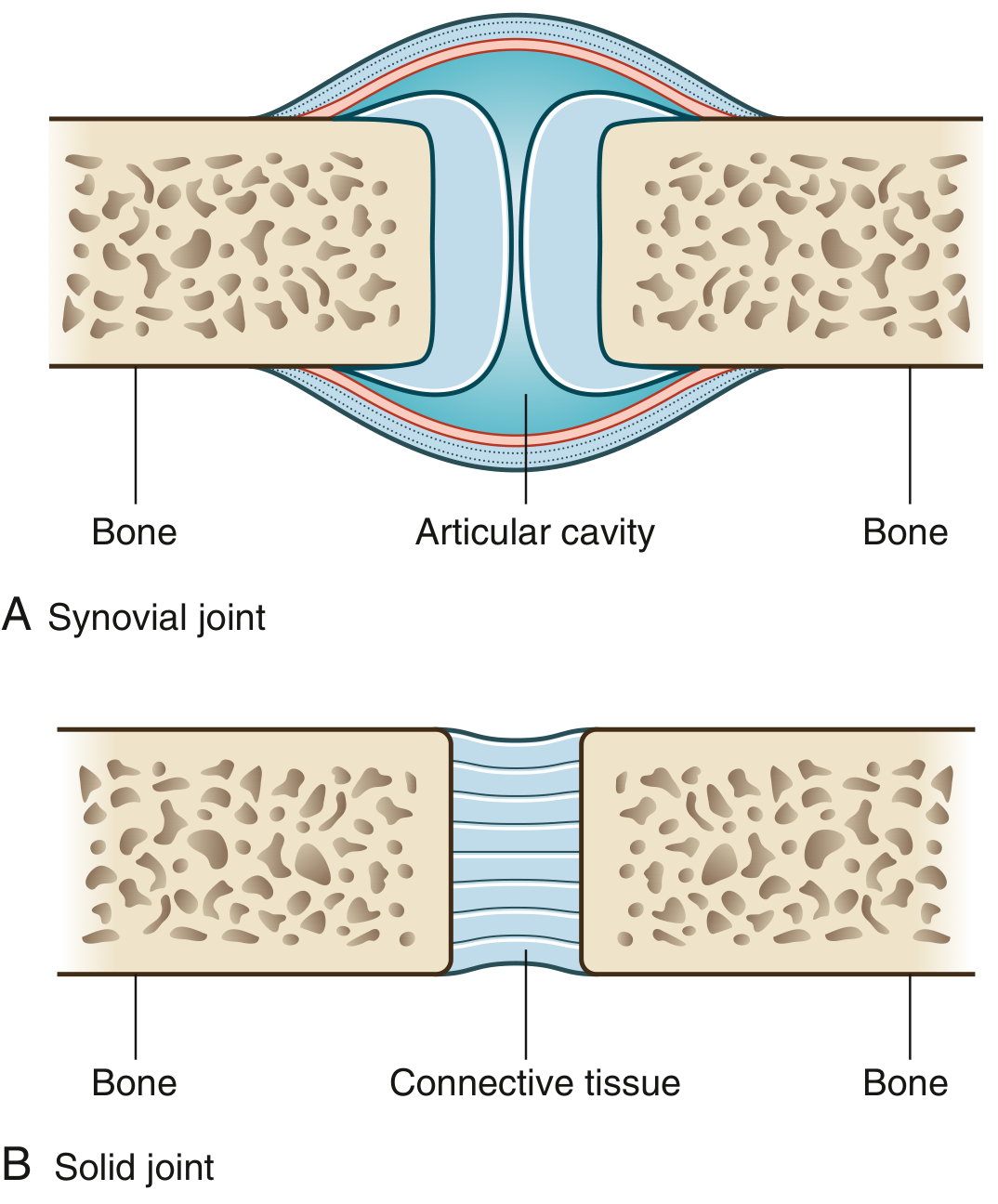
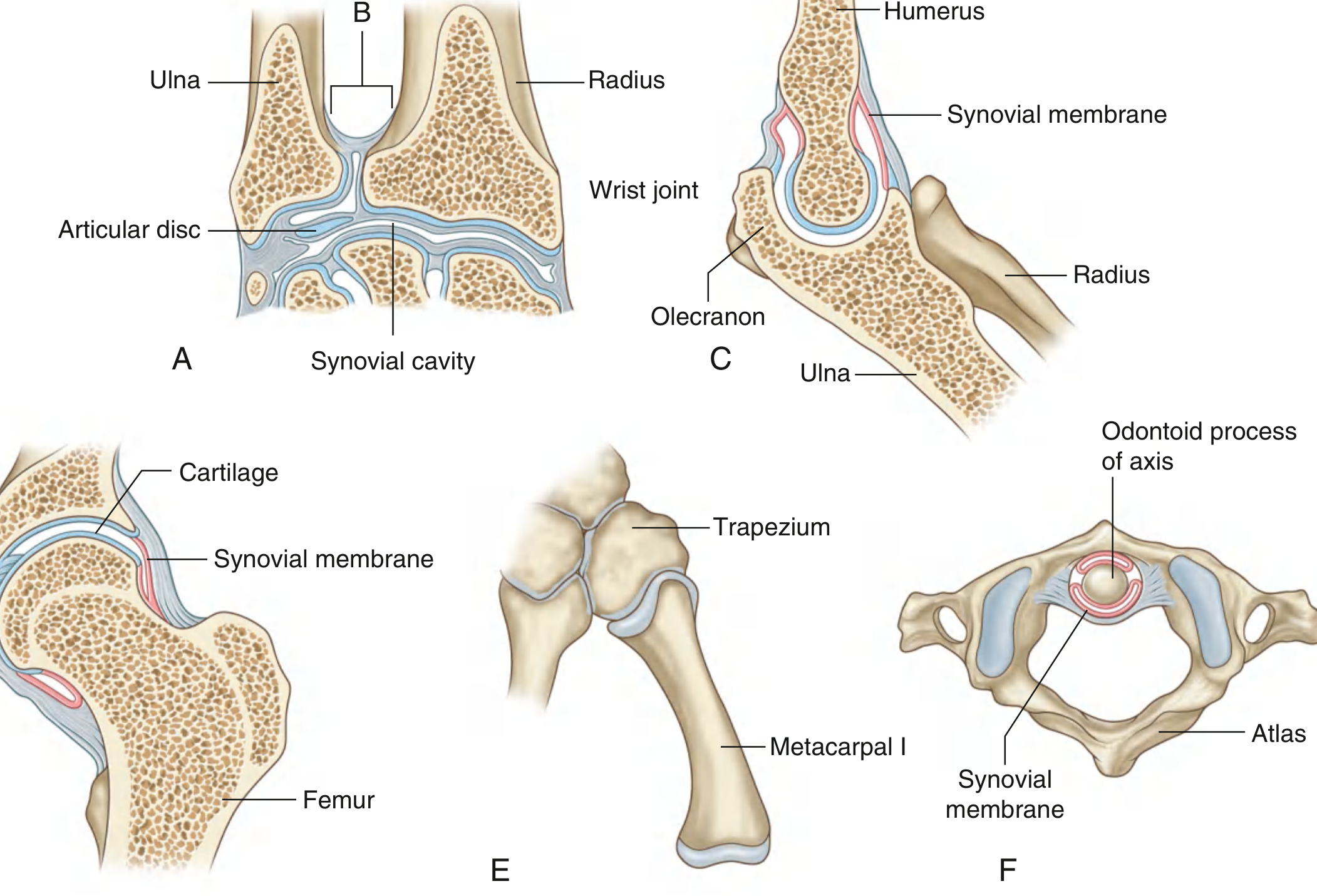
I. Synovial Joints (Diarthroses)
Skeletal elements are separated by an articular cavity. These are the most mobile joints in the body.
Characteristic features:
- Hyaline cartilage covers articulating surfaces
- Joint capsule with an inner synovial membrane (produces synovial fluid for lubrication) and an outer fibrous membrane
- May contain accessory structures: articular discs (fibrocartilage), fat pads, intra-articular tendons
Sub-types based on shape and movement:
| Type | Movement | Example |
|---|---|---|
| Plane (gliding) | Sliding/gliding (uniaxial) | Acromioclavicular joint |
| Hinge | Flexion & extension only (uniaxial) | Elbow (humero-ulnar) joint |
| Pivot | Rotation around longitudinal axis (uniaxial) | Atlanto-axial joint (C1–C2) |
| Bicondylar | Mostly uniaxial + limited rotation | Knee joint |
| Condylar (Ellipsoid) | Flexion, extension, abduction, adduction, circumduction (biaxial) | Wrist joint |
| Saddle | Same as condylar; saddle-shaped surfaces (biaxial) | Carpometacarpal joint of thumb |
| Ball and Socket | All movements incl. rotation (multiaxial) | Hip joint, shoulder joint |
II. Solid Joints (Synarthroses / Amphiarthroses)
No articular cavity; bones are held together directly by connective tissue. Movement is restricted compared to synovial joints.
A. Fibrous Joints
Bones united by fibrous connective tissue.
| Sub-type | Description | Example |
|---|---|---|
| Suture | Thin sutural ligament between bones; permits no movement | Coronal suture (skull) |
| Gomphosis | Periodontal ligament anchors tooth root in bony socket | Tooth in alveolar socket |
| Syndesmosis | Bones linked by a ligament or interosseous membrane; slight movement possible | Inferior tibiofibular joint; interosseous membrane between radius and ulna |
B. Cartilaginous Joints
Bones united by cartilage.
| Sub-type | Description | Example |
|---|---|---|
| Synchondrosis | Hyaline cartilage unites the bones; typically temporary (ossifies with age) | Epiphyseal (growth) plate; joint between first rib and sternum |
| Symphysis | Fibrocartilage pad between bones; slight movement allowed | Pubic symphysis; intervertebral discs |
Summary Tree
Joints
├── Synovial (cavity present)
│   ├── Plane — acromioclavicular
│   ├── Hinge — elbow
│   ├── Pivot — atlanto-axial
│   ├── Bicondylar — knee
│   ├── Condylar — wrist
│   ├── Saddle — 1st carpometacarpal
│   └── Ball & Socket — hip
└── Solid (no cavity)
    ├── Fibrous
    │   ├── Suture — skull
    │   ├── Gomphosis — tooth socket
    │   └── Syndesmosis — tibiofibular
    └── Cartilaginous
        ├── Synchondrosis — epiphyseal plate
        └── Symphysis — pubic symphysis
Gray's Anatomy for Students, pp. 34–36
This is a shared conversation. Sign in to Orris to start your own chat.