
Mention the boundaries, alpha content of cubital fossa with it applied aspect. Please prepare this question according to the exam point of view, and it is of five marks, so please make answer according to that.
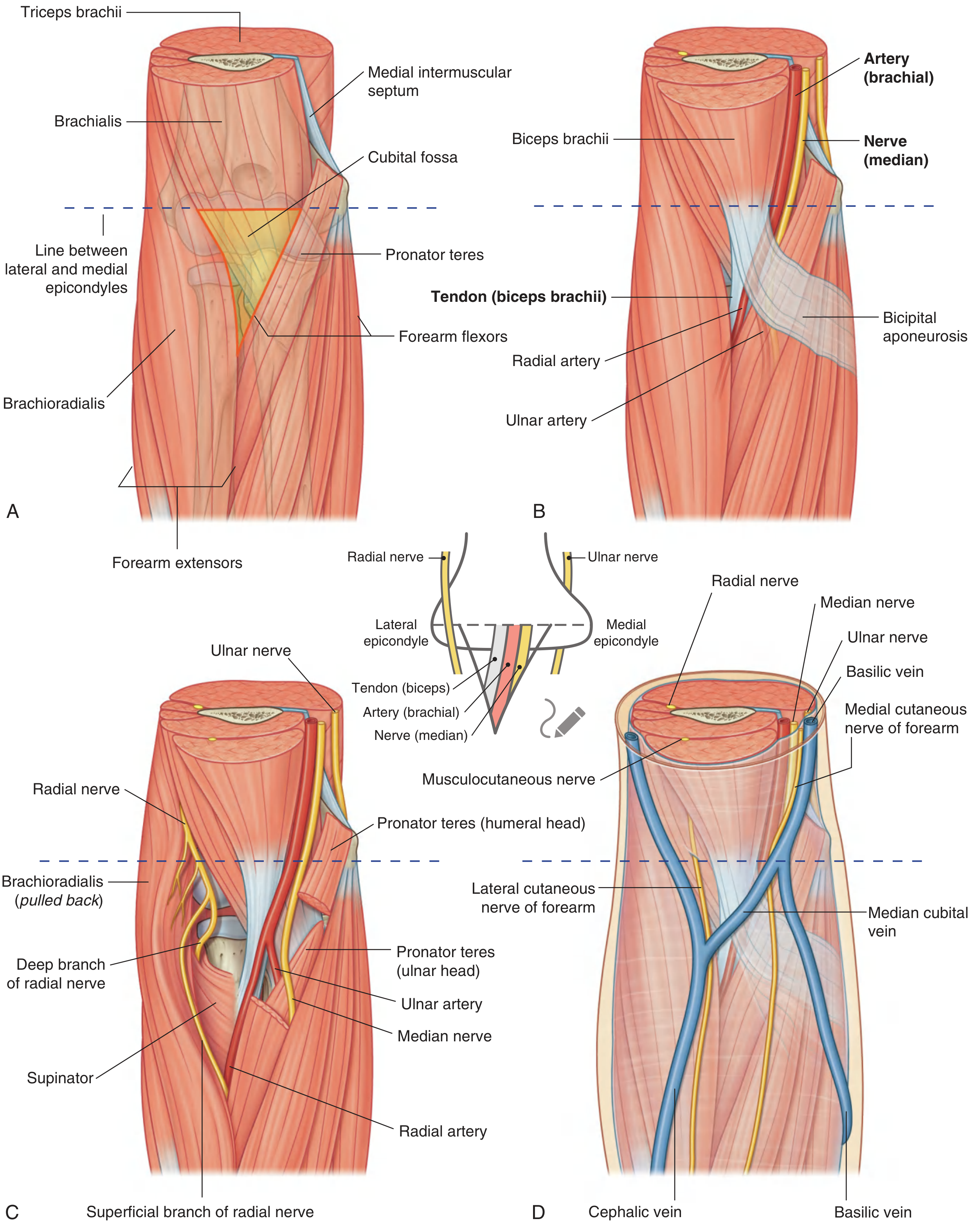
Cubital Fossa - Boundaries, Contents, and Applied Aspects
Definition
Boundaries (2 Marks)
| Boundary | Structure |
|---|---|
| Superior (Base) | An imaginary horizontal line connecting the medial and lateral epicondyles of the humerus |
| Medial | Pronator teres muscle (arising from the medial epicondyle) |
| Lateral | Brachioradialis muscle (arising from the lateral supraepicondylar ridge) |
| Floor (Bed) | Brachialis muscle (mainly) + supinator laterally |
| Roof | Deep fascia reinforced by the bicipital aponeurosis (lacertus fibrosus), covered by superficial fascia and skin |
Contents - "MALT" mnemonic, lateral to medial (2 Marks)
-
Radial nerve - lies just deep to the brachioradialis muscle (under its lateral lip) and divides here into:
- Superficial branch - continues deep to brachioradialis into the forearm
- Deep branch - winds around the radius through the two heads of supinator to reach the posterior compartment
-
Biceps brachii tendon - central structure; passes to the radial tuberosity
-
Brachial artery - lies medial to the biceps tendon; normally bifurcates into radial and ulnar arteries at the apex of the fossa
-
Median nerve - lies immediately medial to the brachial artery; exits the fossa by passing between the ulnar and humeral heads of pronator teres
Memory aid: From lateral to medial - Radially Big Men (Radial nerve, Biceps tendon, brachial artery [B for Big], Median nerve)
- Median cubital vein - passes diagonally, connecting the cephalic vein (lateral) to the basilic vein (medial)
- Medial cutaneous nerve of the forearm (medially)
- Lateral cutaneous nerve of the forearm (laterally, terminal branch of musculocutaneous nerve)
Applied Aspects (1 Mark)
-
Venipuncture and IV cannulation: The median cubital vein in the roof of the cubital fossa is the most commonly used site for venous blood sampling and intravenous drug/fluid administration. The bicipital aponeurosis protects the underlying brachial artery and median nerve during venepuncture.
-
Blood pressure measurement: The brachial artery is auscultated in the cubital fossa when measuring blood pressure with a sphygmomanometer.
-
Brachial artery injury: A fracture of the lower end of the humerus (supracondylar fracture, especially in children) can injure the brachial artery inside the cubital fossa, leading to Volkmann's ischemic contracture due to compartment syndrome of the forearm.
-
Dialysis fistula: The brachial artery can be anastomosed to the cephalic vein at the elbow (within the cubital fossa region) to create an arteriovenous fistula for hemodialysis access.
-
Median nerve injury: Stab wounds or lacerations in the cubital fossa can damage the median nerve, causing weakness of pronation, wrist flexion, and loss of sensation over the lateral palm.
No, please prepare a question like same to same so that I can literally write same to same answer in exam. According to that, make it.
Q. Describe the boundaries and contents of the cubital fossa. Add a note on its applied anatomy. (5 Marks)
Cubital Fossa
Boundaries
- Superiorly (Base): An imaginary horizontal line drawn between the medial and lateral epicondyles of the humerus.
- Medially: The pronator teres muscle, arising from the medial epicondyle.
- Laterally: The brachioradialis muscle, arising from the lateral supraepicondylar ridge.
- Floor (Bed): Formed mainly by the brachialis muscle, with the supinator forming the lateral part of the floor.
- Roof: Formed by the deep fascia of the forearm, reinforced by the bicipital aponeurosis (lacertus fibrosus), covered externally by superficial fascia and skin.
Contents
-
Radial nerve - Lies just deep to the brachioradialis muscle, at the lateral margin of the fossa. Here, it divides into:
- Superficial branch - Continues into the forearm deep to brachioradialis.
- Deep branch - Winds around the neck of the radius through the two heads of supinator to reach the posterior compartment of the forearm.
-
Tendon of biceps brachii - The most central and easily palpable structure; passes to insert on the radial tuberosity.
-
Brachial artery - Lies medial to the biceps tendon. It bifurcates into the radial and ulnar arteries at the apex of the fossa. It is covered and protected by the bicipital aponeurosis anteriorly.
-
Median nerve - Lies immediately medial to the brachial artery. It exits the fossa by passing between the humeral and ulnar heads of pronator teres.
- Median cubital vein - The most important superficial structure; crosses the roof diagonally, connecting the cephalic vein (lateral) to the basilic vein (medial).
- Lateral cutaneous nerve of the forearm (lateral side of roof).
- Medial cutaneous nerve of the forearm (medial side of roof).
Note: The ulnar nerve does NOT pass through the cubital fossa. It passes posterior to the medial epicondyle.
Applied Anatomy
-
Venipuncture: The median cubital vein in the roof of the cubital fossa is the most commonly used site for drawing blood and intravenous cannulation. The bicipital aponeurosis protects the underlying brachial artery and median nerve during this procedure.
-
Blood pressure measurement: The brachial artery is palpated and auscultated in the cubital fossa when recording blood pressure with a sphygmomanometer.
-
Supracondylar fracture: A fracture of the lower end of the humerus (common in children) can injure the brachial artery, causing ischemia of the forearm muscles and leading to Volkmann's ischemic contracture.
-
Arteriovenous fistula for dialysis: The brachial artery can be surgically anastomosed to the cephalic vein at the elbow region to create an AV fistula for long-term hemodialysis access.
-
Median nerve injury: Penetrating wounds to the cubital fossa can damage the median nerve, resulting in weakness of pronation, loss of wrist flexion, and sensory loss over the lateral palm and digits.
Human style sketch for cutital fossa
Human style hand-drawn pencil sketch of the cubital fossa anatomy, anterior view of the right elbow, drawn like a medical student's notebook diagram. Show the triangular shape of the cubital fossa clearly outlined. Label the following structures with handwritten-style text and leader lines: Medial epicondyle, Lateral epicondyle, Base (imaginary line between epicondyles), Pronator teres (medial border), Brachioradialis (lateral border), Brachialis (floor), Bicipital aponeurosis (roof), Biceps brachii tendon (central), Brachial artery (medial to tendon), Median nerve (most medial), Radial nerve (under brachioradialis), Median cubital vein (superficial in roof), Radial artery, Ulnar artery (bifurcation shown at apex). The sketch should look like it is drawn with pencil on plain white paper, rough hand-drawn lines, anatomical cross-hatching for muscles, clear triangular fossa outline, with neat handwritten labels - the style of a first or second year medical student's anatomy practical notebook.
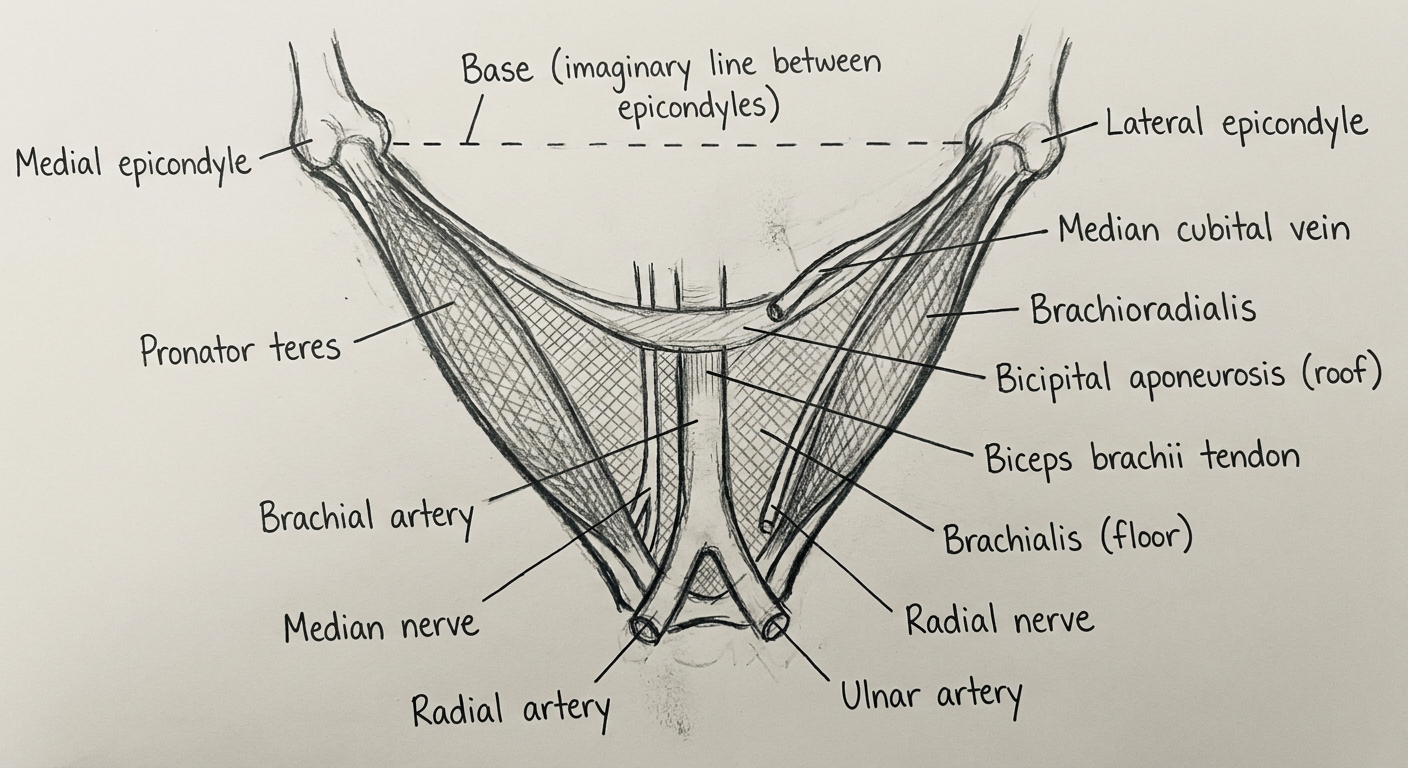
- The triangular outline of the fossa with the base between the two epicondyles
- Pronator teres (medial border) and Brachioradialis (lateral border)
- Brachialis forming the floor
- Bicipital aponeurosis as the roof
- Contents in order - Radial nerve, Biceps tendon, Brachial artery, Median nerve (lateral to medial)
- Brachial artery bifurcating into radial and ulnar arteries at the apex
- Median cubital vein superficially in the roof
In bd chaurasia at what page number is topic carpel tunnel
- Carpal Tunnel is covered in Chapter 10 (The Hand)
- It typically falls around pages 130-135 (varies slightly by edition - 8th edition has it near pg. 132)
- Flexor retinaculum (boundaries of the tunnel)
- Contents (9 tendons + median nerve)
- Carpal tunnel syndrome