
Can you tell me the expected price for the surgery of nose in which there is increased and deviation of the bone inside the nose which cause blockage
You're asking about septoplasty - the surgical correction of a deviated nasal septum (the bone/cartilage inside the nose that divides the two nostrils), which causes nasal blockage.
Searching sources...
Searching the Web
septoplasty surgery cost price 2025 2026
Searching the Web
deviated nasal septum surgery cost with without insurance
You're describing a deviated nasal septum - and the surgery to fix it is called Septoplasty. Here's a complete cost breakdown:
Septoplasty (Deviated Nasal Septum Surgery) - 2026 Price Guide
What is it?
Septoplasty corrects a deviated septum - the bone and cartilage dividing your two nostrils. When it's crooked or deviated (sometimes with overgrowth called a nasal spur), it blocks airflow and causes breathing difficulty. Surgery straightens it to restore normal breathing.
Cost by Country (2026)
🇺🇸 United States
| Scenario | Cost |
|---|---|
| National Average (self-pay) | $5,200 |
| Typical range (no insurance) | $3,000 - $10,000 |
| With PPO insurance (out-of-pocket) | ~$2,549 - $3,280 |
| With Medicare | ~$518 |
| Combined with cosmetic rhinoplasty | $10,000 - $20,000+ |
Cheapest US states: Mississippi, West Virginia, Alabama ($4,600-$4,700)
Most expensive: Major metro areas like New York ($8,000+)
🇮🇳 India
| Type of Procedure | Min | Average | Max |
|---|---|---|---|
| Traditional Septoplasty | ₹25,000 | ₹45,000 | ₹85,000 |
| Endoscopic Septoplasty | ₹65,000 | ₹75,000 | ₹80,000 |
| Revision Septoplasty | ₹45,000 | ₹52,500 | ₹65,000 |
| With Turbinate Reduction | ₹40,000 | ₹50,000 | ₹60,000 |
🌍 Other Countries (self-pay)
| Country | Approximate Cost |
|---|---|
| Turkey (incl. Istanbul) | $2,390 - $5,300 (often all-inclusive packages) |
| Mexico | From $1,700 |
| United Kingdom | £3,000 - £8,000 |
What Affects the Price?
- Type of surgery - Traditional vs. endoscopic vs. combined with rhinoplasty
- Facility - Hospital vs. outpatient surgery center (outpatient is cheaper)
- Anesthesia - General anesthesia adds $800-$1,500
- Surgeon's experience - Senior ENT specialists charge more
- Location/city - Major cities cost significantly more
- Insurance coverage - If medically necessary, most insurance plans cover it partially or fully
- Additional procedures - Turbinate reduction (for bony overgrowth inside nose) often done at the same time, adding cost
Insurance Coverage
Septoplasty is generally covered by insurance when it is medically necessary (i.e., causing significant breathing problems). You will need:
- Documentation from an ENT specialist confirming functional impairment
- Possibly a failed trial of conservative treatment (nasal sprays, etc.)
The cosmetic portion (reshaping the nose) is typically NOT covered.
Quick Summary
- Budget option (India/Mexico/Turkey): $1,700 - $5,300
- Mid-range (US with insurance): $2,500 - $3,300 out-of-pocket
- US without insurance: $3,000 - $10,000
- Complex/revision cases: $10,000 - $25,000+
If you share your country or city, I can give a more targeted estimate. I'd also recommend getting a consultation with an ENT (Ear, Nose & Throat) specialist first, as the exact procedure needed (septoplasty alone, or combined with turbinate reduction) will determine the final cost.
If we deny for the surgery what coud be the complications
If you skip septoplasty surgery for a deviated nasal septum, the untreated blockage can lead to a range of worsening complications over time.
Searching sources...
Reading File
Searching the Web
untreated deviated nasal septum complications long term effects
Finding Sources
Searching the Web
deviated septum untreated sleep apnea sinusitis cardiovascular complications
Here is a thorough breakdown of what can happen if a deviated nasal septum is left untreated:
Complications of Untreated Deviated Nasal Septum
If you refuse or delay septoplasty, the blocked nasal passage does not self-correct. The problems tend to worsen progressively over time. Here are the complications grouped by severity:
1. Chronic Nasal Congestion & Breathing Difficulty
- Permanent blockage on one or both sides of the nose
- Constant feeling of a "stuffed nose" even without a cold
- Forced mouth breathing, which dries out the throat and lips
- Reduced ability to smell and taste over time
2. Chronic Sinusitis (Sinus Infections)
- The deviated septum blocks normal mucus drainage from the sinuses
- Mucus builds up and becomes a breeding ground for bacteria
- Results in repeated sinus infections (sinusitis) - pain, pressure, fever, thick discharge
- Over time, these infections become harder to treat and may require long-term antibiotics
- Can progress to nasal polyps (soft growths inside the nose that further block airflow)
3. Sleep Problems & Obstructive Sleep Apnea (OSA)
- Nasal obstruction worsens when lying down, causing loud snoring
- Can trigger or worsen Obstructive Sleep Apnea - repeated pauses in breathing during sleep
- OSA causes poor sleep quality, daytime fatigue, poor concentration, and irritability
- Untreated sleep apnea is linked to serious downstream risks (see below)
4. Cardiovascular Complications (Long-Term)
This is the most serious risk from chronic untreated sleep apnea caused by the deviated septum:
- High blood pressure (hypertension) - from repeated drops in oxygen at night
- Increased risk of heart attack
- Increased risk of stroke
- Irregular heart rhythm (arrhythmia)
- The research published in Deviated Nasal Septum: A Comprehensive Review (2024) specifically identifies these cardiovascular risks as long-term consequences
5. Nosebleeds (Epistaxis)
- The deviated side of the septum is exposed to drier, faster-moving air
- This dries out the nasal mucosa (lining), making it fragile and prone to frequent nosebleeds
6. Headaches & Facial Pain
- Pressure from blocked sinuses causes recurring headaches
- Pain and pressure around the forehead, cheeks, and around the eyes
- Can mimic migraine-type headaches
7. Ear Complications
- The nose and ears are connected via the Eustachian tube
- Chronic nasal blockage can lead to ear pressure, ear infections, and reduced hearing
- Particularly common in children
8. Psychological & Quality of Life Impact
- Chronic poor sleep leads to anxiety, depression, and brain fog
- Reduced productivity and concentration at work or school
- Social embarrassment from loud snoring
9. Worsening of the Deviation Itself
- Without treatment, the bony spur or deviation can enlarge or worsen over time
- This can make surgery more complex (and more expensive) if you delay it further
Summary Table
| System | Complication |
|---|---|
| Nasal | Chronic congestion, mouth breathing, nosebleeds |
| Sinuses | Repeated infections, nasal polyps |
| Sleep | Snoring, Sleep Apnea |
| Heart/Blood vessels | Hypertension, heart attack, stroke |
| Ears | Pressure, infection, hearing loss |
| Head | Headaches, facial pain |
| Mental health | Fatigue, anxiety, depression |
Important Note
Not every deviated septum requires surgery immediately. A mild deviation may be managed with:
- Nasal decongestant sprays
- Saline rinses
- Antihistamines (if allergy is a factor)
However, for a significant deviation with bone involvement (like a nasal spur causing real blockage), these measures only mask symptoms - they do not fix the structural problem. Over time, refusing surgery increases the risk of all the complications above. The longer it's left untreated, the more damage accumulates.
It is strongly recommended to consult an ENT specialist to assess the severity and get personalized advice.
Nasal bone increase inside
You're asking about increased bone growth inside the nose - this is most likely referring to a Nasal Spur or Turbinate Hypertrophy (enlarged nasal bones/structures inside the nose).
Searching sources...
Finding Sources
Searching the Web
nasal bone increase inside nose turbinate hypertrophy nasal spur causes symptoms treatment
Finding Sources
Finding Sources
Reading File
Loading Image
Here is a complete medical explanation of increased bone inside the nose, sourced directly from the Cummings Otolaryngology textbook:
Nasal Bone Increase Inside the Nose
There are two main conditions that describe increased or enlarged bone inside the nose:
1. Nasal Spur (Septal Spur)
A nasal/septal spur is a sharp bony projection or overgrowth at the base of the nasal septum - the wall that divides the two nostrils. It typically forms at the bony-cartilaginous junction (where the bone and cartilage of the septum meet).
Here is an actual intraoperative (inside-nose) image of a septal spur from Cummings Otolaryngology:
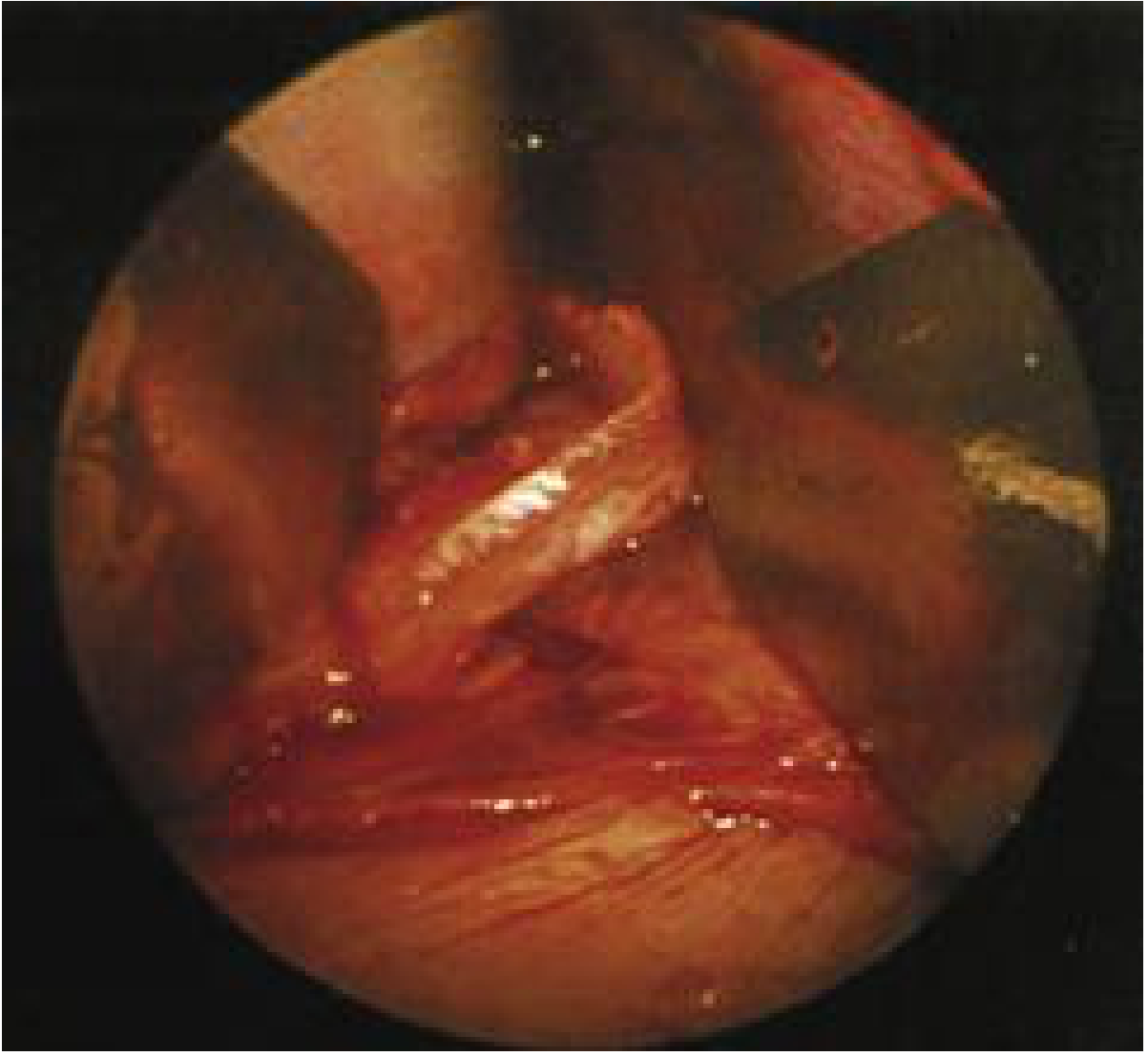
The whitish bony protrusion visible in the centre is the septal spur causing nasal obstruction.
Where it forms: Usually at the floor of the nose where the septal cartilage meets the bone (maxillary crest area).
How it causes blockage: It physically juts into the nasal passage, narrowing the airway and pressing against the opposite side wall.
2. Turbinate Hypertrophy (Enlarged Nasal Turbinates)
The turbinates are three shelf-like bony structures projecting from the side wall of the nose (inferior, middle, and superior turbinates). They normally warm and filter incoming air. When they enlarge (hypertrophy), they block airflow.
According to Cummings Otolaryngology:
"Hypertrophy of the nasal turbinate can be classified as either mucosal or bony."
| Type | Cause | Response to Decongestants |
|---|---|---|
| Mucosal hypertrophy | Allergies, vasomotor rhinitis | Yes - improves with sprays |
| Bony hypertrophy | Compensatory growth, chronic irritants | No - constant blockage |
Key fact: When the nasal septum is deviated to one side, the turbinate on the opposite (more open) side enlarges compensatorily - the bone literally grows to fill the space and normalize airflow resistance. This means many patients have both a deviated septum AND a hypertrophied turbinate at the same time.
"The bony conchal and mucosal hypertrophy is considered compensatory and can be found in the patient with a septum deviated significantly away from the enlarged turbinate. The turbinate mucosa and underlying bone enlarge into the more open nasal passage in pursuit of normalizing nasal airway resistance."
- Cummings Otolaryngology Head and Neck Surgery
Causes of Bony Increase Inside the Nose
| Cause | Explanation |
|---|---|
| Trauma/injury | Old nasal fracture causes abnormal bone healing |
| Compensatory growth | Opposite turbinate enlarges when septum is deviated |
| Chronic inflammation | Long-term allergies or rhinitis stimulate bone growth |
| Developmental | Bone grows abnormally during facial development |
| Smoking/irritants | Chronic nasal irritation leads to bony changes |
Symptoms
- Blocked nose (one or both sides) - constant, not improving with sprays
- Difficulty breathing, especially at night
- Snoring and poor sleep
- Frequent sinus infections
- Headaches and facial pressure
- Nosebleeds (from dryness on the exposed side)
- Mouth breathing
Treatment Options
| Severity | Treatment |
|---|---|
| Mild | Nasal steroid sprays, antihistamines, saline rinses |
| Moderate | Decongestants + specialist review |
| Severe / Bony | Surgery required - medical treatment will NOT fix bony growth |
Surgical options for bony turbinate hypertrophy:
- Turbinate reduction (submucous resection) - shaving down the enlarged bone
- Septoplasty - correcting the deviated septum at the same time
- Both are usually done together in the same operation
"Straightening only the septum without modifying the hypertrophic turbinate will result in obstruction as a result of the large turbinate on the side on which obstruction was not perceived before."
- Cummings Otolaryngology
This means if your doctor found both a deviation and a bony increase, they should correct both in one surgery for the best result.
Bottom line: The "increased bone inside the nose" you're describing is most likely a septal spur and/or bony turbinate hypertrophy. Both are real structural changes that cannot shrink on their own - surgery is the only definitive fix when the blockage is significant.
Cholinergic drugs usage
Cholinergic drugs act on the cholinergic (acetylcholine) system - either by mimicking acetylcholine directly or by preventing its breakdown. They are used in a wide range of conditions from glaucoma to Alzheimer's disease.
Searching sources...
Reading File
Finding Sources
Finding Sources
Reading File
Finding Sources
Reading File
Finding Sources
Reading File
Finding Sources
Reading File
Loading Image
Here is a complete, textbook-based guide to Cholinergic Drugs and Their Uses:
Cholinergic Drugs - Complete Overview
What Are Cholinergic Drugs?
Cholinergic drugs act on the acetylcholine (ACh) system - the neurotransmitter of the parasympathetic nervous system. They either:
- Mimic ACh directly (cholinomimetics / agonists), or
- Prevent ACh breakdown (anticholinesterases / indirect-acting)
The diagram below shows the two receptor types these drugs act on:
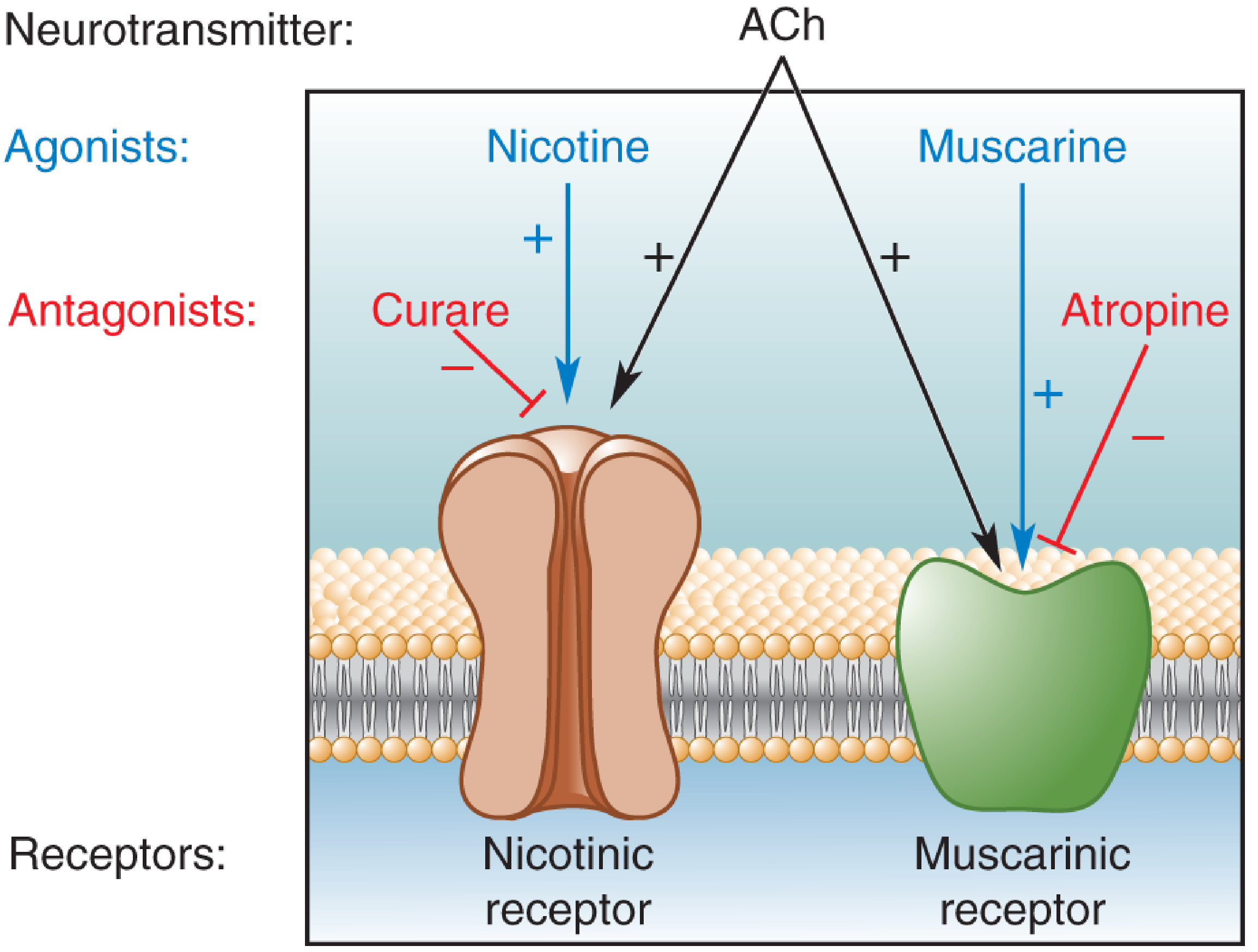
ACh acts on both Nicotinic receptors (blocked by curare) and Muscarinic receptors (blocked by atropine) - Neuroscience: Exploring the Brain, 5e
Classification of Cholinergic Drugs
CHOLINERGIC DRUGS
├── DIRECT-ACTING (mimic ACh)
│   ├── Choline Esters: ACh, Methacholine, Bethanechol, Carbachol
│   └── Alkaloids: Pilocarpine, Muscarine
└── INDIRECT-ACTING (block cholinesterase → ACh accumulates)
    ├── Reversible: Physostigmine, Neostigmine, Pyridostigmine, Edrophonium
    └── Irreversible: Echothiophate, Organophosphates (nerve agents)
Group 1: Direct-Acting Cholinergic Agonists
A. Choline Esters
| Drug | Key Use | Notes |
|---|---|---|
| Acetylcholine (ACh) | Topical eye drops (1%) during cataract surgery - causes rapid pupil constriction (miosis) | No systemic use - destroyed too rapidly by cholinesterase |
| Methacholine | Provocation test for asthma diagnosis (inhaled); terminates supraventricular tachycardia | Contraindicated in asthmatics (can trigger severe bronchospasm) |
| Bethanechol | Urinary retention (neurogenic bladder); Gastric/intestinal atony post-surgery | Selective for GI and urinary tract; does not slow the heart |
| Carbachol (Carbamylcholine) | Glaucoma treatment (eye drops); intraoperative miosis | Has both muscarinic and nicotinic activity |
"Bethanechol is relatively selective for the gastrointestinal and urinary tracts. In usual doses, it does not slow the heart."
- Barash Clinical Anesthesia, 9e
B. Alkaloids
| Drug | Key Use | Notes |
|---|---|---|
| Pilocarpine | Glaucoma (reduces intraocular pressure); dry mouth (Sjögren's syndrome) | Only alkaloid used therapeutically in the US |
| Muscarine | No therapeutic use | Found in poisonous mushrooms; used in research only |
Group 2: Indirect-Acting (Anticholinesterases)
These drugs block acetylcholinesterase, the enzyme that breaks down ACh. This allows ACh to accumulate and produce prolonged effects.
"Inhibition of acetylcholinesterase permits the accumulation of ACh transmitter in the synapse, resulting in intense parasympathetic nervous system activity."
- Barash Clinical Anesthesia, 9e
Reversible Anticholinesterases
| Drug | Key Clinical Uses |
|---|---|
| Neostigmine | Reversal of non-depolarising neuromuscular blockade after surgery; Myasthenia gravis treatment |
| Pyridostigmine | Myasthenia gravis (long-term oral treatment); nerve agent pre-treatment (military) |
| Physostigmine | Reversal of central anticholinergic syndrome (atropine overdose/toxicity); glaucoma (eye drops) |
| Edrophonium | Diagnosis of Myasthenia gravis (Tensilon test - short-acting, rapid onset) |
Irreversible Anticholinesterases
| Drug | Use |
|---|---|
| Echothiophate | Severe glaucoma (long-acting eye drops) |
| Organophosphates | Pesticides and nerve agents (toxic, not therapeutic) |
Clinical Uses - Organized by Body System
| System | Condition | Drug Used |
|---|---|---|
| Eye | Glaucoma (reduce pressure) | Pilocarpine, Carbachol, Echothiophate |
| Eye | Miosis during cataract surgery | Acetylcholine (topical) |
| Heart | Supraventricular tachycardia | Methacholine |
| GI Tract | Post-operative ileus, gastric atony | Bethanechol, Neostigmine |
| Urinary | Neurogenic bladder, urinary retention | Bethanechol |
| Lungs | Asthma diagnosis (provocation test) | Methacholine (inhaled) |
| Neuromuscular | Reversal of muscle relaxants post-surgery | Neostigmine, Pyridostigmine |
| Neuromuscular | Myasthenia gravis (long-term) | Pyridostigmine, Neostigmine |
| Neuromuscular | Myasthenia gravis diagnosis | Edrophonium (Tensilon test) |
| Brain/CNS | Alzheimer's disease (slow memory loss) | Donepezil, Rivastigmine, Galantamine |
| Toxicology | Atropine/anticholinergic overdose | Physostigmine |
Important Contraindications
Cholinergic (muscarinic) agonists are dangerous in:
- Asthma - can cause severe bronchospasm
- Mechanical intestinal obstruction - increases gut contractions against the blockage
- Urinary obstruction - same principle
- Cardiac disease - can cause dangerous bradycardia and hypotension
- Myasthenia gravis patients on anticholinesterases - excess ACh can cause a cholinergic crisis
- Peptic ulcer disease - increases gastric acid secretion
Memory Aid: Cholinergic Effects (SLUDGE/DUMBELS)
When cholinergic drugs are overactive or overdosed, they produce the classic signs:
| Mnemonic | Effect |
|---|---|
| S - Salivation | Excess saliva |
| L - Lacrimation | Excessive tearing |
| U - Urination | Increased urination |
| D - Defecation | Diarrhea |
| G - GI distress | Nausea, vomiting, cramps |
| E - Emesis | Vomiting |
| B - Bradycardia | Slow heart rate |
| B - Bronchospasm | Airway constriction |
| M - Miosis | Pinpoint pupils |
Overdose treatment: Atropine (muscarinic antagonist) is the antidote.
Sources: Barash Clinical Anesthesia 9e; Neuroscience: Exploring the Brain 5e; Morgan & Mikhail's Clinical Anesthesiology 7e
TAH
TAH stands for Total Abdominal Hysterectomy - the surgical removal of the uterus (and cervix) through an abdominal incision.
Searching sources...
Finding Sources
Finding Sources
Reading File
Finding Sources
Reading File
Finding Sources
Finding Sources
Loading Image
Finding Sources
Finding Sources
Finding Sources
Finding Sources
Here is a complete, textbook-based guide to TAH (Total Abdominal Hysterectomy):
Total Abdominal Hysterectomy (TAH)
Definition
TAH = surgical removal of the uterus AND cervix through an abdominal incision (open surgery). When the fallopian tubes and ovaries are also removed, the full procedure is called TAH-BSO (Total Abdominal Hysterectomy + Bilateral Salpingo-Oophorectomy).
"A total hysterectomy is removal of both the uterine corpus and cervix. This can be accomplished via an open incision, vaginal incision, or minimally invasive techniques."
- Sabiston Textbook of Surgery
Types of Hysterectomy
| Type | What is Removed | Abbreviation |
|---|---|---|
| Total Abdominal Hysterectomy | Uterus + Cervix (open abdomen) | TAH |
| TAH-BSO | Uterus + Cervix + Both ovaries + Both fallopian tubes | TAH-BSO |
| Subtotal / Supracervical | Uterus only (cervix kept) | SAH |
| Radical Hysterectomy | Uterus + Cervix + Upper vagina + Pelvic lymph nodes | Used for cancer |
| Vaginal Hysterectomy | Uterus removed through vagina | VH |
| Laparoscopic Hysterectomy | Uterus removed using keyhole surgery | LH / TLH |
Indications (Reasons to Perform TAH)
| Category | Conditions |
|---|---|
| Benign | Uterine fibroids (leiomyomas), adenomyosis, abnormal/heavy uterine bleeding (AUB), uterine prolapse, chronic pelvic pain |
| Malignant | Uterine/endometrial cancer, cervical cancer, ovarian cancer |
| Precancerous | Endometrial hyperplasia with atypia, high-grade CIN (cervical intraepithelial neoplasia) |
| Emergency | Postpartum hemorrhage unresponsive to medical treatment, ruptured uterus |
| Other | Severe endometriosis, pelvic inflammatory disease (PID) unresponsive to treatment |
Surgical Steps (TAH Procedure)
According to Sabiston Textbook of Surgery, the key steps are:
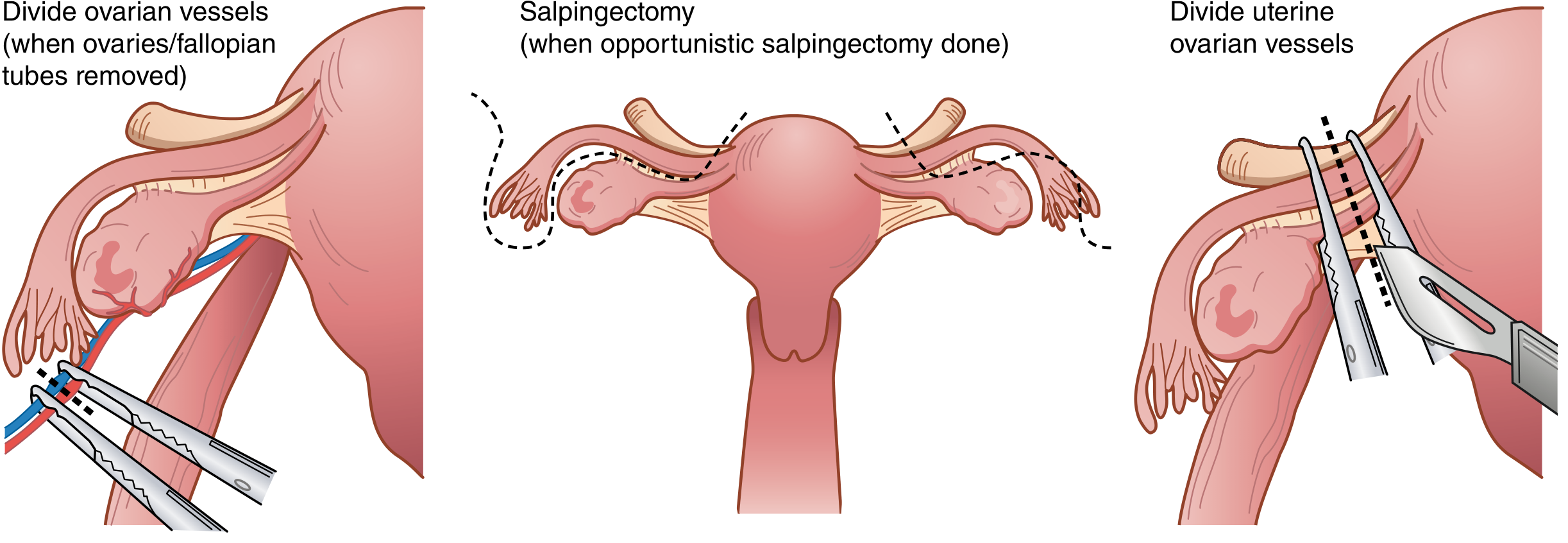
Steps D, E, F from the TAH procedure - Sabiston Textbook of Surgery
Step-by-step:
- Abdominal incision - low transverse (Pfannenstiel/bikini cut) OR vertical midline, depending on the indication, body type, and size of pathology
- Round ligaments - clamped and divided bilaterally
- Broad ligament - anterior leaf incised to develop the bladder flap
- Bladder dissection - bladder separated and pushed down away from the cervix
- Ovarian vessels (if BSO) - doubly clamped and ligated in the infundibulopelvic ligament
- Uterine vessels - clamped at the level of the internal cervical os, cut and suture-ligated
- Cardinal and uterosacral ligaments - divided in serial steps bilaterally
- Colpotomy - incision into the upper vagina just below the cervix; uterus + cervix completely excised
- Vaginal cuff closure - sutured closed with absorbable sutures
- Abdominal closure - layers closed in sequence
Anaesthesia
TAH is classified as a major surgical procedure and is performed under:
- General anaesthesia (most common), OR
- Regional anaesthesia (spinal or epidural)
Complications
Intraoperative
| Complication | Details |
|---|---|
| Haemorrhage | Injury to uterine vessels, ovarian vessels, or pelvic veins |
| Ureter injury | Ureters run close to the uterine vessels - at risk of ligation or transection (occurs in ~1.3% of radical cases) |
| Bladder injury | During bladder dissection off the cervix |
| Bowel injury | Especially with adhesions from prior surgery/endometriosis |
Postoperative
| Complication | Details |
|---|---|
| Wound infection | Abdominal incision or vaginal cuff infection |
| Vesicovaginal fistula (VVF) | Abnormal connection between bladder and vagina - most common gynaecological cause is hysterectomy |
| Deep vein thrombosis (DVT) / PE | Risk increased by pelvic surgery and immobility |
| Vault haematoma | Blood collection at the vaginal cuff |
| Paralytic ileus | Temporary bowel shutdown post-surgery |
| Hormonal effects | If BSO performed - immediate surgical menopause (hot flushes, bone loss, cardiovascular risk) |
"In the industrialized world, surgical injury to the bladder is the most common cause of vesicovaginal fistula, most commonly seen after hysterectomy."
- Campbell-Walsh Wein Urology
Recovery
| Phase | Timeline |
|---|---|
| Hospital stay | 2-4 days |
| Return to light activity | 2-4 weeks |
| Full recovery | 6-8 weeks |
| Driving | After 4-6 weeks (when off strong painkillers) |
| Sexual intercourse | After 6-8 weeks (vaginal cuff healed) |
Laparoscopic hysterectomy has faster recovery than TAH - shorter hospital stay, less pain, and quicker return to normal activity.
TAH vs. Laparoscopic Hysterectomy
| Feature | TAH (Open) | Laparoscopic (LH) |
|---|---|---|
| Incision | Large (10-15 cm) | Small keyhole ports |
| Blood loss | More | Less |
| Hospital stay | 3-5 days | 1-2 days |
| Recovery | 6-8 weeks | 2-4 weeks |
| Pain | More | Less |
| Used when | Large uterus, cancer, emergencies, adhesions | Routine, uncomplicated cases |
Sources: Sabiston Textbook of Surgery; Berek & Novak's Gynecology; Gray's Anatomy for Students; Campbell-Walsh Wein Urology
This is a shared conversation. Sign in to Orris to start your own chat.