
Commities in community health nursing
committees in community health nursing types functions
https://www.slideshare.net/slideshow/health-committees-in-co…
https://www.slideshare.net/slideshow/health-committees-in-co…
Committees in Community Health Nursing (India)
Overview Table
| Committee | Year | Chairman | Also Known As |
|---|---|---|---|
| Bhore Committee | 1943 | Sir Joseph Bhore | Health Survey & Development Committee |
| Mudaliar Committee | 1959 | Dr. A.L. Mudaliar | Health Survey & Planning Committee |
| Chadha Committee | 1963 | Dr. M.S. Chadha | National Malaria Eradication Programme Committee |
| Mukherjee Committee | 1965 | Dr. Mukherjee | Committee on Strengthening Health Services |
| Jungalwalla Committee | 1964 | Dr. N. Jungalwalla | Committee on Integration of Health Services |
| Kartar Singh Committee | 1972 | Kartar Singh | Committee on Multipurpose Workers (MPW) |
| Shrivastav Committee | 1974 | Dr. J.C. Shrivastav | Group on Medical Education & Support Manpower |
| Bajaj Committee | 1986 | Dr. J.S. Bajaj | Health Manpower Planning, Production & Management |
1. Bhore Committee (1943-1946)
- Appointed by the Government of India in 1943 under Sir Joseph Bhore
- Report submitted in 1946
Background
- High Crude Death Rate (CDR), Infant Mortality Rate (IMR), Maternal Mortality Rate (MMR)
- Low life expectancy
- Widespread communicable diseases
Key Recommendations
- Establishment of a 3-tier healthcare system: primary, secondary, and tertiary
- Short-term plan: 1 Primary Health Unit per 40,000 population
- 2 Medical Officers, 1 Nurse, 4 Public Health Nurses, 4 Midwives, 4 Trained Dais, 2 Health Assistants, 2 Sanitary Inspectors, 1 Pharmacist, 15 Class IV workers
- Long-term plan: 1 PHC per 10,000-20,000 population
- Integration of curative, preventive, and promotive health services
- Emphasis on social medicine and community-based care
- "No financial barrier" principle - free healthcare for all
- Massive increase in medical, nursing, and allied health personnel
Note: The targets were not achieved due to lack of doctors, nurses, and infrastructure.
2. Mudaliar Committee (1959-1961)
- Appointed on 12th June 1959 under Dr. A.L. Mudaliar
- Purpose: To assess progress made since the Bhore Committee (1946)
Six Sub-Committees were formed to analyze:
- Public Health
- Medical Relief
- Population Problem
- Communicable Diseases
- Professional Education
- Drugs & Medical Appliances
Key Findings
- Basic health facilities had NOT reached half the population
- Health services remained unsatisfactory
Key Recommendations
- Strengthen existing Primary Health Centers before creating new ones
- Upgrade district hospitals
- Improve health manpower training
- Focus on maternal and child health services
3. Chadha Committee (1963)
- Constituted in 1963 by Government of India
- Under Dr. M.S. Chadha, Director General of Health Services
- A team of malariologists reviewed the National Malaria Eradication Programme
Terms of Reference
- Review planning and requirements of PHCs for the maintenance phase of Malaria Eradication
- Study staffing patterns needed for the malaria eradication programme
Key Recommendations
- 1 Basic Health Worker (BHW) per 10,000 population
- BHW to visit house-to-house once a month for malaria vigilance
- BHW to serve as Multipurpose Health Worker (MPHW) for family planning and vital statistics
4. Mukherjee Committee (1965)
- Appointed to review and strengthen existing health services
- Focused on family planning services and integration with health infrastructure
Key Recommendations
- Strengthening of Primary Health Centers
- Better integration of family planning with general health services
- Increased health manpower for MCH (Maternal and Child Health)
5. Jungalwalla Committee (1964-1967)
- Set up by the Central Council of Health at its 1964 Srinagar session
- Under Dr. N. Jungalwalla, Additional Director General of Health Services
- Report submitted in 1967
Terms of Reference
- Study problems of health services
- Review service conditions
- Address elimination of private practice by government doctors
Key Recommendations
- Unified cadre for all health workers
- Common seniority across departments
- Recognition of extra qualifications
- Equal pay for equal work
- Special pay for specialized work
- No private practice for government health workers
- Good service conditions
- States were left to work out their own implementation strategies
6. Kartar Singh Committee (1972-1973)
- Formed in 1972 under Kartar Singh, Additional Secretary, Ministry of Health and Family Planning (MOHFP)
- Addressed the growing demand for health staff and the need to reduce population per worker
Key Recommendations
- ANM (Auxiliary Nurse Midwife) to be replaced by Female Health Worker (FHW)
- Introduction of multipurpose worker concept
- 1 PHC = 50,000 population = 16 Sub-Centres
- 1 Sub-centre = 3,000-3,500 population
- 1 Sub-centre staffed by: 1 Male Health Worker + 1 Female Health Worker
- 1 Male Health Supervisor to supervise 3-4 Male Health Workers
- 1 Female Health Supervisor to supervise 4 Female Health Workers
- Programme introduced in 2 pilot areas:
- Areas where malaria was in the maintenance phase
- Areas where smallpox was in the control phase
- To be implemented during the 5th Five Year Plan
7. Shrivastav Committee (1974-1975)
- Constituted by MOHFP, GOI in 1974 under Dr. J.C. Shrivastav
- Report submitted in 1975
Problems Identified
- Urban orientation of medical education, heavily dependent on curative medicine
- Failure of training programmes in nutrition and family welfare due to isolation from mainstream medical education
- Rural communities deprived of doctors
Terms of Reference
- Devise curriculum for training Health Assistants
- Improve medical education with emphasis on community care
- Integrate family planning teaching into medical education
Key Recommendations
- Organization of basic health services (nutrition, health education, family planning) within the community itself
- Training of community health workers at the village level
- Re-orientation of undergraduate medical education toward community and primary care rather than hospital-based curative care
- Concept of a community health worker trained locally (precursor to ASHA)
8. Bajaj Committee (1986)
- Appointed in 1986 under Dr. J.S. Bajaj
- Focused on planning and managing health manpower at the national level
Key Recommendations
- Rational planning of health manpower production
- Improving management of existing health workforce
- Addressing urban-rural imbalance in health personnel distribution
- Strengthening health manpower education and training infrastructure
Role of the Community Health Nurse in Committees
- Take the initiative to ensure health committees are created where they do not exist
- Facilitate and coordinate health committee activities
- Act as a bridge between the community and formal health services
- Identify, plan and implement health projects
- Educate the community about health matters
- Participate in policy making, problem solving, and handling of community complaints
- Engage in community mobilization and community development
Summary: Significance of These Committees
- Primary Health Care (PHC) system in India
- The multipurpose health worker concept
- ASHA workers (community health worker model from Shrivastav)
- Integration of curative, preventive, and promotive services
- The National Rural Health Mission (NRHM) and current health policies

Prpvide me answers of these long short and very short questions as per the marking bade
- Q.2: Q1(a+b) and Q2 are ticked
- Q.3: Q2, Q3, Q4, Q5, Q6 are ticked (any five)
- Q.4: Q1, Q2, Q4, Q5 are ticked (any four)
National Health Policy 2017 India key features objectives community health nursing
health illness continuum model home visits nursing dimensions of health BCC IEC sustainable development goals community health
COMMUNITY HEALTH NURSING - EXAM ANSWERS
Q.2 — LONG QUESTIONS (2 × 15 Marks)
Q.2 (1a) Health Care Delivery System in India at Various Levels [~8 marks]
Definition
Levels of Health Care Delivery in India
TIER 1 - Primary Level (Grassroots/Community Level)
- Preventive, promotive, curative, and rehabilitative services
- Maternal and child health (MCH) services
- Family planning services
- Immunization
- Health education
| Institution | Population Covered |
|---|---|
| Sub-Centre (SC) | 5,000 (plain); 3,000 (hilly/tribal) |
| Primary Health Centre (PHC) | 30,000 (plain); 20,000 (hilly/tribal) |
| Community Health Centre (CHC) | 1,20,000 population (4 PHCs) |
- Lowest level of health infrastructure
- Staffed by 1 ANM (Auxiliary Nurse Midwife) and 1 Male Health Worker
- Functions: immunization, ANC, postnatal care, family planning, first aid
- First contact point with a medical officer
- Staffed by 1 Medical Officer, 14-15 paramedical & other staff
- Functions: OPD, MCH services, school health, disease surveillance, health education
- 30-bedded referral hospital for 4 PHCs
- Staffed by 4 specialists (surgeon, physician, gynecologist, pediatrician)
- Functions: specialist care, emergency obstetric care, referrals
TIER 2 - Secondary Level (District Level)
- District Hospital (DH): Serves district population (approximately 1-3 million)
- Provides specialist services, emergency care, surgery
- Acts as referral center for CHCs and PHCs
- Generally has 75-500 beds depending on district size
- Staffed by specialists in all major disciplines
TIER 3 - Tertiary Level (State/National Level)
- Teaching/Medical College Hospitals, AIIMS, Apex Institutions
- Provides super-specialist care for complex, rare, or difficult cases
- Serves as training centers for health professionals
- Conducts medical education and research
- Examples: AIIMS, PGI Chandigarh, NIMHANS
Other Components:
- ASHA (Accredited Social Health Activist): Village-level link worker
- Anganwadi Centers: Under ICDS for maternal and child nutrition
- Urban Health Centers: For urban slum populations
Q.2 (1b) National Health Policy 2017 [~7 marks]
Introduction
Vision
Key Principles (9 Guiding Principles)
- Professionalism, Integrity and Ethics
- Equity - reduce disparities based on gender, caste, poverty, disability
- Affordability - no financial hardship while seeking healthcare
- Universality - health care for all citizens
- Patient-centered - dignity, confidentiality, non-discrimination
- Community participation in health planning
- Decentralization - decision-making at local level
- Pluralism - AYUSH systems integrated with allopathy
- Accountability - of public health institutions
Key Policy Shifts (from NHP 2002)
- From selective care → Assured comprehensive primary care
- From sick care → Wellness and prevention
- Increased public spending on health to 2.5% of GDP
- From institution-based care → Community-based care
- From treatment alone → Health promotion and prevention
- Make in India for drugs and medical devices
Specific Quantitative Goals (by 2025)
| Indicator | Target |
|---|---|
| Life Expectancy | 70 years |
| Infant Mortality Rate (IMR) | < 28/1000 live births |
| Maternal Mortality Rate (MMR) | < 100/1,00,000 live births |
| Under-5 Mortality Rate (U5MR) | < 23/1000 live births |
| Total Fertility Rate (TFR) | 2.1 |
| Neonatal Mortality Rate | < 16/1000 live births |
| Health expenditure (public) | 2.5% of GDP |
Key Provisions Relevant to Nursing
- Establishing cadres of Nurse Practitioners and Public Health Nurses
- Nursing schools in every large district (population of 20-30 lakh)
- Centers of Excellence for Nursing in each State
- Developing specialized nursing training (critical care, trauma, palliative)
Importance
- Shifts focus from curative to preventive and promotive health
- Aims at Universal Health Coverage (UHC)
- Integrates AYUSH (Ayurveda, Yoga, Unani, Siddha, Homeopathy)
- Addresses epidemiological transition (rising NCDs, aging population)
Q.2 (2) Epidemiology — Definition, Aims, Uses & Epidemiological Triad [15 marks]
Definition of Epidemiology
- John Last (1988): "Epidemiology is the study of the distribution and determinants of health-related states or events in specified populations and the application of this study to the prevention and control of health problems."
- MacMahon and Pugh: "Epidemiology is the study of the distribution and determinants of disease frequency in man."
- It studies who gets the disease, when, where, and why.
Aims of Epidemiology
- To describe the distribution and magnitude of health and disease problems in human populations
- To identify etiological factors (risk factors) for disease
- To provide data for planning, implementing, and evaluating preventive and curative measures
- To study the natural history and prognosis of disease
- To identify high-risk groups needing priority attention
- To evaluate the effectiveness of health programs and interventions
- To develop and test preventive strategies
Uses of Epidemiology
- To study historical trends in disease occurrence
- Community diagnosis - assess health status of a population
- Planning and evaluation of health services
- Individual risks and chances - assess risk in individuals
- Completing the clinical picture - understand full spectrum of disease
- Identifying syndromes - cluster of signs/symptoms
- Determining causes - causal factors and risk factors
- Search for risk factors - identify preventable causes
- Testing hypotheses - etiological hypotheses
- Health policy development - evidence-based policy making
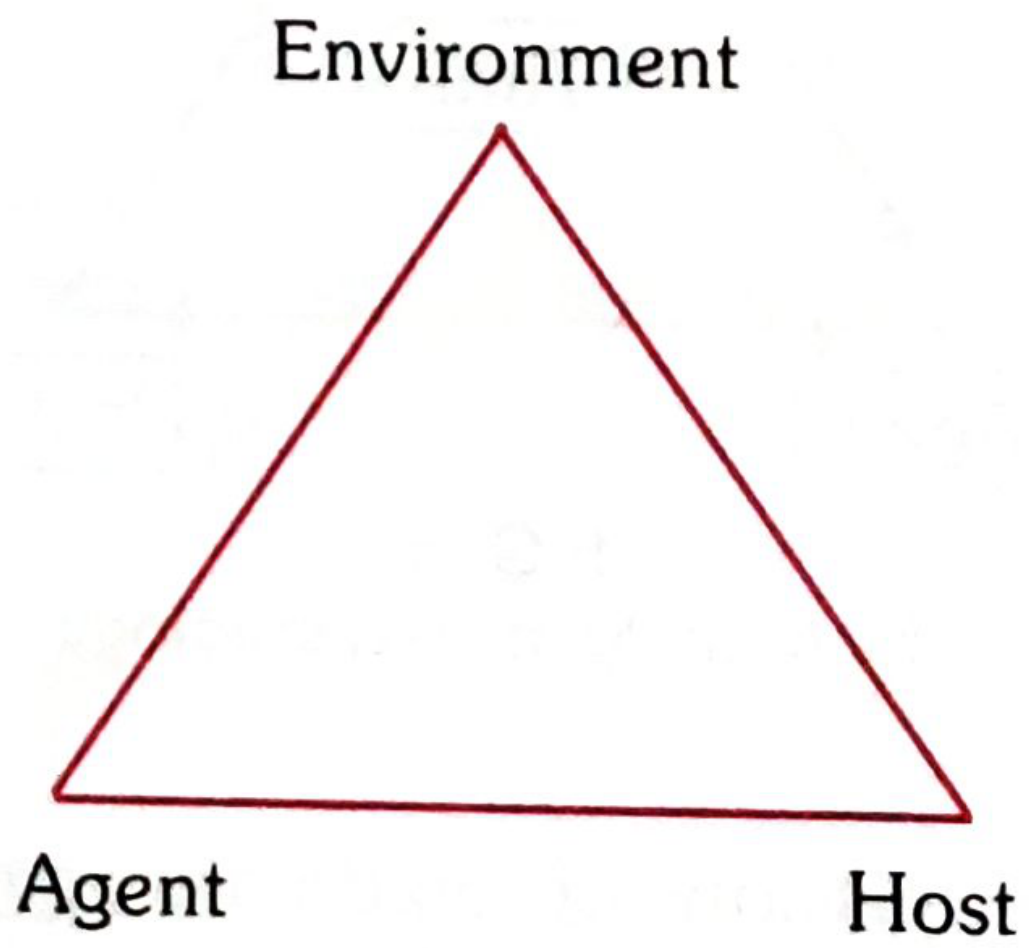
Concept of Epidemiological Triad
1. AGENT
| Type | Examples |
|---|---|
| Biological | Bacteria, viruses, parasites, fungi |
| Nutrient | Protein deficiency (PEM), vitamin deficiencies |
| Physical | Heat, cold, radiation, trauma |
| Chemical | Endogenous (urea, bilirubin), Exogenous (pesticides, lead) |
| Social/Psychological | Stress, grief, poverty |
- Infectivity: Ability to invade and multiply in host
- Pathogenicity: Ability to cause clinical illness
- Virulence: Proportion causing severe illness
2. HOST
- Age, sex, race/ethnicity
- Genetic makeup and heredity
- Immunity (natural or acquired)
- Nutritional status
- Physiological state (pregnancy, stress)
- Habits and customs (smoking, diet, exercise)
- Occupation
- Pre-existing diseases
3. ENVIRONMENT
| Type | Examples |
|---|---|
| Physical | Climate, geography, season, water supply |
| Biological | Flora, fauna, vectors, reservoir hosts |
| Social | Socioeconomic status, culture, overcrowding |
| Psychosocial | Stress, family relationships |
Interaction in the Triad
- Disease occurs when the agent overcomes host defenses in a favorable environment
- If the HOST is strong (good immunity, good nutrition) → disease may not occur even when exposed
- If the ENVIRONMENT is favorable to the agent (e.g., poor sanitation) → disease spreads more easily
- Time is a fourth factor sometimes added (Triangle of Epidemiology) — accounting for incubation periods, duration of illness, life expectancy
Q.3 — SHORT NOTES (5 × 5 Marks)
1. Levels of Disease Prevention [5 Marks]
Primary Prevention
- Applied during the pre-pathogenesis phase (before disease develops)
- Goal: Prevent disease from occurring at all
- Two components:
- Health Promotion: Improving general health and resistance
- Balanced nutrition, health education, adequate rest, exercise
- Good living standards, genetic counseling
- Specific Protection: Protection against specific diseases
- Immunization (vaccines), use of specific nutrients (iodized salt)
- Protection from occupational hazards, use of condoms
- Health Promotion: Improving general health and resistance
Secondary Prevention
- Applied during early pathogenesis phase
- Goal: Halt the progress of disease at its incipient stage, prevent complications
- Two components:
- Early Diagnosis: Screening tests, case finding programs (e.g., Pap smear, mass chest X-ray)
- Prompt Treatment: Treating disease before irreversible damage occurs
Tertiary Prevention
- Applied during late pathogenesis phase when disease is established
- Goal: Reduce disability, prevent complications, promote rehabilitation
- Two components:
- Disability Limitation: Preventing complications from advancing disease
- Rehabilitation: Restoring function — physical, psychological, social, vocational
| Level | Phase | Activities |
|---|---|---|
| Primary | Pre-pathogenesis | Health promotion, specific protection |
| Secondary | Early pathogenesis | Early diagnosis, prompt treatment |
| Tertiary | Late pathogenesis | Disability limitation, rehabilitation |
2. Home Visits [5 Marks]
Definition
Purpose of Home Visits
- To provide nursing care to sick persons who cannot visit health facilities
- To follow up on previously treated patients (e.g., TB, post-delivery)
- To provide antenatal and postnatal care
- To conduct health assessment of families
- To provide health education in the family setting
- To verify home conditions and identify risk factors
- To assess and improve environmental sanitation
Types of Home Visits
- Case finding visits: To find unreported or untreated cases
- Follow-up visits: After hospital discharge or clinic visit
- Instructional visits: Teaching patients/family about care
- Emergency visits: For acute illness or injury at home
Principles of Home Visits
- Plan the visit in advance (review records, prepare bag)
- Make appointments when possible
- Carry the nursing bag with necessary supplies
- Respect the family's privacy, culture, and dignity
- Observe the home environment (sanitation, overcrowding)
- Document all findings and care provided
- Prioritize visits based on need (most urgent first)
Steps in a Home Visit
- Preparation: Review client records, plan objectives, prepare bag
- Introduction: Introduce yourself, state purpose
- Assessment: Physical, social, environmental assessment
- Care/Teaching: Provide nursing care and education
- Documentation: Record observations, care given, and follow-up plan
- Evaluation: Assess effectiveness of care
Advantages
- Care is given in the patient's natural, comfortable environment
- Family members can be involved in care
- Nurse can assess actual living conditions
- Reduces need for hospitalization
- Strengthens nurse-family relationship
3. Barriers of Effective Communication [5 Marks]
Definition of Communication
Barriers to Effective Communication
A. Physical/Environmental Barriers
- Noise in the surroundings
- Distance between communicators
- Poor lighting or ventilation
- Distractions in the environment
B. Language and Linguistic Barriers
- Use of technical/medical jargon that the patient doesn't understand
- Difference in language or dialect
- Use of unfamiliar words or abbreviations
- Low literacy level of the receiver
C. Psychological/Emotional Barriers
- Fear and anxiety (patient may not listen due to stress)
- Anger, hostility, or frustration
- Prejudice or bias toward the communicator
- Lack of trust or credibility
- Depression or mental illness
D. Cultural and Social Barriers
- Differences in cultural values and beliefs
- Gender differences (especially in conservative settings)
- Caste and class differences
- Taboos related to certain health topics (e.g., reproductive health)
E. Physiological Barriers
- Hearing impairment or deafness
- Visual impairment affecting non-verbal communication
- Speech disorders (stuttering, aphasia)
- Cognitive impairment or dementia
F. Organizational/Structural Barriers
- Lack of time for communication
- Overworked staff
- Lack of privacy
- Hierarchical communication gaps
Measures to Overcome Barriers
- Use simple, clear, local language
- Use visual aids and demonstrations
- Ensure privacy and a quiet environment
- Be culturally sensitive
- Use active listening
- Provide feedback and check for understanding
4. Health-Illness Continuum Model [5 Marks]
Introduction
Concept
Premature         Disability    Symptoms    Signs    Neutral    Awareness    Education    Growth    High-level
  Death  ←———————————————————————————————————————|——————————————————————————————————————→  Wellness
         [  TREATMENT PARADIGM (illness side)   ] [ WELLNESS PARADIGM (health side)      ]
Key Components
- Neutral Point: The midpoint — neither sick nor optimally well; absence of disease
- Treatment Paradigm (left side): Movement toward illness and death
- Includes signs, symptoms, disability, premature death
- Wellness Paradigm (right side): Movement toward optimal health
- Includes awareness, education, personal growth, high-level wellness
Significance in Nursing
- Nurses can identify where a patient stands on the continuum
- Guides nursing interventions toward moving the patient toward wellness
- Emphasizes prevention and health promotion, not just disease treatment
- Helps patients visualize their health status and set goals
- Supports holistic nursing care (physical, mental, social, spiritual)
Application
- A patient recovering from TB is moving from left toward center (treatment)
- A healthy person practicing yoga is moving further right (wellness)
- The nurse's role is to help patients move toward the wellness end
5. Dimensions of Health [5 Marks]
Introduction
Dimensions of Health
1. Physical Dimension
- Refers to the structural and functional integrity of the body
- Includes: absence of disease, good nutrition, adequate sleep, fitness
- Indicators: BP, weight, BMI, laboratory values
2. Mental/Psychological Dimension
- Refers to emotional and psychological well-being
- Ability to cope with stress, think clearly, make decisions
- Includes: self-esteem, emotional stability, absence of mental illness
- WHO: "Mental health is a state of well-being in which every individual realizes his/her potential, copes with normal stresses of life, works productively, and contributes to the community"
3. Social Dimension
- Refers to ability to maintain satisfying interpersonal relationships
- Ability to function socially in family, workplace, and community
- Includes: social support systems, role performance, community ties
4. Spiritual Dimension
- Refers to belief in a higher purpose, meaning of life, values
- Sense of purpose and meaning in life
- Religious beliefs, values, ethics
- Provides strength during illness
5. Emotional Dimension
- Ability to manage and express emotions appropriately
- Capacity for love, empathy, and self-awareness
- Ability to deal with grief, loss, and stress
6. Environmental Dimension
- The interaction of humans with their physical environment
- Clean air, safe water, healthy housing, absence of pollution
- Occupational and environmental safety
7. Vocational/Occupational Dimension
- Satisfaction derived from work or productive activities
- Ability to contribute meaningfully to society
Significance in Community Health Nursing
- The nurse must assess all dimensions for holistic care
- Interventions must address all dimensions, not just physical illness
- Community health programs must target multiple dimensions simultaneously
Q.4 — VERY SHORT NOTES (4 × 2 Marks)
1. Sustainable Development Goals (SDGs) [2 Marks]
- Adopted by UN in September 2015, to be achieved by 2030
- Replaced the Millennium Development Goals (MDGs)
- 17 SDGs with 169 targets covering all dimensions of development
- SDG 3: "Ensure healthy lives and promote well-being for all at all ages" - the health-specific goal
- Key health targets under SDG 3:
- Reduce MMR to < 70/1,00,000 live births
- Reduce U5MR to < 25/1,000 live births
- End epidemics of AIDS, TB, malaria by 2030
- Achieve Universal Health Coverage (UHC)
- Reduce premature NCD mortality by 1/3rd
- Other SDGs relevant to health: SDG 2 (Zero Hunger), SDG 6 (Clean Water), SDG 13 (Climate Action)
- India's focus: achieving equity, reducing maternal and child mortality, strengthening primary healthcare
2. Women Empowerment [2 Marks]
- Women empowerment means giving women the power, resources, and opportunity to make decisions about their own lives, health, and bodies
- Key components:
- Education and literacy
- Economic independence (employment, income)
- Social equality and freedom from discrimination
- Political participation and representation
- Legal rights and access to justice
- Reproductive rights and health decision-making
- Importance in Community Health:
- Empowered women make better health decisions for themselves and families
- Reduces maternal mortality, child malnutrition, and domestic violence
- Improves immunization rates and child survival
- Key programs in India: Beti Bachao Beti Padhao, Mahila Shakti Kendras, Self-Help Groups (SHGs), ASHA workers, Janani Suraksha Yojana
3. BCC & IEC [2 Marks]
- A strategy to provide health information to the public
- Uses mass media (TV, radio, posters, pamphlets) to spread health messages
- One-way communication (from provider to community)
- Goal: Increase awareness and knowledge
- Examples: Polio vaccination campaigns, TB awareness pamphlets, AIDS posters
- An evolution of IEC - goes beyond knowledge to actual behavior change
- Two-way, interactive communication process
- Based on understanding the audience's beliefs, attitudes, motivations
- Goal: Motivate communities to adopt healthier behaviors
- Uses interpersonal communication, community meetings, peer education
- Examples: Promoting handwashing, healthy diet, contraceptive use, stopping open defecation
| IEC | BCC |
|---|---|
| Information-focused | Behavior-focused |
| One-way communication | Two-way, interactive |
| Increases knowledge | Changes behavior |
| Mass media approach | Community & interpersonal approach |
4. Principles of PHC (Primary Health Care) [2 Marks]
- Sanitation and safe water supply
- Antenatal and MCH care including family planning
- Food supply and proper nutrition
- Education about prevailing health problems
- Mental health
- Immunization against major infectious diseases
- National disease control (TB, malaria, etc.)
- Community participation
- Essential drugs availability (+ treatment of common diseases)
- Equitable distribution: Services available to all, especially rural and poor
- Community participation: Communities involved in planning and implementation
- Intersectoral coordination: Health linked with agriculture, education, water, housing
- Appropriate technology: Cost-effective, acceptable technology
- Focus on prevention: Preventive and promotive care over curative
- Accessibility: Geographically, financially, socially accessible to all
- Sustainability: Affordable within community and national resources
Sources: Park's Textbook of Preventive and Social Medicine (23rd ed.); National Health Policy 2017, Ministry of Health and Family Welfare, GoI; Alma Ata Declaration (1978); Travis Health-Illness Continuum (1972); UN Sustainable Development Goals (2015).
Tb and dots theray
NTEP DOTS therapy TB treatment regimen India nursing role community health 2023
TUBERCULOSIS (TB) AND DOTS THERAPY
PART A: TUBERCULOSIS (TB)
Definition
Causative Organism
- Mycobacterium tuberculosis - an acid-fast bacillus (AFB)
- Gram-positive, non-motile, non-spore forming rod
- Detected by Ziehl-Neelsen (ZN) staining - appears as red rods on blue background
- Grows slowly - culture takes 2-8 weeks (Lowenstein-Jensen medium)
Epidemiology
| Indicator | Data |
|---|---|
| India's global share | ~26% of world TB burden |
| Estimated cases (India) | ~26 lakh/year |
| Case Fatality Rate | ~17% |
| Mostly affects | 15-45 years age group (65%) |
| Sex | Men 62%, Women 38% |
| Area | Rural 58%, Urban 33%, Tribal 9% |
| TB-HIV co-infection | ~2% |
Mode of Transmission
- Airborne (droplet nuclei) - primary and most common route
- Coughing, sneezing, talking, spitting by an infected person
- Droplet nuclei (1-5 microns) can remain suspended in air for hours
- Direct contact - rare (skin TB)
- Ingestion - M. bovis through unpasteurized milk
- Inoculation - extremely rare
Pathogenesis
- Bacilli inhaled and reach alveoli
- Phagocytized by macrophages but not killed
- Ghon's focus forms (small area of consolidation in lung, usually lower lobe)
- Bacilli travel to hilar lymph nodes → Ghon's complex (Ghon focus + hilar LN = primary complex)
- Cell-mediated immunity develops in 4-6 weeks → tuberculin test becomes positive
- Usually heals with calcification in immunocompetent individuals
- Reactivation of dormant bacilli from primary infection (latent TB)
- Occurs in immunocompromised states (HIV, malnutrition, diabetes, old age, steroids)
- Affects upper lobes of the lung (well-oxygenated areas)
- Forms cavities, caseation, fibrosis
- Highly infectious - patient can spread disease
Clinical Features
Pulmonary TB (Most common)
| Symptom | Description |
|---|---|
| Cough | Persistent cough > 2 weeks (key symptom) |
| Haemoptysis | Blood-tinged sputum (alarming sign) |
| Fever | Low-grade, evening rise |
| Night sweats | Drenching sweats at night |
| Weight loss | Progressive, significant |
| Fatigue/Weakness | General malaise |
| Dyspnoea | In advanced disease |
| Chest pain | Pleuritic pain in pleural TB |
Extrapulmonary TB
- Lymph node TB (Scrofula): Most common extrapulmonary - cervical LN enlargement
- Pleural TB: Pleural effusion
- TB Meningitis: Headache, neck stiffness, vomiting, altered sensorium
- Abdominal TB: Abdominal pain, ascites, altered bowel habits
- Bone/Joint TB: Pott's spine (spinal TB), arthritis
- Miliary TB: Hematogenous spread - tiny lesions throughout all organs (millet-seed appearance on X-ray)
- Genitourinary TB: Hematuria, sterile pyuria
Diagnosis
1. Sputum Smear Microscopy (AFB Smear)
- First-line test under NTEP
- Ziehl-Neelsen stain - detects AFB
- 3 specimens (early morning preferred)
- Fast, cheap, widely available
- Limitation: detects only when bacilli load > 10,000/mL
2. Culture
- Gold standard for TB diagnosis
- Media: Lowenstein-Jensen (solid) or MGIT/Bactec (liquid)
- Takes 2-8 weeks; rapid methods: 5-14 days
3. Rapid Molecular Tests (GeneXpert/CBNAAT)
- Nucleic Acid Amplification Test (NAAT)
- Detects TB DNA AND rifampicin resistance simultaneously
- Results in 2 hours
- Recommended for all presumptive TB patients under NTEP (Universal DST)
4. Line Probe Assay (LPA)
- Detects resistance to Isoniazid and Rifampicin
- For MDR-TB diagnosis
5. Chest X-Ray
- Shows: cavitary lesions, hilar lymphadenopathy, apical infiltrates, miliary pattern, pleural effusion
- Not specific for TB alone
6. Tuberculin Skin Test (Mantoux Test)
- Intradermal injection of 5 TU of PPD (0.1 mL)
- Read at 48-72 hours
- Interpretation of induration:
- > 5 mm: positive in HIV, immunocompromised, close contacts
- > 10 mm: positive in most patients
- > 15 mm: positive in very low-risk individuals
- Indicates exposure/infection, NOT active disease
PART B: DOTS THERAPY
Full Form
Definition
History of DOTS in India
| Year | Event |
|---|---|
| 1962 | National Tuberculosis Programme (NTP) launched |
| 1993 | GOI decided to revamp NTP; RNTCP formulated |
| 1997 | RNTCP with DOTS introduced in pilot areas |
| 2006 | DOTS expanded to entire country; STOP TB strategy adopted |
| 2012-17 | Mandatory TB notification, rapid molecular testing introduced |
| 2020 | RNTCP renamed to NTEP (National TB Elimination Programme) |
| 2025 | India's target: End TB (5 years ahead of global SDG 2030 target) |
5 Components of DOTS Strategy (RNTCP)
| # | Component | Details |
|---|---|---|
| 1 | Political will and administrative commitment | Government support, budget, infrastructure, legal framework |
| 2 | Diagnosis by quality-assured sputum smear microscopy | Decentralized, quality-controlled AFB smear testing at DMCs |
| 3 | Adequate supply of quality-assured short-course drugs | Uninterrupted supply in patient-wise boxes; blister packs |
| 4 | Directly Observed Treatment | Health worker observes patient swallowing every dose |
| 5 | Systematic monitoring and accountability | Case registration, cohort analysis, NIKSHAY IT system |
STOP TB Strategy (2006) - Additional Components
- Pursuing quality DOTS expansion and enhancement
- Addressing TB/HIV and MDR-TB
- Contributing to health system strengthening
- Engaging ALL care providers (public AND private)
- Empowering patients and communities
- Enabling and promoting research (diagnosis, treatment, vaccine)
DOTS Treatment Regimen (NTEP - Current)
| Phase | Duration | Drugs | Route |
|---|---|---|---|
| Intensive Phase | 2 months (8 weeks/56 doses) | H + R + Z + E (Isoniazid + Rifampicin + Pyrazinamide + Ethambutol) | Daily FDC under DOT |
| Continuation Phase | 4 months (16 weeks) | H + R + E (Isoniazid + Rifampicin + Ethambutol) | Daily |
- H = Isoniazid (INH)
- R = Rifampicin
- Z = Pyrazinamide
- E = Ethambutol
Patient-Wise Drug Boxes
- Drugs are supplied in colour-coded patient-wise boxes:
- Red box: Category I (new patients)
- Blue box: Category II (retreatment patients)
- Intensive phase: Each blister pack = 1 day's medication
- Continuation phase: Each blister pack = 1 week's medication
Objectives of RNTCP/NTEP
- Achieve at least 85% cure rate of infectious TB cases through DOTS
- Detect at least 70% of estimated cases through quality sputum microscopy
- End TB in India by 2025 (five years ahead of global SDG target of 2030)
NIKSHAY - IT System for TB
- Web-based case-based notification and tracking system
- "Nikshay" = NI (eradication) + KSHAY (TB)
- All TB patients notified mandatorily (public + private)
- Tracks patient journey from diagnosis to treatment outcome
Nikshay Poshan Yojana (NPY)
- Rs. 500/month provided as Direct Benefit Transfer (DBT) to all TB patients
- During the entire duration of treatment
- To support nutrition (undernutrition is major risk factor for TB)
- Launched: April 2018
PART C: ROLE OF COMMUNITY HEALTH NURSE IN DOTS/TB CONTROL
1. Case Detection
- Identify presumptive TB cases (cough > 2 weeks) during home visits and OPD
- Collect and send sputum specimens to Designated Microscopy Centre (DMC)
- Active case finding in high-risk populations (slums, tribal areas, prisons)
2. Treatment Support (DOT Provider)
- Act as DOT provider - directly observe patient swallowing each dose
- Ensure patient receives drugs daily without interruption
- Maintain treatment cards and record drug intake
- Ensure patient-wise drug boxes are properly managed
3. Patient and Family Education
- Explain the nature of TB (infectious, curable)
- Emphasize the importance of completing full treatment
- Teach cough hygiene and respiratory etiquette (cover mouth, use mask)
- Educate about side effects of drugs (yellow urine with Rifampicin is normal; jaundice, rashes - report immediately)
- Reduce stigma associated with TB
4. Contact Tracing
- Identify all close contacts of the TB patient (household contacts)
- Screen contacts for TB symptoms
- Refer symptomatic contacts for diagnosis
- Administer TB Preventive Therapy (TPT) to eligible contacts (especially under-5 children and HIV patients)
5. Monitoring and Follow-up
- Follow up defaulters (patients who miss doses) immediately
- Ensure sputum tests are done at 2 months (end of intensive phase) and end of treatment
- Monitor for adverse drug reactions
- Coordinate with MO and DOTS Centre for patient management
6. Recording and Reporting
- Maintain TB registers (TB treatment card, NIKSHAY notification)
- Report all TB cases mandatorily under NTEP
- Submit monthly/quarterly reports to PHC/CHC
7. ASHA's Role in DOTS (per NTEP)
- ASHA acts as DOT provider in the community
- She is trained to provide DOTS under RNTCP/NTEP
- Acts as depot holder for drugs at community level
- Provides health education and reduces stigma
- Receives incentive for successful treatment completion
Prevention of TB
| Measure | Details |
|---|---|
| BCG Vaccine | Given at birth; protects against severe childhood TB (meningitis, miliary TB) |
| Early case detection and treatment | Prevents spread to contacts |
| Contact tracing | Find and treat/prevent disease in contacts |
| TB Preventive Therapy (TPT) | Isoniazid 6 months for HIV+ and under-5 contacts |
| Nutrition improvement | Malnutrition is a major risk factor |
| Ventilation and sunlight | Bacilli killed by UV light; good ventilation reduces transmission |
| Cough etiquette | Covering mouth, using masks |
| HIV control | HIV is biggest risk factor for TB reactivation |
MDR-TB (Multi-Drug Resistant TB)
- TB resistant to at least Isoniazid AND Rifampicin (two most potent first-line drugs)
- Prevalence in India: 2.84% in new cases, 11.60% in retreatment cases
- Treated at Drug Resistant TB Centres (DRTB Centres)
- Treatment duration: 9-11 months (shorter regimen) or 18-20 months
- Managed with Bedaquiline, Delamanid + other second-line drugs
Treatment Success Rates (Recent Data)
| Type | Success Rate |
|---|---|
| Drug-Sensitive TB | 89% (2023) |
| MDR-TB | 87% |
| Pre-XDR TB | 72% |
| XDR-TB | 68% |
Sources: Park's Textbook of Preventive and Social Medicine, 27th Edition; National TB Elimination Programme (NTEP) - DGHS, MoHFW; Textbook of Family Medicine 9e; ICMR Drug-Sensitive TB Treatment Guidelines (2022).
Rntcp
RNTCP — Revised National Tuberculosis Control Programme
(Now renamed: NTEP — National TB Elimination Programme)
1. Introduction and Background
- Treatment success rates were unacceptably low
- Death and default (dropout) rates remained high
- Spread of Multi-Drug Resistant TB (MDR-TB) was worsening the situation
- Drugs were in short supply and not reaching patients
2. Key Milestones
| Year | Milestone |
|---|---|
| 1962 | National Tuberculosis Programme (NTP) launched |
| 1993 | Decision to revamp NTP; RNTCP formulated |
| 1997 | RNTCP launched in pilot areas |
| 2006 | RNTCP covers entire country; STOP TB Strategy adopted |
| 2012 | Mandatory TB notification made law (May 2012); NIKSHAY IT system launched |
| 2014 | End TB Strategy adopted by World Health Assembly |
| 2018 | Nikshay Poshan Yojana launched (Rs. 500/month nutritional support) |
| 2020 | RNTCP renamed → NTEP (National TB Elimination Programme) |
| 2025 | India's target to End TB (5 years ahead of global SDG target of 2030) |
3. Objectives of RNTCP
- Achieve at least 85% cure rate of infectious TB cases through DOTS involving peripheral health functionaries
- Detect at least 70% of estimated TB cases through quality sputum smear microscopy
- Provide standardized treatment and diagnostic facilities to ALL TB patients
- Improve access to marginalized groups (urban slums, tribal areas)
4. Five Components of DOTS Strategy under RNTCP
| # | Component | Details |
|---|---|---|
| 1 | Political will and administrative commitment | Sustained government support, adequate budget, legal framework, political priority |
| 2 | Diagnosis by quality-assured sputum smear microscopy | Decentralized Designated Microscopy Centres (DMCs); quality controlled AFB smear testing |
| 3 | Adequate supply of quality-assured short-course drugs | Uninterrupted supply in patient-wise, colour-coded drug boxes in blister packs |
| 4 | Directly Observed Treatment (DOT) | Health worker observes patient swallowing EVERY dose throughout treatment |
| 5 | Systematic monitoring and accountability | Case registration, cohort analysis, treatment outcome monitoring, NIKSHAY IT system |
5. STOP TB Strategy (2006) — Adopted by RNTCP
- Pursuing quality DOTS - expansion and enhancement
- Addressing TB/HIV and MDR-TB
- Contributing to health system strengthening
- Engaging all care providers (public AND private sector)
- Empowering patients and communities
- Enabling and promoting research (diagnosis, treatment, vaccine)
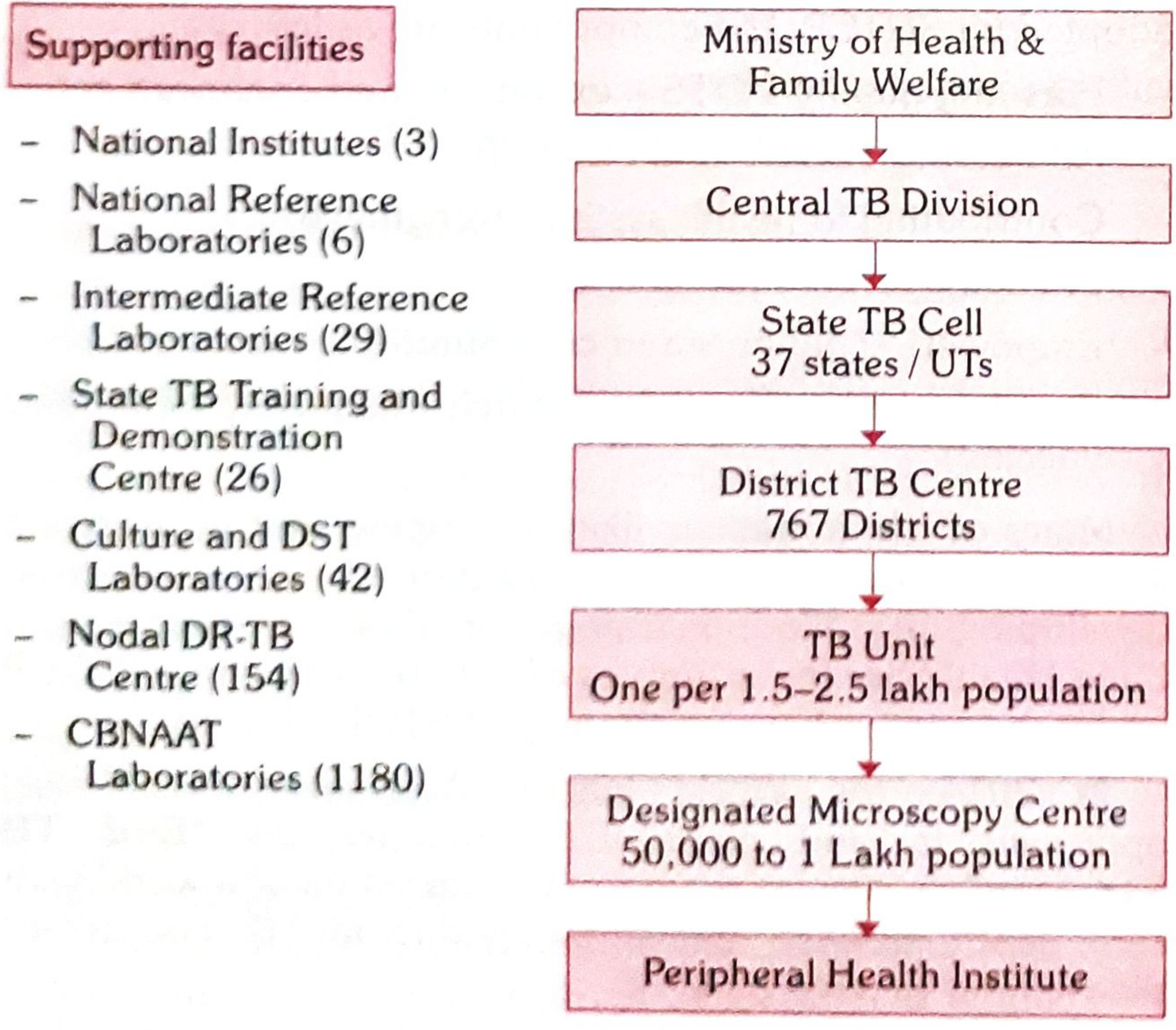
6. Organizational Structure of NTEP (5 Levels)
Level 1 — National Level
- Central TB Division (CTD), Ministry of Health and Family Welfare
- Headed by Deputy Director General - TB (DDG-TB)
- Supported by:
- National TB Institute (NTI), Bengaluru
- Six National Reference Laboratories (NRLs)
- National Institute for Research in Tuberculosis (NIRT), Chennai
- NITRD, Delhi; JALMA, Agra; RMRC Bhubaneshwar; BMHRC, Bhopal
Level 2 — State Level
- State TB Cell (STC) under NHM
- State Tuberculosis Officer (STO) - trained, full-time officer
- Supported by State TB Training and Demonstration Centre (STDC)
- STDC has 3 units: Training, Supervision/Monitoring, Intermediate Reference Laboratory (IRL)
- State Drug Store (SDS): 1 per 5 crore population - manages drugs and logistics
Level 3 — District Level
- District Tuberculosis Centre (DTC) - nodal point for TB at district
- District Tuberculosis Officer (DTO) - full-time, trained officer
- Responsibilities: Planning, training, supervising, monitoring TB programme in district
- District-level DRTB Centres (DDRTBCs) for DR-TB management
Level 4 — Sub-District Level (Tuberculosis Unit Level)
- Tuberculosis Unit (TU) - new sub-district level structure created under RNTCP/NTEP
- Coverage: 1 TU per 2,00,000 population (rural/urban); 1 TU per 1,00,000 (hilly/tribal)
- Staffed by:
- MO-TC (Medical Officer TB Control)
- STS (Senior Treatment Supervisor) - 1 per TU
- STLS (Senior TB Laboratory Supervisor) - 1 per 5 lakh population
- Each TU has Designated Microscopy Centres (DMCs):
- 1 DMC per 1,00,000 population (plain areas)
- 1 DMC per 50,000 population (tribal/hilly/desert areas)
Level 5 — Peripheral Health Institutions (PHIs)
- Sub-Centres, PHCs, CHCs, Referral Hospitals, Medical Colleges
- Also includes private/NGO sector facilities participating in NTEP
- Functions: TB case finding, diagnosis referral, treatment (DOTS), follow-up
- All PHCs function as DOTS Centres
7. Laboratory Services under RNTCP/NTEP (3-Tier System)
Tier 1 — Peripheral Laboratories (DMCs)
- Located at PHCs, CHCs, dispensaries, hospitals
- Perform AFB sputum smear microscopy
- Some function as sputum collection centres only (in remote areas)
- Large hospitals: additional facilities for CBNAAT, LPA, X-ray, FNAC, histopathology
Tier 2 — Intermediate Reference Laboratories (IRLs)
- Located at STDC / medical college / public health labs (1 per state)
- 27 IRLs across India
- Perform culture & DST (Solid - LJ media and Liquid - MGIT)
- Molecular testing: LPA and CBNAAT
Tier 3 — National Reference Laboratories (NRLs)
- 6 NRLs at central level
- Highest quality external quality assurance
- Drug Resistance Surveillance (DRS)
- NIRT Chennai - WHO Supra-National Reference Lab (SNRL)
8. RNTCP Diagnostic Tools (NTEP Endorsed)
| Test | Details |
|---|---|
| Sputum Smear Microscopy | AFB by Ziehl-Neelsen stain; first-line; cheap, fast |
| Culture | LJ solid media or MGIT liquid; gold standard; takes 2-8 weeks |
| GeneXpert (CBNAAT) | Rapid molecular - detects TB + Rifampicin resistance in 2 hours; Universal DST |
| Line Probe Assay (LPA) | Detects Isoniazid and Rifampicin resistance |
| Tuberculin Skin Test (Mantoux) | PPD 5 TU intradermal; read at 48-72 hours |
| Chest X-Ray | Supportive; not confirmatory alone |
Note: TB serology tests (antibody-based) are BANNED by Government of India due to poor specificity.
9. Treatment Under RNTCP/NTEP
Drug-Sensitive TB Regimen: 2HRZE/4HR
| Phase | Duration | Drugs |
|---|---|---|
| Intensive Phase | 2 months (56 doses daily) | H + R + Z + E (Isoniazid + Rifampicin + Pyrazinamide + Ethambutol) |
| Continuation Phase | 4 months (daily) | H + R + E |
- Total duration: 6 months
- Given as Fixed Dose Combinations (FDC) in weight bands
- Under Direct Observation throughout
- Red box = new patients; Blue box = retreatment patients
- Intensive phase blister = 1 day's dose; Continuation phase blister = 1 week's dose
Drug-Resistant TB (DR-TB) Regimen
- Managed at DRTB Centres
- Shorter regimen: 9-11 months (Bedaquiline-containing)
- Longer regimen: 18-20 months
- Newer drugs: Bedaquiline, Delamanid
10. New Initiatives under RNTCP/NTEP
A. NIKSHAY (2012)
- Web-based case-based surveillance system
- "Ni" + "Kshay" = Eradication of TB
- Functions: Patient registration, diagnosis details, DOT provider, HIV status, follow-up, outcome reporting
- Mandatory notification of ALL TB cases (public + private)
- Mobile app, SMS alerts to patients and programme officers
- Automated reports: case finding, sputum conversion, treatment outcome
B. Nikshay Poshan Yojana (April 2018)
- Rs. 500/month Direct Benefit Transfer (DBT) to all TB patients
- Linked with Aadhaar
- Duration: entire treatment period
- Purpose: address undernutrition (major risk factor for TB)
- Till 2023: Rs. 2781 crores disbursed to ~1 crore beneficiaries
C. Universal Drug Susceptibility Testing (UDST)
- GeneXpert/CBNAAT offered to ALL notified TB patients
- Detects Rifampicin resistance early → prevents MDR-TB development
- 1180+ CBNAAT sites across all districts
D. Active Case Finding (ACF)
- Systematic TB screening among high-risk populations through house visits
- Targets: tribal populations, slums, old age homes, prisons, orphanages, transit camps
E. 99DOTS
- IT-enabled adherence monitoring tool
- Patient dials a toll-free number after each dose → system confirms dose taken
- Used for HIV-TB co-infected patients; being expanded
F. TB Vijetas (TB Champions)
- Cured TB patients who serve as peer educators and motivators
- Reduce stigma and encourage treatment adherence
G. Ni-kshay SAATHI
- Family caregiver model to support TB patients
- Families trained to support adherence and monitoring
11. Private Sector Involvement under RNTCP
| Feature | Public Sector | Private Sector |
|---|---|---|
| Advantages | Free diagnosis, free treatment, standardized regimen, accountability | Wide choices, better access, convenient timings, personal attention |
| Disadvantages | Staff delays, distance, difficulty transporting specimens | Non-standard regimens, over-reliance on X-rays, no treatment outcome tracking |
- ~70% of TB patients first seek care in private sector
- RNTCP mandates mandatory notification from all private practitioners
- Private sector can access free NTEP drugs through NIKSHAY
12. TB Burden in India (Current Data)
| Indicator | Data |
|---|---|
| Annual cases | ~26 lakh (India = 26% of global burden) |
| Age group most affected | 15-45 years (65%) |
| Sex ratio | Men 62%, Women 38% |
| Rural:Urban | 58% Rural, 33% Urban, 9% Tribal |
| HIV-TB co-infection | ~2% |
| DR-TB among new cases | 2.84% |
| DR-TB among retreatment cases | 11.60% |
| Treatment success rate (2023) | 89% (drug-sensitive TB) |
| TB Incidence (2023) | 195/lakh population (down from 322 in 2000) |
13. End TB Strategy
- WHO approved End TB Strategy in 2014 (World Health Assembly)
- Vision: "World with zero death, disease and suffering due to TB"
- Global target: End TB by 2030 (SDG)
- India's target: End TB by 2025 (5 years ahead)
- Programme renamed from RNTCP to NTEP in January 2020 to reflect this ambition
End TB Targets for India:
- Reduce TB incidence by 90%
- Reduce TB deaths by 95%
- Zero TB-affected families facing catastrophic costs
Summary Box
| Feature | Detail |
|---|---|
| Full form | Revised National TB Control Programme |
| Renamed to | NTEP (2020) |
| Core strategy | DOTS |
| Launched | 1997 (pilot); 2006 (nationwide) |
| Objectives | 85% cure rate, 70% case detection |
| Organizational levels | 5: National → State → District → TU → PHI |
| Lab network | 3-tier: DMC → IRL → NRL |
| IT system | NIKSHAY |
| Patient support | Nikshay Poshan Yojana (Rs. 500/month) |
| India's target | End TB by 2025 |
Source: Park's Textbook of Preventive and Social Medicine, 27th Edition - National TB Elimination Programme (pp. 480-490); DGHS NTEP Guidelines.
Define community health nursing role of nirsing methods typed and all introduction
community health nursing definition introduction role of community health nurse methods approaches India nursing
https://uomus.edu.iq/img/lectures21/MUCLecture_2024_11225579…
community health nursing roles caregiver educator advocate scope India PHN types methods
https://nursingcollege.mespune.in/wp-content/uploads/2026/01…
COMMUNITY HEALTH NURSING (CHN)
Introduction, Definition, Scope, Roles, Methods and Approaches
1. INTRODUCTION
- Pre-1920: Nursing focused purely on physical/curative care (sick care in hospitals)
- 1920-1960: Health promotional phase - public health nursing emerged as a concept (Winslow's influence)
- Post-1960: Community-oriented care, preventive focus, PHC model
- Post-1978: Alma Ata Declaration - PHC became foundation; community health nursing expanded
- Today: Holistic, multidimensional approach covering all aspects of individual, family, and community health
2. DEFINITION OF COMMUNITY HEALTH NURSING
Standard Definitions:
"Public Health Nursing is the practice of promoting and protecting the health of populations using knowledge from nursing, social, and public health sciences."
"Community health nursing is the synthesis of nursing and public health practice applied to promote and protect the health of the population."
"Community health nursing is a synthesis of nursing theory and public health science, directed towards promoting and preserving the health of populations. It combines all basic elements of professional clinical nursing with public health and community practice."
"The scope of nursing practice includes autonomous and collaborative care of individuals, families, groups, and communities in all settings."
Simple Definition:
3. KEY CONCEPTS
| Concept | Meaning |
|---|---|
| Community | A group of people sharing a common geographic area, characteristics, or interests |
| Health | "A state of complete physical, mental and social well-being, not merely absence of disease" (WHO, 1948) |
| Public Health | "The science and art of preventing disease, prolonging life and promoting health through organized community effort" (Winslow) |
| Community Health | Health status of a defined community or population group |
| CHN | Synthesis of nursing + public health practice for population health |
4. CHARACTERISTICS OF COMMUNITY HEALTH NURSING
- Population-focused: Concern is for the entire community, not just sick individuals
- Prevention-oriented: Emphasis on health promotion and disease prevention
- Holistic approach: Physical, mental, social, spiritual dimensions of health
- Home and community-based: Services provided where people live and work
- Continuity of care: Long-term care across the lifespan
- Family-centered: Family is the unit of service
- Collaborative: Works with a team of health professionals
- Autonomous: Nurse functions independently in many settings
- Evidence-based: Uses research and epidemiological data for practice
5. SCOPE OF COMMUNITY HEALTH NURSING
- Maternal and Child Health (MCH): Antenatal, natal, postnatal care; child immunization; growth monitoring
- School Health: Health assessments, immunization, health education for school children
- Occupational Health: Health of workers in industries and workplaces
- Geriatric Health: Care of the elderly in the community
- Mental Health: Community mental health programs, counseling
- Communicable Disease Control: TB, HIV, malaria control programs (RNTCP, NACP)
- Non-Communicable Disease Prevention: Diabetes, hypertension, cancer screening
- Environmental Health: Safe water, sanitation, vector control
- Nutrition Programs: ICDS, mid-day meal monitoring
- Family Planning: Counseling, promoting spacing and limiting methods
- Rehabilitation: Physical, social, vocational rehabilitation
- Disaster Management: First aid, disease prevention in emergencies
6. ROLES OF A COMMUNITY HEALTH NURSE
Role 1: CARE PROVIDER (Clinician)
- The most fundamental role
- Uses the nursing process (ADPIE) to assess, diagnose, plan, implement, and evaluate care
- Provides direct nursing care to individuals, families, and population groups
- Care is given at home, clinics, schools, workplaces
- Focus on health promotion and prevention, not just curative care
- Example: Dressing wounds at home, providing antenatal care, giving injections
Role 2: EDUCATOR (Teacher)
- Facilitates learning to bring positive health behavior change
- Teaches individuals, families, and groups about:
- Disease prevention and hygiene
- Nutrition and balanced diet
- Immunization
- Family planning methods
- Management of chronic conditions (diabetes, hypertension)
- Safe motherhood and infant care
- Uses health education methods: demonstrations, group teaching, pamphlets, flip charts, home visits
- Principles: Use simple language, assess readiness to learn, evaluate understanding
Role 3: ADVOCATE
- Speaks or acts on behalf of clients who cannot do so for themselves
- Ensures patients' rights are respected
- Advocates for:
- Access to health services for poor and marginalized communities
- Better health policies
- Resources for underserved populations
- Helps clients navigate the health system
- Reduces discrimination and stigma (e.g., in TB, HIV, mental illness)
Role 4: MANAGER/ADMINISTRATOR
- Exercises administrative direction toward accomplishment of health goals
- Functions:
- Assesses clients' health needs
- Plans and organizes health services
- Directs and coordinates health team members
- Evaluates effectiveness of programmes
- Manages resources (staff, supplies, equipment, time)
- Maintains records and reports
- Plans and conducts home visits, immunization camps, health camps
Role 5: COLLABORATOR
- Works with other health team members and agencies to meet client needs
- Collaborates with:
- Doctors, pharmacists, nutritionists, social workers
- ASHA workers, ANMs, health visitors
- NGOs, government departments, schools, religious organizations
- Community leaders and Panchayat
- Coordinates referrals between different levels of care
- Team approach is essential in community health
Role 6: LEADER
- Influences individuals, families, and communities to adopt healthy behaviors
- Motivates health team members
- Acts as a change agent in the community
- Initiates health-related programs and campaigns
- Role model for healthy behavior
- Empowers community members to take charge of their health
Role 7: RESEARCHER
- Identifies health problems in the community through systematic observation
- Participates in epidemiological surveys and studies
- Collects, analyzes, and interprets health data
- Contributes to evidence-based practice
- Evaluates effectiveness of health programs
- Reports unusual disease patterns, outbreaks
- Participates in operational research
Additional Roles:
- Counselor: Provides guidance for mental health, family planning, grief, chronic illness
- Advisor: Gives advice on health matters, referral to appropriate facilities
- Planner: Plans home visits, health programs, screening camps
- Case Finder: Actively identifies new cases of disease in the community
- Epidemiologist: Tracks disease patterns and trends
- Coordinator: Links different health services for the benefit of the client
7. FUNCTIONS OF COMMUNITY HEALTH NURSE
A. Assessment Functions
- Community health assessment and data collection
- Identifying health needs of the population
- Surveillance of communicable and non-communicable diseases
- Monitoring vital statistics (birth rate, death rate, IMR)
B. Policy Development Functions
- Participating in health planning
- Advocating for community health policies
- Developing health education materials
- Contributing to program design and protocols
C. Assurance Functions
- Ensuring access to health services
- Providing direct nursing care
- Supervising and training health workers
- Evaluating health programs
8. METHODS/APPROACHES OF COMMUNITY HEALTH NURSING
Method 1: NURSING PROCESS APPROACH
| Step | Action | Question |
|---|---|---|
| A - Assessment | Collect data | "What data is needed?" |
| D - Diagnosis | Identify health problems | "What is the problem?" |
| P - Planning | Set goals and interventions | "How to manage the problem?" |
| I - Implementation | Execute the plan | "Putting the plan into action" |
| E - Evaluation | Assess outcomes | "Did the plan work?" |
- Cyclical and ongoing
- Goal-directed and client-centered
- Interpersonal and collaborative
- Universally applicable (individuals, families, communities)
- Systematic and documented
Method 2: EPIDEMIOLOGICAL APPROACH
- Uses epidemiological principles to study health and disease in populations
- Investigates distribution, determinants, and frequency of diseases
- Applies the epidemiological triad (Agent-Host-Environment)
- Identifies risk factors and vulnerable populations
- Guides preventive interventions based on data
- Example: Identifying high-risk areas for TB, planning targeted interventions
Method 3: PROBLEM-SOLVING APPROACH (Case Management)
- Define the problem (community needs assessment)
- Problem analysis (causes, contributing factors)
- Generating solutions (alternatives)
- Analysis of solutions (pros and cons)
- Selecting the best solution
- Implementation
- Revision and evaluation
- Assesses, plans, implements, coordinates, monitors, and evaluates services
- Characterized by advocacy, communication, and resource management
- Promotes quality, cost-effective interventions
Method 4: HEALTH PROMOTION APPROACH
- Focuses on enabling people to increase control over their health
- Goes beyond treating disease to building wellness
- Strategies:
- Health education and literacy
- Community engagement and participation
- Behavioral interventions (smoking cessation, exercise)
- Policy advocacy (clean air, safe water, workplace safety)
- Nutrition promotion
- Based on Ottawa Charter (1986) principles of health promotion
Method 5: EMPOWERMENT APPROACH
- Involves building the capacity of communities to identify and solve their own health problems
- Key elements:
- Participatory decision-making
- Building self-reliance
- Developing community leadership
- Reducing health inequalities
- Example: Training ASHA workers, forming Self-Help Groups (SHGs), community health committees
Method 6: EVIDENCE-BASED APPROACH
- Integrates the best available research evidence with clinical expertise and patient values
- Steps:
- Formulate a clinical question
- Search for evidence (research studies)
- Critically appraise the evidence
- Apply evidence to practice
- Evaluate outcomes
- Ensures nursing interventions are based on current, reliable research
- Example: Using WHO/NTEP guidelines for TB treatment rather than personal opinion
Method 7: PERSUASIVE APPROACH
- Convincing people through dialogue and education to change or modify health behaviors
- Does NOT use force or legislation
- Builds awareness, trust, and motivation
- Example: Motivating a mother to bring her child for immunization through counseling
Method 8: ENFORCEMENT APPROACH
- Uses legislation and legal measures to ensure health behaviors
- Applied when persuasion alone is insufficient
- Examples:
- Mandatory immunization as a condition for school admission
- Prohibition of tobacco use in public places
- Mandatory TB notification for all healthcare providers
- Laws against child marriage and child labor
Method 9: TEAM APPROACH
- Community health problems are complex and require multidisciplinary collaboration
- Team members:
- Doctors, nurses, ANMs, health visitors
- ASHA workers, Anganwadi workers
- Social workers, nutritionists
- Community leaders, NGOs
- Each member contributes unique expertise
- Regular team meetings, coordination, shared goals
- Example: MCH team working together for maternal health - doctor, ANM, ASHA, nutritionist
9. TYPES/SETTINGS OF COMMUNITY HEALTH NURSING
| Setting | Type of CHN Practice |
|---|---|
| Home | Home visits, domiciliary nursing |
| PHC/Sub-Centre | Primary care, immunization, ANC clinics |
| School | School health nursing |
| Industry/Workplace | Occupational health nursing |
| Community clinics | Outreach, mobile health units |
| Urban slums | Urban health nursing |
| Tribal areas | Tribal health services |
| Old age homes | Geriatric community nursing |
| Prisons/Correctional | Correctional health nursing |
| NGO sector | Community-based NGO programs |
10. QUALITIES OF A COMMUNITY HEALTH NURSE
| Quality | Details |
|---|---|
| Educational qualification | BSc Nursing / GNM + PHN certificate |
| Communication skills | Clear, effective, empathetic communication |
| Observation skills | Keen assessment of health status and environment |
| Leadership | Ability to lead and motivate community and team |
| Advocacy | Champion for community's health rights |
| Adaptability | Flexible in different cultural and community settings |
| Health education skills | Ability to teach at appropriate literacy levels |
| Empathy | Understanding and compassion for clients |
| Ethical practice | Maintaining confidentiality, dignity, and respect |
| Physical stamina | Ability to travel, do home visits, work in field conditions |
| Cultural competence | Sensitivity to local customs, beliefs, practices |
| Resourcefulness | Making do with limited resources in the community |
11. IMPORTANCE OF COMMUNITY HEALTH NURSING
- Reduces disease burden - through prevention and early detection
- Reaches the unreached - provides care to rural, tribal, and marginalized populations
- Reduces healthcare costs - prevention is cheaper than treatment
- Empowers communities - builds self-reliance and health literacy
- Reduces inequalities - brings services to vulnerable groups
- Supports national health programs - backbone of NTEP, UIP, MCH services
- Bridges hospital and community - ensures continuity of care
- Promotes primary health care - cornerstone of PHC system
Summary
| Aspect | Details |
|---|---|
| Focus | Community/population as a whole |
| Settings | Homes, schools, workplaces, PHCs, community |
| Core functions | Assessment, Policy Development, Assurance |
| Major roles | Care provider, Educator, Advocate, Manager, Collaborator, Leader, Researcher |
| Key methods | Nursing process, Epidemiological, Problem-solving, Health promotion, Empowerment, Evidence-based, Team approach |
| Goal | Health promotion, disease prevention, rehabilitation |
| Philosophy | Health for All through community participation |
Sources: American Nurses Association (ANA); WHO; APHA; ICN; Park's Textbook of Preventive and Social Medicine; MES College of Nursing, Pune - CHN Approaches and Concepts (2026); Alma Ata Declaration (1978).
Icds
ICDS integrated child development services India objectives beneficiaries six services anganwadi community health nursing
ICDS structure organization block CDPO supervisor anganwadi worker helper role nursing India
ICDS — INTEGRATED CHILD DEVELOPMENT SERVICES
1. INTRODUCTION
2. BASIC FACTS
| Feature | Details |
|---|---|
| Full name | Integrated Child Development Services |
| Launched | 2nd October 1975 (Gandhi Jayanti) |
| Ministry | Ministry of Women and Child Development (MWCD), GOI |
| Type | Centrally Sponsored Scheme (CSS) |
| Delivery platform | Anganwadi Centre (AWC) |
| Current name | Anganwadi Services (under Umbrella ICDS Scheme) |
| Cost per child | Approximately $10-$22 per child per year |
3. DEFINITION
4. OBJECTIVES OF ICDS
- To improve the nutritional and health status of children in the age group of 0 to 6 years
- To lay the foundation for proper psychological, physical, and social development of the child
- To reduce the incidence of mortality, morbidity, malnutrition, and school dropout
- To achieve effective coordination of policy and implementation amongst various departments to promote child development
- To enhance the capability of the mother to look after the normal health and nutritional needs of her children
- To ensure early childhood care and education as a right
- To empower women through nutrition and health education
5. BENEFICIARIES OF ICDS
| Beneficiary | Age/Category |
|---|---|
| Children | 0-6 years (primary beneficiaries) |
| Pregnant Women | From conception to delivery |
| Lactating Mothers | Until child is 6 months old |
| Women (general) | 15-45 years of age |
| Adolescent Girls | 11-18 years (under Kishori Shakti Yojana/SABLA) |
6. SIX SERVICES OF ICDS
Service 1: SUPPLEMENTARY NUTRITION
- Provides additional food to supplement the normal diet (NOT a replacement)
- Targets: Children (0-6 years), pregnant and lactating women, adolescent girls
- Caloric norms:
| Beneficiary | Calories | Protein |
|---|---|---|
| Children 6 months - 3 years | 500 Cal | 12-15 g |
| Children 3-6 years | 500 Cal | 12-15 g |
| Severely malnourished children | 800 Cal | 20-25 g |
| Pregnant/Lactating women | 600 Cal | 18-20 g |
| Adolescent girls | 600 Cal | 18-20 g |
- Provided for 300 days per year
- Food is locally prepared, culturally acceptable
- Examples: khichdi, halwa, chikki, dal-rice, eggs, banana
- Under Supplementary Nutrition Programme (SNP)
Service 2: PRE-SCHOOL NON-FORMAL EDUCATION (ECCE)
- For children 3-6 years of age
- Provides Early Childhood Care and Education (ECCE)
- Prepares children for formal schooling
- Activities: play-based learning, rhymes, stories, art, motor skill development
- Uses local play material, toy banks
- Reduces school dropout rates
- Important for cognitive, emotional, and social development
Service 3: NUTRITION AND HEALTH EDUCATION (NHE)
- For women aged 15-45 years (including pregnant, lactating mothers)
- Aims to bring behavior change regarding nutrition and health practices
- Topics covered:
- Importance of nutritious food and balanced diet
- Personal hygiene and sanitation
- Breastfeeding (exclusive breastfeeding for 6 months)
- Care during pregnancy and postnatal period
- Family planning
- Immunization awareness
- Prevention of anemia, vitamin A deficiency
- ORS use during diarrhea
- Forms part of BCC (Behaviour Change Communication) strategy
- Long-term goal: Build women's capacity to care for their own and their children's health
Service 4: IMMUNIZATION
- Immunization of children under 5 years and pregnant women
- Done through coordination with ANM/NHM/Public Health Infrastructure
- Vaccines under Universal Immunization Programme (UIP):
- BCG, OPV, DPT, Hepatitis B, Measles/MMR, Pentavalent
- Pregnant women: Tetanus Toxoid (TT)
- AWC serves as the immunization session site
- AWW mobilizes beneficiaries for immunization days
- Monitors immunization records and growth charts
Service 5: HEALTH CHECK-UP
- Regular health check-up of children (0-6 years) and pregnant/lactating women
- Conducted at the AWC by the ANM/Medical Officer
- Includes:
- Growth monitoring (weighing children monthly, maintaining growth charts)
- Nutritional assessment
- Detection of malnourished children (Grade I, II, III, IV)
- ANC check-ups for pregnant women
- Detection of common illnesses (diarrhea, ARI, skin infections, eye problems)
- Detection of disabilities in children (early intervention)
- AWW maintains the child growth chart (Road to Health card)
- Organizes Health Days monthly at AWC (with ANM and ASHA)
Service 6: REFERRAL SERVICES
- During health check-ups, cases needing specialist or hospital care are referred
- AWW is trained to identify sick children, severely malnourished children, and high-risk pregnancies
- Refers to:
- PHC/CHC/District Hospital
- Nutrition Rehabilitation Centres (NRC) for severely malnourished children
- Specialist doctors (for disabilities, developmental issues)
- Maintains referral slips and follows up on referred cases
- AWW is also trained to detect disabilities in children for early intervention
Summary: Delivery of Six Services
| Service | Delivered by |
|---|---|
| Supplementary Nutrition | AWW (ICDS) |
| Pre-school Education | AWW (ICDS) |
| Nutrition & Health Education | AWW (ICDS) |
| Immunization | ANM/NHM (linked to ICDS) |
| Health Check-up | ANM/MO (linked to ICDS) |
| Referral Services | AWW + ANM/MO (linked) |
First 3 services = provided by ICDS directly Last 3 services = provided through NHM/Public Health Infrastructure
7. ORGANIZATIONAL STRUCTURE OF ICDS
NATIONAL LEVEL
Ministry of Women & Child Development (MWCD)
         ↓
STATE LEVEL
State Child Development Department
         ↓
DISTRICT LEVEL
District Programme Officer (DPO)
         ↓
BLOCK LEVEL (ICDS Project Level)
Child Development Project Officer (CDPO)
         ↓
VILLAGE/COMMUNITY LEVEL
Anganwadi Worker (AWW) + Anganwadi Helper (AWH)
A. National Level — Ministry of Women and Child Development (MWCD)
- Formulates policy, national guidelines, and standards
- Allocates central budget
- Monitors national-level implementation
- Launches new initiatives (e.g., Poshan Abhiyaan, SABLA)
B. State Level — State Child Development Department
- State-level planning, budget allocation
- Appoints CDPOs and District-level officers
- State-specific adaptations of ICDS guidelines
- Training institutions at state level
C. District Level — District Programme Officer (DPO)
- Manages all ICDS Blocks in the district
- Supervision and monitoring of CDPOs
- Coordination with district health and education departments
- Reviews programme progress
D. Block Level — Child Development Project Officer (CDPO)
- 1 ICDS Project per Block (each ICDS block covers ~100 Anganwadi Centres)
- CDPO is the key implementation manager at block level
- A statistical assistant supports the CDPO
- Supervisors (Anganwadi Supervisors): each supervises ~20-25 AWCs
- CDPO's responsibilities:
- Planning ICDS block activities
- Training and supervision of supervisors and AWWs
- Monitoring nutrition and health services
- Coordinating with health, education, and PRI departments
- Monitoring supplementary nutrition supply
- Reporting to DPO
E. Village Level — Anganwadi Centre (AWC)
Anganwadi Worker (AWW):
- Selected from the same community she serves
- Covers 400-800 population (1 per village habitation)
- Training: 3 months institutional + 4 months community-based (total ~7 months)
- Paid honorarium of Rs. 1500/month (has since been revised upward by states)
- Along with Village Health Guides, is the community's primary link with health services
Duties of Anganwadi Worker (AWW):
- Supplementary nutrition: Prepare and distribute food to beneficiaries
- Growth monitoring: Weigh children monthly, maintain growth charts
- Health check-up: Organize monthly health day (with ANM)
- Immunization: Mobilize children and pregnant women for immunization sessions
- Pre-school education: Conduct ECCE activities for 3-6 year olds
- Health and nutrition education: Conduct group sessions for mothers
- Referral: Identify and refer sick/malnourished children and high-risk pregnancies
- Record keeping: Maintain village registers (pregnant women, children under 6, birth/death records)
- Coordination: With ASHA, ANM, and community leaders
- ASHA support: Guide ASHA in organizing Health Days
Anganwadi Helper (AWH):
- Assists AWW in all activities
- Helps with food preparation and cleanliness of AWC
- Part-time, paid lower honorarium
8. THE AAA TEAM — Synergy in ICDS
| Worker | Role in ICDS |
|---|---|
| ASHA | Community mobilizer; brings beneficiaries to AWC; supports AWW |
| AWW | Core ICDS service delivery at village level |
| ANM | Provides health check-ups and immunization at AWC on Health Day |
9. HEALTH DAY (Village Health, Sanitation and Nutrition Day — VHSND)
- Organized once or twice a month at the AWC
- All three (ASHA, ANM, AWW) participate
- Activities on Health Day:
- Weighing of children
- Immunization
- ANC check-up
- Health and nutrition education
- Distribution of Iron-Folic Acid (IFA) tablets
- ORS demonstration
- IEC activities (posters, folk dances, demonstrations)
10. GROWTH MONITORING UNDER ICDS
- Children weighed every month
- Weight plotted on Road to Health Card (growth chart)
- Grades of malnutrition (WHO/IAP classification):
| Grade | Weight for Age |
|---|---|
| Grade I (Mild) | 71-80% of expected weight |
| Grade II (Moderate) | 61-70% |
| Grade III (Severe) | 51-60% |
| Grade IV (Very Severe) | < 50% |
- Severely malnourished children (Grade III/IV) referred to Nutrition Rehabilitation Centres (NRC)
11. KEY SCHEMES LINKED WITH ICDS
| Scheme | Details |
|---|---|
| Poshan Abhiyaan (2018) | PM's Overarching Scheme for Holistic Nourishment; targets stunting, underweight, anemia |
| SABLA (2010) | Rajiv Gandhi Scheme for Empowerment of Adolescent Girls; merged RGSEAG + KISHORI |
| NRC | Nutrition Rehabilitation Centres for severely malnourished children |
| Janani Suraksha Yojana | Convergence for institutional delivery |
| Mid-Day Meal Scheme | For school children (6+ years, beyond ICDS age) |
12. ROLE OF COMMUNITY HEALTH NURSE IN ICDS
- Supervision: Supervises AWW activities, growth monitoring, and immunization
- Training: Trains AWWs on nutrition assessment, health education, and referral
- Health Education: Provides health and nutrition education at AWC
- Growth Monitoring: Assesses nutritional status of children; plots on growth chart
- Immunization: Administers vaccines on Health Days (ANM role)
- ANC services: Provides ANC check-up to pregnant women visiting AWC
- Referral: Identifies and refers cases of malnutrition, high-risk pregnancies, disabled children
- Record keeping: Maintains registers, reports for ICDS
- Coordination: Links ICDS with PHC/CHC for medical services
- Advocacy: Advocates for nutrition security and child rights
13. ACHIEVEMENTS AND CHALLENGES
Achievements:
- Over 7,000+ ICDS projects (blocks) functioning across India
- 13+ lakh Anganwadi Centres operational
- Significant reduction in child malnutrition, IMR, and MMR over decades
- Increased immunization coverage
- Improved early childhood education access for rural/tribal children
- Platform for multiple national programs
Challenges:
- AWW overburdened with too many responsibilities
- Inadequate infrastructure of many AWCs
- Irregular supplementary nutrition supply
- AWW honorarium still low despite revisions
- Poor quality of pre-school education in many states
- Under-coverage of severely malnourished children
- Urban poor and tribal areas remain underserved
14. POSHAN ABHIYAAN (2018) — New ICDS Vision
- Launched in March 2018 by PM Narendra Modi
- India's flagship National Nutrition Mission
- Targets by 2022:
- Reduce stunting by 2% per year
- Reduce underweight by 2% per year
- Reduce low birth weight by 2% per year
- Reduce anemia among women and children by 3% per year
- Uses technology, real-time monitoring, community-based events (Poshan Maah/Month)
- Strengthens AWC platform with digital tools
Summary Table
| Feature | Details |
|---|---|
| Launched | 2nd October 1975 |
| Ministry | Women and Child Development |
| Beneficiaries | 0-6 yr children, pregnant/lactating women, adolescent girls |
| Services | 6 (Supplementary nutrition, pre-school education, NHE, immunization, health check-up, referral) |
| Delivery point | Anganwadi Centre |
| Key worker | Anganwadi Worker (AWW) |
| AWW covers | 400-800 population |
| AWC per block | ~100 |
| Block officer | CDPO |
| Supervisor | 1 per 20-25 AWCs |
| Key goal | Holistic child development + maternal empowerment |
Sources: Park's Textbook of Preventive and Social Medicine, 27th Edition; Ministry of Women and Child Development, GOI (PIB 2022); NITI Aayog Evaluation of ICDS (2023); Gokhale Education Society, MES College of Nursing; PMC - ICDS and Child Health (2025).
Phc