
Can you able to make powerpoint presentation
- Topic and purpose
- Target audience
- Approximate number of slides
- Any required points, images, branding, or references
- Preferred style, such as academic, business, minimal, or colorful
.pptx file.Absolutely — for a 10-slide MBBS presentation, I’d structure it so each slide has enough detail for presentation but isn’t overloaded. Neonatal Conjunctivitis (Ophthalmia Neonatorum) Slide 1 — Title NEONATAL CONJUNCTIVITIS Ophthalmia Neonatorum Topics covered: Definition Etiology and risk factors Pathogenesis Clinical features Diagnosis Differential diagnosis Treatment Complications Prevention Presented by: Name Avishkar /. Group - 23-46 Department- pediatrics Volgograd State medical University. --- Slide 2 — Definition and Overview Neonatal conjunctivitis is inflammation of the conjunctiva occurring during the first 28 days of life. It is characterized by: Conjunctival redness and hyperemia Eyelid edema Ocular discharge, which may be watery, mucous or purulent Sometimes chemosis and pseudomembrane formation It may be caused by bacteria, viruses, or chemical irritation. The most clinically important infectious causes include Chlamydia trachomatis and Neisseria gonorrhoeae. Importance: Some forms are self-limited. Gonococcal infection can rapidly damage the cornea and cause blindness. Chlamydial infection may be associated with neonatal pneumonia. HSV infection can potentially disseminate. --- Slide 3 — Etiology 1. Bacterial causes Most important: Chlamydia trachomatis Neisseria gonorrhoeae Other bacteria: Staphylococcus aureus Streptococcus pneumoniae Non-typeable Haemophilus influenzae 2. Viral causes Herpes simplex virus (HSV-1, HSV-2) Rare compared with bacterial causes 3. Chemical conjunctivitis Can occur after administration of prophylactic eye medication immediately after birth. 4. Other causes Mechanical irritation Nasolacrimal duct obstruction can mimic conjunctivitis --- Slide 4 — Transmission, Risk Factors & Pathogenesis Mode of transmission The major infectious route is perinatal transmission during passage through an infected birth canal. Maternal infections of particular importance: Chlamydia Gonorrhea Genital HSV Risk factors Maternal STI Lack of prenatal screening Untreated maternal infection No or inadequate neonatal ocular prophylaxis Prolonged rupture of membranes Poor perinatal hygiene Pathogenesis Maternal genital infection → exposure of newborn's conjunctiva during delivery → microorganism colonization → conjunctival inflammation → edema, hyperemia and discharge. For C. trachomatis, infection may also involve the nasopharynx and respiratory tract. --- Slide 5 — Clinical Picture The time of onset is an important diagnostic clue, although it is not sufficient by itself to establish the cause. Cause Typical onset Characteristic features Chemical Within hours Mild redness, edema, watery discharge Gonococcal 2–5 days Severe edema, chemosis, profuse purulent discharge Chlamydial 5–14 days Eyelid edema, mucopurulent discharge Other bacteria Usually 4 days–several weeks Purulent/mucopurulent discharge HSV Variable Conjunctivitis ± keratitis, vesicular skin lesions Gonococcal conjunctivitis is an emergency because untreated infection may cause corneal ulceration, perforation and blindness. --- Slide 6 — Diagnosis Diagnosis is based on clinical examination + laboratory identification of the causative organism. Clinical examination Inspect eyelids for edema Assess conjunctival hyperemia Characterize discharge Look for chemosis Examine the cornea for ulceration Check for vesicular skin lesions suggesting HSV Laboratory investigations Conjunctival specimen: Gram stain Bacterial culture and antimicrobial susceptibility testing Testing for C. trachomatis Testing for N. gonorrhoeae NAATs may be used according to laboratory validation and local guidelines For suspected chlamydial disease, the specimen should contain conjunctival epithelial cells, not just surface exudate. --- Slide 7 — Differential Diagnosis Neonatal conjunctival redness/discharge should be differentiated from: 1. Chemical conjunctivitis Occurs soon after prophylactic eye medication Usually mild Resolves spontaneously 2. Nasolacrimal duct obstruction Persistent tearing/discharge Usually less conjunctival inflammation 3. Bacterial conjunctivitis Purulent discharge Conjunctival hyperemia 4. HSV keratoconjunctivitis May have vesicular skin lesions Corneal involvement may occur Requires urgent systemic antiviral treatment 5. Serious ocular infection Corneal ulceration or severe inflammation should prompt urgent ophthalmologic assessment. Key clinical clue: Very severe purulent discharge + marked eyelid edema in the first few days → suspect gonococcal ophthalmia. --- Slide 8 — Treatment Treatment depends on the identified or strongly suspected organism. Chlamydial conjunctivitis Systemic antibiotic therapy is required Oral erythromycin or azithromycin may be used according to neonatal treatment guidelines. Topical therapy alone is inadequate. Evaluate for associated respiratory infection/pneumonia. CDC recommends oral erythromycin 50 mg/kg/day divided into 4 doses for 14 days for neonatal chlamydial infection; infants receiving macrolides should be monitored for infantile hypertrophic pyloric stenosis. Gonococcal conjunctivitis Urgent systemic treatment Ceftriaxone or cefotaxime according to neonatal circumstances Hospital evaluation is generally required Evaluate for disseminated infection Topical antibiotics alone are inadequate. HSV Systemic acyclovir Ophthalmology consultation Topical antiviral therapy may be added for ocular disease. --- Slide 9 — Complications Ocular complications Corneal ulceration Corneal scarring Corneal perforation Endophthalmitis Permanent visual impairment Blindness Systemic complications Chlamydia: Nasopharyngeal infection Neonatal pneumonia Gonococcus: Bacteremia/sepsis Arthritis Meningitis HSV: Disseminated infection Encephalitis Severe systemic disease Therefore, neonatal conjunctivitis should never be treated as simple “pink eye” without considering the cause. --- Slide 10 — Prevention & Key Points Prevention 1. Antenatal prevention Routine prenatal care Screening for maternal chlamydia and gonorrhea according to local recommendations Prompt treatment of infected pregnant patients Appropriate management of maternal genital HSV 2. Neonatal ocular prophylaxis Apply recommended prophylactic ophthalmic medication after birth according to local/national guidelines. In the US, erythromycin 0.5% ophthalmic ointment is recommended for prevention of gonococcal ophthalmia. Important: routine ocular prophylaxis is not effective for preventing chlamydial ophthalmia, so maternal screening and treatment are particularly important. Take-home message > The timing of onset, character of discharge and severity of inflammation help identify the cause, but laboratory testing is important. Gonococcal ophthalmia requires urgent systemic treatment because it can rapidly threaten vision. References: CDC STI Treatment Guidelines; Merck Manual Professional; American Academy of Pediatrics Red Book.
CDC ophthalmia neonatorum chlamydial gonococcal neonatal conjunctivitis treatment prevention
neonatal conjunctivitis AND treatment
~/
- Definition and clinical importance
- Causes and mimics
- Perinatal transmission, risk factors, and pathogenesis
- Time-based clinical presentation
- Examination and laboratory diagnosis
- Differential diagnosis
- Cause-specific treatment
- Ocular and systemic complications
- Antenatal and neonatal prevention
- References and final take-home messages
What would you like me to develop in detail?
- Topic and purpose
- Target audience
- Approximate number of slides
- Any required points, images, branding, or references
- Preferred style, such as academic, business, minimal, or colorful
.pptx file.Your 10-slide plan maps into these core teaching areas:- Definition and clinical importance
- Causes and mimics
- Perinatal transmission, risk factors, and pathogenesis
- Time-based clinical presentation
- Examination and laboratory diagnosis
- Differential diagnosis
- Cause-specific treatment
- Ocular and systemic complications
- Antenatal and neonatal prevention
- References and final take-home messages
diagram neonatal conjunctivitis ophthalmia neonatorum bacterial chlamydial gonococcal eye inflammation
~/
https://www.cdc.gov/std/treatment-guidelines/chlamydia.htm
site:cdc.gov/std/treatment-guidelines gonococcal infections among neonates ophthalmia neonatorum ceftriaxone
~/
mkdir -p "/tmp/workspace/neonatal-conjunctivitis-ppt/src" "/tmp/workspace/neonatal-conjunctivitis-ppt/output"
~/neonatal-conjunctivitis-ppt/src/create_deck.py
from pptx import Presentation
from pptx.util import Inches, Pt
from pptx.dml.color import RGBColor
from pptx.enum.text import PP_ALIGN, MSO_ANCHOR
from pptx.enum.shapes import MSO_SHAPE
from pptx.enum.dml import MSO_THEME_COLOR
from pptx.enum.text import MSO_AUTO_SIZE
from pptx.enum.shapes import MSO_CONNECTOR

OUT = '/tmp/workspace/neonatal-conjunctivitis-ppt/output/Neonatal_Conjunctivitis_Avishkar.pptx'
prs = Presentation()
prs.slide_width = Inches(13.333)
prs.slide_height = Inches(7.5)
blank = prs.slide_layouts[6]

# Palette
NAVY = RGBColor(13, 39, 67)
TEAL = RGBColor(24, 128, 137)
AQUA = RGBColor(223, 244, 243)
CORAL = RGBColor(232, 107, 83)
GOLD = RGBColor(246, 186, 73)
INK = RGBColor(31, 48, 66)
MUTED = RGBColor(90, 107, 122)
WHITE = RGBColor(255,255,255)
PALE = RGBColor(246,249,251)
LINE = RGBColor(216,226,232)
RED = RGBColor(183, 50, 46)


def shape(slide, kind, x,y,w,h, fill=None, line=None, radius=False):
    s = slide.shapes.add_shape(kind, Inches(x), Inches(y), Inches(w), Inches(h))
    if fill:
        s.fill.solid(); s.fill.fore_color.rgb = fill
    else: s.fill.background()
    if line:
        s.line.color.rgb = line
    else: s.line.fill.background()
    return s

def textbox(slide, text, x,y,w,h, size=18, color=INK, bold=False, font='Aptos', align=PP_ALIGN.LEFT, valign=MSO_ANCHOR.TOP, margin=0.04):
    tb=slide.shapes.add_textbox(Inches(x),Inches(y),Inches(w),Inches(h))
    tf=tb.text_frame; tf.clear(); tf.word_wrap=True
    tf.margin_left=tf.margin_right=Inches(margin); tf.margin_top=tf.margin_bottom=Inches(margin)
    tf.vertical_anchor=valign
    p=tf.paragraphs[0]; p.alignment=align
    r=p.add_run(); r.text=text
    r.font.name=font; r.font.size=Pt(size); r.font.bold=bold; r.font.color.rgb=color
    return tb

def rich_text(slide, paragraphs, x,y,w,h, base_size=16, fill=None):
    if fill:
        shape(slide, MSO_SHAPE.ROUNDED_RECTANGLE, x,y,w,h,fill=fill)
    tb=slide.shapes.add_textbox(Inches(x+.18),Inches(y+.14),Inches(w-.36),Inches(h-.28))
    tf=tb.text_frame; tf.clear(); tf.word_wrap=True
    tf.margin_left=tf.margin_right=tf.margin_top=tf.margin_bottom=0
    for i, item in enumerate(paragraphs):
        text, level, color, bold, size = item
        p=tf.paragraphs[0] if i==0 else tf.add_paragraph()
        p.level=level; p.space_after=Pt(6); p.text=text
        p.font.name='Aptos'; p.font.size=Pt(size or base_size); p.font.bold=bold; p.font.color.rgb=color or INK
    return tb

def header(slide, title, subtitle=None, n=None):
    # top bar / accent
    shape(slide, MSO_SHAPE.RECTANGLE,0,0,13.333,.17,fill=TEAL)
    textbox(slide,title,.62,.40,11.3,.48,size=27,color=NAVY,bold=True)
    if subtitle: textbox(slide,subtitle,.64,.93,11,.30,size=11.5,color=MUTED)
    if n is not None:
        shape(slide,MSO_SHAPE.ROUNDED_RECTANGLE,12.05,.39,.65,.42,fill=AQUA)
        textbox(slide,f'{n:02d}',12.05,.45,.65,.2,size=12,color=TEAL,bold=True,align=PP_ALIGN.CENTER)

def footer(slide, text='MBBS Pediatrics | Volgograd State Medical University'):
    shape(slide,MSO_SHAPE.RECTANGLE,.62,7.08,12.1,.012,fill=LINE)
    textbox(slide,text,.65,7.16,8.7,.16,size=8.5,color=MUTED)
    textbox(slide,'Neonatal Conjunctivitis',10.1,7.16,2.55,.16,size=8.5,color=MUTED,align=PP_ALIGN.RIGHT)

def card(slide, title, body, x,y,w,h, accent=TEAL, title_size=15, body_size=14):
    shape(slide,MSO_SHAPE.ROUNDED_RECTANGLE,x,y,w,h,fill=WHITE,line=LINE)
    shape(slide,MSO_SHAPE.ROUNDED_RECTANGLE,x+.02,y+.02,.08,h-.04,fill=accent)
    textbox(slide,title,x+.25,y+.18,w-.4,.28,size=title_size,color=NAVY,bold=True)
    rich_text(slide,body,x+.12,y+.52,w-.22,h-.65,base_size=body_size)

def pill(slide, text, x,y,w, color=TEAL):
    shape(slide,MSO_SHAPE.ROUNDED_RECTANGLE,x,y,w,.34,fill=color)
    textbox(slide,text,x,y+.07,w,.14,size=9,color=WHITE,bold=True,align=PP_ALIGN.CENTER)

def arrow(slide,x1,y1,x2,y2,color=TEAL):
    ln=slide.shapes.add_connector(MSO_CONNECTOR.STRAIGHT, Inches(x1), Inches(y1), Inches(x2), Inches(y2))
    ln.line.color.rgb=color; ln.line.width=Pt(2.2); ln.line.end_arrowhead=True

# 1 Title
s=prs.slides.add_slide(blank)
shape(s,MSO_SHAPE.RECTANGLE,0,0,13.333,7.5,fill=NAVY)
# decorative circles
shape(s,MSO_SHAPE.OVAL,9.75,-.65,4.2,4.2,fill=TEAL)
shape(s,MSO_SHAPE.OVAL,10.75,.35,2.6,2.6,fill=AQUA)
shape(s,MSO_SHAPE.OVAL,10.95,.55,2.2,2.2,fill=WHITE)
shape(s,MSO_SHAPE.OVAL,11.2,.84,1.7,1.35,fill=AQUA)
# eye icon
shape(s,MSO_SHAPE.ARC,10.9,1.3,2.25,.92,line=TEAL)
shape(s,MSO_SHAPE.OVAL,11.65,1.53,.62,.62,fill=TEAL)
textbox(s,'NEONATAL\nCONJUNCTIVITIS',.78,1.28,8.9,1.6,size=39,color=WHITE,bold=True)
textbox(s,'Ophthalmia neonatorum',.83,3.05,6.5,.38,size=21,color=AQUA)
shape(s,MSO_SHAPE.RECTANGLE,.82,3.68,1.28,.08,fill=CORAL)
textbox(s,'A concise clinical approach for MBBS Pediatrics',.82,4.06,7.4,.34,size=17,color=WHITE)
textbox(s,'Presented by: Avishkar\nGroup: 23-46\nDepartment of Pediatrics\nVolgograd State Medical University',.83,5.32,5.7,.9,size=14,color=AQUA)
textbox(s,'10-slide teaching presentation',.82,7.03,3.4,.18,size=9,color=AQUA)

# 2 overview
s=prs.slides.add_slide(blank); header(s,'Definition and clinical importance','Recognize early because the cause determines urgency',2)
card(s,'Definition',[('Conjunctival inflammation developing during the first 28 days of life.',0,INK,False,20)],.65,1.43,5.85,1.15,TEAL,16,17)
card(s,'Typical findings',[('• Red conjunctiva and hyperemia',0,INK,False,15),('• Eyelid edema and chemosis',0,INK,False,15),('• Watery, mucoid, or purulent discharge',0,INK,False,15),('• Occasionally pseudomembrane formation',0,INK,False,15)],.65,2.88,5.85,2.55,TEAL)
card(s,'Why it matters',[('Gonococcus',0,CORAL,True,16),('Can rapidly ulcerate the cornea and threaten sight.',0,INK,False,14),('Chlamydia',0,TEAL,True,16),('May coexist with nasopharyngeal infection and later pneumonia.',0,INK,False,14),('HSV',0,RED,True,16),('Potential ocular, CNS, and disseminated disease.',0,INK,False,14)],6.83,1.43,5.85,3.98,CORAL)
shape(s,MSO_SHAPE.ROUNDED_RECTANGLE,6.83,5.78,5.85,.74,fill=AQUA)
textbox(s,'Clinical principle: do not label it “simple pink eye” until infection is assessed.',7.08,5.99,5.32,.26,size=13.5,color=NAVY,bold=True,align=PP_ALIGN.CENTER)
footer(s,'Source: Tintinalli’s Emergency Medicine, Ophthalmia Neonatorum; CDC STI Guidelines')

# 3 etiology
s=prs.slides.add_slide(blank); header(s,'Etiology: infectious causes and common mimics','Chlamydia and gonococcus are the high-priority pathogens',3)
card(s,'Bacterial',[('HIGH PRIORITY',0,CORAL,True,11),('• Chlamydia trachomatis',0,INK,False,15),('• Neisseria gonorrhoeae',0,INK,False,15),('OTHER BACTERIA',0,TEAL,True,11),('• Staphylococcus aureus',0,INK,False,14),('• Streptococcus pneumoniae',0,INK,False,14),('• Non-typeable H. influenzae',0,INK,False,14)],.65,1.43,3.8,4.82,TEAL)
card(s,'Viral',[('Herpes simplex virus type 1 or 2',0,RED,True,16),('Usually less common than bacterial disease, but it can cause keratitis and disseminated infection.',0,INK,False,14)],4.77,1.43,3.8,2.08,RED)
card(s,'Non-infectious / mimics',[('Chemical conjunctivitis',0,GOLD,True,15),('After instillation of prophylactic eye medication.',0,INK,False,13),('Nasolacrimal duct obstruction',0,TEAL,True,15),('Tearing and discharge with relatively little conjunctival inflammation.',0,INK,False,13),('Mechanical irritation',0,TEAL,True,15)],8.88,1.43,3.8,3.3,GOLD)
shape(s,MSO_SHAPE.ROUNDED_RECTANGLE,4.77,4.02,7.91,2.23,fill=PALE,line=LINE)
textbox(s,'Exam cue',5.05,4.32,1.55,.22,size=15,color=CORAL,bold=True)
textbox(s,'Severe purulent discharge plus marked eyelid edema in the first few days of life should be managed as possible gonococcal ophthalmia while testing is underway.',5.05,4.76,7.05,.78,size=17,color=NAVY,bold=True)
footer(s,'Source: Tintinalli’s Emergency Medicine, Ophthalmia Neonatorum')

# 4 transmission / path
s=prs.slides.add_slide(blank); header(s,'Transmission, risk factors, and pathogenesis','Perinatal exposure is the key mechanism for STI-associated disease',4)
textbox(s,'PERINATAL PATHWAY',.69,1.3,2.8,.23,size=12,color=TEAL,bold=True)
steps=[('Maternal genital infection','Chlamydia • Gonorrhea • HSV'),('Exposure at delivery','Contact with infected cervix / genital tract'),('Conjunctival colonization','Organism adheres to neonatal mucosa'),('Inflammation','Edema • hyperemia • discharge')]
xs=[.65,3.8,6.96,10.1]
for i,(a,b) in enumerate(steps):
    shape(s,MSO_SHAPE.ROUNDED_RECTANGLE,xs[i],1.75,2.55,1.18,fill=WHITE,line=LINE)
    textbox(s,a,xs[i]+.16,1.97,2.2,.21,size=14,color=NAVY,bold=True,align=PP_ALIGN.CENTER)
    textbox(s,b,xs[i]+.14,2.32,2.25,.3,size=10.5,color=MUTED,align=PP_ALIGN.CENTER)
    if i<3: arrow(s,xs[i]+2.55,2.34,xs[i+1]-.12,2.34)
card(s,'Risk factors',[('• Maternal STI or untreated infection',0,INK,False,14),('• No prenatal screening or incomplete prenatal care',0,INK,False,14),('• Prolonged rupture of membranes',0,INK,False,14),('• Poor perinatal hygiene',0,INK,False,14),('• Inadequate ocular prophylaxis where recommended',0,INK,False,14)],.65,3.55,5.7,2.65,TEAL)
card(s,'Chlamydia: extraocular relevance',[('The nasopharynx and respiratory tract can also be infected. Conjunctivitis commonly appears at 5-12 days; afebrile pneumonia may present at 1-3 months.',0,INK,False,16)],6.67,3.55,6.01,2.65,CORAL)
footer(s,'Source: CDC Chlamydial and Gonococcal Infections Treatment Guidelines')

# 5 clinical presentation
s=prs.slides.add_slide(blank); header(s,'Clinical picture: timing guides the differential','Timing supports clinical suspicion but does not replace microbiology',5)
# table
cols=[.65,3.0,5.0,7.0,12.68]
headers=['Cause','Typical onset','Discharge / appearance','Clinical concern']
for i in range(4):
    shape(s,MSO_SHAPE.RECTANGLE,cols[i],1.43,cols[i+1]-cols[i],.48,fill=NAVY)
    textbox(s,headers[i],cols[i]+.11,1.57,cols[i+1]-cols[i]-.2,.16,size=11,color=WHITE,bold=True)
rows=[('Chemical','Within hours','Mild redness, watery discharge','Usually self-limited'),('Gonococcal','2-5 days','Profuse purulent discharge, chemosis','VISION EMERGENCY'),('Chlamydial','5-14 days','Eyelid edema, mucopurulent discharge','Consider pneumonia'),('Other bacteria','~4 days to weeks','Purulent / mucopurulent discharge','Culture-guided care'),('HSV','Variable','Conjunctivitis ± keratitis; vesicles','Urgent systemic therapy')]
for r,row in enumerate(rows):
    y=1.91+r*.76
    fill=WHITE if r%2==0 else PALE
    for i,val in enumerate(row):
        shape(s,MSO_SHAPE.RECTANGLE,cols[i],y,cols[i+1]-cols[i],.76,fill=fill,line=LINE)
        color=CORAL if val in ('VISION EMERGENCY','Urgent systemic therapy') else (TEAL if val=='Consider pneumonia' else INK)
        textbox(s,val,cols[i]+.11,y+.18,cols[i+1]-cols[i]-.2,.37,size=11.2,color=color,bold=val in ('VISION EMERGENCY','Urgent systemic therapy'))
shape(s,MSO_SHAPE.ROUNDED_RECTANGLE,.65,6.05,12.03,.62,fill=RGBColor(255,239,235))
textbox(s,'Red flags: corneal haze or ulceration, marked chemosis, copious pus, vesicular lesions, or systemic illness require urgent specialist assessment.',.92,6.25,11.5,.2,size=13,color=RED,bold=True,align=PP_ALIGN.CENTER)
footer(s,'Source: Tintinalli’s Emergency Medicine, Ophthalmia Neonatorum')

# 6 diagnosis
s=prs.slides.add_slide(blank); header(s,'Diagnosis: examine the eye, then identify the organism','Obtain specimens before treatment when this does not delay urgent care',6)
card(s,'1. Focused eye examination',[('• Eyelid edema and conjunctival injection',0,INK,False,14),('• Character and amount of discharge',0,INK,False,14),('• Chemosis or pseudomembrane',0,INK,False,14),('• Corneal opacity, epithelial defect, or ulcer',0,INK,False,14),('• Vesicular skin lesions suggesting HSV',0,INK,False,14)],.65,1.48,3.8,4.75,TEAL)
card(s,'2. Conjunctival specimens',[('Gram stain',0,NAVY,True,15),('Rapidly detects intracellular gram-negative diplococci in gonococcal disease.',0,INK,False,13),('Culture and susceptibility testing',0,NAVY,True,15),('For bacterial identification and treatment guidance.',0,INK,False,13),('Chlamydia / gonorrhea testing',0,NAVY,True,15),('Use validated NAAT or culture per local laboratory guidance.',0,INK,False,13)],4.77,1.48,3.8,4.75,CORAL)
card(s,'3. Important technical point',[('For suspected chlamydial disease, collect conjunctival epithelial cells, not surface exudate alone.',0,INK,False,17),('Assess for systemic involvement when gonococcus or HSV is suspected.',0,NAVY,True,15)],8.88,1.48,3.8,4.75,GOLD)
footer(s,'Source: CDC STI Treatment Guidelines; Tintinalli’s Emergency Medicine')

#7 differential
s=prs.slides.add_slide(blank); header(s,'Differential diagnosis: use inflammation and context','Not every sticky neonatal eye is infectious conjunctivitis',7)
items=[('Chemical conjunctivitis','Very early onset after prophylaxis; mild; watery; settles spontaneously.',GOLD),('Nasolacrimal duct obstruction','Persistent tearing / discharge with little conjunctival injection.',TEAL),('Bacterial conjunctivitis','Conjunctival hyperemia with purulent or mucopurulent discharge.',TEAL),('HSV keratoconjunctivitis','Vesicles, keratitis, or systemic signs; treat urgently.',RED),('Severe ocular infection','Corneal ulcer, opacity, or severe inflammation demands urgent ophthalmology.',CORAL)]
for i,(title,body,accent) in enumerate(items):
    y=1.37+i*1.05
    shape(s,MSO_SHAPE.ROUNDED_RECTANGLE,.82,y,11.7,.76,fill=WHITE,line=LINE)
    shape(s,MSO_SHAPE.ROUNDED_RECTANGLE,.84,y+.04,.13,.68,fill=accent)
    textbox(s,title,1.17,y+.17,3.05,.2,size=15,color=NAVY,bold=True)
    textbox(s,body,4.2,y+.17,7.72,.32,size=14,color=INK)
shape(s,MSO_SHAPE.ROUNDED_RECTANGLE,.82,6.62,11.7,.36,fill=NAVY)
textbox(s,'Very severe purulence + marked edema in the first days of life = presume gonococcal ophthalmia until proven otherwise.',1.05,6.72,11.2,.13,size=10.5,color=WHITE,bold=True,align=PP_ALIGN.CENTER)
footer(s,'Source: Tintinalli’s Emergency Medicine, Ophthalmia Neonatorum')

# 8 treatment
s=prs.slides.add_slide(blank); header(s,'Treatment: organism-specific, systemic when indicated','Treat suspected gonococcal disease urgently and coordinate specialist care',8)
card(s,'Chlamydial ophthalmia',[('SYSTEMIC THERAPY',0,TEAL,True,11),('Erythromycin base or ethylsuccinate 50 mg/kg/day orally in 4 doses for 14 days.',0,INK,False,14),('Topical treatment alone is inadequate.',0,CORAL,True,13),('Follow for clinical response, IHPS symptoms, and possible pneumonia.',0,INK,False,13)],.65,1.42,3.8,4.9,TEAL)
card(s,'Gonococcal ophthalmia',[('URGENT',0,CORAL,True,11),('Ceftriaxone 25-50 mg/kg IV/IM once (maximum 250 mg).',0,INK,False,14),('If ceftriaxone cannot be used with IV calcium: cefotaxime 100 mg/kg IV/IM once.',0,INK,False,13),('Topical antibiotics alone are inadequate. Evaluate for disseminated disease.',0,CORAL,True,13)],4.77,1.42,3.8,4.9,CORAL)
card(s,'HSV / general measures',[('HSV',0,RED,True,11),('Urgent systemic acyclovir and ophthalmology involvement. Add topical therapy only under specialist direction.',0,INK,False,14),('ALL SUSPECTED INFECTIOUS CASES',0,TEAL,True,11),('Irrigate discharge as needed; treat mother and sexual partner(s) where STI is identified; use local neonatal protocols.',0,INK,False,13)],8.88,1.42,3.8,4.9,RED)
textbox(s,'Doses shown are CDC U.S. guidance. Apply local neonatal protocols and specialist advice, particularly for premature or hyperbilirubinemic infants.',.8,6.58,11.9,.24,size=10.5,color=MUTED,align=PP_ALIGN.CENTER)
footer(s,'Source: CDC Chlamydial and Gonococcal Infections Treatment Guidelines')

# 9 complications
s=prs.slides.add_slide(blank); header(s,'Complications: a missed diagnosis can be sight-threatening','Severity is determined by the pathogen and speed of treatment',9)
card(s,'Ocular',[('• Corneal ulceration',0,INK,False,16),('• Corneal scarring',0,INK,False,16),('• Corneal perforation',0,INK,False,16),('• Endophthalmitis',0,INK,False,16),('• Permanent visual impairment / blindness',0,CORAL,True,16)],.65,1.47,3.8,4.78,CORAL)
card(s,'Systemic: Chlamydia',[('• Nasopharyngeal infection',0,INK,False,16),('• Afebrile neonatal pneumonia, often at 1-3 months',0,INK,False,16)],4.77,1.47,3.8,2.04,TEAL)
card(s,'Systemic: Gonococcus',[('• Bacteremia / sepsis',0,INK,False,16),('• Arthritis',0,INK,False,16),('• Meningitis',0,INK,False,16)],4.77,3.9,3.8,2.35,CORAL)
card(s,'Systemic: HSV',[('• Disseminated infection',0,INK,False,16),('• Encephalitis',0,INK,False,16),('• Severe multisystem illness',0,INK,False,16)],8.88,1.47,3.8,4.78,RED)
footer(s,'Source: CDC STI Treatment Guidelines; Tintinalli’s Emergency Medicine')

# 10 prevention
s=prs.slides.add_slide(blank); header(s,'Prevention and take-home messages','Prevent maternal infection, recognize neonatal danger signs, and act early',10)
card(s,'1. Antenatal prevention',[('• Routine prenatal care',0,INK,False,14),('• Screen for chlamydia and gonorrhea according to local recommendations',0,INK,False,14),('• Prompt treatment of pregnant patients and partners',0,INK,False,14),('• Appropriate management of maternal genital HSV',0,INK,False,14)],.65,1.37,3.8,2.73,TEAL)
card(s,'2. Neonatal prophylaxis',[('U.S. guidance: erythromycin 0.5% ointment once in each eye at birth prevents gonococcal ophthalmia.',0,INK,False,14),('It does NOT prevent chlamydial ophthalmia or pneumonia. Maternal screening and treatment remain essential.',0,CORAL,True,13)],4.77,1.37,3.8,2.73,GOLD)
card(s,'3. Clinical take-home',[('• Timing helps, but test the organism.',0,NAVY,True,14),('• Gonococcus is an emergency: systemic treatment and specialist assessment.',0,NAVY,True,14),('• Chlamydia needs systemic therapy and follow-up for pneumonia.',0,NAVY,True,14),('• Corneal involvement or HSV signs require urgent escalation.',0,NAVY,True,14)],8.88,1.37,3.8,2.73,CORAL)
shape(s,MSO_SHAPE.ROUNDED_RECTANGLE,.65,4.58,12.03,1.08,fill=NAVY)
textbox(s,'“The timing of onset, discharge, and severity guide the differential, but laboratory testing identifies the cause and protects vision.”',1.05,4.86,11.25,.43,size=18,color=WHITE,bold=True,align=PP_ALIGN.CENTER)
textbox(s,'References: CDC Sexually Transmitted Infections Treatment Guidelines: Chlamydial Infections and Gonococcal Infections Among Neonates (accessed 2026). Tintinalli’s Emergency Medicine, 9th ed., Ophthalmia Neonatorum. American Academy of Pediatrics Red Book (for local pediatric practice).',.83,6.08,11.7,.48,size=9.5,color=MUTED,align=PP_ALIGN.CENTER)
footer(s,'Prepared for MBBS Pediatrics | Verify local institutional treatment policies before clinical use')

# metadata
prs.core_properties.title = 'Neonatal Conjunctivitis (Ophthalmia Neonatorum)'
prs.core_properties.subject = 'MBBS Pediatrics presentation'
prs.core_properties.author = 'Avishkar'
prs.save(OUT)
print(OUT)
python "/tmp/workspace/neonatal-conjunctivitis-ppt/src/create_deck.py" && ls -lh "/tmp/workspace/neonatal-conjunctivitis-ppt/output/Neonatal_Conjunctivitis_Avishkar.pptx"
python -c "from pptx import Presentation; p=Presentation('/tmp/workspace/neonatal-conjunctivitis-ppt/output/Neonatal_Conjunctivitis_Avishkar.pptx'); print('slides:',len(p.slides)); [print(i+1, ' | '.join(sh.text.replace('\\n',' / ')[:115] for sh in s.shapes if getattr(sh,'has_text_frame',False) and sh.text.strip())[:300]) for i,s in enumerate(p.slides)]"
Neonatal Conjunctivitis Avishkar
Presentation · PPTX
Add clinical images and a diagnostic flowchart
gonococcal ophthalmia neonatorum clinical photograph purulent neonatal conjunctivitis
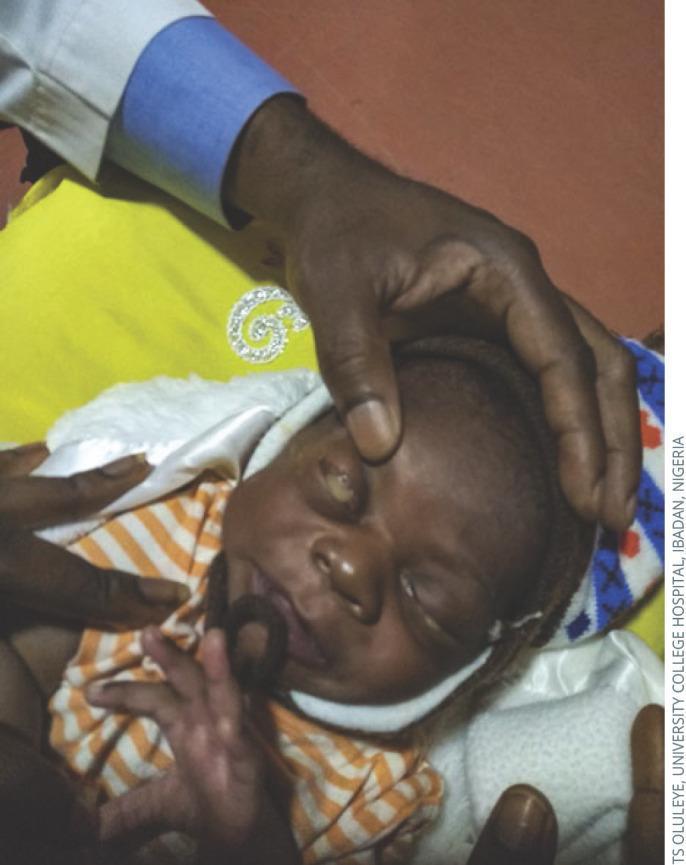
This clinical photograph shows an infant presenting with ophthalmia neonatorum, a form of neonatal conjunctivitis. The primary clinical signs include severe bilateral eyelid edema (swelling) and profuse, thick, purulent (pus-like) discharge emanating from the palpebral fissure. The discharge is thick and yellowish, characteristic of a hyperacute bacterial infection such as gonococcal conjunctivitis. An adult hand is shown gently retracting the upper eyelid to reveal the extent of the inflammation and ocular discharge. The infant is swaddled and using a pacifier, indicating a clinical examination setting. This image serves as a significant educational tool for recognizing the signs of neonatal eye infections, which require urgent diagnosis and treatment to prevent serious complications such as corneal ulceration, perforation, and permanent visual impairment. The anatomical focus is on the ocular and periorbital region, demonstrating the hallmark presentation of severe infectious conjunctivitis in the first weeks of life.
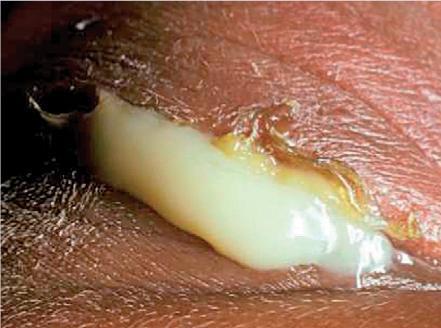
This clinical photograph displays a close-up view of a neonatal eye exhibiting severe ophthalmia neonatorum, likely caused by Neisseria gonorrhoeae infection. The primary visual finding is a massive, hyperacute purulent discharge characterized by a thick, creamy, yellowish-white consistency that is so copious it obscures the underlying globe. The superior and inferior eyelids are markedly edematous (swollen) and erythematous, indicating significant periorbital inflammation. The surrounding skin appears irritated and macerated from contact with the abundant exudate. This presentation is a medical emergency due to the risk of rapid corneal perforation and permanent vision loss. The image serves as a critical educational tool for recognizing the signs of neonatal gonococcal conjunctivitis, emphasizing the urgency of immediate systemic antibiotic treatment and ocular irrigation.
neonatal conjunctivitis chlamydial clinical photograph eyelid edema discharge
neonatal conjunctivitis ophthalmia neonatorum clinical image gonococcal chlamydial public health
~/neonatal-conjunctivitis-ppt/
Error code: 400 - {'error': {'message': 'Your input image may contain content that is not allowed by our content safety system.', 'type': 'invalid_request_error', 'param': None, 'code': 'content_policy_violation'}}
We encountered an error while processing your request. Please try again or reach out to us for help.
This is the file , can you please add realated photos and flow charts
Error code: 400 - {'error': {'message': 'Your input image may contain content that is not allowed by our content safety system.', 'type': 'invalid_request_error', 'param': None, 'code': 'content_policy_violation'}}
We encountered an error while processing your request. Please try again or reach out to us for help.