
Neonatal resuscitation 10 marks obgy pg exam
Reading File
Searching sources...
Finding Sources
Searching Images
neonatal resuscitation algorithm flowchart
Reading File
Finding Sources
Reading File
Reading File
Reading File
Reading File
Reading File
Loading Image
Reading File
I now have comprehensive information from multiple authoritative textbooks. Here is a complete 10-mark exam answer on Neonatal Resuscitation:
Neonatal Resuscitation
Introduction
Approximately 10% of newborns require some assistance to begin breathing at birth, and about 1% need extensive resuscitative measures. The Neonatal Resuscitation Program (NRP), jointly developed by the American Heart Association (AHA) and American Academy of Pediatrics (AAP), provides the standard framework for managing newborns at birth.
Pre-delivery Preparation
Before every delivery, a brief team briefing and equipment check is mandatory. Essential equipment includes:
- Radiant warmer (pre-heated), warm blankets, hat
- Self-inflating bag (450 mL) and flow-inflating bag with appropriately sized masks
- Laryngoscope with straight blades (sizes 00, 0, 1)
- Endotracheal tubes (ETT) - uncuffed, sizes 2.5, 3.0, 3.5, 4.0 mm
- Suction device, bulb syringe, suction catheters (5, 8, 10 Fr)
- Pulse oximeter and ECG leads
- Epinephrine (1:10,000), normal saline
- Umbilical venous catheter (3.5 Fr, 5 Fr)
- Polyethylene bags for infants <29 weeks gestation
NRP Algorithm (Timed Sequence)
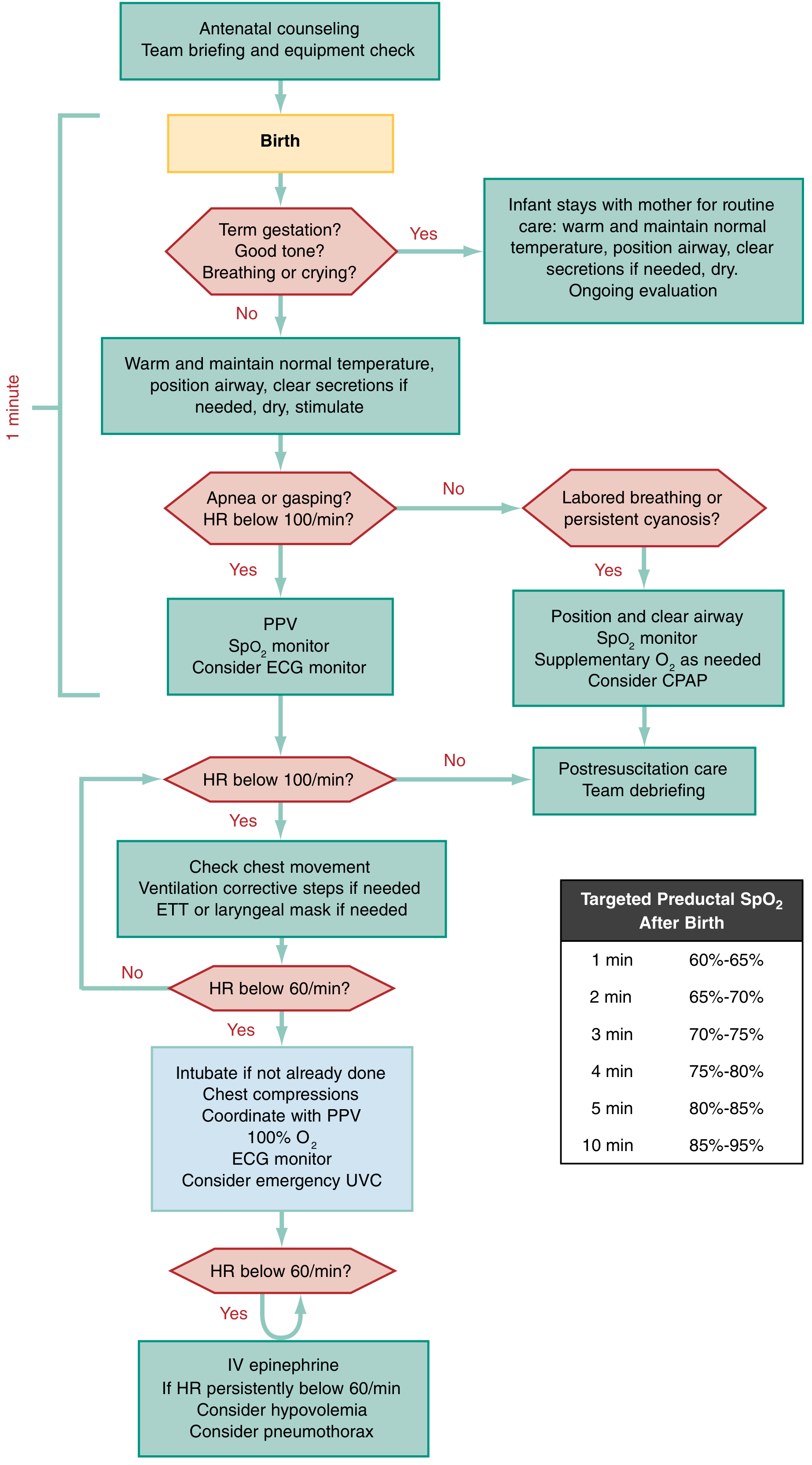
Initial Assessment at Birth (First 30 Seconds - "The Golden Minute")
Three questions are asked immediately:
- Is the baby term gestation?
- Does the baby have good tone?
- Is the baby breathing or crying?
If YES to all three → routine care (skin-to-skin with mother, warmth, airway positioning, drying, ongoing evaluation).
If NO to any → place under radiant warmer and proceed with initial steps:
- Warm - radiant warmer, prewarmed blankets
- Position airway - "sniffing" position (slight neck extension, towel under shoulders)
- Clear secretions - only if visible obstruction; suction mouth first, then nose (routine suctioning is no longer recommended)
- Dry and stimulate - rub the back 2-3 times; if no response, flick soles of feet
- Assess - respiratory effort and heart rate
Ongoing Resuscitation (30-60 Seconds)
After warming, drying, stimulation - reassess:
If HR >100 bpm but labored breathing or persistent cyanosis:
- Open airway, suction if obstruction visible
- Apply pulse oximetry to right wrist/hand (preductal)
- Supplemental O2 to reach targeted SpO2
- Consider CPAP
If apneic, gasping, or HR <100 bpm:
- Begin Positive Pressure Ventilation (PPV)
- Attach SpO2 monitor; consider ECG monitor
- Start with room air (21% O2) in term infants (avoid hyperoxia)
- Rate: 40-60 breaths/min
- Peak inspiratory pressure: 20 cm H2O (initial breaths may need 30 cm H2O to clear lung fluid)
- Assess chest rise as marker of adequacy
Targeted Preductal SpO2 After Birth
| Time After Birth | Target SpO2 |
|---|---|
| 1 min | 60-65% |
| 2 min | 65-70% |
| 3 min | 70-75% |
| 4 min | 75-80% |
| 5 min | 80-85% |
| 10 min | 85-95% |
Advanced Resuscitation (>60-90 Seconds) - HR <100 bpm Despite PPV
Check and correct ventilation (MR SOPA):
- Mask adjustment
- Reposition airway
- Suction
- Open mouth
- Pressure increase
- Airway alternative (ETT or laryngeal mask)
ETT size by gestational age:
- <30 weeks: 2.5 mm
- 30-34 weeks: 3.0 mm
- ≥35 weeks: 3.5 mm
- Depth (cm) = weight (kg) + 6
Chest Compressions - HR <60 bpm Despite Adequate Ventilation for 30 Seconds
- Technique: Two-thumb encircling method (preferred) or two-finger method
- Location: Lower one-third of sternum
- Depth: One-third of anteroposterior chest diameter
- Ratio: 3 compressions : 1 breath = 90 compressions + 30 breaths per minute
- Compressions and ventilations must NOT be simultaneous
- If not already done, intubate and switch to 100% O2
- Establish emergency umbilical venous catheter (UVC) access
- Stop compressions when HR >60 bpm
Medications - HR <60 bpm Despite Compressions + Adequate Ventilation (45-60 Seconds)
Epinephrine (drug of choice):
- IV/IO: 0.01-0.03 mg/kg (0.1-0.3 mL/kg of 1:10,000 solution)
- Intratracheal (if no IV access): 0.05-0.1 mg/kg (0.5-1 mL/kg of 1:10,000 solution)
- Route: Umbilical venous catheter is preferred; IO if UVC not possible
Volume expansion (if hypovolemia suspected - pallor, poor perfusion, weak pulses):
- Normal saline 0.9% - 10 mL/kg IV over 5-10 minutes
- Or O-negative blood 10 mL/kg
- Give slowly in preterm infants (risk of IVH)
Drugs no longer recommended:
- Naloxone - not recommended for respiratory depression; contraindicated if maternal opioid addiction (risk of neonatal seizures)
- Sodium bicarbonate - not recommended routinely (worsens intracellular acidosis)
APGAR Score
Assessed at 1, 5, and 10 minutes:
| Sign | 0 | 1 | 2 |
|---|---|---|---|
| Heart rate | Absent | <100 bpm | ≥100 bpm |
| Respirations | Absent | Slow, irregular | Good, crying |
| Muscle tone | Limp | Some flexion | Active, good flexion |
| Reflex irritability | No response | Grimace | Cough/sneeze |
| Color | Blue/pale | Pink body, blue extremities | Completely pink |
- 1-minute score: assesses need for resuscitation
- 5-minute score: assesses efficacy of resuscitation
- Score <7 at 5 min: repeat every 5 minutes until ≥7
Special Situations
Meconium-stained amniotic fluid:
- Routine intrapartum oropharyngeal/nasopharyngeal suctioning is NOT recommended (even for thick meconium)
- Tracheal suctioning is also NOT recommended for vigorous infants
- Only if poor tone, poor respiratory effort, or HR <100 bpm after 1 min of PPV - consider tracheal suctioning
Preterm infants (<29 weeks):
- Wrap in polyethylene bag (plastic wrap) to prevent hypothermia
- No cord milking in <28 weeks (risk of IVH)
- Delayed cord clamping (30-60 seconds) for vigorous term and preterm infants
Delayed cord clamping:
- Recommended for at least 30-60 seconds for vigorous term and preterm infants
- Improves iron stores, blood volume, reduces need for transfusion
Post-resuscitation Care
- Transfer to NICU for monitoring
- Therapeutic hypothermia (cooling to 33.5°C for 72 hours) for term/near-term (≥36 weeks) newborns with moderate-to-severe hypoxic-ischemic encephalopathy (HIE) - reduces mortality and improves neurological outcomes
- Monitor for hypoglycemia (associated with adverse outcomes in birth asphyxia)
- Avoid hyperglycemia as well
When to Discontinue Resuscitation
If no signs of life (no heartbeat, no breathing) after 10 minutes of complete, adequate resuscitative efforts, it is appropriate to consider stopping resuscitation. Counseling should be done with the family.
Sources: Tintinalli's Emergency Medicine, p. 716-719 | Rosen's Emergency Medicine, p. 3125-3126 | Harriet Lane Handbook, 23rd ed., p. 640
This is a shared conversation. Sign in to Orris to start your own chat.