
'Type 1 diabetes malitus' endocrinology
Reading File
Reading File
Finding Sources
Finding Sources
Searching PubMed
"Diabetes Mellitus, Type 1"[MeSH Terms] AND "treatment"
Reading File
Reading File
Searching the Web
ADA Standards of Care 2026 type 1 diabetes teplizumab screening staging CGM automated insulin delivery
Reading File
Type 1 Diabetes Mellitus (Endocrinology Overview)
The topic is broad, so this is a high-yield overview. Tell me if you want more depth on any section (DKA, insulin regimens, complications, screening and immunotherapy).
Definition and epidemiology
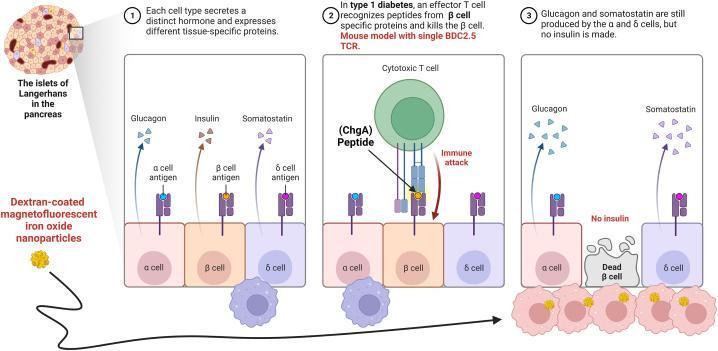
- T1D is an autoimmune disease. Immune-mediated destruction of pancreatic β cells causes absolute insulin deficiency. It accounts for 5-10% of diabetes and is the most common type diagnosed before age 20. - Robbins & Kumar Basic Pathology, Classification section
- It can occur at any age. Up to 40% of cases are diagnosed after age 30. - Goodman & Gilman's, Pathogenesis of Type 1 Diabetes
- "Insulin-dependent diabetes" is no longer the preferred term, because type 2 diabetes can also need insulin.
Pathogenesis
- Genetics: Concordance in identical twins is 60-70%. HLA class II genes (HLA-DR/DQ) give 40-50% of the genetic risk. More than 75% of patients have no affected relative.
- Trigger: The trigger is unknown. Enteroviruses and other environmental agents are favored.
- Mechanism: β-cell destruction is mainly T-cell mediated. Infiltrating cells release TNF-α, IFN-γ and IL-1, which cause β-cell death. This takes months to years, and hyperglycemia appears only after most β cells are lost. - Goodman & Gilman's
- Associated autoimmunity: Autoimmune adrenal insufficiency, Graves or Hashimoto disease, pernicious anemia, vitiligo and celiac disease.
Staging (ADA)
| Stage | Features |
|---|---|
| 1 | 2 or more islet autoantibodies, normoglycemia |
| 2 | Autoantibodies with dysglycemia |
| 3 | Autoantibodies with overt hyperglycemia, usually symptomatic |
Autoantibodies include GAD65, IA-2, insulin (IAA) and ZnT8. 85-90% of patients have at least one at diagnosis. - ROSEN's Emergency Medicine, Types of Diabetes
Clinical presentation
- Polyuria, polydipsia, fatigue and abrupt weight loss over several weeks. - Goodman & Gilman's
- About 30% present with diabetic ketoacidosis (DKA). - Tietz Textbook of Laboratory Medicine
- Adults with slower onset and islet antibodies have LADA (latent autoimmune diabetes of adults).
Diagnosis
These are standard ADA criteria, from my own knowledge rather than the retrieved passages:
- Fasting glucose ≥126 mg/dL, 2-h OGTT ≥200 mg/dL, HbA1c ≥6.5%, or random glucose ≥200 mg/dL with classic symptoms.
- Check autoantibodies (GAD65 first) to confirm autoimmune T1D.
- C-peptide helps distinguish T1D from T2D or MODY when the diagnosis is unclear.
- Screening for T1D is not recommended outside research settings. - Goodman & Gilman's
Management
- Insulin is lifelong and essential. Basal insulin is always required to prevent ketosis. - Washington Manual
- Options are multiple daily injections (basal glargine, detemir or degludec plus rapid-acting prandial insulin), or a pump (CSII).
- Automated insulin delivery (hybrid closed-loop) is preferred where available.
- Glucose monitoring. The 2026 ADA Standards of Care recommend CGM from diagnosis for anyone on insulin. Targets use time in range (70-180 mg/dL, goal above 70%). The usual HbA1c goal is below 7% in most adults, individualized.
- Education. Carbohydrate counting, sick-day rules, exercise adjustment and hypoglycemia recognition.
- Hypoglycemia treatment. Give 15 g of fast carbohydrate. Use glucagon (injectable or nasal) for severe episodes.
- Perioperative care. Continue basal insulin, give dextrose-containing fluids while NPO, and use an insulin infusion for prolonged procedures. - Washington Manual
Acute complications
- DKA: Hyperglycemia, ketonemia and high anion gap metabolic acidosis. Treat with fluids, IV insulin and potassium replacement, and find the precipitant.
- Severe hypoglycemia: This is the main limit on tight control.
Chronic complications and surveillance
- Microvascular:
- Retinopathy: dilated eye exam, starting 5 years after diagnosis in adults.
- Nephropathy: annual urine albumin-to-creatinine ratio and eGFR.
- Neuropathy: annual foot exam.
- Macrovascular: Cardiovascular risk is high, so manage blood pressure and lipids.
- Autoimmune screening: TSH and celiac serology at diagnosis and periodically.
Recent evidence
These PubMed results from the last 2 years may update the textbook picture:
- A 2024 meta-analysis of RCTs (PMID 38757421) covers teplizumab, an anti-CD3 antibody that delays stage 3 disease in at-risk people.
- A 2025 systematic review (PMID 40215252) covers immunotherapy in children and young adults with T1D.
- A 2024 systematic review (PMID 38383908) covers mesenchymal stromal cells.
The textbook statement that screening is not recommended outside trials predates teplizumab. Autoantibody screening and staging are now increasingly used, so check current ADA guidance for this.
Which area should I expand?
This is a shared conversation. Sign in to Orris to start your own chat.