
Orris yaa asphaxia ko smjhayo yrr
Asphyxia ek medical condition hai - iska simple matlab hai oxygen ki kami aur carbon dioxide ka buildup body mein, jo breathing ya oxygen supply rokne se hota hai.
Searching sources...
Reading File
Finding Sources
Finding Sources
Bahut accha! Forensic textbook mein detailed section hai. Ab main full content read karta hoon.
Reading File
Reading File
Reading File
Reading File
Loading Image
Reading File
Ab mere paas poori information hai. Ab ek complete, easy-to-understand answer taiyar karta hoon Hinglish mein.
🫁 Asphyxia - Poori Tarah Samjho!
Definition - Kya Hota Hai?
Asphyxia wo condition hai jisme breathing mein rukawat aati hai ya respired air mein oxygen kam ho jaati hai, jis se organs aur tissues oxygen se vanchit ho jaate hain - saath hi CO₂ bahar nahi nikal paata. Iska result: unconsciousness ya death.
Yaad rakho: "Asphyxia ek mode of dying hai, cause of death nahi."
- The Essentials of Forensic Medicine & Toxicology, 36th Ed.
Anoxia ke 4 Types (Basic Framework)
Asphyxia mein mool mein 4 types of anoxia kaam karti hain:
| Type | Meaning |
|---|---|
| Anoxic anoxia | Blood mein oxygen hi nahi pahuncha |
| Anaemic anoxia | Blood ki oxygen-carrying capacity kam ho gayi (e.g., CO poisoning) |
| Stagnant anoxia | Blood flow ruk gaya |
| Histotoxic anoxia | Tissues oxygen use nahi kar pa rahi (e.g., cyanide) |
Types & Causes of Asphyxia
1. Mechanical Asphyxia
Air passages physically block ho jaate hain:
- Smothering - naak/mooh band kar do haath ya kapde se
- Hanging / Strangulation / Throttling - neck pe external pressure
- Choking - foreign body larynx/pharynx mein phans jaaye
- Drowning - air passages fluid se bhar jaayein
- Traumatic asphyxia - chest/abdomen pe bhaari weight
2. Pathological Asphyxia
Lung/airway disease se oxygen entry ruk jaaye - pneumonia, tumour, etc.
3. Toxic Asphyxia
Poisonous substances oxygen use nahi hone dete:
- CO poisoning - Hb ki O₂ bind karne ki capacity ghaat deta hai
- Cyanide - tissue enzymes block kar deta hai
- Opiates / Barbiturates - respiratory center paralyze
4. Environmental Asphyxia
- Enclosed jagah mein oxygen ki kami (e.g., bandh refrigerator)
- Sewer gas, CO, CO₂ wali atmosphere
- High altitude
5. Traumatic Asphyxia (Separate cause)
- Pulmonary embolism (fat, air, thrombus)
- Bilateral pneumothorax
6. Postural / Positional Asphyxia
Alcohol/drugs se unconscious insaan jo awkward position mein ho jisse breathing impair ho
7. Iatrogenic
Anaesthesia se associated
Pathophysiology - Kaise Hoti Hai Death?
Ye vicious cycle hai:
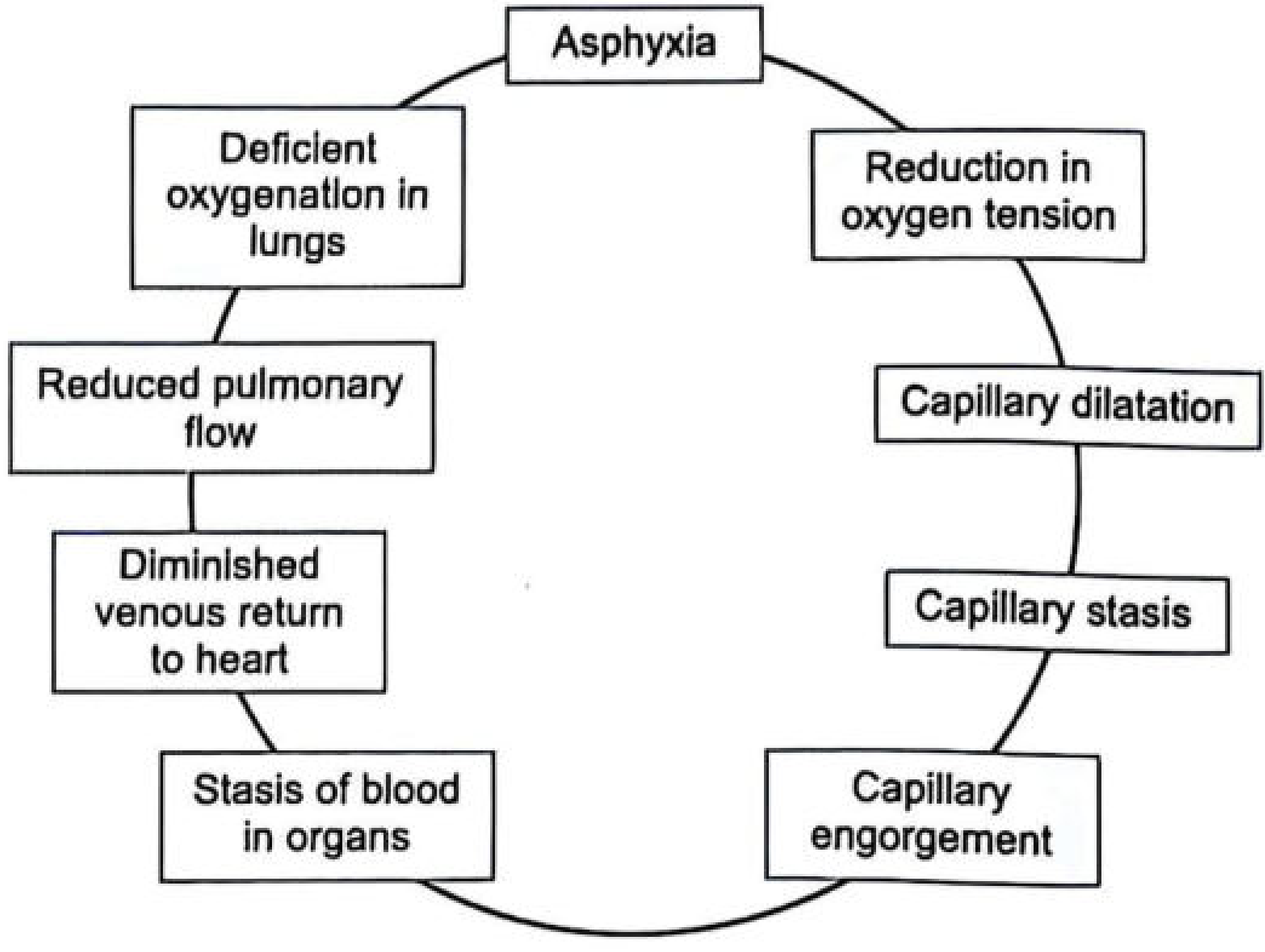
Step-by-step:
- Oxygen tension ghat jaati hai
- Capillaries dilate hoti hain
- Capillary stasis aur engorgement
- Deficient oxygenation in lungs
- Reduced pulmonary blood flow
- Venous return to heart kum hoti hai
- Organs mein blood stasis
- Back to step 1 - cycle repeat hoti rehti hai
Brain ke baare mein:
- Brain weight = sirf 1.4% of body weight
- Lekin 20% total oxygen use karta hai!
- Cortex: 8-15 seconds mein function band
- Brainstem: 25-30 seconds mein affect
- Cortex mein irreparable damage: ~3 minutes mein
- Basal ganglia: 6-7 minutes
- Vagal center: 9-10 minutes
Thumb Rule: "Breathing stops within 20 seconds of cardiac arrest - Heart stops within 20 minutes of breathing stopping."
Cardinal Signs of Asphyxia (Death ke baad ke signs)
1. Petechial Hemorrhages (Tardieu Spots)
- 0.1-2 mm ke chote red/purple spots
- Raised venous pressure se venules overdistend ho kar rupture hote hain
- Kahaan milte hain: skin, sclerae (aankhon mein), conjunctiva, eyelids, brain
2. Cyanosis
- Lips, ears, naak ki tip, fingernails, cheeks neelay-purple ho jaate hain
- Tab hoti hai jab >5g/100ml blood mein reduced Hb ho
3. Congestion
- Face aur upper body congested/red-purple dikhte hain
- Organs (lungs, liver, spleen, kidneys) bhi congested
4. Fluidity of Blood (Blood ka liquid rehna)
- Asphyxia mein blood stasis hoti hai
- Endothelium se fibrinolysin release hota hai blood ko liquid rakhne ke liye
- Death ke baad bhi 4-6 hours tak blood liquid rehta hai
5. Lung Changes
- Normal lung weight ~300g
- Asphyxia mein lungs 450-500g+ ho jaate hain (fluid/blood engorgement se)
Histological Signs
- Alveolar septa torn + hemorrhage + intra-alveolar oedema
- Brain cortex mein nerve cells ka brick-red discoloration (stained sections mein)
- Purkinje cells (cerebellum) mein pallor aur vacuolar degeneration
- Prolonged suffocation mein liver cells ka vacuolar degeneration
Asphyxial Triad (Exam Important!)
Asphyxia confirm karne ke liye teen cheezein dekhi jaati hain:
- Cyanosis
- Petechial (facial, palpebral, bulbar, subpleural) hemorrhages
- Visceral congestion + pulmonary oedema
Note: Asphyxia ek pathological entity nahi hai - sirf morbid anatomical findings se clearly recognize nahi ho sakti. Circumstances + autopsy dono chahiye.
Quick Summary Table
| Feature | Detail |
|---|---|
| Definition | Oxygen deprivation + CO₂ retention due to respiratory interference |
| Brain damage | Starts 8-15 sec, irreversible by 3 min |
| Classic signs | Petechiae, cyanosis, congestion, fluid blood |
| Tardieu spots | Subpleural petechial hemorrhages (classic forensic sign) |
| Blood post-death | Dark, fluid (fibrinolysin effect) |
| Lung weight | >450g in asphyxia vs normal ~300g |
Sources: The Essentials of Forensic Medicine & Toxicology, 36th Ed. (2026); DiMaio's Forensic Pathology, 3rd Ed.
This is a shared conversation. Sign in to Orris to start your own chat.