
Streptococcaceae
I'll read the medical library skill first, then research Streptococcaceae comprehensively.
Reading File
Now let me search the medical library and web simultaneously for Streptococcaceae.
Finding Sources
Searching the Web
Streptococcaceae family microbiology classification genera clinical importance
Now let me read the key sections from Medical Microbiology on Streptococcaceae in parallel:
Reading File
Finding Sources
Let me now read the core Streptococcus/Streptococcaceae sections and get the broader overview from Medical Microbiology:
Reading File
Reading File
Excellent - I now have very rich content. Let me read a bit more on the key species details and the Goldman-Cecil coverage on Group B and other streptococci:
Reading File
Reading File
I now have comprehensive information. Let me also grab the S. pyogenes section for completeness:
Reading File
I now have enough comprehensive information to write a detailed, well-organized answer. Let me fetch the erysipelas image that appeared in the text:
Loading Image
I now have everything needed for a thorough, well-structured answer. Here is a comprehensive overview of Streptococcaceae:
Streptococcaceae
1. Taxonomy and Classification
Streptococcaceae is a family of gram-positive bacteria within:
- Order: Lactobacillales (lactic acid bacteria)
- Phylum: Bacillota (formerly Firmicutes)
The family contains several medically important genera. The two most prominent are Streptococcus and Enterococcus (the latter was reclassified from Streptococcus into its own genus in 1984). Other related genera associated with "streptococcal-like" infections include Abiotrophia, Aerococcus, Granulicatella, Lactococcus, Leuconostoc, and Pediococcus.
| Genus | Diseases |
|---|---|
| Streptococcus | Pharyngitis, pneumonia, meningitis, endocarditis, cellulitis, toxic shock |
| Enterococcus | Bacteremia, endocarditis, UTI, peritonitis, wound infections |
| Abiotrophia | Bacteremia, endocarditis, nosocomial brain abscesses, eye infections |
| Aerococcus | Bacteremia, endocarditis, UTI |
| Granulicatella | Bacteremia, endocarditis (native and prosthetic valves), eye infections |
| Lactococcus | Bacteremia in immunocompromised patients, endocarditis, UTI, osteomyelitis |
| Leuconostoc | Opportunistic: bacteremia, wound infections, CNS infections, peritonitis |
| Pediococcus | Opportunistic bacteremia in severely immunocompromised patients |
- Medical Microbiology 9e, p. 224
2. General Characteristics of Streptococcus
- Morphology: Gram-positive spherical cocci; divide along a single axis to form pairs or chains (never grape-like clusters, which distinguishes them from Staphylococcus)
- Metabolism: Oxidase-negative, catalase-negative (key differentiator from staphylococci), facultative anaerobes
- Name origin: From Greek streptos ("twisted") + kokkos ("grain")
3. Classification Systems for Streptococci
A. Hemolysis on Blood Agar
This is the primary phenotypic classification:
| Pattern | Description | Example |
|---|---|---|
| Alpha (α) | Partial hemolysis - green discoloration (oxidizes hemoglobin iron) | S. pneumoniae, viridans group |
| Beta (β) | Complete hemolysis - clear zone around colonies | S. pyogenes, S. agalactiae |
| Gamma (γ) | No hemolysis | Enterococcus (most) |
B. Lancefield Serologic Grouping
Developed by Rebecca Lancefield in 1933. Beta-hemolytic strains are classified by group-specific cell wall carbohydrate antigens (groups A through W, excluding E, I, J - 21 serotypes total). Clinically important groups:
| Group | Species | Key Diseases |
|---|---|---|
| A | S. pyogenes | Pharyngitis, scarlet fever, impetigo, rheumatic fever, glomerulonephritis, toxic shock, necrotizing fasciitis |
| B | S. agalactiae | Neonatal sepsis/meningitis, puerperal sepsis, adult infections |
| C | S. dysgalactiae | Pharyngitis, skin/soft-tissue infections, bacteremia |
| D | Enterococcus (reclassified) | UTI, endocarditis, bacteremia |
| F | S. anginosus group | Abscesses (suppurative infections) |
| G | S. dysgalactiae subsp. | Pharyngitis, skin infections |
- Medical Microbiology 9e, p. 224-225
C. Viridans Streptococci (α- and γ-hemolytic)
These are classified by biochemical (physiologic) properties into five phylogenetic groups (by 16S rRNA):
| Group | Key Species | Clinical Relevance |
|---|---|---|
| Mutans | S. mutans, S. sobrinus | Dental caries |
| Mitis | S. mitis, S. oralis | Bacteremia, meningitis, endocarditis |
| Sanguinis | S. sanguinis, S. parasanguinis | Endocarditis (native valves) |
| Salivarius | S. salivarius, S. vestibularis | Bacteremia (immunocompromised) |
| Anginosus | S. anginosus, S. constellatus, S. intermedius | Suppurative infections, abscesses |
4. Clinically Important Species
S. pyogenes (Group A Streptococcus - GAS)
Trigger words: Group A, pharyngitis, pyoderma, rheumatic fever, glomerulonephritis
Biology & Virulence:
- Rapidly growing gram-positive cocci in chains
- Cell wall contains: group-specific carbohydrate (A antigen) + type-specific M protein
- Virulence factors:
- Antiphagocytic: Capsule (hyaluronic acid), M protein, M-like proteins, C5a peptidase
- Adhesion/invasion: M protein, lipoteichoic acid, F protein
- Toxins: Streptococcal pyrogenic exotoxins (SPE-A, B, C), streptolysin S (SLS), streptolysin O (SLO), streptokinase, DNases
Epidemiology:
- Transient colonization in upper respiratory tract and skin surface
- Person-to-person spread by respiratory droplets (pharyngitis) or through skin breaks
- Pharyngitis: most common in children 5-15 years old
- Pyoderma: children 2-5 years with poor personal hygiene
Diseases:
- Suppurative: Pharyngitis, scarlet fever, pyoderma (impetigo), erysipelas, cellulitis, streptococcal toxic shock syndrome (STSS), necrotizing fasciitis
- Nonsuppurative (post-streptococcal sequelae): Acute rheumatic fever (ARF), post-streptococcal glomerulonephritis (PSGN)
Diagnosis:
- Antigen tests (rapid strep test) for pharyngitis
- Identified by: catalase-negative, positive PYR reaction, bacitracin susceptibility, group A antigen
- Antistreptolysin O (ASO) titer for ARF; anti-DNase B for PSGN
Treatment:
- Penicillin G (drug of choice) - GAS remains universally penicillin-susceptible
- Amoxicillin equally effective; erythromycin/azithromycin for penicillin-allergic patients
Scarlet Fever
Complication of pharyngitis when the strain is lysogenized by a bacteriophage encoding pyrogenic exotoxin. Features:
- Diffuse erythematous rash starting on upper chest, spreading to extremities
- Circumoral pallor (area around mouth spared)
- "Strawberry tongue" - yellow-white coating shed to reveal raw red surface
- Pastia lines (rash in skinfolds)
- Rash blanches on pressure; desquamation follows over 5-7 days
Erysipelas
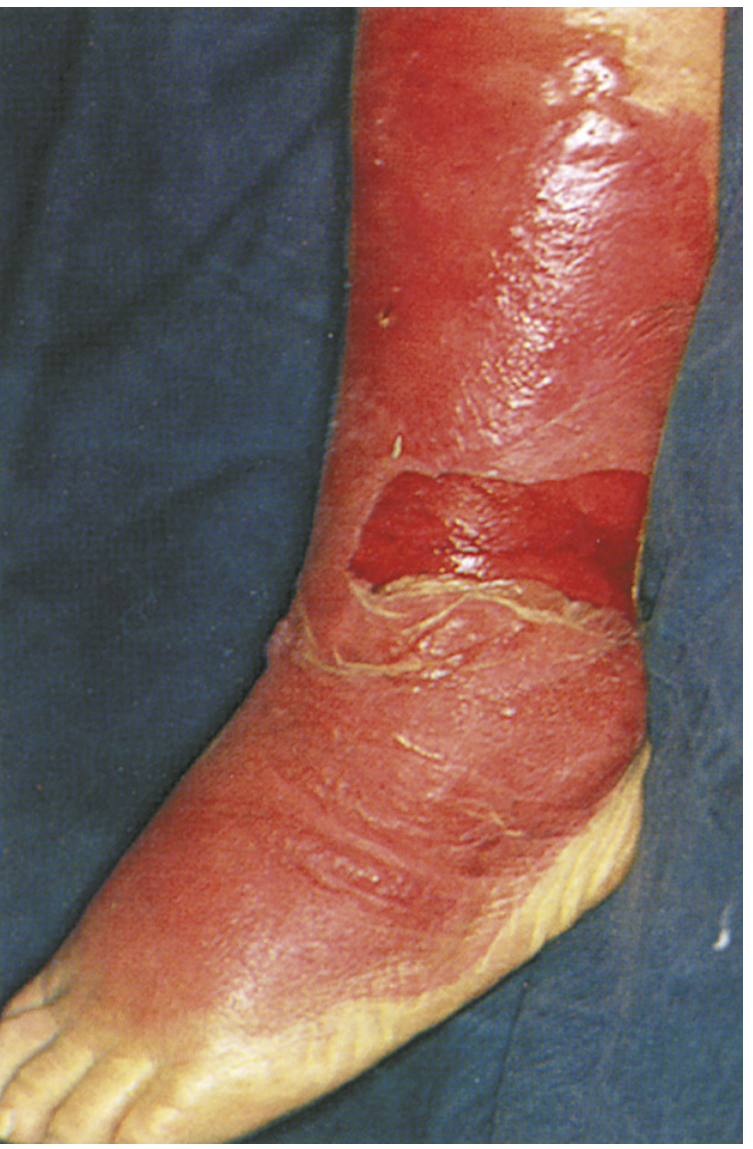
Acute erysipelas of the leg (from Medical Microbiology 9e, Fig. 19.3) - Note the intense erythema and sharply demarcated borders characteristic of GAS skin infection.
Streptococcal Toxic Shock Syndrome (STSS)
- Associated with strains producing pyrogenic exotoxin A (SPEA)
- Presents with bacteremia, hypotension, and multi-organ failure
- Frequently preceded by skin or soft-tissue infection (necrotizing fasciitis)
- Mortality: 30%-70%
S. agalactiae (Group B Streptococcus - GBS)
Biology & Virulence:
- Gram-positive cocci; chains in clinical specimens, longer chains in culture
- Colonies: large with a narrow zone of β-hemolysis (1-2% strains nonhemolytic)
- Polysaccharide capsule is the primary virulence factor - inhibits phagocytosis
- Nine type-specific capsular polysaccharides (Ia, Ib, II-VIII); serotypes Ia, III, and V most common in disease
- Sialic acid on capsular types Ia, Ib, II inhibits alternative complement pathway activation
Epidemiology:
- Colonizes lower GI tract and genitourinary tract
- Transient vaginal carriage in 10%-30% of pregnant women
- ~60% of infants born to colonized mothers become colonized during vaginal delivery
Diseases:
- Neonates: Septicemia, pneumonia, meningitis (early-onset: <7 days; late-onset: 7-90 days)
- Adults: Puerperal sepsis, UTI, endocarditis, bacteremia (especially in diabetics, elderly, immunocompromised)
Treatment/Prevention:
- Penicillin G (drug of choice); combination with aminoglycoside for serious infections
- High-risk neonates: penicillin given at least 4 hours before delivery
- No vaccine currently available
S. pneumoniae (Pneumococcus)
Trigger words: Diplococci, capsule, pneumonia, meningitis, vaccine
Biology & Virulence:
- Elongated gram-positive cocci arranged in pairs (diplococci) and short chains
- Cell wall contains teichoic acid rich in phosphorylcholine (C polysaccharide) - required for autolytic enzyme (amidase) activity
- Virulence factors:
- Polysaccharide capsule - primary antiphagocytic factor
- Pneumolysin - damages respiratory epithelium, stimulates inflammation
- IgA protease - cleaves secretory IgA
- Surface protein adhesins - mediate colonization
Epidemiology:
- Most infections from endogenous spread (colonized nasopharynx/oropharynx to distal sites)
- Risk factors: antecedent viral respiratory illness, malignancy, sickle cell disease, functional asplenia, age extremes
- More common in cool months
Diseases: Pneumonia, sinusitis, otitis media, meningitis, bacteremia
Diagnosis:
- Culture on enriched media (sheep blood agar)
- Identified by: catalase-negative, optochin susceptibility, bile solubility, presence of C polysaccharide antigen
- Nucleic acid-based tests preferred for meningitis (especially in antibiotic-treated patients)
- Antigen test for C polysaccharide: sensitive in CSF but not in urine
Treatment & Prevention:
- High-dose penicillin G (or amoxicillin) for susceptible strains; ceftriaxone + vancomycin empirically for meningitis
- Vaccines:
- PCV13/PCV15/PCV20 (conjugate - children and adults)
- PPSV23 (polysaccharide - adults ≥65, high-risk patients)
5. Enterococcus (formerly Group D Streptococcus)
Reclassified in 1984; currently 58 species. Most important pathogens:
- E. faecalis - majority of human clinical isolates
- E. faecium - remarkable capacity for antibiotic resistance (including VRE)
- E. gallinarum and E. casseliflavus - inherently vancomycin-resistant
Key Features:
- Share group D cell wall antigen (glycerol teichoic acid) with streptococci
- Grow in 6.5% NaCl, at pH 9.6, at 10°C and 45°C (hardier than streptococci)
- Catalase-negative, PYR-positive
Diseases: UTI (especially nosocomial), bacteremia, endocarditis, peritonitis, wound infections
Resistance concern: Vancomycin-resistant enterococci (VRE) are a major nosocomial pathogen
6. Key Differentiating Tests
| Test | Streptococcus | Enterococcus | Staphylococcus |
|---|---|---|---|
| Catalase | Negative | Negative | Positive |
| PYR | Variable | Positive | Positive (S. aureus) |
| Growth in 6.5% NaCl | No | Yes | Yes |
| Bacitracin sensitivity | GAS: susceptible | Resistant | Resistant |
| Optochin sensitivity | S. pneumoniae: susceptible | Resistant | Resistant |
| Bile esculin hydrolysis | Negative | Positive | Variable |
7. Streptococcaceae and the Human Microbiome
Beyond overt infection, the family has important microbiome roles:
- Oral cavity: Viridans streptococci are primary colonizers; S. mutans is the key etiologic agent of dental caries
- Gut microbiome: Streptococcaceae abundance increases with PPI use and is associated with antibiotic exposure; elevated in gastric cancer and cirrhosis (Goodman & Gilman's notes increased Streptococcaceae/Enterobacteriaceae with cirrhosis severity)
- Skin: Streptococcaceae are transiently enriched on recently washed hands
8. Nonsuppurative Sequelae (Post-Streptococcal)
These occur after GAS infections and are immune-mediated:
| Disease | Follows | Mechanism | Key Features |
|---|---|---|---|
| Acute Rheumatic Fever (ARF) | Pharyngitis (not pyoderma) | Molecular mimicry (anti-M protein antibodies cross-react with cardiac tissue) | Carditis, polyarthritis, chorea, Aschoff nodules |
| Post-streptococcal Glomerulonephritis (PSGN) | Pharyngitis or pyoderma | Immune complex deposition in glomeruli | Hematuria, edema, hypertension; follows "nephritogenic" strains |
Diagnosis of sequelae:
- ASO titer: confirms prior pharyngitis (rises after throat infection)
- Anti-DNase B: better for prior pyoderma
Sources: Medical Microbiology 9e (Murray), pp. 221-240; Goldman-Cecil Medicine, Chapter 44; Goodman & Gilman's Pharmacological Basis of Therapeutics
This is a shared conversation. Sign in to Orris to start your own chat.