

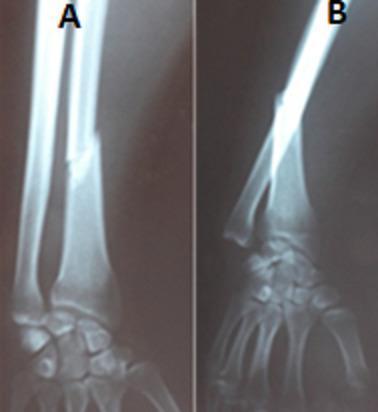
Here is given three documents, analyse them properly and answer the diagnosis of given image, with every aspect where there can be question can be arises. Answer the bone fracture x-ray in given image.
cd /home/daytona/workspace/attachments/623eca53-7ff1-4013-8d7b-efa1ac97562c && python3 -c " import pdfplumber with pdfplumber.open('practice bones and joints part1 2022(1).pdf') as pdf: for i, page in enumerate(pdf.pages[:30]): text = page.extract_text() if text and ('forearm' in text.lower() or 'radius' in text.lower() or 'ulna' in text.lower() or 'fracture' in text.lower() or 'monteggia' in text.lower() or 'galeazzi' in text.lower()): print(f'=== PAGE {i+1} ===') print(text[:3000]) print() "
cd /home/daytona/workspace/attachments/623eca53-7ff1-4013-8d7b-efa1ac97562c && python3 -c " import pdfplumber with pdfplumber.open('practice bones and joints part1 2022(1).pdf') as pdf: print(f'Total pages: {len(pdf.pages)}') for i, page in enumerate(pdf.pages): text = page.extract_text() if text: tl = text.lower() if any(k in tl for k in ['monteggia','galeazzi','both bone','forearm fractur','radius fractur','ulna fractur','nightstick','night stick']): print(f'=== PAGE {i+1} ===') print(text[:4000]) print() "
cd /home/daytona/workspace/attachments/623eca53-7ff1-4013-8d7b-efa1ac97562c && python3 -c " import pdfplumber with pdfplumber.open('bones 4 курс.pdf') as pdf: print(f'Total pages: {len(pdf.pages)}') for i, page in enumerate(pdf.pages[:60]): text = page.extract_text() if text: tl = text.lower() if any(k in tl for k in ['monteggia','galeazzi','both bone','forearm','radius','ulna','nightstick','fracture']): print(f'=== PAGE {i+1} ===') print(text[:4000]) print() "
Galeazzi fracture forearm distal radius fracture DRUJ dislocation X-ray
X-Ray Analysis: Galeazzi Fracture-Dislocation
Patient Demographics (from film label)
- Name: Isaev A.V.
- DOB: 25-12-1955 (age ~66 at time of X-ray)
- Sex: Male
- Date of study: 08-10-2022
- Side: Left (L marker visible)
- View: AP/lateral of left forearm
X-Ray Findings
What is visible on the film:
- Fracture of the distal-to-middle third of the radial shaft — complete, displaced, with angulation and foreshortening of the radius
- The ulna appears intact proximally but there is visible disruption at the wrist level
- Significant displacement of the fracture fragments — the distal radial fragment is shortened and angulated (dorsal/volar)
- Disruption of the Distal Radioulnar Joint (DRUJ) — the ulnar head is displaced relative to the sigmoid notch of the radius, indicating DRUJ dislocation/subluxation
- Soft tissue swelling evident around the fracture site
- No visible comminution — fracture appears as a simple (22-A2) or possibly oblique/transverse pattern
Primary Diagnosis
GALEAZZI FRACTURE-DISLOCATION
(aka "Piedmont fracture" / "Reverse Monteggia" / "Fracture of Necessity")
Classification
OTA/AO Classification:
- 22-A2.3 (Simple radial fracture with DRUJ dislocation = Galeazzi type)
- Code breakdown: 22 = forearm shaft; A = simple fracture; 2 = radius; .3 = with DRUJ dislocation
Galeazzi Subclassification (by distance from articular surface):
- Type I: Fracture within 7.5 cm of the distal radial articular surface → higher DRUJ instability (likely here given the distal location visible)
- Type II: More proximal
In this patient, the fracture appears to be in the distal-to-middle third, placing it in Type I territory, which carries a significantly higher rate of DRUJ instability requiring operative stabilization.
DRUJ Dislocation Subtype:
- Simple (reducible after radial ORIF) vs. Complex (irreducible — interposition of ECU or EDM tendons)
- This distinction is determined intraoperatively.
Mechanism of Injury
| Mechanism | Details |
|---|---|
| Primary | Fall on outstretched hand in forced hyperpronation |
| Biomechanics | Torsional + axial loading → radial shaft fracture → proximal-to-distal propagation through interosseous membrane → rupture of distal radioulnar ligaments → TFCC injury → DRUJ instability |
| Alternative | Direct dorsolateral blow to the forearm |
- Radial shaft fractures
- Interosseous membrane tears (distal to proximal)
- Distal radioulnar ligaments rupture
- TFCC (triangular fibrocartilage complex) injury
- DRUJ becomes unstable/dislocated
Clinical Features (What to Examine)
| Feature | Finding |
|---|---|
| Deformity | Visible forearm deformity at fracture site |
| DRUJ instability | Prominent ulnar head at wrist (piano key sign), tenderness over DRUJ |
| Range of motion | Painful/reduced forearm rotation (pronation/supination) |
| Neurovascular | Check anterior interosseous nerve (AIN), radial nerve, radial artery |
| Soft tissues | Swelling, ecchymosis over mid-distal forearm and wrist |
| Open vs closed | Examine skin integrity; ulnar subcutaneous border prone to skin breach |
Radiographic Diagnostic Criteria (What to Look For)
- DRUJ space widened >2 mm
- Relative shortening of the radius (radial shortening >5 mm suggests DRUJ disruption)
- Fracture at base of ulnar styloid (strong indicator of DRUJ disruption)
- Dorsally angulated radial fracture
- Dorsal displacement of the ulnar head
- Dedicated wrist AP + lateral (assess DRUJ, ulnar variance)
- Elbow AP + lateral (rule out associated elbow injury, confirm PRUJ intact)
Differential Diagnosis
| Condition | Key Distinction |
|---|---|
| Monteggia fracture | Ulnar shaft fracture + radial HEAD dislocation at elbow (not wrist) |
| Nightstick (isolated ulnar) fracture | Ulnar shaft only, no DRUJ/joint dislocation |
| Both-bone forearm fracture | Both radius AND ulna shaft fractures |
| Essex-Lopresti lesion | Radial head fracture + interosseous membrane disruption + DRUJ injury (triad) |
| Colles fracture | Distal radial metaphysis (not shaft) fracture |
Treatment
In Adults: "Fracture of Necessity" — Operative Surgery Is Mandatory
Step-by-Step Surgical Management:
- ORIF of the radius with a 3.5 mm dynamic compression plate (DCP) — gold standard
- Anatomic reduction and rigid fixation restores radial length and alignment
- Restores DRUJ congruency indirectly in most cases
- Assess DRUJ stability after radial fixation:
- If stable → immobilize in supination in long-arm cast ×4-6 weeks
- If unstable (simple dislocation) → closed reduction of DRUJ + supination casting or temporary radioulnar Kirschner wire fixation
- If irreducible (complex dislocation) → open DRUJ, remove interposed ECU/EDM, repair TFCC ± temporary K-wire
- TFCC repair if significant ligamentous injury identified
In Children: Closed reduction + long-arm casting (most cases)
Complications
| Complication | Notes |
|---|---|
| Malunion | Most common if managed non-operatively |
| Nonunion | Less common with plating |
| DRUJ chronic instability/dislocation | If initial DRUJ disruption missed |
| Limited forearm rotation | Due to malunion or DRUJ arthrosis |
| Interosseous membrane synostosis | Radioulnar synostosis (rare) |
| Anterior interosseous nerve palsy | From traction during injury or surgery |
| Compartment syndrome | Emergency → fasciotomy |
| Refracture | After implant removal |
Key Teaching Points for Exams
- "Fracture of Necessity" — Galeazzi fractures in adults ALWAYS require operative treatment; no exceptions
- Never miss the DRUJ — A solitary radial shaft fracture must prompt dedicated wrist views; DRUJ dislocation occurs in ≥25% of radial shaft fractures
- Galeazzi vs Monteggia mnemonic:
- Galeazzi = Gadget at the wrist (DRUJ affected)
- Monteggia = Middle/Monteggia at the elbow (PRUJ/radial head affected)
- DRUJ widening >2 mm on AP or ulnar styloid base fracture = presume DRUJ disruption
- Radial shortening >5 mm correlates with DRUJ ligamentous incompetence
- Type I Galeazzi (fracture within 7.5 cm of distal radius joint surface) = highest rate of DRUJ instability
Reference Images
- Rockwood and Green's Fractures in Adults, 10th ed. 2025 — Chapter 42 (Diaphyseal Fractures of Radius/Ulna)
- Rosen's Emergency Medicine — Galeazzi Fracture section
- Miller's Review of Orthopaedics, 9th ed.
- Tintinalli's Emergency Medicine
- Provided course documents: Practice Bones and Joints Part 1 (2022), Bones 4th Year