
4 types of estrogen
The four main types of estrogen are:
- Estrone (E1) - the primary estrogen in postmenopausal women, produced mainly in fat tissue
- Estradiol (E2) - the most potent and predominant estrogen in reproductive-age women, produced by the ovaries
- Estriol (E3) - the weakest of the three classical estrogens, produced in large amounts during pregnancy by the placenta
- Estetrol (E4) - produced exclusively during pregnancy by the fetal liver; has unique receptor-binding properties
Searching sources...
Reading File
Finding Sources
Searching the Web
four types of estrogen E1 E2 E3 E4 physiology differences
Reading File
Reading File
Loading Image
Here is a complete overview of the four types of estrogen, sourced from Creasy & Resnik's Maternal-Fetal Medicine and corroborated by current sources:
The 4 Types of Estrogen
| E1 | E2 | E3 | E4 | |
|---|---|---|---|---|
| Name | Estrone | Estradiol | Estriol | Estetrol |
| Potency | Weak | Strongest | Weakest (classical) | Weak/selective |
| Predominant in | Postmenopause | Reproductive years | Pregnancy | Pregnancy only |
| Primary source | Adipose tissue | Ovaries | Placenta (from fetal precursors) | Fetal liver |
1. Estrone (E1)
- A 17-ketone form of estradiol
- The dominant estrogen after menopause, produced mainly by peripheral conversion of androgens in adipose tissue
- Estrogenic activity roughly 10-30% that of estradiol
- Can be converted back to estradiol in tissues
2. Estradiol (E2 / 17β-Estradiol)
- The most potent and biologically active estrogen
- Predominates during the reproductive years, produced primarily by granulosa cells of the ovarian follicle
- Drives follicular development, endometrial proliferation, secondary sex characteristics, bone density, and cardiovascular protection
- Highest serum levels at the LH peak (ovulation)
3. Estriol (E3)
- The major estrogen of pregnancy - makes up more than 90% of estrogen in the urine of pregnant women
- Produced in the placenta from fetal adrenal precursors (primarily 16α-hydroxy-DHEAS, which undergoes 16α-hydroxylation mainly in the fetal liver)
- Has very low affinity for sex hormone-binding globulin (SHBG) and is cleared rapidly
- Maternal serum levels rise to 12-20 ng/mL by term
- Formerly used as a marker of fetoplacental function, but now largely abandoned due to poor specificity
4. Estetrol (E4)
- A 15α-hydroxy derivative of estriol, making it unique among the four
- Produced exclusively during pregnancy from fetal precursors - the fetal liver is the primary source
- Appears in maternal serum from around week 20 onwards and rises through term (as shown in the figure below)
- Has selective estrogen receptor modulator (SERM)-like properties - a synthetic form is now used in oral contraceptives (Nextstellis/Drovelis)
- Not present in non-pregnant women or men
Estrogen Levels During Pregnancy (from textbook Figure 10.5)
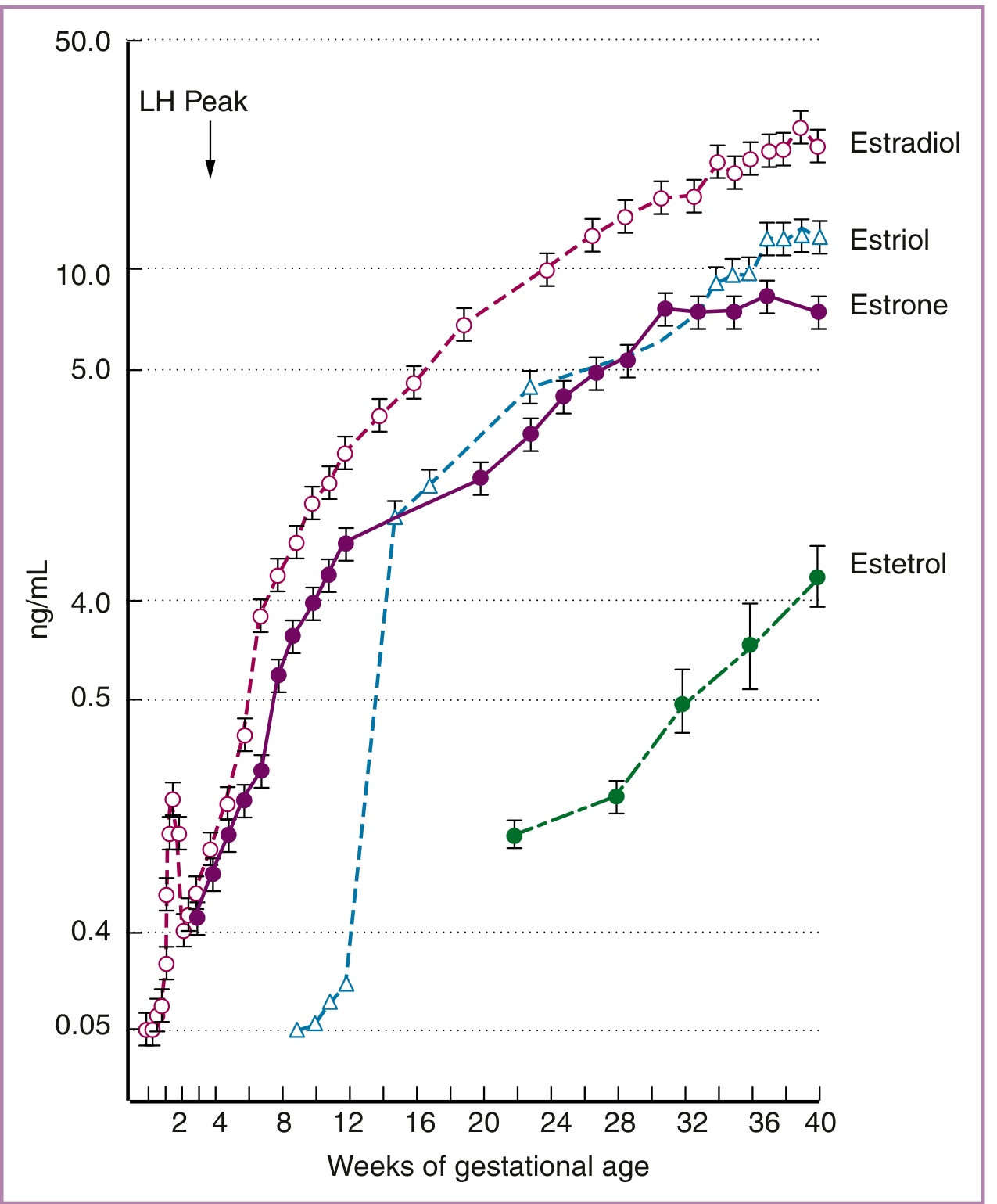
Note: Estradiol rises earliest and highest; Estriol surges after 12 weeks as the placenta matures; Estetrol only becomes detectable around week 20 and remains the lowest of the four.
Key clinical mnemonics:
- E1 = post-menopause (One = done with ovulation)
- E2 = reproductive years (Two ovaries)
- E3 = pregnancy (Three = Third party = placenta)
- E4 = fetal (Four = Fetal)
Source: Creasy & Resnik's Maternal-Fetal Medicine, Chapter 10 (Estrogens section); NIH/PMC structural biology review
This is a shared conversation. Sign in to Orris to start your own chat.