
Write the steps of glycolysis in anaerobic condition, with enzymes and coenzymes. Write energetics and regulation of it.
Reading File
Searching sources...
Finding Sources
Finding Sources
Good results. Now let me read the key sections from Lippincott (Biochemistry 8e) and Basic Medical Biochemistry, plus Harper's - the best biochemistry textbook sources.
Finding Sources
Reading File
Reading File
Excellent content. Let me now read the detailed 10-step reactions from Lippincott and Harper's, and then the regulation sections.
Reading File
Reading File
Now let me read more of Lippincott's detailed 10 steps and regulation, plus anaerobic glycolysis section from Basic Medical Biochemistry.
Reading File
Reading File
Now let me read the rest of the Lippincott steps (reactions 3-10) and the regulation section:
Reading File
Reading File
Now let me get the regulation section from Lippincott and Harper's:
Reading File
Reading File
Now let me get the regulation of glycolysis section from Lippincott:
Reading File
Now let me get the regulation details - specifically the PFK-1, hexokinase, and pyruvate kinase regulation sections from Lippincott:
Reading File
I now have comprehensive material from Lippincott (Biochemistry 8e) and Harper's (32e) to write a thorough answer. Let me also fetch one of the key diagrams:
Loading Image
I have all the information needed. Now let me compile a comprehensive, well-organized answer.
Glycolysis Under Anaerobic Conditions
Glycolysis is a sequence of 10 cytosolic reactions that converts one molecule of glucose (6C) into two molecules of pyruvate (3C), generating ATP by substrate-level phosphorylation. Under anaerobic conditions, pyruvate cannot enter the mitochondria for oxidation; instead, it is reduced to lactate by lactate dehydrogenase (LDH), regenerating NAD+ so that glycolysis can continue.
Overall anaerobic equation:
Glucose + 2 ADP + 2 Pi → 2 Lactate + 2 ATP + 2 H₂O + 2 H⁺
The Two Phases
| Phase | Steps | Events |
|---|---|---|
| Energy Investment Phase | 1-5 | 2 ATP consumed; glucose is phosphorylated and cleaved into two triose phosphates |
| Energy Generation Phase | 6-10 | 4 ATP produced (net +2); NADH generated and re-oxidized to NAD⁺ via lactate |
The 10 Steps
Step 1 - Glucose → Glucose 6-phosphate (G6P)
- Enzyme: Hexokinase (most tissues) / Glucokinase (liver, pancreatic β-cells) -- Hexokinase IV
- Coenzyme/Cofactor: Mg²⁺ (for ATP-Mg²⁺ complex)
- ATP consumed: 1
- Notes: Irreversible. G6P traps glucose inside the cell. Hexokinase I-III are inhibited allosterically by G6P (product inhibition). Glucokinase (hexokinase IV) has a high Km and high Vmax -- it is not inhibited by G6P and acts as a glucose sensor in the liver.
Step 2 - Glucose 6-phosphate → Fructose 6-phosphate (F6P)
- Enzyme: Phosphoglucose isomerase (phosphohexose isomerase)
- Coenzyme: None
- Notes: Reversible aldose-ketose isomerization. Not a regulated step.
Step 3 - Fructose 6-phosphate → Fructose 1,6-bisphosphate (F1,6-BP)
- Enzyme: Phosphofructokinase-1 (PFK-1)
- Coenzyme/Cofactor: Mg²⁺
- ATP consumed: 1
- Notes: Rate-limiting, committed, irreversible step -- the most important regulatory point in glycolysis. PFK-1 is the "pacemaker" enzyme.
Step 4 - Fructose 1,6-bisphosphate → DHAP + Glyceraldehyde 3-phosphate (G3P)
- Enzyme: Aldolase
- Coenzyme: None
- Notes: Reversible aldol cleavage. Produces two triose phosphates: dihydroxyacetone phosphate (DHAP) and glyceraldehyde 3-phosphate (G3P).
Step 5 - DHAP → Glyceraldehyde 3-phosphate
- Enzyme: Triose phosphate isomerase (TPI)
- Coenzyme: None
- Notes: Reversible. DHAP is converted to G3P so it can continue in the pathway. From this step onward, all reactions occur twice per glucose (once for each G3P).
Step 6 - G3P → 1,3-Bisphosphoglycerate (1,3-BPG)
- Enzyme: Glyceraldehyde 3-phosphate dehydrogenase (GAPDH)
- Coenzyme: NAD⁺ (reduced to NADH + H⁺); inorganic phosphate (Pi)
- Notes: Oxidative phosphorylation at substrate level. Produces one molecule of NADH per G3P (2 total per glucose). Under anaerobic conditions, this NADH must be re-oxidized to NAD⁺ (via LDH at step 11); otherwise glycolysis halts. Inhibited by iodoacetate (–SH poison). Arsenate competes with Pi and prevents ATP generation at this step.
Step 7 - 1,3-BPG → 3-Phosphoglycerate (3-PG) + ATP
- Enzyme: Phosphoglycerate kinase (PGK)
- Coenzyme/Cofactor: Mg²⁺
- ATP produced: 1 per G3P → 2 ATP per glucose (substrate-level phosphorylation)
- Notes: Physiologically reversible reaction. This step recovers the 2 ATP invested in steps 1 and 3. (Side note: some 1,3-BPG is diverted to 2,3-BPG in RBCs by bisphosphoglycerate mutase -- this is the Rapoport-Luebering shunt.)
Step 8 - 3-Phosphoglycerate → 2-Phosphoglycerate (2-PG)
- Enzyme: Phosphoglycerate mutase
- Coenzyme: Mg²⁺; requires 2,3-BPG as a cofactor
- Notes: Reversible intramolecular phosphate shift from C-3 to C-2.
Step 9 - 2-Phosphoglycerate → Phosphoenolpyruvate (PEP) + H₂O
- Enzyme: Enolase
- Coenzyme/Cofactor: Mg²⁺ or Mn²⁺ (required)
- Notes: Reversible dehydration. Creates PEP, a high-energy phosphate compound. Inhibited by fluoride (fluoride-oxalate used in blood collection tubes to prevent glycolysis and preserve glucose levels for lab measurement).
Step 10 - PEP → Pyruvate + ATP
- Enzyme: Pyruvate kinase (PK)
- Coenzyme/Cofactor: Mg²⁺, K⁺
- ATP produced: 1 per G3P → 2 ATP per glucose (substrate-level phosphorylation)
- Notes: Irreversible under physiological conditions (large -ΔG). The immediate product enolpyruvate spontaneously isomerizes to pyruvate, making reversal impossible. Isozymes: L (liver), R (RBC), M1 (muscle/brain), M2 (fetal tissues, tumors).
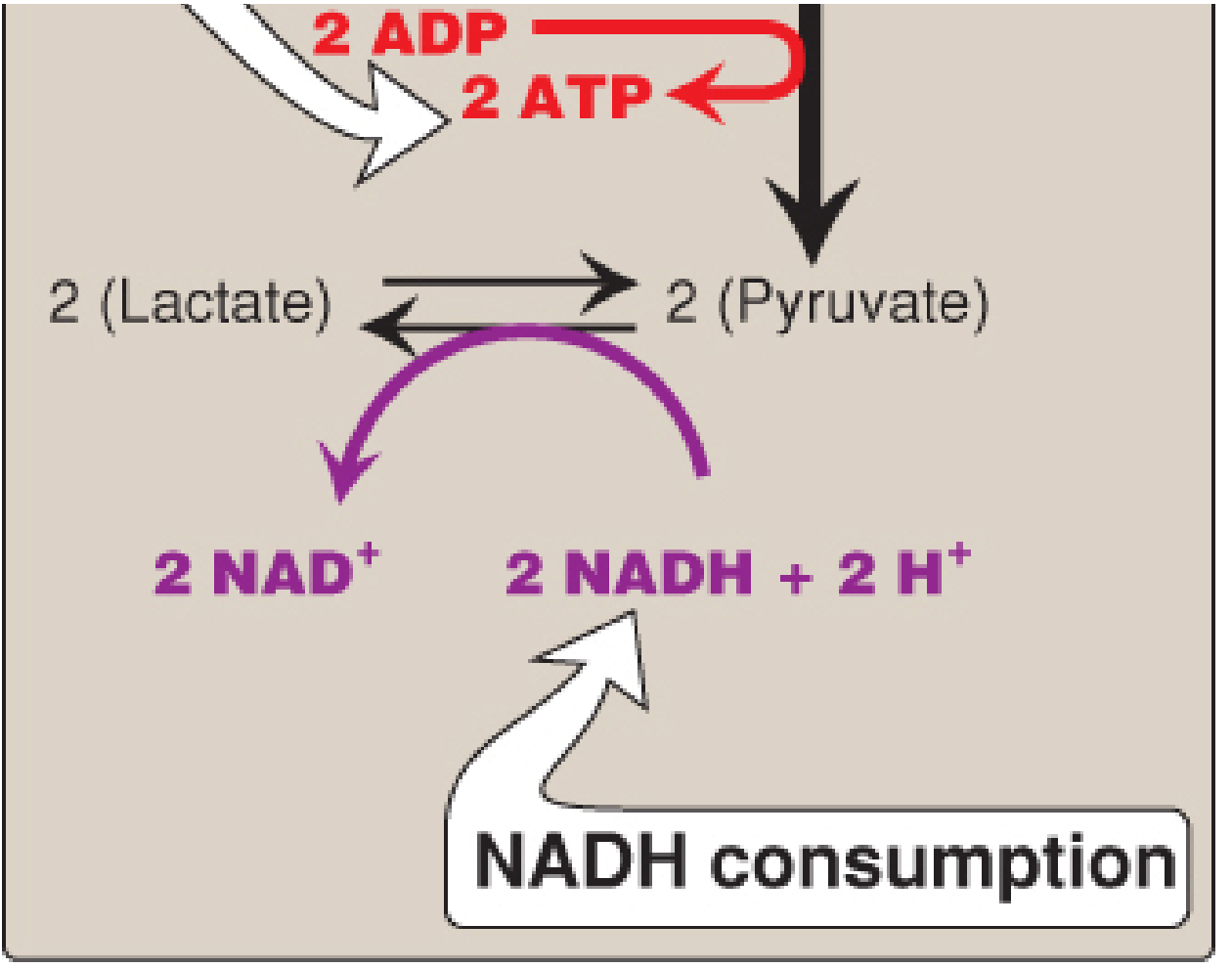
Step 11 (Anaerobic-specific) - Pyruvate → Lactate
- Enzyme: Lactate dehydrogenase (LDH)
- Coenzyme: NADH (oxidized to NAD⁺)
- Notes: This step is unique to anaerobic glycolysis. NADH produced in step 6 is re-oxidized here, regenerating NAD⁺ to sustain glycolysis. No ATP is produced or consumed. LDH reaction is readily reversible -- in well-oxygenated tissues (liver, heart), lactate is oxidized back to pyruvate.
Summary of Enzymes and Coenzymes
| Step | Enzyme | Coenzyme/Cofactor | Reversibility |
|---|---|---|---|
| 1 | Hexokinase / Glucokinase | Mg²⁺, ATP | Irreversible |
| 2 | Phosphoglucose isomerase | - | Reversible |
| 3 | PFK-1 | Mg²⁺, ATP | Irreversible |
| 4 | Aldolase | - | Reversible |
| 5 | Triose phosphate isomerase | - | Reversible |
| 6 | GAPDH | NAD⁺, Pi | Reversible |
| 7 | Phosphoglycerate kinase | Mg²⁺, ADP | Reversible |
| 8 | Phosphoglycerate mutase | Mg²⁺, 2,3-BPG | Reversible |
| 9 | Enolase | Mg²⁺ / Mn²⁺ | Reversible |
| 10 | Pyruvate kinase | Mg²⁺, K⁺, ADP | Irreversible |
| 11* | Lactate dehydrogenase | NADH | Reversible |
*Step 11 is the anaerobic-specific terminal reaction.
Energetics
ATP Balance
| Event | ATP Change |
|---|---|
| Step 1 (Hexokinase) | -1 ATP |
| Step 3 (PFK-1) | -1 ATP |
| Step 7 (PGK) x 2 | +2 ATP |
| Step 10 (Pyruvate kinase) x 2 | +2 ATP |
| Net ATP yield | +2 ATP per glucose |
NADH Balance (Anaerobic)
- Step 6 produces 2 NADH per glucose
- Step 11 (LDH) consumes 2 NADH (re-oxidizes them to NAD⁺)
- Net NADH = 0 (no net production or consumption)
Comparison: Aerobic vs Anaerobic
| Condition | ATP yield per glucose |
|---|---|
| Anaerobic glycolysis | 2 ATP |
| Aerobic glycolysis (to pyruvate only) | 2 ATP + 2 NADH |
| Complete aerobic oxidation (glucose → CO₂ + H₂O) | ~30-32 ATP |
Because anaerobic glycolysis yields only 2 ATP vs ~32 ATP from aerobic oxidation, cells must run glycolysis ~15 times faster under anaerobic conditions to produce the same amount of ATP. They compensate by expressing very high levels of glycolytic enzymes.
Free Energy
The overall reaction (glucose → 2 lactate) has a large negative ΔG, meaning it is thermodynamically favorable and essentially irreversible as a whole, despite individual steps being reversible.
Regulation of Glycolysis
Regulation is focused on the three irreversible enzymes (hexokinase/glucokinase, PFK-1, pyruvate kinase). These are controlled at three levels: allosteric, covalent modification, and transcriptional (hormonal).
1. Hexokinase / Glucokinase (Step 1)
| Feature | Hexokinase I-III | Glucokinase (HK IV) |
|---|---|---|
| Km for glucose | Low (~0.1 mM) -- high affinity | High (~10 mM) -- low affinity |
| Vmax | Low | High |
| Inhibition | Allosterically by G6P (product inhibition) | Not inhibited by G6P |
| Tissue | Most tissues | Liver, pancreatic β-cells |
| Regulation | G6P accumulates → hexokinase off | Regulated by GKRP (glucokinase regulatory protein) in nucleus; fructose-6-P sequesters GK into nucleus (inactive); glucose releases it |
| Role | Efficient trapping at low glucose | Glucose sensor; handles glucose floods post-meal |
2. PFK-1 (Step 3) -- The Master Regulator
Inhibitors:
- ATP (high energy signal - binds allosteric site, decreases affinity for F6P)
- Citrate (signals TCA intermediates are abundant; also inhibits)
- H⁺ / acidosis (protects against excessive lactate acidosis)
- Long-chain fatty acyl CoA
Activators:
- AMP / ADP (low energy signal -- most powerful physiological activator)
- Fructose 2,6-bisphosphate (F-2,6-BP) -- most potent activator
- Pi (inorganic phosphate)
Fructose 2,6-bisphosphate (F-2,6-BP) regulation:
- Produced by PFK-2 from fructose 6-phosphate
- PFK-2 is a bifunctional enzyme: has both kinase and phosphatase activity
- In the fed state: insulin activates PFK-2 (kinase domain) → F-2,6-BP rises → PFK-1 activated → glycolysis stimulated
- In the fasted state: glucagon → PKA → phosphorylates PFK-2 (inactivates kinase, activates phosphatase) → F-2,6-BP falls → PFK-1 inhibited → glycolysis slows
- F-2,6-BP also inhibits fructose 1,6-bisphosphatase (gluconeogenesis), ensuring the two pathways don't run simultaneously (preventing a futile cycle)
3. Pyruvate Kinase (Step 10)
Inhibitors (allosteric):
- ATP
- Acetyl-CoA
- Alanine (L isozyme in liver -- feed-forward inhibition if amino acids are abundant)
- Long-chain fatty acids
Activators (allosteric):
- Fructose 1,6-bisphosphate (F-1,6-BP) -- feed-forward activation (product of PFK-1 activates PK downstream)
- AMP
Covalent regulation (L isozyme, liver only):
- Glucagon → cAMP → PKA → phosphorylates PK → inhibits PK → prevents futile cycling with gluconeogenesis
- Insulin → dephosphorylation → activates PK
- M1 isozyme (muscle/brain) is NOT regulated by covalent modification
4. Hormonal (Transcriptional) Regulation
| Hormone | Effect on Glycolytic Enzymes | Enzymes Affected |
|---|---|---|
| Insulin (fed state) | Increases gene transcription (+10-20 fold over hours-days) | Glucokinase, PFK-1, Pyruvate kinase (liver) |
| Glucagon/Epinephrine (fasted/stress) | Decreases gene transcription; also activates PKA for covalent inhibition | Same three enzymes |
Transcription factors involved: SREBP-1c (insulin-mediated) and ChREBP (carbohydrate/glucose-mediated).
Tissues Dependent on Anaerobic Glycolysis
| Tissue | Reason |
|---|---|
| Red blood cells | No mitochondria |
| Lens and cornea of eye | Poorly vascularized, avascular |
| Renal medulla | Relatively low oxygen tension |
| Exercising skeletal muscle (fast-twitch) | O₂ delivery lags demand; high glycolytic enzyme content |
| Tumors | Warburg effect -- preferentially use glycolysis even in oxygen |
| White matter of brain | Under hypoxic conditions |
Key Clinical Points
- Lactic acidosis: Collapse of circulation (MI, shock, sepsis) → impaired O₂ delivery → cells rely entirely on anaerobic glycolysis → lactate accumulates → metabolic acidosis. Blood lactate measurement allows rapid detection of O₂ debt.
- Muscle cramps during exercise: NADH accumulation and H⁺ production from lactate.
- Fluoride-oxalate blood tubes: Fluoride inhibits enolase (step 9), preventing glycolysis in blood samples collected for glucose measurement.
- Arsenic poisoning: Arsenate competes with Pi at GAPDH (step 6), bypassing 1,3-BPG formation, thus preventing ATP synthesis by glycolysis.
- Thiamine deficiency (Wernicke's encephalopathy, alcoholism): Impairs pyruvate dehydrogenase (requires TPP), causing pyruvate accumulation and lactic acidosis -- technically affects the step after glycolysis, but functionally blocks glucose metabolism.
Sources: Biochemistry, 8th ed. Lippincott Illustrated Reviews (pp. 293-321); Harper's Illustrated Biochemistry, 32nd ed. (pp. 175-180); Basic Medical Biochemistry: A Clinical Approach, 6th ed. (pp. 803-805)
This is a shared conversation. Sign in to Orris to start your own chat.