
PDR vs NPDR in tabular form
Reading File
Searching for PDR vs NPDR classification and features.
search_medical_text
proliferative diabetic retinopathy PDR vs non-proliferative NPDR features classification staging
Diabetic Retinopathy
Page 12
search_medical_image
diabetic retinopathy PDR NPDR fundus findings
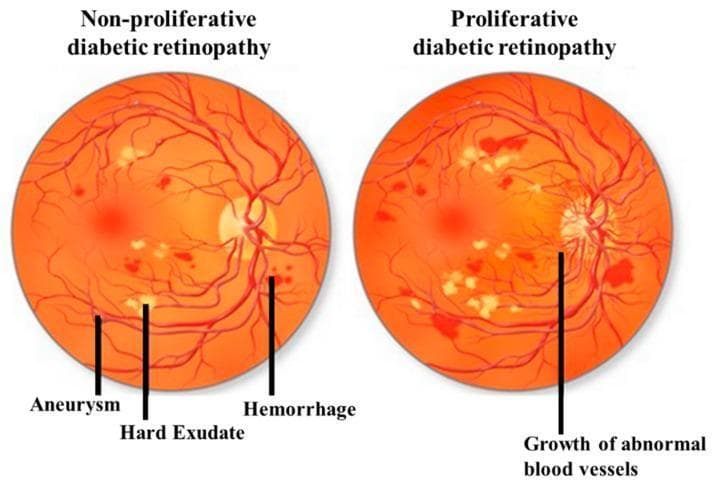
Hugging Face pmc clinical VQA raw
Page 0
GradeResponse
GradeResponse
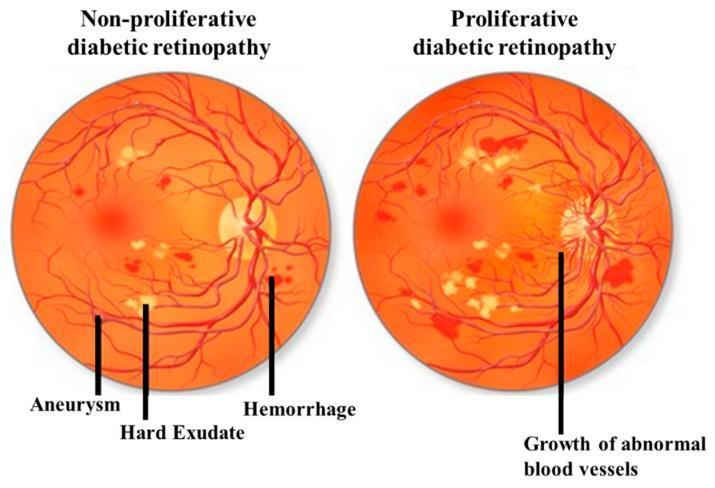
Proliferative (PDR) vs Non-Proliferative Diabetic Retinopathy (NPDR)
| Feature | NPDR | PDR |
|---|---|---|
| Definition | Early-to-intermediate stage; microvascular damage confined within the retina | Advanced stage; new abnormal blood vessels grow beyond the retina |
| Pathophysiology | Capillary wall damage → increased permeability, microaneurysm formation, retinal ischemia | Retinal ischemia → VEGF release → neovascularization of disc (NVD), elsewhere (NVE), iris (NVI) |
| Neovascularization | Absent | Present (hallmark feature) |
| Microaneurysms | Present (earliest visible sign — defines mild NPDR) | Present |
| Intraretinal hemorrhages | Present (dot & blot) | Present |
| Hard exudates | Present (lipid deposits from leaky vessels) | Present |
| Cotton wool spots | Present in moderate–severe NPDR | May be present |
| IRMA | Present in severe NPDR | May be present |
| Venous beading | Present in severe NPDR | May be present |
| Vitreous hemorrhage | Absent | Present (from fragile new vessels) |
| Tractional retinal detachment | Absent | Present (fibrovascular proliferation) |
| Neovascular glaucoma | Absent | Present (NVI → angle closure) |
| Macular edema (DME) | Can occur | Can occur |
| Visual symptoms | Often asymptomatic; blur/distortion if DME develops | Floaters, sudden visual loss, severe blur |
| Severity grading | Mild / Moderate / Severe (4-2-1 rule for severe) | High-risk PDR vs non-high-risk PDR |
| 4-2-1 Rule (severe NPDR) | ≥20 hemorrhages in all 4 quadrants; venous beading in ≥2 quadrants; IRMA in ≥1 quadrant | Not applicable (already PDR) |
| Treatment | Observation (mild–moderate); anti-VEGF/laser if DME; close monitoring for severe | Pan-retinal photocoagulation (PRP); anti-VEGF; vitrectomy for VH/TRD |
| Risk of progression to PDR | ~50% of severe NPDR progress to PDR within 1 year | Already PDR |
| Screening interval | Mild: annually; Moderate: 6 months; Severe: 3–4 months | 2–3 months (or urgent) |
NPDR Sub-staging Summary
| Grade | Key Finding |
|---|---|
| Mild | Microaneurysms only |
| Moderate | More than microaneurysms but less than severe |
| Severe | Any one of the 4-2-1 criteria (see above) |
(Diabetic Retinopathy, p. 12)
This is a shared conversation. Sign in to Orris to start your own chat.