
HCl secretion and its mechanism MBBS first year Physiology notes
Reading File
search_medical_text
HCl secretion mechanism parietal cells gastric acid
search_medical_text
regulation of gastric acid secretion phases stimulation inhibition
search_medical_image
HCl secretion parietal cell mechanism diagram
GradeResponse
GradeResponse
GradeResponse
search_medical_text
parietal cell HCl secretion carbonic anhydrase hydrogen potassium ATPase proton pump chloride
search_medical_text
gastrin histamine acetylcholine parietal cell cAMP calcium second messenger acid secretion
GradeResponse
GradeResponse
Here are comprehensive MBBS First Year Physiology notes on HCl secretion and its mechanism:
🧪 Gastric HCl Secretion — MBBS First Year Physiology Notes
1. Introduction
Hydrochloric acid (HCl) is secreted by the parietal cells (oxyntic cells) of the gastric oxyntic glands, located primarily in the body and fundus of the stomach. The intraluminal pH can fall as low as 1.0–2.0, making gastric juice one of the most acidic body fluids.
Functions of HCl:
- Activates pepsinogen → pepsin (protein digestion)
- Creates an acidic environment for gastric digestion
- Kills ingested microorganisms (bactericidal)
- Aids absorption of iron and calcium
- Denatures dietary proteins
2. The Parietal Cell
The parietal cell is a unique, large triangular cell with an extensive intracellular canalicular system lined with microvilli, giving it a large secretory surface area.
Key organelles/features:
| Feature | Function |
|---|---|
| Secretory canaliculi | Channel for HCl secretion |
| Tubulovesicles | Store inactive H⁺,K⁺-ATPase pumps |
| Abundant mitochondria | Energy (ATP) for active transport |
| Carbonic anhydrase | Generates H⁺ from CO₂ + H₂O |
The parietal cell also secretes Intrinsic Factor (IF) and IL-11 (Harrison's, p. 8897).
3. Mechanism of HCl Secretion
Step-by-Step Intracellular Mechanism
CO₂ + H₂O ──[Carbonic Anhydrase]──▶ H₂CO₃ ──▶ H⁺ + HCO₃⁻
| Step | Event |
|---|---|
| 1 | CO₂ diffuses into parietal cell from blood/metabolism |
| 2 | Carbonic anhydrase catalyzes: CO₂ + H₂O → H₂CO₃ → H⁺ + HCO₃⁻ |
| 3 | H⁺ is actively pumped into the canalicular lumen via H⁺,K⁺-ATPase (proton pump) in exchange for K⁺ |
| 4 | K⁺ is recycled back into the lumen via apical K⁺ channels |
| 5 | Cl⁻ is transported into the canalicular lumen via apical Cl⁻ channels |
| 6 | H⁺ + Cl⁻ combine in the lumen → HCl |
| 7 | HCO₃⁻ exits via the basolateral Cl⁻/HCO₃⁻ exchanger (alkaline tide) |
The H⁺,K⁺-ATPase (proton pump) is the final common pathway — it pumps H⁺ against a concentration gradient of ~1,000,000:1, making it one of the most powerful ion pumps in the body (Harrison's, p. 8899).
4. Resting vs. Stimulated State of the Parietal Cell
(Harrison's, p. 8891)
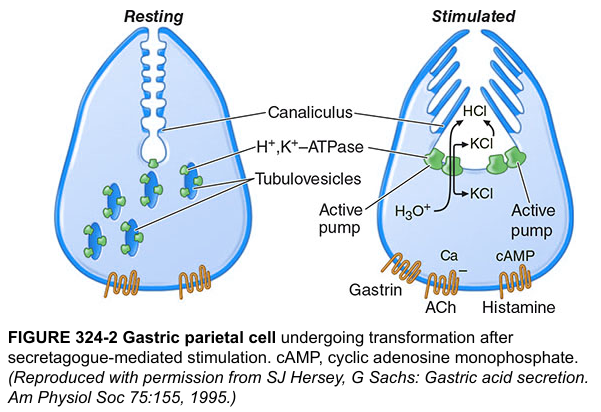
| State | Tubulovesicles | H⁺,K⁺-ATPase location | Secretion |
|---|---|---|---|
| Resting | Present in cytoplasm | Cytoplasmic vesicles (inactive) | None |
| Stimulated | Fuse with canalicular membrane | Apical canalicular membrane (active) | Active HCl secretion |
On stimulation, tubulovesicles fuse with the secretory canaliculus membrane, inserting H⁺,K⁺-ATPase pumps into the active position. This process involves actin, myosin, ezrin, SNAREs, and Rab family proteins (Harrison's, p. 8899).
5. Stimulants of HCl Secretion — The "Big Three"
The parietal cell has three major receptors (Harrison's, p. 8897):
| Stimulant | Receptor | Source | Second Messenger |
|---|---|---|---|
| Histamine | H₂ receptor | ECL cells | ↑ cAMP → Protein Kinase A |
| Gastrin | CCK-2/Gastrin receptor | G cells (antrum) | ↑ Ca²⁺ → Protein Kinase C |
| Acetylcholine | Muscarinic M₃ receptor | Vagus nerve | ↑ Ca²⁺ → Protein Kinase C |
Histamine is the most potent stimulant — it works via cAMP pathway. Gastrin and ACh activate the phosphoinositide/Ca²⁺ pathway. All three ultimately activate H⁺,K⁺-ATPase.
6. Three Phases of Gastric Secretion
(Bailey & Love, p. 1172)
Phase 1 — Cephalic Phase (30% of total acid)
- Trigger: Sight, smell, taste, thought of food
- Mediator: Vagus nerve → ACh
- First demonstrated by Pavlov (conditioned reflex)
Phase 2 — Gastric Phase (60% of total acid)
- Trigger: Food entering the stomach
- Mediators:
- Distension → vago-vagal reflex → ACh
- Peptides/amino acids → stimulate G cells → Gastrin release
- Gastrin is the principal mediator
Phase 3 — Intestinal Phase (10% of total acid)
- Trigger: Chyme entering the duodenum
- Initially stimulatory (amino acids stimulate intestinal gastrin)
- Predominantly inhibitory:
- Acidification of duodenum → Secretin release → inhibits acid
- GIP, CCK, VIP — enterogastrones that inhibit acid secretion
7. Inhibition of HCl Secretion
| Inhibitor | Mechanism |
|---|---|
| Somatostatin (D cells) | Acts on G cells, ECL cells, and parietal cells directly to inhibit acid; released in response to acidification (Bailey & Love, p. 1172) |
| Secretin | Released when duodenal pH < 4.5; inhibits gastrin and acid |
| GIP (Gastric Inhibitory Peptide) | Released by fat/carbs in duodenum |
| Prostaglandins (E₂) | Inhibit adenylate cyclase, ↓ cAMP in parietal cells |
| Low intragastric pH | Direct negative feedback on G cells |
8. Pharmacology — Drugs Acting on Acid Secretion
| Drug Class | Example | Mechanism |
|---|---|---|
| Proton Pump Inhibitors (PPIs) | Omeprazole, Pantoprazole | Irreversibly block H⁺,K⁺-ATPase |
| H₂ Blockers | Ranitidine, Famotidine | Block H₂ receptors → ↓ cAMP |
| Anticholinergics | Pirenzepine | Block M₁/M₃ receptors |
| Antacids | Mg(OH)₂, Al(OH)₃ | Neutralize secreted HCl |
| Proton pump enhancers | — | Somatostatin analogues act on D cells |
9. Quick Summary Flowchart
Stimuli (food, smell, distension)
        ↓
Vagus (ACh) + G cells (Gastrin) + ECL cells (Histamine)
        ↓
Parietal cell receptors (M₃, CCK-2, H₂)
        ↓
↑ cAMP (Histamine) + ↑ Ca²⁺ (Gastrin, ACh)
        ↓
Tubulovesicle fusion → H⁺,K⁺-ATPase activated
        ↓
H⁺ pumped into canaliculus + Cl⁻ secreted
        ↓
HCl formed in stomach lumen (pH 1-2)
10. Key Points for Exams
- Parietal cells are located in the body and fundus (oxyntic glands)
- H⁺,K⁺-ATPase is the proton pump and the final common pathway
- Carbonic anhydrase is essential for generating H⁺
- Histamine acts via cAMP; Gastrin and ACh act via Ca²⁺
- Somatostatin is the major paracrine inhibitor
- PPIs (omeprazole) irreversibly inhibit H⁺,K⁺-ATPase — most effective acid suppressants
- The alkaline tide = HCO₃⁻ entering blood after a meal (↑ blood pH postprandially)
- Basal acid output (BAO) = ~2 mEq/hr; Maximal acid output (MAO) = ~20–25 mEq/hr
Sources: Harrison's Principles of Internal Medicine, 21st Edition (pp. 8891, 8897, 8899); Bailey & Love's Short Practice of Surgery, 28th Edition (p. 1172)
This is a shared conversation. Sign in to Orris to start your own chat.