
Hcl secretion and mechanism mbbs 1st year notes physiology
Reading File
Searching for HCl secretion physiology content now.
search_medical_text
HCl secretion mechanism parietal cells stomach physiology
Bailey and Love's Short Practice of Surgery 28th Edition
Page 1171
search_medical_text
regulation of gastric acid secretion stimulation inhibition
Harrison's Principles of Internal Medicine, Twenty First Edition
Page 8896
search_medical_image
HCl secretion parietal cell mechanism diagram
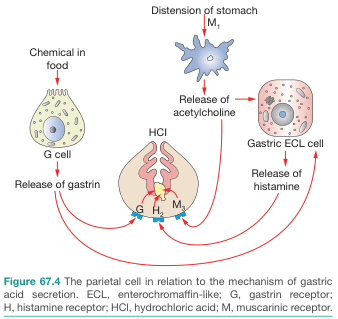
Bailey and Love's Short Practice of Surgery 28th Edition
Page 1171
GradeResponse
GradeResponse
GradeResponse
HCl Secretion and Mechanism (MBBS 1st Year Physiology Notes)
1) Site of secretion
- Hydrochloric acid (HCl) is secreted by parietal (oxyntic) cells of gastric glands, mainly in fundus and body of stomach.
2) Functions of HCl
- Converts pepsinogen to pepsin
- Provides acidic pH for protein digestion
- Bactericidal action (kills ingested microbes)
- Helps absorption of iron and indirectly supports calcium, magnesium, vitamin B12 handling
3) Mechanism of HCl secretion by parietal cell
Core concept: final common pathway = H⁺/K⁺ ATPase (proton pump) on apical canalicular membrane.
Stepwise mechanism
- Inside parietal cell:
[ CO_2 + H_2O \xrightarrow[\text{carbonic anhydrase}]{} H_2CO_3 \rightarrow H^+ + HCO_3^- ] - H⁺ is pumped into canaliculus/lumen by H⁺/K⁺ ATPase (K⁺ enters cell).
- Cl⁻ enters cell from blood side via Cl⁻/HCO₃⁻ exchange and then moves to lumen through chloride channels.
- In lumen: H⁺ + Cl⁻ = HCl
- HCO₃⁻ goes to blood (post-meal alkaline tide in gastric venous blood).
4) Regulation of HCl secretion
Major stimulants (3)
- Histamine from ECL cells -> H2 receptor (↑cAMP)
- Acetylcholine (vagus) -> M3 receptor (↑Ca²⁺)
- Gastrin from G cells -> CCK-B (G) receptor (↑Ca²⁺), also stimulates ECL histamine release
These pathways potentiate each other and strongly activate proton pump.
Inhibitors
- Somatostatin (D cells)
- Prostaglandins (PGE2)
- Low antral pH (negative feedback via somatostatin)
- Intestinal enterogastrones (e.g., secretin in acidic chyme state)
5) Phases of gastric acid secretion
- Cephalic phase (~30%)
Sight/smell/taste/thought of food -> vagal stimulation - Gastric phase (~50-60%)
Food in stomach, distension, peptides -> vagovagal + gastrin - Intestinal phase (~10%)
Brief stimulation, then mainly inhibition as chyme enters duodenum
6) Clinical correlation (high-yield)
- PPIs block H⁺/K⁺ ATPase -> most potent acid suppression
- H2 blockers inhibit histamine-mediated acid secretion
- Vagal overactivity/gastrinoma -> hyperacidity
- Atrophic gastritis/parietal cell loss -> hypochlorhydria/achlorhydria
Quick diagram memory line
ACh (M3) + Gastrin (CCK-B) + Histamine (H2) -> Parietal cell proton pump -> HCl
Sources used:
- Bailey & Love’s Short Practice of Surgery, 28th ed., p.1171 (parietal cell pathways and receptor-level regulation)
- Harrison’s Principles of Internal Medicine, 21st ed., p.8896 (physiology and phases of gastric secretion)
This is a shared conversation. Sign in to Orris to start your own chat.