
Pharmacology notes of hormone’s regulating calcium for exams
Reading File
Now let me search the library for calcium-regulating hormones content in parallel.
Finding Sources
Finding Sources
Finding Sources
Good results. Now let me read the key pharmacology sections from Goodman & Gilman and Guyton & Hall in parallel.
Finding Sources
Reading File
Finding Sources
Reading File
Excellent. Now let me read the Goodman & Gilman pharmacology chapter on agents affecting mineral ion homeostasis, and also get vitamin D and calcitonin content.
Reading File
Reading File
Now let me read the Goodman & Gilman pharmacology section more deeply - the PTH/vitamin D/calcitonin drug content, and also the vitamin D section from Guyton.
Reading File
Reading File
Let me get more pharmacology content from Goodman & Gilman on specific drugs (bisphosphonates, calcitonin, vitamin D analogs, teriparatide, cinacalcet).
Reading File
Reading File
I now have rich content from Goodman & Gilman and Guyton & Hall. Let me get a bit more on bisphosphonates, teriparatide, and cinacalcet from Goodman & Gilman.
Reading File
I now have excellent, comprehensive content. Let me compile the full pharmacology notes.
Loading Image
I now have all the material needed to write comprehensive exam pharmacology notes. Here they are:
Pharmacology Notes: Hormones Regulating Calcium
Sources: Goodman & Gilman's Pharmacological Basis of Therapeutics; Guyton & Hall Textbook of Medical Physiology
Overview of Calcium Homeostasis
Normal serum Ca²⁺: 8.5-10.2 mg/dL (ionized: 4.5-5.6 mg/dL). Three hormones primarily regulate it:
| Hormone | Gland | Effect on Ca²⁺ |
|---|---|---|
| PTH | Parathyroid | ↑ Ca²⁺ |
| Vitamin D (calcitriol) | Kidney (activation) | ↑ Ca²⁺ |
| Calcitonin | Thyroid C cells | ↓ Ca²⁺ |
A fourth regulator, FGF23 (from osteocytes), primarily regulates phosphate.
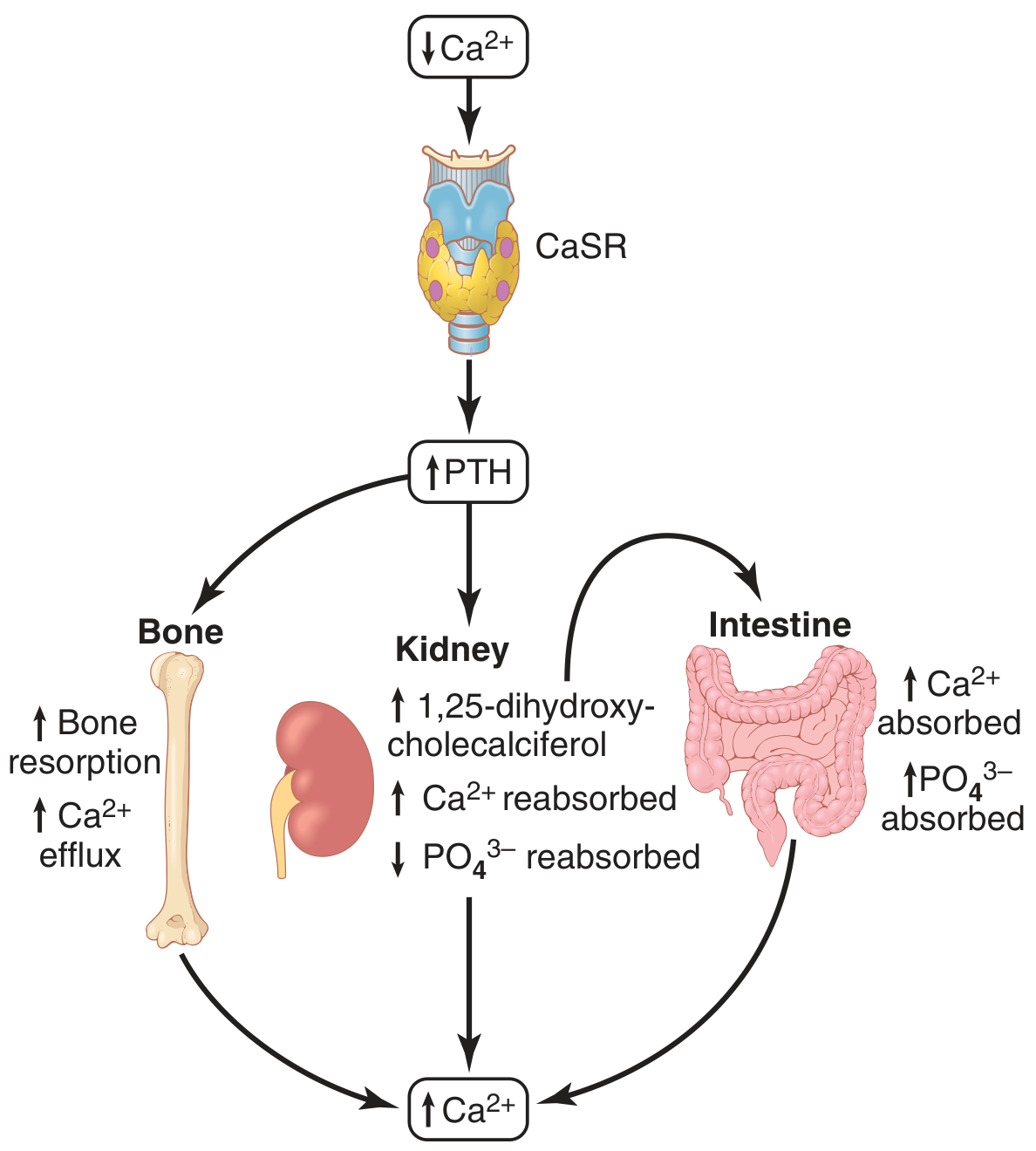
1. PARATHYROID HORMONE (PTH)
Structure & Secretion
- 84-amino acid peptide; biologically active fragment = PTH(1-34)
- Secreted by chief cells of parathyroid glands
- Regulated by Calcium-Sensing Receptor (CaSR) - a GPCR on parathyroid cells
- ↓ Ca²⁺ → CaSR inhibited → ↑ PTH secretion
- ↑ Ca²⁺ → CaSR activated (via phospholipase C / IP3 / DAG) → ↓ PTH secretion
- Even a small drop in Ca²⁺ can double or triple plasma PTH; chronic deficiency causes gland hypertrophy up to 5-fold
Mechanism of Action (3 target organs)
Bone:
- Rapid phase (minutes-hours): Activates osteocyte/osteoblast membrane pump (osteolysis) - releases Ca²⁺ from bone fluid to ECF without matrix resorption
- Slow phase (days-weeks): Stimulates osteoclast proliferation → increased osteoclastic bone resorption (raises both Ca²⁺ and PO₄³⁻)
Kidney (most important for rapid response):
- ↑ Ca²⁺ reabsorption (distal tubule)
- ↓ Phosphate reabsorption (proximal tubule) → phosphaturia
- ↑ 1α-hydroxylase activity → converts 25-OH-D₃ to 1,25-(OH)₂D₃ (calcitriol)
Intestine (indirect via calcitriol):
- ↑ Ca²⁺ and PO₄³⁻ absorption
Net effect: ↑ plasma Ca²⁺, ↓ plasma PO₄³⁻
2. VITAMIN D
Synthesis Pathway (exam favourite)
Skin: 7-dehydrocholesterol → UV light → Cholecalciferol (Vit D3)
     Diet: Ergocalciferol (Vit D2)
          ↓ 25-hydroxylase (liver)
     25-hydroxycholecalciferol [storage form, t½ ~3 weeks]
          ↓ 1α-hydroxylase (kidney) ← stimulated by PTH, hypophosphatemia
     1,25-(OH)₂D₃ = CALCITRIOL [active form]
Mechanism of Action
- Nuclear receptor (VDR) - genomic action
- Intestine: ↑ calbindin synthesis → ↑ Ca²⁺ and PO₄³⁻ absorption (main action)
- Bone: ↑ bone mineralization; large doses cause bone resorption
- Kidney: ↑ Ca²⁺ and PO₄³⁻ reabsorption (minor effect)
- Parathyroid: ↓ PTH gene transcription (negative feedback)
- Immune modulation: ↓ cytokine production, autoimmune protection
Vitamin D Preparations (Exam-Ready Table)
| Drug | Form | Notes |
|---|---|---|
| Cholecalciferol (D3) | Native vit D | Requires liver + kidney activation |
| Ergocalciferol (D2) | Plant-derived | Used for deficiency, hypoparathyroidism; 50,000-200,000 units/day |
| Calcitriol (1,25-(OH)₂D3) | Active form | Fastest onset; no renal activation needed; used in CKD, hypoparathyroidism |
| Alfacalcidol (1α-OHD3) | 1α-hydroxylated | Rapidly activated by liver 25-hydroxylase; bypasses kidney; equivalent to calcitriol |
| Paricalcitol | Calcitriol analogue | Suppresses PTH without significant hypercalcemia; oral/IV for secondary hyperparathyroidism in CKD |
| Calcipotriene (calcipotriol) | Calcitriol analogue | <1% calcitriol activity on Ca²⁺ metabolism; used topically for psoriasis |
| Doxercalciferol | D2 prodrug | Requires hepatic activation; secondary HPT in CKD |
Deficiency States
| Condition | Key Features |
|---|---|
| Rickets (children) | Bowed legs, rachitic rosary, craniotabes; serum Ca²⁺ slightly ↓, PO₄³⁻ greatly ↓ (PTH keeps Ca²⁺ up but worsens phosphaturia); osteoid accumulates |
| Osteomalacia (adults) | Bone pain, pseudofractures; often due to steatorrhea, CKD |
| Renal rickets | Failure of 1α-hydroxylation; treat with calcitriol/alfacalcidol |
| Tetany | Ca²⁺ <7 mg/dL → laryngospasm; treat with IV calcium gluconate |
3. CALCITONIN
Structure & Secretion
- 32-amino acid peptide, MW ~3,400 Da
- Secreted by parafollicular C cells of thyroid (only ~0.1% of gland mass)
- Stimulus: ↑ Ca²⁺ → ↑ calcitonin (opposite of PTH)
- Receptor: CTR - a GPCR coupling to multiple G proteins
Actions
- Inhibits osteoclast activity (main mechanism) → reduces bone resorption → ↓ Ca²⁺ and PO₄³⁻
- Promotes calcium deposition in bone
- Minor renal effects: ↓ Ca²⁺ and PO₄³⁻ reabsorption (opposite to PTH)
Clinical reality: WEAK effect in adult humans
- Any initial Ca²⁺ drop triggers compensatory ↑ PTH, which overrides calcitonin
- Calcitonin effect is mainly transient (hours to a few days)
- Much more important in young animals and children than in adults
Therapeutic Uses
- Hypercalcemia (short-term; injection or nasal spray)
- Paget disease (second-line)
- Postmenopausal osteoporosis (nasal spray; largely replaced by bisphosphonates)
- Diagnosis of medullary thyroid carcinoma (MTC) - calcitonin is a sensitive/specific tumour marker for MTC
Adverse Effects
- Nausea, facial flushing, local reactions at injection site
- Tachyphylaxis (reduced response on repeated dosing)
4. DRUGS TARGETING CALCIUM HOMEOSTASIS
A. PTH Analogues (Anabolic Agents)
| Drug | Details |
|---|---|
| Teriparatide hPTH(1-34) | Subcutaneous daily injection; anabolic on bone when given intermittently (continuous PTH is catabolic); used for severe osteoporosis; max 2 years; risk of osteosarcoma in rats (black-box warning) |
| Abaloparatide (PTHrP analogue) | Similar to teriparatide; sc injection |
| Recombinant PTH(1-84) | Less available; hypoparathyroidism treatment |
Key Exam Point: Intermittent PTH → anabolic (↑ bone formation). Continuous PTH (as in hyperparathyroidism) → catabolic (↑ resorption).
B. Calcimimetics (CaSR Agonists)
| Drug | Mechanism | Uses |
|---|---|---|
| Cinacalcet | Allosteric activator of CaSR on parathyroid cells → ↑ sensitivity to Ca²⁺ → ↓ PTH secretion | Primary and secondary hyperparathyroidism; parathyroid carcinoma |
| Etelcalcetide | IV CaSR agonist | Secondary HPT in CKD on dialysis |
C. Bisphosphonates (Anti-Resorptive)
Mechanism: Bind hydroxyapatite in bone matrix; taken up by osteoclasts → inhibit farnesyl pyrophosphate synthase (nitrogen-containing BPs) → interfere with osteoclast function and survival
ADME:
- Oral bioavailability very poor (<1-6%)
- Reduced further by food, Ca²⁺ supplements, antacids with divalent cations
- Take on empty stomach, with full glass of water, remain upright ≥30 min
- Renally excreted; avoid if CrCl <30 mL/min
- Distributes into bone (long t½)
| Drug | Route | Key Uses |
|---|---|---|
| Etidronate | PO/IV | Paget disease; hypercalcemia |
| Pamidronate | IV only | Hypercalcemia of malignancy; Paget; bone mets |
| Alendronate | PO weekly | Postmenopausal osteoporosis; steroid-induced OP |
| Risedronate | PO weekly/monthly | Osteoporosis; Paget |
| Ibandronate | PO monthly / IV quarterly | Osteoporosis |
| Zoledronate | IV annually | Osteoporosis; hypercalcemia; bone mets; Paget |
Adverse Effects:
- Oral: esophagitis, heartburn, abdominal pain (contraindicated in active upper GI disease)
- Osteonecrosis of the jaw (ONJ) - rare (~2/100,000 patient-years)
- Atypical femoral shaft fractures (especially alendronate, zoledronate)
- Zoledronate: severe hypocalcemia, nephrotoxicity (infuse over ≥15 min)
- Flu-like symptoms with IV infusion (pamidronate, zoledronate) - transient
D. RANKL Inhibitor
| Drug | Mechanism | Uses |
|---|---|---|
| Denosumab | Monoclonal Ab against RANKL → inhibits osteoclast formation (OPG-like) | Postmenopausal osteoporosis; bone mets; giant cell tumour |
E. FGF23
- Secreted by osteocytes in response to ↑ phosphate load and ↑ 1,25-(OH)₂D₃
- Promotes urinary phosphate excretion; suppresses 1α-hydroxylase (↓ calcitriol)
- Unlike PTH, also suppresses intestinal phosphate absorption
- Requires α-klotho as co-receptor for FGFR signalling
5. DISORDERS - QUICK PHARMACOLOGY SUMMARY
Hypocalcemia / Hypoparathyroidism
- Acute: IV calcium gluconate (tetany emergency)
- Chronic: Oral calcium + activated vitamin D (calcitriol) ± alfacalcidol
- Hypoparathyroidism: Large doses of vitamin D + 1-2 g oral calcium; consider 1,25-(OH)₂D₃ for faster action
Hypercalcemia
- IV hydration + furosemide (increase renal Ca²⁺ excretion)
- Bisphosphonates - pamidronate IV or zoledronate IV (drug of choice for hypercalcemia of malignancy)
- Calcitonin - rapid but short-lived effect; useful as bridge
- Glucocorticoids - in vitamin D toxicity, granulomatous disease, lymphoma
- Cinacalcet - for primary/secondary hyperparathyroidism
Osteoporosis
- First-line: Bisphosphonates (alendronate, risedronate, zoledronate)
- Anabolic: Teriparatide or abaloparatide (severe OP, fractures)
- Hormone therapy: Estrogens, SERMs (raloxifene)
- Anti-RANKL: Denosumab
Secondary Hyperparathyroidism (CKD)
- Active vitamin D analogues: Calcitriol, paricalcitol
- Calcimimetic: Cinacalcet (oral) or Etelcalcetide (IV)
- Phosphate binders: calcium carbonate, sevelamer
6. HIGH-YIELD EXAM MNEMONICS
PTH actions (BIKE):
- Bone resorption ↑
- Intestinal Ca²⁺ absorption ↑ (via calcitriol)
- Kidney: Ca²⁺ ↑, PO₄³⁻ ↓
- Enzyme 1α-hydroxylase ↑ (activates vit D)
Calcitonin vs PTH:
- Calcitonin = "C" for Cold (inhibits osteoclasts, lowers Ca²⁺)
- PTH = parathyroid = raises Ca²⁺
Bisphosphonate ADME rule:
- Empty stomach + water + upright = no esophagitis
- No use if CrCl <30 mL/min
Vitamin D activation:
- Skin → Liver (25-OH) → Kidney (1α-OH) = active calcitriol
- PTH stimulates the kidney step; FGF23 inhibits it
- Goodman & Gilman's The Pharmacological Basis of Therapeutics, pp. 1072-1156
- Guyton and Hall Textbook of Medical Physiology, pp. 989-994
This is a shared conversation. Sign in to Orris to start your own chat.