
Explain urticaria
Urticaria (hives) is a skin condition characterized by raised, itchy wheals (welts) caused by mast cell degranulation and histamine release. It can be acute (under 6 weeks) or chronic (over 6 weeks), and is triggered by allergens, infections, medications, physical stimuli, or may be idiopathic. Treatment centers on antihistamines, with omalizumab for refractory chronic cases.
Searching sources...
Reading File
Finding Sources
Searching PubMed
"urticaria" AND "management"
Good. I'll read from the most comprehensive sources - Fitzpatrick's Dermatology (the gold standard for skin conditions), Rosen's Emergency Medicine, and Goldman-Cecil Medicine for clinical management.
Reading File
Reading File
Reading File
Now let me get the detailed Goldman-Cecil section on urticaria (pathobiology, triggers, clinical features, treatment) and also read the Robbins Pathology section for the pathological basis.
Reading File
Reading File
Now let me search for the detailed clinical features, classification, and treatment sections from the Rosen's Emergency Medicine and Family Medicine texts.
Reading File
Finding Sources
Let me get the Harrison's section on urticaria treatment and the Washington Manual chronic urticaria section for the management algorithm.
Reading File
Reading File
Now let me get the clinical image of urticaria and also the Harrison's treatment continuation.
Reading File
Loading Image
I now have comprehensive information from multiple authoritative textbooks. Let me compile the full, detailed answer.
Urticaria (Hives)
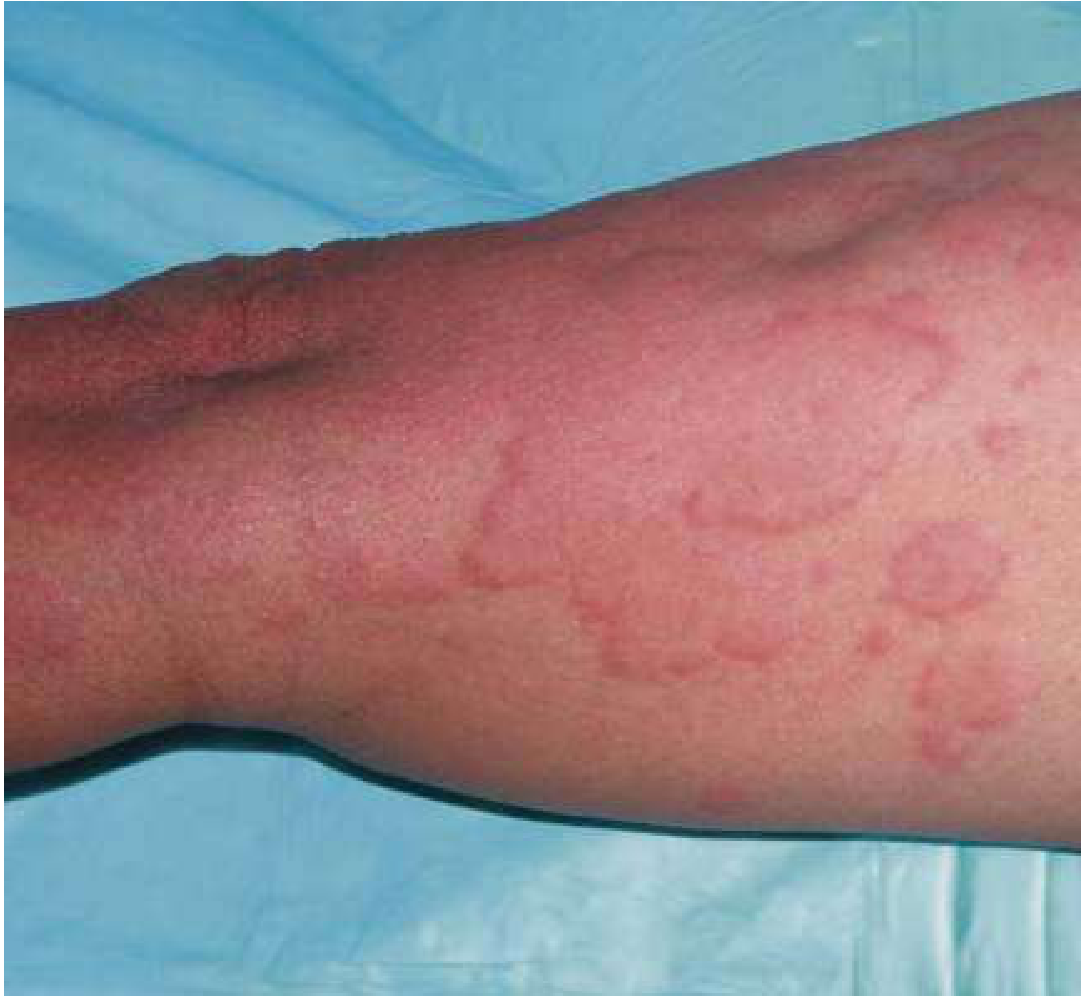
Definition
Urticaria (hives) is one of the most common cutaneous reaction patterns, characterized by transient, pruritic, erythematous wheals (raised plaques) resulting from localized mast cell degranulation and dermal microvascular hyperpermeability. It is a spectrum that ranges from simple wheals to angioedema (deep dermal/subcutaneous swelling). - Goldman-Cecil Medicine, p. 4300; Robbins & Kumar Basic Pathology, p. 879
Epidemiology
- Affects approximately 15-20% of the population during their lifetime.
- Acute urticaria: occurs in both sexes; common in children with atopic dermatitis.
- Chronic urticaria: more common in women in their 40s and 50s; peaks in the 3rd-4th decades overall. Half of all chronic urticaria patients have disease lasting 5 years or more.
-
- Rosen's Emergency Medicine, p. 2413; Goldman-Cecil Medicine, p. 4300
Classification
| Type | Duration | Key Features |
|---|---|---|
| Acute urticaria | < 6 weeks | Often identifiable trigger; infection, food, drug |
| Chronic urticaria | ≥ 6 weeks | Usually idiopathic; autoimmune in many |
| Chronic spontaneous | ≥ 6 weeks | No reproducible trigger |
| Inducible (physical) | Variable | Triggered by specific physical stimuli |
Pathobiology / Mechanism
Urticaria arises through two broad pathways - Goldman-Cecil Medicine, p. 4302; Rosen's Emergency Medicine, p. 2413:
Immunologic Mechanisms
- IgE-dependent: Allergen cross-links IgE bound to the high-affinity IgE Fc receptor (FcεRI) on mast cells → degranulation → histamine, slow-reacting substance of anaphylaxis (leukotrienes), bradykinin, kallikrein, acetylcholine release → vasodilatation and increased vascular permeability → wheal and flare.
- Autoimmune: Functional IgG autoantibodies directed against IgE or the FcεRI receptor itself trigger mast cell degranulation (seen in ~30-50% of chronic spontaneous urticaria).
- Immune complex-mediated and complement-kinin dependent mechanisms also contribute.
Nonimmunologic Mechanisms
- Direct mast cell degranulating agents: opiates (narcotics), certain antibiotics, radiocontrast media, aspirin (mechanism unclear, likely nonimmunologic - effects persist weeks after ingestion).
- Vasoactive stimuli and physical forces.
Histopathology
On biopsy, the changes are subtle: sparse superficial perivenular infiltrate of mononuclear cells, rare neutrophils and eosinophils. Superficial dermal edema causes splaying of collagen bundles (wider spacing than normal). Mast cells in the area show degranulation. - Robbins & Kumar Basic Pathology, p. 879
Triggers and Causes
Foods
Allergic (IgE-mediated): seafood, tree nuts, peanuts, eggs.
Non-allergic (histamine-releasing): lobster, strawberries - through direct mast cell release.
Drugs
- Almost any drug can cause urticaria. Most common: penicillin and aspirin.
- Traces of penicillin may be present in dairy products.
Infections
- Viral: rhinovirus, rotavirus, hepatitis viruses, Epstein-Barr virus (mononucleosis), coxsackievirus.
- Occult infections: Candida, dermatophytes, bacteria, parasites.
Physical / Inducible Urticaria
| Subtype | Trigger | Notes |
|---|---|---|
| Dermatographism | Firm skin stroking | Most common physical urticaria; wheal within 30 min |
| Pressure urticaria | Sustained pressure | Delayed onset 4-8 hours after pressure |
| Cold urticaria | Cold exposure | Can be familial or acquired; associated with cryoglobulinemia |
| Cholinergic urticaria | Exercise, heat, emotional stress | Tiny 1-3 mm wheals with extensive erythematous flare; may have nausea, abdominal pain, headache |
| Solar urticaria | UV light | Confined to sun-exposed areas; clears when light removed |
Contact Triggers
Foods, textiles, animal dander/saliva, plants, topical medications, cosmetics.
Systemic Disease
SLE, lymphoma, carcinoma, hyperthyroidism, rheumatic fever, juvenile rheumatoid arthritis.
Clinical Features
- Wheal: raised, edematous plaque with a pale center and red border - easily recognizable.
- Lesions are transient - individual wheals typically last less than 24 hours, though new lesions continuously develop.
- Intensely pruritic.
- Results from localized dermal edema produced by transvascular fluid extravasation.
- May occur alone or as part of a systemic anaphylactic reaction.
- Angioedema (deeper swelling of dermis/subcutis/mucosa) may co-exist - particularly involving lips, eyelids, and tongue. Note: if angioedema occurs without urticaria and is non-pruritic with GI involvement and lasting >24 h, consider bradykinin-mediated causes (ACE inhibitors, hereditary angioedema).
Diagnosis
- Usually clinical based on appearance.
- Acute urticaria with a clear trigger: history + allergen-specific IgE testing or skin testing.
- Chronic urticaria: initial workup guided by history and exam. Options include:
- No testing (if clinical exam is unrevealing)
- Limited testing: CBC with differential (for eosinophilia), ESR, CRP
- Extended testing: thyroid function, complement levels if isolated angioedema is present.
- Biopsy indicated if: lesions last >36 hours, are painful rather than pruritic, or leave scarring (raises concern for urticarial vasculitis - look for cellular infiltrate, nuclear debris, fibrinoid necrosis of venules).
- Provocation/threshold testing for inducible urticaria.
-
- Harrison's Principles of Internal Medicine 22E, p. 2851
Differential Diagnosis
Drug eruptions, viral exanthems, erythema multiforme, erythema marginatum, juvenile rheumatoid arthritis, urticarial vasculitis, urticarial bullous pemphigoid.
Treatment
Acute Urticaria
- Remove the inciting factor when identified.
- H1 antihistamines (first-line) - non-sedating second-generation agents preferred: cetirizine, fexofenadine, loratadine. Can be dosed up to 4x daily.
- H2 blockers (ranitidine, famotidine) may be added for additive benefit.
- Oral corticosteroids (prednisone, dexamethasone): for moderate-severe disease; will not have immediate effect but may prevent relapse.
- Epinephrine (self-injectable): prescribe if systemic symptoms or anaphylaxis risk. - Rosen's Emergency Medicine, p. 2414
Chronic Urticaria - Step-Up Algorithm
| Step | Treatment |
|---|---|
| Step 1 | Second-generation H1 antihistamine once or twice daily (up to 4x daily) |
| Step 2 | Add H1 antihistamine + leukotriene receptor antagonist (montelukast 10 mg/day) ± first-gen antihistamine or doxepin at bedtime |
| Step 3 | Omalizumab (anti-IgE monoclonal antibody) - FDA approved for chronic urticaria failing H1 antihistamines |
| Step 4 | Cyclosporine, hydroxychloroquine, dapsone, or other immunosuppressants |
- Taper medications after 3-6 months of symptom control.
- Topical glucocorticoids: no value in urticaria.
- Systemic glucocorticoids: generally avoided long-term in idiopathic or allergen-induced urticaria; useful in pressure urticaria, vasculitic urticaria, or debilitating disease.
- For vasculitic urticaria: hydroxychloroquine, dapsone, or colchicine may be added.
- All patients with chronic urticaria or history of anaphylaxis should be referred to an allergist/immunologist.
-
- Washington Manual of Medical Therapeutics, p. 436; Harrison's Principles of Internal Medicine 22E, p. 2852
Urticaria vs. Angioedema vs. Hereditary Angioedema (HAE)
| Feature | Urticaria | Allergic Angioedema | HAE (Bradykinin-mediated) |
|---|---|---|---|
| Pruritus | Present | Present | Absent |
| Urticarial lesions | Yes | May coexist | No |
| Duration per episode | <24 hours | Hours | >24 hours |
| GI involvement | Rare | Rare | Common (recurrent colic) |
| Response to antihistamines | Yes | Partial | No |
| Lab findings | Normal | IgE elevated | Low C1INH, C4, C2 |
Recent Evidence (2024-2026)
Two recent systematic reviews are relevant:
- A 2024 network meta-analysis on omalizumab dosing found that optimal cost-effective dosing for chronic urticaria can differ from standard doses (PMID: 39673624).
- A 2024 systematic review on acute urticaria treatment (J Eur Acad Dermatol Venereol) supports H1 antihistamines as first-line with corticosteroids as adjuncts (PMID: 38420865).
Sources: Goldman-Cecil Medicine (International Edition); Harrison's Principles of Internal Medicine 22E; Rosen's Emergency Medicine; Robbins & Kumar Basic Pathology; Washington Manual of Medical Therapeutics; Fitzpatrick's Dermatology.
This is a shared conversation. Sign in to Orris to start your own chat.