
Cell cycle
Reading File
The cell cycle is the ordered sequence of events a cell undergoes to duplicate its DNA and divide into two daughter cells. It consists of interphase (G1, S, G2) and mitosis (M phase), regulated by cyclins, CDKs, and checkpoints.
Searching sources...
Finding Sources
Finding Sources
Good results. Let me read the key sections from Robbins (pathology-focused cell cycle control) and Junqueira's Histology (which has a diagram), plus the Histology Atlas section.
Reading File
Reading File
Reading File
Excellent content. Now let me get the Robbins cell cycle control section and fetch the key diagram images.
Reading File
Loading Image
Loading Image
Now let me get the Robbins cyclin/CDK diagram and read the rest of the cell cycle control section.
Loading Image
Reading File
Reading File
I now have comprehensive material from multiple authoritative textbooks with diagrams. Let me compile the full answer.
The Cell Cycle
The cell cycle is the ordered, self-regulated sequence of events by which a cell duplicates its contents and divides into two genetically identical daughter cells. In rapidly dividing human cells, the full cycle takes about 24 hours. - Junqueira's Basic Histology, p. 167
Overview: Phases of the Cell Cycle
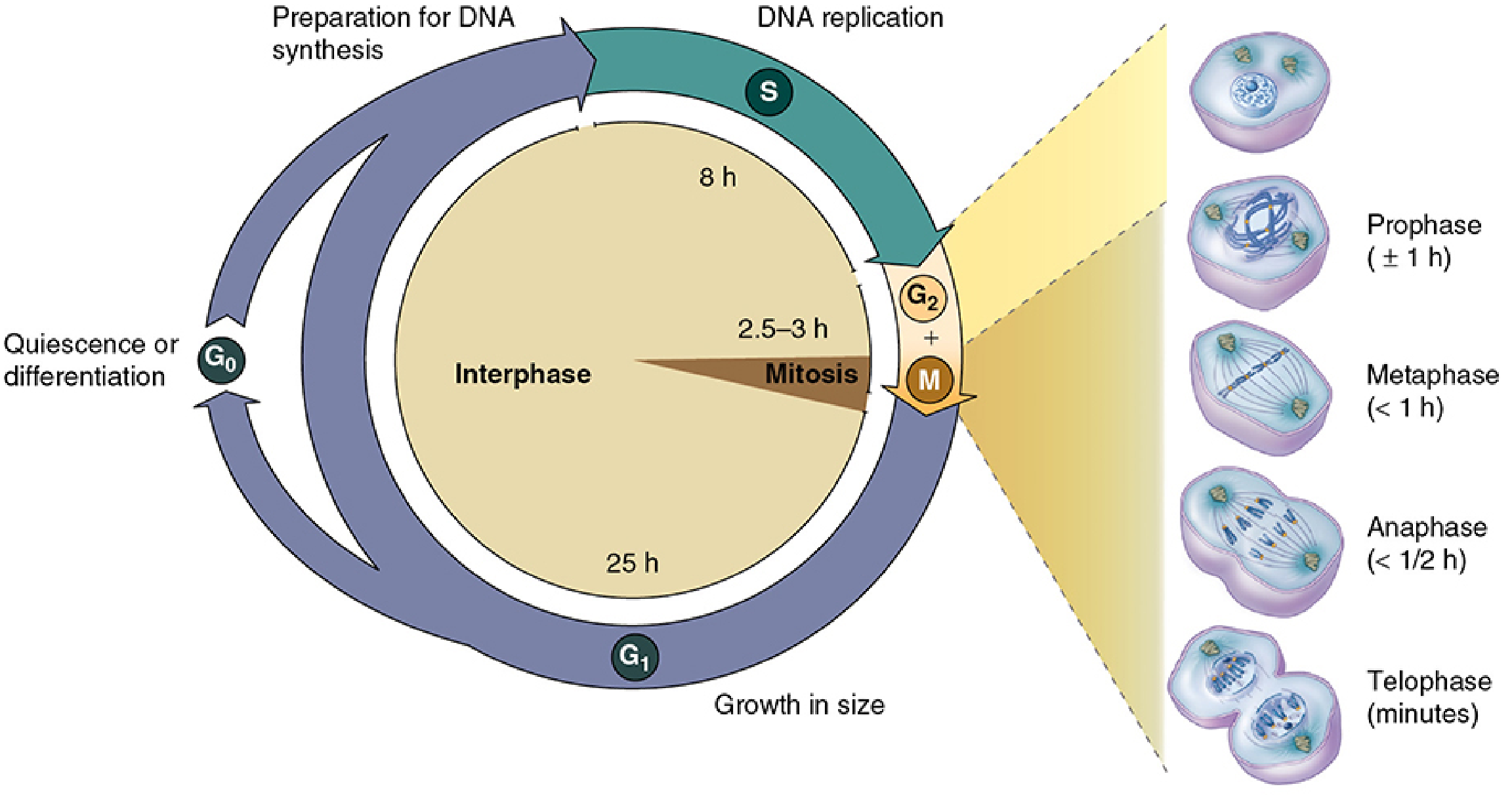
The cycle is divided into two major parts: Interphase (G1, S, G2) and M phase (Mitosis).
| Phase | Duration | Key Events |
|---|---|---|
| G1 (Gap 1) | ~9-25 h | Cell grows; RNA and protein synthesis; response to mitogens; most variable phase |
| S (Synthesis) | ~7.5-10 h | DNA replication; histone synthesis; centrosome duplication begins |
| G2 (Gap 2) | ~3.5-4.5 h | Proteins for mitosis accumulate; proofreading of replicated DNA |
| M (Mitosis) | ~1 h | Chromosome segregation and cell division (prophase, metaphase, anaphase, telophase) |
| G0 | Variable | Quiescent state; cells exit cycle; may re-enter or terminally differentiate |
- Histology: A Text and Atlas, p. 255; Junqueira's Basic Histology, p. 167-168
Checkpoints
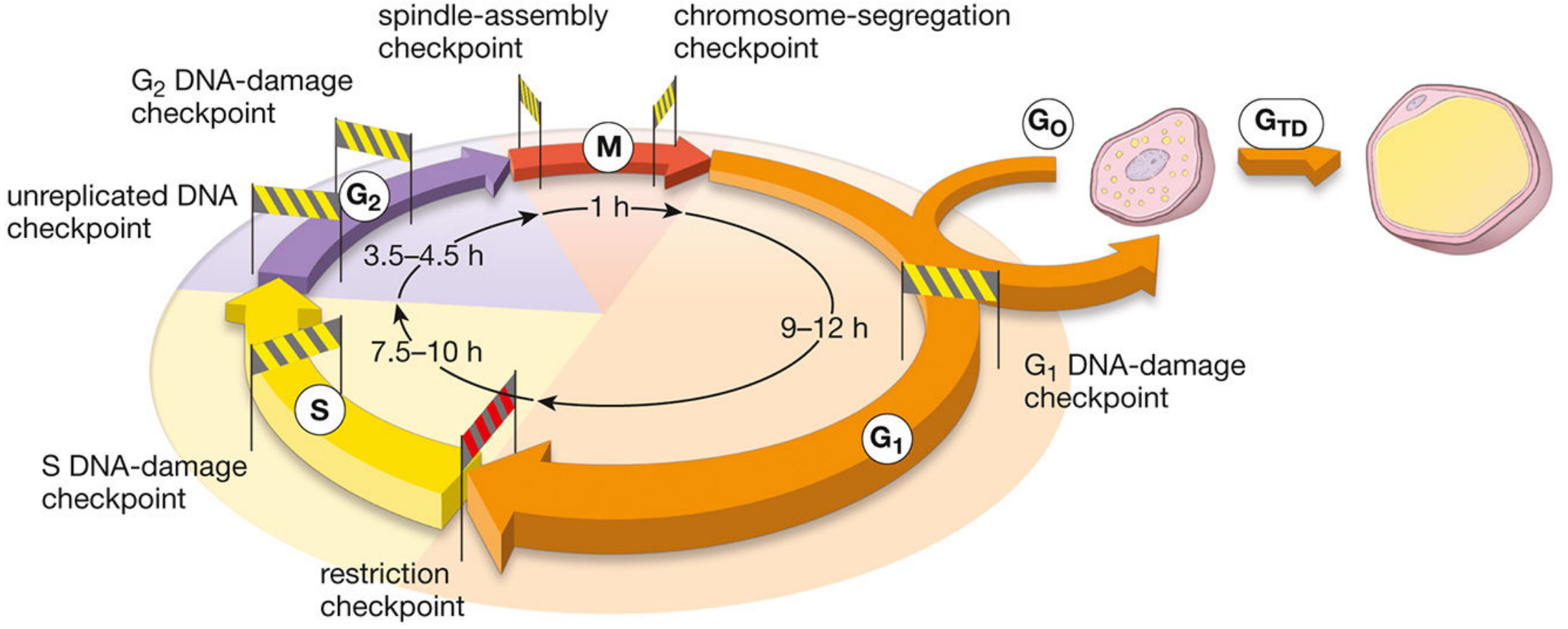
Checkpoints are internal quality-control mechanisms that halt the cycle unless specific conditions are met. - Histology: A Text and Atlas, p. 255
Major Checkpoints
-
Restriction Checkpoint (late G1, G1/S boundary)
- The "point of no return" - the most important checkpoint in the cell cycle
- The cell evaluates its own replicative potential, nutrient availability, and extracellular signals
- Once passed, the cell is committed to completing division
- Regulated by CDK4/6-Cyclin D complexes phosphorylating RB protein
-
G1 DNA-Damage Checkpoint
- Monitors integrity of newly replicated DNA
- If DNA is irreparably damaged, p53 levels rise and block entry to S phase
- Cell is diverted to apoptosis or senescence
-
S DNA-Damage Checkpoint
- Detects DNA damage during replication and stalls replication forks
-
G2 Checkpoints (two)
- Unreplicated DNA checkpoint: ensures complete DNA replication before mitosis
- G2 DNA-damage checkpoint: monitors for damage acquired during S phase
-
M Phase Checkpoints (two)
- Spindle-assembly checkpoint: ensures all chromosomes are properly attached to spindle fibers
- Chromosome-segregation checkpoint: ensures equal distribution to daughter cells
- Histology: A Text and Atlas, p. 255-260; Robbins & Kumar Basic Pathology, p. 232
Molecular Regulation: Cyclins, CDKs, and CDKIs
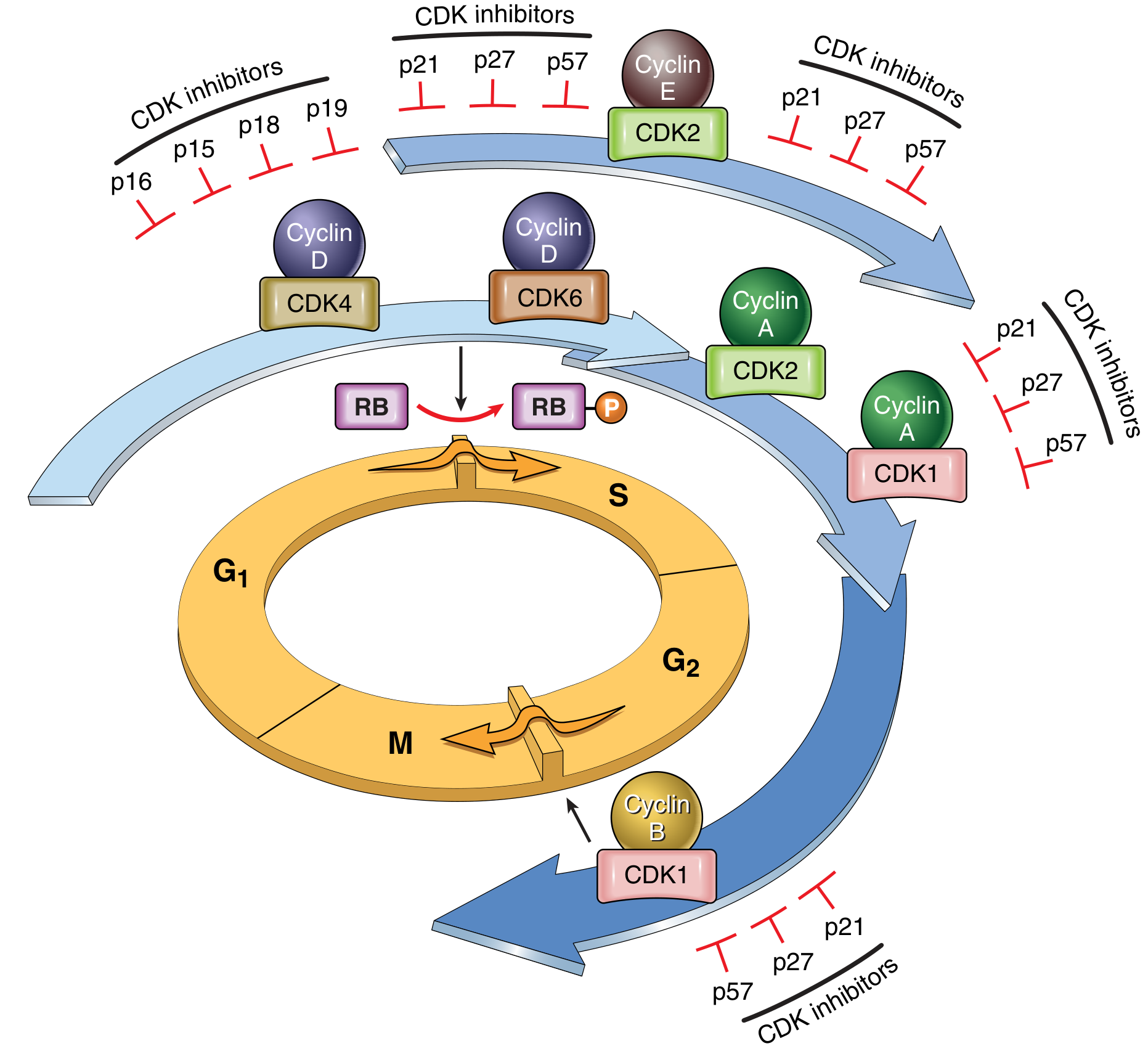
The molecular engine of the cell cycle is driven by Cyclin-Dependent Kinases (CDKs) that become active only when bound to their cyclin partner. Cyclins rise and fall in concentration as the cycle progresses - hence the name. - Robbins & Kumar Basic Pathology, p. 232
Key Cyclin-CDK Complexes
| Cyclin | CDK | Phase Active | Key Target |
|---|---|---|---|
| Cyclin D | CDK4/6 | G1 progression | Phosphorylates RB protein (releases E2F) |
| Cyclin E | CDK2 | G1/S transition (S phase entry) | ATM/ATR kinases, p53 |
| Cyclin A | CDK2 | S phase progression | DNA replication machinery (RPA, DNA polymerase) |
| Cyclin A | CDK1 | G2/M entry | Cdc25 phosphatase, Cyclin B |
| Cyclin B | CDK1 | M phase | Chromatin proteins, nuclear lamins, centrosomal proteins |
- Histology: A Text and Atlas, Table 3.1, p. 260
The RB Protein - Master Brake at G1/S
In early G1, RB (retinoblastoma protein) is in its hypophosphorylated (active) form and suppresses cell cycle progression by binding and inactivating transcription factor E2F. When Cyclin D-CDK4/6 complexes phosphorylate RB, E2F is released and drives transcription of genes needed for S phase entry (including Cyclin E). This creates a positive feedback loop that makes the G1/S transition essentially irreversible. - Robbins & Kumar Basic Pathology, p. 232-233
CDK Inhibitors (CDKIs)
Two families of CDKIs act as molecular brakes:
- INK4 family (p15, p16, p18, p19): selectively inhibit Cyclin D-CDK4 and Cyclin D-CDK6
- CIP/KIP family (p21, p27, p57): broadly inhibit all CDK complexes
p53 is particularly important - in response to DNA damage, p53 induces transcription of p21, which then inhibits CDK complexes and halts the cycle to allow DNA repair.
G0 - The Quiescent State
Cells that exit the cycle in G1 enter G0. Some cells (hepatocytes, lymphocytes) can return to G1 under appropriate stimuli. Others undergo terminal differentiation (G_TD) and never divide again - most neurons and skeletal muscle cells are examples. - Histology: A Text and Atlas, p. 255
Mitosis - The M Phase
Mitosis itself is subdivided into four stages:
| Stage | Events |
|---|---|
| Prophase (~1 h) | Chromosomes condense; spindle apparatus forms; nuclear envelope breaks down |
| Metaphase (<1 h) | Chromosomes align at the metaphase plate; kinetochores attach to spindle fibers |
| Anaphase (<0.5 h) | Sister chromatids pulled to opposite poles |
| Telophase (minutes) | Nuclear envelopes reform; chromosomes decondense; cytokinesis begins |
Clinical Relevance: Cell Cycle Dysregulation in Cancer
The G1/S checkpoint is the one most commonly disabled in human cancers. Two main mechanisms: - Robbins & Kumar Basic Pathology, p. 233
-
Gain-of-function in CDK4 or D cyclins
- Cyclin D overexpressed in breast, esophageal, liver cancers, lymphomas
- CDK4 amplified in melanomas, sarcomas, glioblastomas
-
Loss-of-function in CDKIs
- CDKN2A (encoding p16) is deleted or silenced in gliomas, carcinomas, sarcomas, and leukemias
- Germline CDKN2A mutations found in familial melanoma
-
Loss of RB
- RB mutations disable the G1/S checkpoint directly
- Prototype tumor suppressor; mutated in retinoblastoma, osteosarcoma, and others
This means that essentially all cancers carry some genetic alteration that frees them from normal G1/S checkpoint constraints, allowing continuous re-entry into S phase.
Key summary: The cell cycle is a tightly choreographed G1 → S → G2 → M sequence controlled by cyclin-CDK complexes at each transition. Checkpoints - especially the restriction point at G1/S - sense DNA damage and cellular readiness to prevent defective replication. CDKIs (p16, p21, p27, etc.) and tumor suppressors (RB, p53) are the brakes. Their loss is a hallmark of cancer.
This is a shared conversation. Sign in to Orris to start your own chat.