
My mother had + right side headache from 3 days associated with nausea no vomiting no fever take Medici Naproxen Sodium & Domperidone no relief 2days due to persistent of symptoms sought consult at near by clinic where noted Bp 130/90 all other vitals are normal proscribe Ergotamine Tartrate 1 mg & Caffeine 100 mg Tablets, Etoricpxib paracetamol, Flunarizine and Propranorcyroeblorde tablets given No relief noted still my mother had headache from morning and it’s sharp pain Give me why it happened and treatment and management and I suggested to visit near by hospital and check Bp
migraine treatment refractory acute management
migraine headache pathophysiology trigeminal vascular mechanism diagram
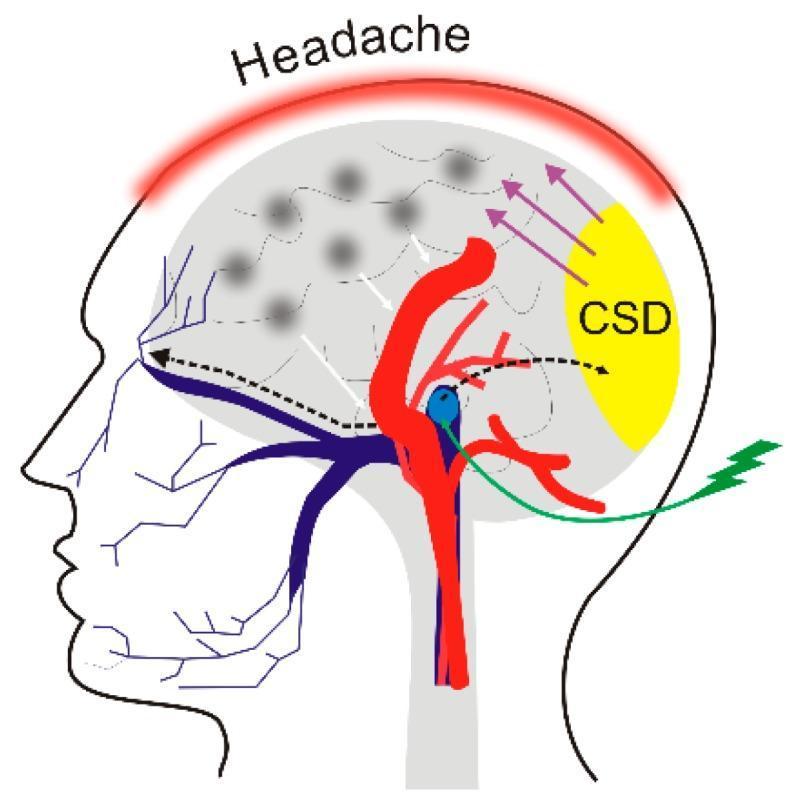
This pathophysiology diagram illustrates the hypothetical mechanism of a migraine attack in a profile view of the human head. The process begins with an external trigger (represented by a green lightning bolt) that activates the trigeminal nerve (dark blue), specifically targeting the trigeminal nucleus (light blue oval). Waves of depolarization (black dashed arrows) propagate along the nerve pathways, reaching the cerebral cortex and initiating Cortical Spreading Depression (CSD), visualized as a yellow posterior region. This activity triggers neurogenic inflammation, represented by gray 'cloud' shapes across the cortex. The subsequent release of inflammatory neurotransmitters (white arrows) leads to the vasodilation of intracranial blood vessels (bright red). The culmination of these vascular and neurological events results in the clinical manifestation of pain, indicated by a red 'Headache' arc over the superior aspect of the skull. This anatomical illustration integrates concepts of neurology and pain management, highlighting the interaction between the trigeminal vascular system and cortical activity in migraine pathogenesis.
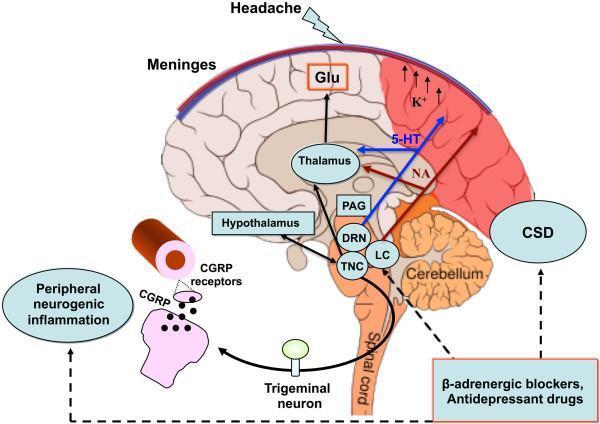
This pathophysiology diagram illustrates the neurobiological mechanisms of migraine with aura, focusing on Cortical Spreading Depression (CSD) and trigeminovascular activation. A sagittal view of the human brain highlights the cortex, thalamus, hypothalamus, cerebellum, and brainstem. In the posterior cortex, CSD is represented by a red-shaded area characterized by increased extracellular potassium (K+) and excitatory glutamate (Glu). The diagram traces neurochemical signaling pathways, including serotonin (5-HT) from the Dorsal Raphe Nucleus (DRN) and norepinephrine (NA) from the Locus Coeruleus (LC) projecting to the cortex. Pain processing involves the Trigeminal Nucleus Caudalis (TNC), Periaqueductal Gray (PAG), and thalamus. The 'Headache' phase is linked to meningeal stimulation and peripheral neurogenic inflammation, shown via a detailed inset of a trigeminal neuron releasing Calcitonin Gene-Related Peptide (CGRP) onto vascular receptors. Pharmacological modulation is indicated at the bottom, showing where beta-blockers and antidepressants interfere with CSD and trigeminal hypersensitivity. This visual resource is designed for advanced medical education regarding the pathogenesis of primary headache disorders.
Your Mother's Headache: Full Clinical Breakdown
⚠️ URGENT NOTE - Read This First
What Is Most Likely Happening: Migraine (Probably Without Aura)
| Feature | Your Mother's Case |
|---|---|
| One-sided (unilateral) | Right side only |
| Nausea | Present |
| No fever | Confirmed |
| Duration | Days (migraine can last 4-72 hrs, or longer in status migrainosus) |
| Medications tried | Multiple, without relief |
Why Did It Happen? (The Mechanism)
- A trigger (stress, hormones, sleep disruption, certain foods, weather changes, or the elevated blood pressure itself) activates the trigeminal nerve.
- This causes Cortical Spreading Depression - a wave of abnormal electrical activity across the brain surface.
- Blood vessels in the brain dilate (widen), and inflammatory chemicals - especially CGRP (Calcitonin Gene-Related Peptide), substance P, and serotonin - are released around them.
- These chemicals irritate the trigeminal nerve endings, producing throbbing, one-sided pain, nausea, and sensitivity to light/sound.
- Serotonin levels drop during the headache phase, which worsens the vasodilation and pain cycle.
-
Hormonal changes (especially in women)
-
Stress or post-stress relaxation
-
Disrupted sleep
-
Skipping meals
-
Bright lights, strong smells
-
Elevated blood pressure (can both trigger and worsen migraine)
-
Lippincott Illustrated Reviews: Pharmacology, 16th Ed.
-
Frameworks for Internal Medicine
Why Isn't the Medicine Working?
First attempt (self-treatment):
- Naproxen Sodium - An NSAID. Useful for mild-moderate migraine, but often insufficient for moderate-severe attacks or when the headache is already established.
- Domperidone - Antiemetic (for nausea). Helpful adjunct but doesn't treat the headache itself.
Second attempt (clinic prescription):
- Ergotamine Tartrate 1 mg + Caffeine 100 mg - This IS a migraine-specific drug. Ergotamine constricts dilated blood vessels and works at 5-HT1 receptors. Key problem: it is most effective when taken at the very EARLIEST sign of migraine. After 3-5 days of established headache, it is far less effective. Also, overuse causes "rebound headache." - Lippincott Illustrated Reviews: Pharmacology
- Etoricoxib + Paracetamol - COX-2 inhibitor with paracetamol for pain. Reasonable but not migraine-specific.
- Flunarizine - Calcium channel blocker used for migraine prevention, not acute treatment. It takes weeks of daily use to work. It won't stop today's headache.
- Propranolol - Beta-blocker, also a preventive (prophylactic) agent. Again, takes weeks to work. Zero effect on an acute attack.
The Drugs Used for Migraine: What They Do
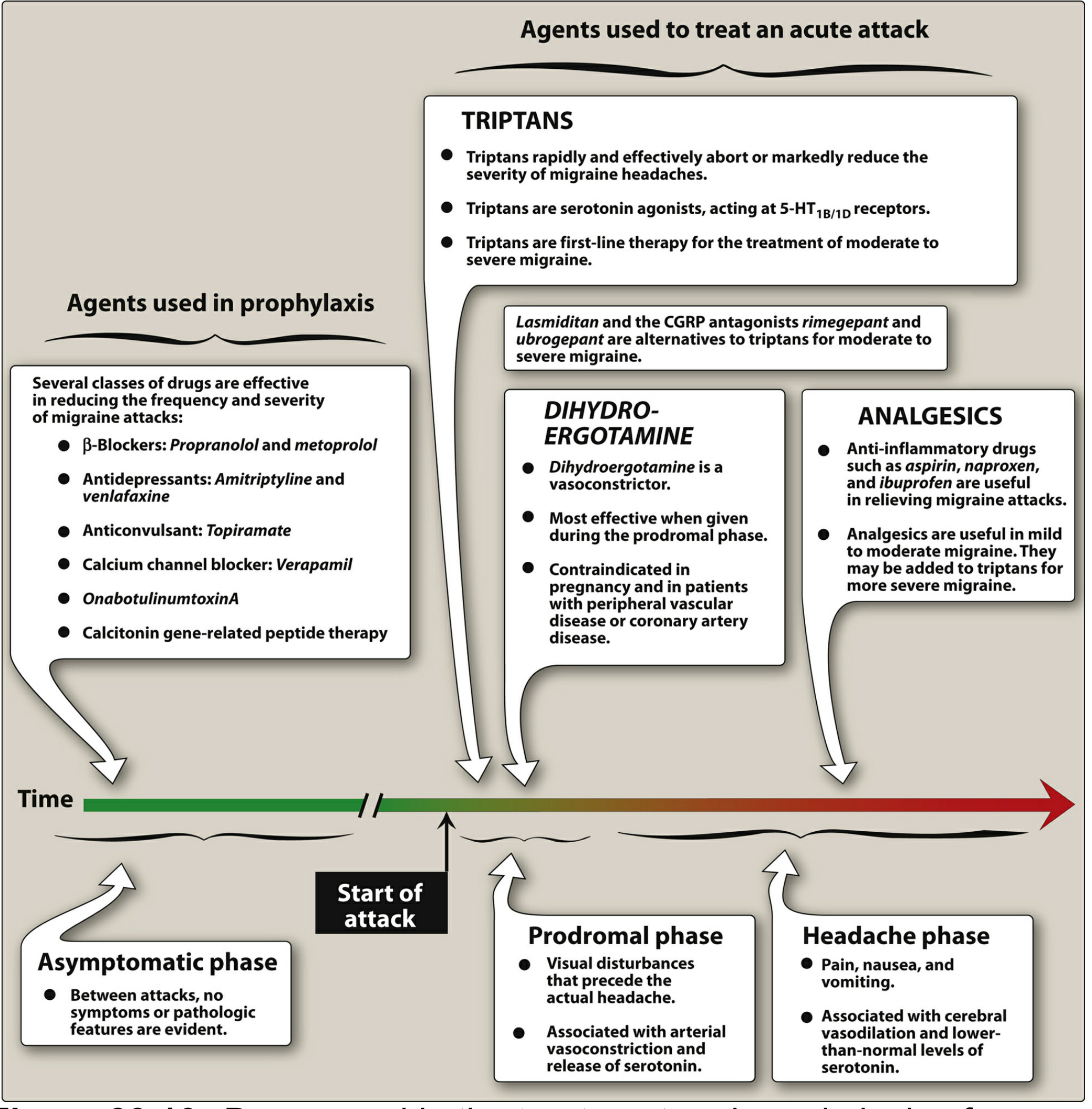
- Lippincott Illustrated Reviews: Pharmacology, Fig. 39.10
What Should Happen at the Hospital
Step 1: Rule Out Dangerous Causes (RED FLAGS)
| Dangerous Condition | Why It Must Be Excluded |
|---|---|
| Subarachnoid hemorrhage | "Worst headache of life," sudden onset - can present atypically |
| Hypertensive emergency | BP can cause severe headache if very high |
| Intracranial mass / tumour | Persistent headache not responding to treatment |
| Meningitis | No fever helps, but must be clinically assessed |
| Cerebral venous thrombosis | More common in women, can cause persistent headache |
-
BP is significantly elevated
-
Headache has changed in character (now described as "sharp" - previously may have been throbbing)
-
No response to multiple medications
-
Tintinalli's Emergency Medicine, Table 165-7 and ACR Guidelines
Step 2: BP Check and Management
- BP > 160/100: This can directly cause headache and needs treatment.
- BP > 180/120 with headache: This is a hypertensive urgency/emergency - needs urgent management.
Step 3: Acute Treatment at Hospital
| Drug | Route | Notes |
|---|---|---|
| Sumatriptan (triptan) | Oral / Nasal / Subcutaneous | First-line migraine-specific therapy; 70% effective |
| Prochlorperazine or Metoclopramide | IV/IM | Antiemetic + direct anti-migraine effect |
| Ketorolac | IV/IM | NSAID by injection, more effective than oral |
| Dexamethasone (steroid) | IV | Reduces chance of 24-hour recurrence |
| IV fluids | IV | If dehydrated from nausea |
- Tintinalli's Emergency Medicine, Treatment Options for Migraine Headache
Long-Term Management (After This Episode)
- Identify and avoid triggers - Keep a headache diary (date, what was eaten, sleep, stress level, weather).
- Preventive medication - Propranolol and Flunarizine (already prescribed) will help reduce frequency - but they take 4-12 weeks to show full effect. She should continue them.
- Early treatment - The moment the next headache starts (or even at the "warning signs" stage), take the acute medication immediately - do not wait.
- BP monitoring - If her BP is consistently elevated, this needs to be managed as a separate condition, as it can both trigger and worsen headaches.
- Avoid analgesic overuse - Using pain relievers more than 10-15 days/month causes "medication overuse headache" (rebound headache), which makes the condition worse.
Summary Action Plan for Today
- Go to the hospital now - do not wait further
- Get BP re-checked (it may have gone higher)
- Request blood tests and consider CT brain if the doctor deems necessary
- Ask for IV/injectable acute migraine treatment (sumatriptan, or prochlorperazine + ketorolac)
- Confirm that Flunarizine and Propranolol will be continued daily as preventive agents going forward
- Follow up with a neurologist for proper migraine evaluation and long-term plan
Important disclaimer: This is educational medical information based on textbooks. It does not replace an in-person clinical evaluation. Please take your mother to a hospital today. A doctor examining her is the only way to safely exclude serious causes and provide the right treatment.