
Hey I have mbbs biochemistry exam tomorrow paper 1 what are the important topics to study in last few hours(6hrs)
MBBS biochemistry paper 1 important topics university exam high yield 2025
https://www.diginerve.com/blogs/important-topics-for-biochem…
Could you make this for rghus paper
RGUHS MBBS first year biochemistry paper 1 important questions previous year 2023 2024 2025
RGUHS biochemistry paper 1 syllabus topics exam pattern first year MBBS
https://www.reddit.com/r/indianmedschool/comments/1nzd1h3/rg…
http://www.rguhs.ac.in/Exam/2025/qp%20blueprint.pdf
RGUHS Biochemistry Paper 1 - Last 6 Hours Study Plan 🎯
Official RGUHS Paper 1 Blueprint (Total: 100 Marks)
| Topic | Marks | Priority |
|---|---|---|
| Enzymes | 10 | 🔴 HIGH |
| Carbohydrate Metabolism | 10 | 🔴 HIGH |
| Vitamins | 10 | 🔴 HIGH |
| Minerals | 10 | 🔴 HIGH |
| Acid Base Balance | 10 | 🔴 HIGH |
| Lipid Metabolism | 10 | 🔴 HIGH |
| Nutrition | 08 | 🟡 MED |
| Biological Oxidation | 05 | 🟡 MED |
| Carbohydrate Chemistry | 05 | 🟡 MED |
| Lipid Chemistry | 05 | 🟡 MED |
| Cell & Subcellular Organelles | 05 | 🟡 MED |
| Extra Cellular Matrix | 03 | 🟢 LOW |
| Water & Electrolyte Balance | 02 | 🟢 LOW |
| Integration/Alcohol Metabolism | 02 | 🟢 LOW |
| AETCOM | 05 | MCQ only |
Paper Pattern (Know This!)
- Long Essay (LE): 1 × 10 = 10 marks
- Short Essays (SE): 3 × 5 = 15 marks (applied/integrated topics - Anaemia, DM, IHD, TB, Hypertension, Thyroid)
- Short Notes (SN): 4 × 5 = 20 marks
- Reasoning / Short Answers: 5 × 3 = 15 marks
- MCQs (case scenario-based): 10 × 2 = 20 marks
- Long Essay: 1 × 10 = 10 marks (AETCOM + applied)
6-Hour Study Schedule
Hour 1 - Enzymes (10 marks - highest yield)
- Classification & nomenclature
- Enzyme kinetics - Km, Vmax, Michaelis-Menten equation
- Inhibition types (competitive, non-competitive) - draw graphs
- Allosteric enzymes & regulation
- Coenzymes and cofactors
- Isoenzymes - LDH, CK (clinical use in MI diagnosis)
- Marker enzymes and their significance
Hour 2 - Carbohydrate Metabolism (10 marks)
- Glycolysis - steps, energetics, regulation (key enzymes: PFK-1, pyruvate kinase)
- TCA cycle - steps, ATP yield, clinical relevance
- Glycogen synthesis & degradation + glycogen storage diseases (Von Gierke, Pompe, McArdle)
- Gluconeogenesis - substrates, key enzymes
- HMP shunt - significance, Rapaport-Luebering cycle
- Blood glucose regulation - insulin/glucagon effects
- Diabetes mellitus - biochemical basis (case scenario likely!)
Hour 3 - Vitamins & Minerals (20 marks combined - do NOT skip)
- Fat soluble: A, D, E, K - deficiency diseases + active forms
- Vitamin D metabolism (synthesis, activation, calcitriol, rickets/osteomalacia)
- Water soluble: B1 (TPP - active form), B2 (FAD/FMN), B3 (NAD/NADP), B6 (PLP), B12 & Folate (megaloblastic anaemia, pernicious anaemia), C (scurvy - collagen link)
- Biotin, pantothenic acid functions
- Iron - absorption, transport (transferrin), storage (ferritin), deficiency anaemia (case scenario: Anaemia!)
- Calcium & Phosphorus - regulation (PTH, calcitriol, calcitonin)
- Zinc, Iodine, Fluorine (fluorosis), Copper (Menkes/Wilson)
- Selenium, Manganese
Hour 4 - Acid Base Balance (10 marks)
- Buffer systems - bicarbonate (most important), phosphate, protein
- Henderson-Hasselbalch equation
- Respiratory & metabolic acidosis/alkalosis - causes, compensation
- Anion gap concept
- Clinical cases: DKA (metabolic acidosis), vomiting (metabolic alkalosis), pneumonia (respiratory acidosis)
- Renal regulation of pH
Hour 5 - Lipid Metabolism + Biological Oxidation (15 marks)
- Beta oxidation of even-chain fatty acid - steps, ATP yield, regulation
- Ketone body formation, utilization, ketoacidosis (DKA - high-yield case scenario)
- Cholesterol synthesis - HMG-CoA reductase (statin target), regulation
- Lipoproteins - structure, types (LDL, HDL, VLDL, chylomicrons), apo proteins (ApoB-100, ApoE, ApoCII)
- Essential fatty acids - omega-3, omega-6, eicosanoids
- ETC - complexes I-IV, sites of ATP synthesis
- Chemiosmotic theory (Mitchell's hypothesis)
- ATP yield from glucose oxidation (30-32 ATP)
- Uncouplers (DNP, thermogenin in brown fat)
- Inhibitors of ETC
Hour 6 - Applied Integration + MCQ Prep (Revision)
- Anaemia - Iron deficiency (B12/folate) - biochemical basis, lab findings
- Diabetes Mellitus - metabolic changes in insulin deficiency, HbA1c, DKA
- Ischemic Heart Disease - lipoproteins, cholesterol, cardiac markers (LDH, CK-MB, troponin)
- Nutrition - PEM (kwashiorkor vs marasmus), BMI, caloric value
- Thyroid - T3/T4 synthesis, iodine role
- Pulmonary surfactant
- Ketone bodies
- HMP shunt significance
- Isoenzymes
- Vitamin D metabolism
- Iron absorption
- Metabolic acidosis
- Role of ApoC-II
Quick-Recall Tips for MCQs (Case-Based)
- DKA = metabolic acidosis + increased anion gap + ketones in urine
- Rickets in child = Vitamin D deficiency; Osteomalacia in adult
- Pernicious anaemia = intrinsic factor deficiency → B12 deficiency → megaloblastic
- Pellagra (3Ds: Dermatitis, Diarrhoea, Dementia) = Niacin (B3) deficiency
- Scurvy = Vitamin C deficiency → impaired hydroxylation of proline/lysine → defective collagen
- Statins block HMG-CoA reductase
- Cyanide/CO = ETC inhibitors (Complex IV)
- Phenylketonuria = phenylalanine hydroxylase deficiency (this may overlap from Paper 2)
Make a study poster summarizing enzymes, vitamins & metabolic pathways
A detailed medical study poster for MBBS Biochemistry exam titled "BIOCHEMISTRY QUICK REFERENCE - Enzymes, Vitamins & Metabolic Pathways". The poster is divided into 3 color-coded sections on a dark navy background with bright text: SECTION 1 - ENZYMES (green header): - Km = substrate conc at half Vmax | Low Km = high affinity - Competitive inhibition: increases Km, same Vmax - Non-competitive: same Km, decreases Vmax - Allosteric enzymes: sigmoidal curve, regulated by modulators - Isoenzymes: LDH1 (heart), LDH5 (liver) | CK-MB (MI marker) - Marker enzymes: ALP (liver/bone), ALT/AST (hepatocytes), Amylase (pancreas) - Coenzymes: NAD+ (B3), FAD (B2), TPP (B1), PLP (B6), CoA (pantothenic acid) SECTION 2 - VITAMINS (orange header): Fat Soluble: A (retinol - night blindness), D (calcitriol - rickets/osteomalacia), E (antioxidant), K (clotting factors II,VII,IX,X) Water Soluble: B1 (TPP - beriberi/Wernicke), B2 (FAD/FMN), B3 (NAD - pellagra 3Ds), B6 (PLP - transamination), B12 (megaloblastic anaemia - needs intrinsic factor), Folate (NTD in pregnancy), C (scurvy - collagen synthesis) SECTION 3 - METABOLIC PATHWAYS (blue header): GLYCOLYSIS: Glucose → 2 Pyruvate | Net: 2 ATP | Key enzyme: PFK-1 (rate limiting) TCA CYCLE: Acetyl-CoA → 3 NADH + 1 FADH2 + 1 GTP per turn | Isocitrate DH = rate limiting ETC: Complex I→II→III→IV | 2.5 ATP per NADH | 1.5 ATP per FADH2 | Total glucose = 30-32 ATP BETA OXIDATION: Palmitate (16C) → 8 Acetyl-CoA | Net 106 ATP KETOGENESIS: Acetyl-CoA → Acetoacetate → BHB + Acetone | Occurs in liver | ↑ in DKA GLUCONEOGENESIS: Pyruvate/Lactate/AA/Glycerol → Glucose | Key enzymes: PEPCK, F-1,6-BPase Bottom strip: CLINICAL PEARLS - DKA = metabolic acidosis + ketones | Statins = block HMG-CoA reductase | Cyanide = inhibits Complex IV | Scurvy = defective collagen (proline hydroxylation fails) Clean, readable fonts, color-coded boxes, arrows for pathways, medical diagram style suitable for last-minute exam revision
400, message: Got more than 4194304 bytes when reading: b'data: {"candidates": [{"content": {"role": "model","parts": [{"inlineData": {"mimeType": "image/png"...'.
We encountered an error while processing your request. Please try again or reach out to us for help.
?
A vibrant MBBS Biochemistry study poster with 3 color-coded sections on dark background. Title: "BIOCHEMISTRY PAPER 1 - QUICK REFERENCE". Left panel in green: ENZYMES - Michaelis-Menten curve diagram, competitive vs non-competitive inhibition comparison, isoenzymes table (LDH1=heart, CK-MB=MI), coenzymes list (NAD=B3, FAD=B2, TPP=B1). Middle panel in orange: VITAMINS - two columns Fat Soluble (A,D,E,K with deficiency diseases) and Water Soluble (B1 beriberi, B3 pellagra, B12 megaloblastic anemia, C scurvy). Right panel in blue: METABOLIC PATHWAYS - flowchart showing Glucose to Pyruvate (glycolysis, 2ATP), Pyruvate to Acetyl-CoA, TCA cycle wheel diagram, ETC chain with ATP yield 30-32 total, Beta oxidation of fatty acids, Ketogenesis arrow to DKA note. Bottom banner in red: CLINICAL PEARLS - DKA, statins, cyanide poisoning, scurvy collagen defect. Clean medical education poster style, bold readable labels, suitable for exam revision.
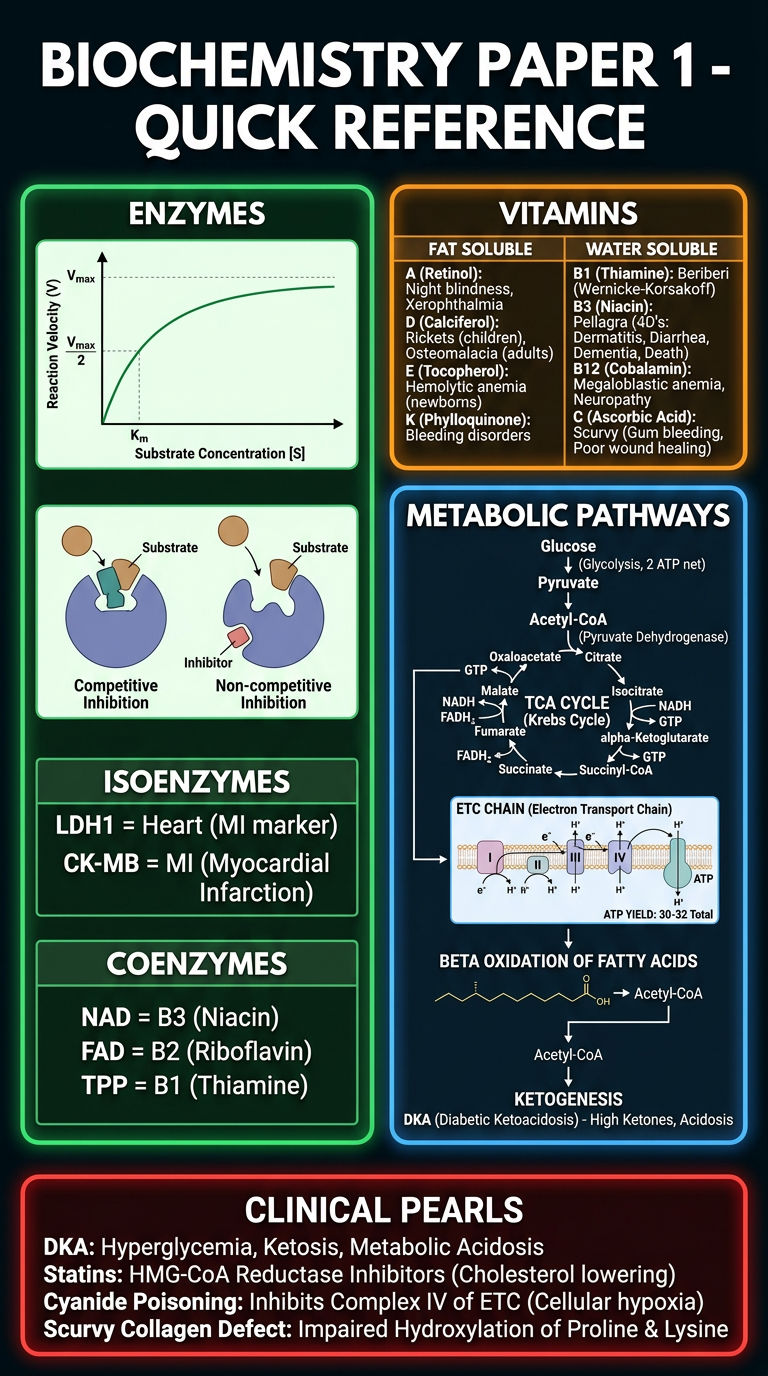
- Green panel - Enzymes: Kinetics, inhibition types, isoenzymes, coenzymes
- Orange panel - Vitamins: Fat & water soluble with deficiency diseases
- Blue panel - Metabolic Pathways: Glycolysis → TCA → ETC → Beta oxidation → Ketogenesis flow
- Red banner - Clinical Pearls: Quick-recall facts for case-based MCQs