
Types of TAH
- Total Hysterectomy - removes uterus + cervix
- Subtotal (Supracervical) - removes uterus, leaves cervix
- Radical Hysterectomy (Wertheim's) - removes uterus, cervix, upper vagina, parametrium, and pelvic lymph nodes
- TAH-BSO - Total Abdominal Hysterectomy + Bilateral Salpingo-Oophorectomy (adds removal of both tubes and ovaries)
types of total abdominal hysterectomy TAH classification gynecology
types of hysterectomy total subtotal radical diagram
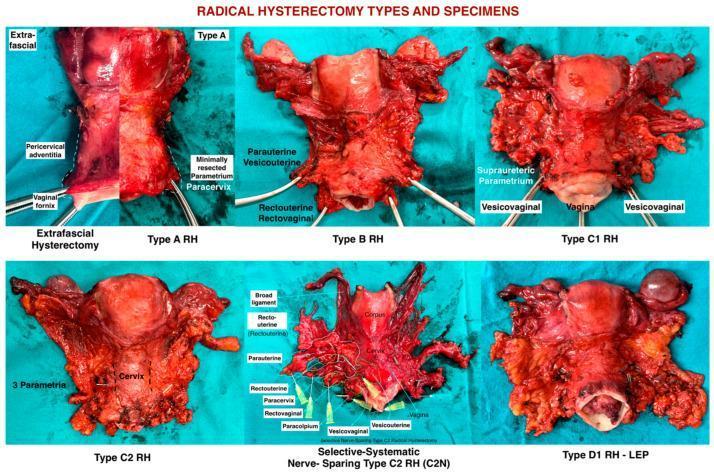
A comparison of surgical specimens from different types of radical hysterectomy (RH), demonstrating the varying extent of tissue resection according to the Querleu-Morrow classification. The image includes six panels: Extrafascial Hysterectomy, Type A RH, Type B RH, Type C1 RH, Type C2 RH, Selective-Systematic Nerve-Sparing Type C2 RH (C2N), and Type D1 RH-LEP. Key anatomical structures and landmarks are labeled, including the pericervical adventitia, parauterine and paracervical tissues, rectouterine/rectovaginal ligaments, vesicouterine/vesicovaginal ligaments, and paracolpium. The specimens illustrate the progression of surgical radicality: Type A shows minimal parametrial resection; Type B shows resection at the ureteric level; Type C1 focuses on supraureteric parametria; Type C2 shows total resection of supraureteric and infraureteric parametria to the pelvic floor; C2N highlights nerve-sparing techniques preserving autonomic pathways; and Type D1 represents laterally extended parametrectomy involving the internal iliac vascular system at the pelvic sidewall. This visual resource is used to teach surgical-anatomical margins and oncological resection principles in gynecologic oncology.
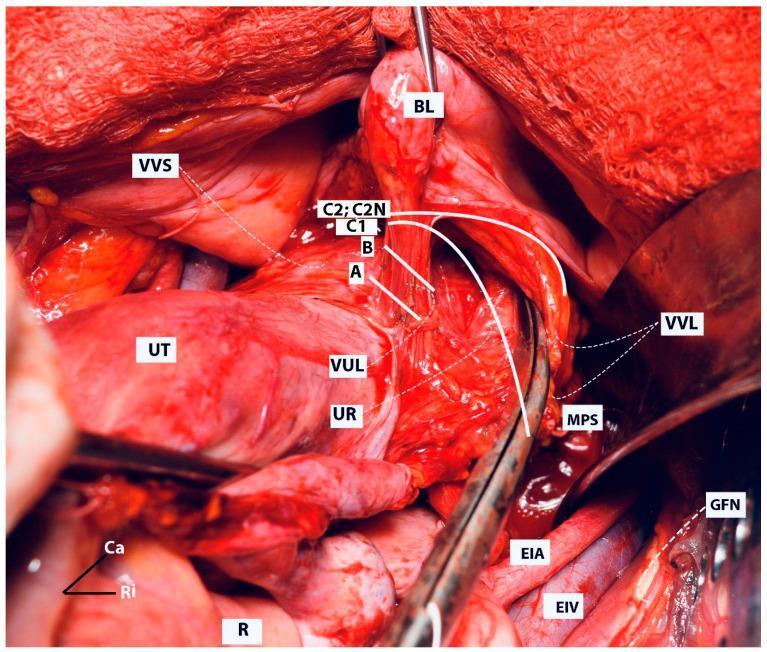
An intraoperative clinical photograph from a radical hysterectomy illustrating the surgical anatomy of the ventral parametrium. The image depicts the pelvic cavity with labels for the uterus (UT), bladder (BL), and rectum (R). The ureter (UR) is shown in relation to the vesicouterine ligament (VUL) and vesicovaginal ligament (VVL). Anatomical landmarks include the medial paravesical space (MPS), vesicovaginal space (VVS), external iliac artery (EIA), external iliac vein (EIV), and genitofemoral nerve (GFN). Overlayed white curves represent four distinct surgical resection lines corresponding to different classes of radicality: Type A (pericervical adventitia), Type B (ureteric level), Type C1 (partial nerve-sparing), and Type C2/C2N (selective-systematic nerve-sparing). The diagram illustrates how the extent of resection progresses laterally from line A to C2N, emphasizing the surgical planes used to tailor radicality while attempting to preserve autonomic pelvic nerves. Orientation is indicated by caudal (Ca) and right (Ri) markers.
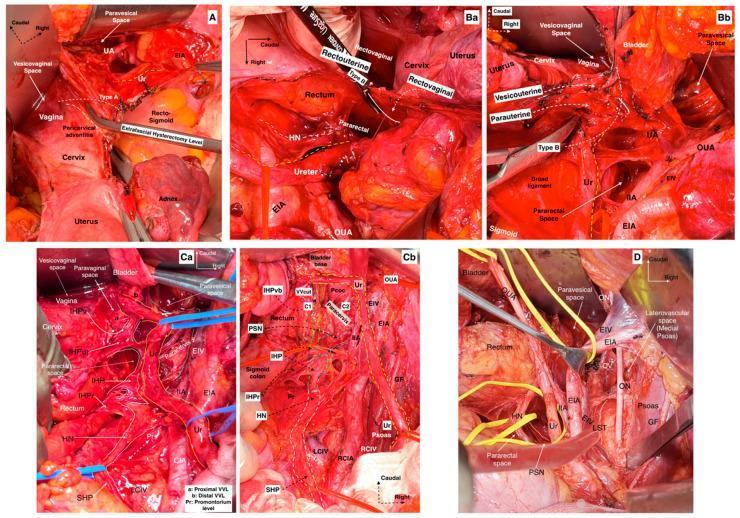
A multi-panel series of intraoperative clinical photographs illustrating surgical anatomy and resection planes for different types of Radical Hysterectomy (RH) according to the Querleu-Morrow classification. Panel A shows Type A minimal RH with a resection level between the pericervical adventitia and the ureter (Ur). Panels Ba and Bb demonstrate Type B modified RH, highlighting resection along the longitudinal axis of the ureter involving the parauterine and vesicouterine ligaments. Panels Ca and Cb depict Type C1 nerve-sparing RH, focusing on the preservation of the inferior hypogastric plexus (IHP) vesical branches and resection of the proximal vesicovaginal ligament (VVL). Panel D illustrates the anatomy for paracervical lymphadenectomy, showing the laterovascular plane (medial psoas plane) bounded by the obturator nerve (ON), external/internal iliac vessels (EIA/EIV/IIA), and the lumbosacral trunk (LST). Key anatomical landmarks identified across the panels include the uterine artery (UA), hypogastric nerves (HN), pelvic splanchnic nerves (PSN), and various pelvic avascular spaces (paravesical, pararectal, and vesicovaginal).
Types of Hysterectomy
A. By Extent of Tissue Removed
| Type | What is Removed | Key Points |
|---|---|---|
| Subtotal (Supracervical) Hysterectomy | Uterine body only; cervix left in place | Faster, less risk of bladder/ureter injury; requires continued cervical screening |
| Total Hysterectomy (TAH) | Uterus + cervix | Most common type; eliminates need for cervical Pap smears |
| TAH-BSO | Uterus + cervix + both ovaries + both fallopian tubes | Induces surgical menopause; used for ovarian cancer risk reduction, endometriosis |
| Radical Hysterectomy (Wertheim's) | Uterus + cervix + upper vaginal cuff + parametrium + pelvic lymph nodes | For cervical/endometrial cancer; more extensive dissection around the ureter |
B. Radical Hysterectomy - Querleu-Morrow Classification
| Class | Name | Extent of Resection |
|---|---|---|
| Type A | Minimum resection (extrafascial) | Resection medial to ureter; minimal parametria; equivalent to simple TAH |
| Type B | Modified radical (Wertheim) | Resection at ureter level; partial parametrectomy; ureter unroofed but not mobilized |
| Type C1 | Radical - nerve sparing | Resection at pelvic wall; preserves autonomic nerves (inferior hypogastric plexus) |
| Type C2 | Radical - no nerve sparing | Complete parametrectomy to pelvic floor; greater radicality |
| Type D | Laterally extended parametrectomy | Extends to internal iliac vessels/pelvic sidewall; for advanced/recurrent disease |
C. By Surgical Route/Approach
| Route | Description | Advantages |
|---|---|---|
| Abdominal (TAH / AH) | Open laparotomy - midline or Pfannenstiel incision | Best for large uteri, extensive adhesions, malignancy |
| Vaginal (VH) | Uterus removed through vagina | Less pain, faster recovery, no abdominal scar |
| Laparoscopic (LH / TLH) | Endoscopic instruments; specimen removed vaginally or via port | Less morbidity vs. AH; equivalent to VH in outcomes |
| Laparoscopic-Assisted Vaginal (LAVH) | Laparoscopic dissection + vaginal delivery of specimen | Combines benefits of both routes |
| Robot-Assisted (RALH) | da Vinci system-assisted laparoscopic approach | Used in complex cases; higher cost |
Summary Mnemonic: STAR-V
- Subcervical (supracervical/subtotal)
- Total (TAH)
- Addition of adnexa (TAH-BSO)
- Radical (Wertheim/QM classified)
- Variable routes (abdominal, vaginal, laparoscopic, robotic)
- TAH is the most commonly performed type for benign disease (fibroids, DUB, adenomyosis)
- TAH-BSO is preferred when ovarian pathology coexists or for surgical risk reduction in BRCA carriers
- Radical hysterectomy (Types B-D) is reserved for gynecologic malignancies, especially cervical cancer
- Vaginal and laparoscopic approaches are preferred over open abdominal when feasible, due to lower morbidity and faster recovery