

IMG_20260610_075720.jpg
Diagnosis of this, 2.5 year old child, no fever, only tenderness.
Reading File
The image shows a small, dome-shaped, flesh-colored papule with a central umbilication (dimple) on the forearm/wrist of a 2.5-year-old child. No fever, only tenderness on palpation. This is classic for molluscum contagiosum.
Searching sources...
Finding Sources
Searching PubMed
"molluscum contagiosum" AND children
Reading File
Reading File
Loading Image
Diagnosis: Molluscum Contagiosum (MC)
The image shows a single, dome-shaped, flesh-colored papule with a central white core/umbilication on the forearm of a 2.5-year-old child. This is the hallmark appearance of molluscum contagiosum.
Textbook reference image for comparison (Andrews' Diseases of the Skin):
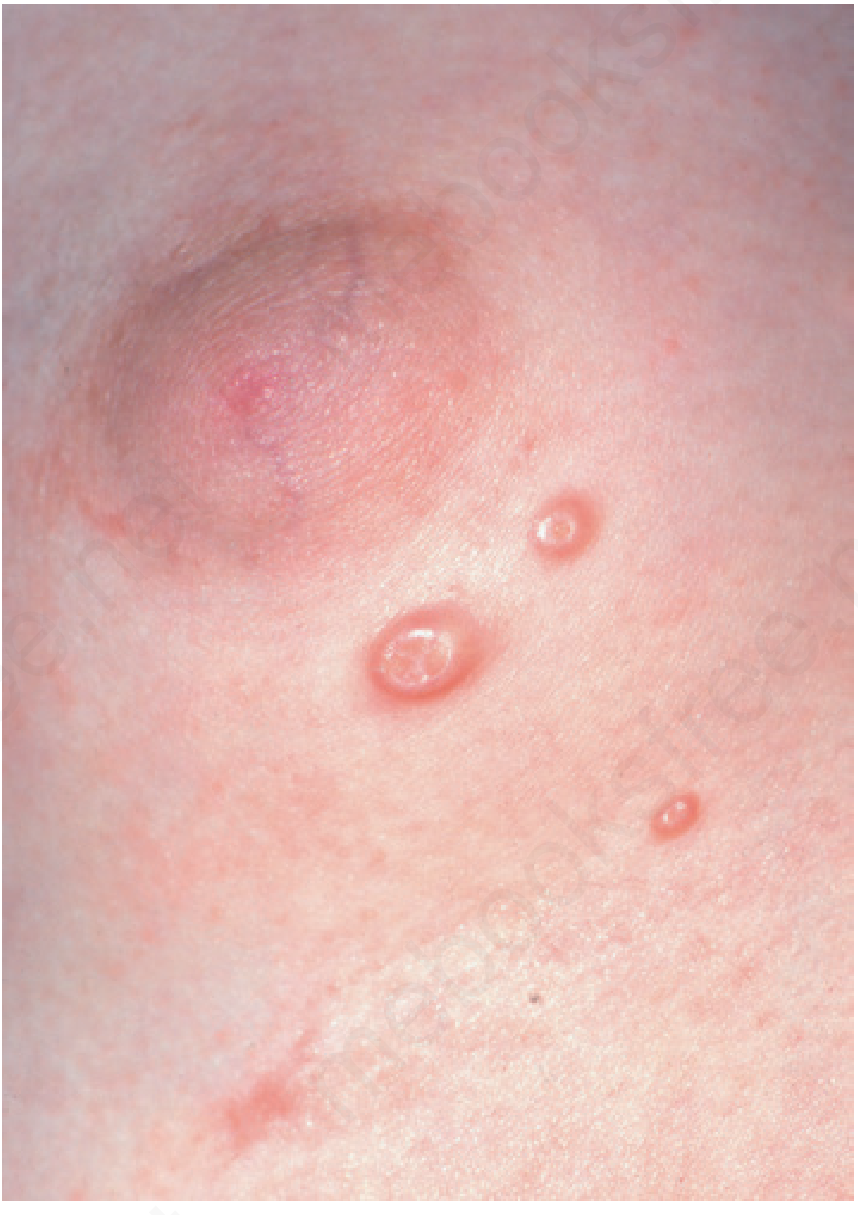
Why MC fits perfectly
| Feature | This Child | MC Typical |
|---|---|---|
| Age | 2.5 years | Peak age 1-4 years |
| Morphology | Dome-shaped papule, central umbilication/white core | Smooth, firm, dome-shaped pearly papule 3-5 mm, central umbilication |
| Location | Forearm | Generalized in children; any site |
| Fever | Absent | Absent (no systemic involvement) |
| Tenderness | Present | Inflamed MC = erythema, pain, swelling (occurs in ~20% of children) |
| Virus | - | MCV-1 (virtually all childhood cases) |
The tenderness without fever is explained by the textbook concept of "BOTE" sign (Beginning Of The End) - inflamed, tender MC lesions in children actually signal the immune system is attacking the virus and the lesion is approaching spontaneous resolution, not a secondary infection.
Pathogen & Transmission
- Causative agent: Molluscum contagiosum virus (MCV), type 1 - a poxvirus
- Transmission in children: direct skin-to-skin contact, wet skin, shared towels or pool equipment
- Self-limiting in immunocompetent children
Management Options
In young immunocompetent children, most guidelines favor a "watchful waiting" approach since lesions self-resolve (over months to ~2 years). Active treatment is considered if:
- Lesions are spreading rapidly
- Causing significant distress or cosmetic concern
- Child has underlying atopic dermatitis (increased risk of spread)
Treatment options when indicated:
- Cantharidin (applied in-office) - most commonly used in children; painless at application
- Curettage - physical removal; requires local anesthetic in young children
- Cryotherapy - liquid nitrogen; less tolerated in toddlers
- Imiquimod 5% cream (off-label) - for older, cooperative children
- Topical salicylic acid - mild, home-based option
Key point: The tenderness in this child is a positive prognostic sign - it likely indicates the lesion is undergoing immune-mediated involution (BOTE sign). The parent can be reassured that this is a benign, self-limiting viral infection, not a bacterial process.
- Andrews' Diseases of the Skin: Clinical Dermatology, pp. 453-454
Recent evidence: Silverberg NB et al., 2025 (PMID 40673403) - Systematic review confirming nonsexual (contact/fomite) transmission is the dominant route in children.
These lesions are present on legs also
Multiple lesions on both arms and legs in a 2.5-year-old is completely consistent with molluscum contagiosum - this is the typical disseminated childhood pattern. No change in diagnosis.
Key points this confirms:
- Generalized MC - the textbook specifically states: "In young children, even with normal immunity, the lesions are usually generalized and number from a few to more than 100. Lesions tend to be on the axillae, inguinal areas, popliteal or antecubital fossae and face" - limbs are a classic distribution
- This is not a concerning feature; it is expected at this age
- MCV-1 is the causative type in virtually all childhood cases
What to check next (clinical pointers)
- Atopic dermatitis? - Children with eczema get far more widespread MC (the disrupted skin barrier allows easy viral entry). Check for dry, itchy skin. If present, managing the eczema helps limit further spread.
- Count the lesions - fewer than ~20 lesions is mild; >50 suggests more active spread, consider treatment
- Check axillae, popliteal fossae, groin - autoinoculation spreads MC to skin folds preferentially in children
- Avoid scratching - educate parents that scratching spreads lesions to adjacent skin (autoinoculation)
Management reminder for this child
Since the child is afebrile and immunocompetent, watchful waiting remains first-line. The tender inflamed lesion on the arm (BOTE sign) suggests the immune response is already active. Reassure the parents:
- Lesions will self-resolve over 6-18 months (sometimes up to 2 years)
- No sharing of towels, washcloths, or clothing to prevent spread to siblings
- Cover lesions with clothing or waterproof bandage during swimming/contact sports
- If the child has eczema, use a low-potency topical steroid on the surrounding dermatitis only - this does not worsen the MC
Active treatment (cantharidin in-office, or topical salicylic acid at home) is a reasonable option if the parents want faster resolution or if lesions continue to multiply rapidly.
How does it occurs? Etiology
Searching sources...
Finding Sources
Reading File
Finding Sources
Reading File
Finding Sources
Reading File
Here is a complete breakdown of the etiology and pathogenesis of molluscum contagiosum:
Etiology & Pathogenesis of Molluscum Contagiosum
1. The Virus
- Pathogen: Molluscum contagiosum virus (MCV) - the sole member of genus Molluscipoxvirus, family Poxviridae
- Genome: Large, double-stranded DNA virus
- Subtypes: MCV-1, MCV-2, MCV-3, MCV-4
- MCV-1 - causes virtually 100% of childhood infections
- MCV-2 - predominates in HIV/AIDS patients (60% of cases)
- The subtype does not significantly alter pathogenesis
- Important: MCV cannot be grown in standard tissue culture or animal models - it is strictly a human virus
2. Transmission (How it enters the body)
| Route | Details |
|---|---|
| Direct skin-to-skin contact | Most common in children - especially wet skin |
| Autoinoculation | Child scratches a lesion then touches another body part - explains spread to legs from arms |
| Fomites | Shared towels, washcloths, swimming equipment |
| Bathing/swimming pools | Facilitated by wet, macerated skin (disrupted barrier) |
| Sexual contact | In adults and adolescents |
| Vertical (mother to neonate) | Rare |
Incubation period: 2-7 weeks, but can be up to 6 months
3. How the Lesion Forms (Pathogenesis step by step)
MCV enters skin via microabrasions or disrupted barrier
            ↓
Infects basal epidermal keratinocytes
            ↓
Viral DNA replicates inside keratinocyte cytoplasm
(MCV replicates entirely in cytoplasm - poxvirus hallmark)
            ↓
Infected cells fill with viral particles
→ Large eosinophilic inclusions form = "Molluscum bodies"
  (also called Henderson-Paterson bodies)
→ These compress the cell nucleus to the periphery
            ↓
Acanthosis (thickening) of epidermis occurs
Lesion becomes cup-shaped / lobulated with a central crater
            ↓
Central crater fills with keratinous debris + viral particles
= the "white core" / umbilication you see clinically
            ↓
Immune evasion phase:
MCV produces an IL-18 binding protein
→ Blocks Th1 immune response
→ Reduces local IFN-γ production
→ Allows the virus to persist for months
            ↓
Eventually immune system overcomes evasion
→ Lymphocyte + neutrophil infiltrate destroys the lesion
→ Spontaneous resolution (the tender/red BOTE sign phase)
4. Why It Stays Confined to Skin
- MCV infects only follicular and interfollicular epithelium - no systemic spread
- No viremia occurs
- No latency established (unlike herpes viruses) - once cleared, it's gone
- In immunocompetent children: self-limited
- In immunocompromised (HIV, DOCK8 deficiency, CARD11 mutations): widespread, persistent, recalcitrant - because the Th1 response that normally clears the virus is deficient
5. Why This Child Has Lesions on Both Arms and Legs
The most likely mechanism in a 2.5-year-old is autoinoculation - the child scratches or rubs the initial lesion (possibly on arm), transfers viable viral particles on fingers/hands, then inoculates new skin sites on the legs during normal play and movement. The disrupted skin (scratches, eczema) makes new sites vulnerable.
Sources: Red Book 2021 (AAP), p. 836 | Medical Microbiology 9e, p. 511 | Andrews' Diseases of the Skin, p. 453
In case if this child gave history of mild fever preciously then?
Great clinical thinking. A history of mild preceding fever in a 2.5-year-old with widespread umbilicated papules significantly broadens the differential diagnosis and requires you to rule out more serious conditions.
Searching sources...
Finding Sources
Finding Sources
Finding Sources
Finding Sources
Reading File
Finding Sources
Excellent - now I have enough to give a thorough answer.
Impact of a Prior Mild Fever on the Diagnosis
A history of mild preceding fever in this 2.5-year-old changes the clinical picture in two important ways:
A. Does it rule out Molluscum Contagiosum?
Not entirely - but MC itself does NOT cause fever. MC is a purely epidermal infection with no systemic involvement. If this child had fever before the lesions, it was either:
- An unrelated coincidental viral illness (very common at this age - toddlers get 6-8 viral URIs/year)
- A sign that this is actually a different diagnosis entirely
Revised Differential Diagnosis (with fever history)
1. Varicella (Chickenpox) - TOP priority to rule out
This is the most important differential when fever precedes skin lesions in a toddler.
| Feature | Varicella | MC |
|---|---|---|
| Fever | Yes - 1-2 day prodrome BEFORE rash | No systemic fever |
| Lesion morphology | Macule → Papule → Vesicle ("dewdrop on rose petal") → Pustule → Umbilicated → Crust | Firm dome-shaped papule, central umbilication, no vesicular stage |
| All stages simultaneously | Yes - hallmark feature | No - all lesions look similar |
| Distribution | Face/scalp/trunk first → extremities | Any site, no set order |
| Central core | Crusts, not expressible white core | White cheesy core can be expressed |
| Pruritus | Intensely itchy | Mild or absent |
| Speed of appearance | Rapid - days | Slow - weeks to months |
Key distinguishing point: In varicella, pustules can umbilicate and look exactly like MC. This is a well-known diagnostic pitfall. The temporal relationship (fever first, then rapid rash) and simultaneous stages of lesions clinch varicella.
2. Monkeypox (Mpox) - Must consider in current epidemiological context
| Feature | Mpox | MC |
|---|---|---|
| Fever | Yes - febrile prodrome with lymphadenopathy | No |
| Lesion depth | Deep, well-circumscribed - go through all stages to firm umbilicated crust | Superficial, soft, expressible core |
| Lymphadenopathy | Present (distinguishes from smallpox/varicella) | Absent |
| Distribution | Centrifugal - face → trunk → extremities; palms and soles involved | Trunk, face, extremities - variable |
| Number | Usually <25 lesions | Variable, 1 to >100 |
3. Hand, Foot and Mouth Disease (HFMD)
- Caused by Coxsackievirus A16 (or A6 for atypical cases)
- Mild fever + oral ulcers + flat-topped vesicles on palms, soles, and mouth
- Atypical CV-A6 strains can cause widespread lesions mimicking other exanthems
- Check the mouth (oral ulcers/vesicles) and palms/soles - if positive, this is HFMD
4. Orf / Parapoxvirus
- Contact with infected animals (sheep, goats)
- Single umbilicated nodule, mild fever possible
- Less likely in an urban 2.5-year-old
Clinical Decision Algorithm
2.5-yr-old + umbilicated papules + PRIOR MILD FEVER
                    ↓
Check lesion stages: Are they ALL the same? → Likely MC
Are they in DIFFERENT stages (macule/vesicle/crust)? → Varicella
                    ↓
Check mouth + palms/soles
Oral ulcers present? → HFMD
                    ↓
Check lymph nodes
Lymphadenopathy present? → Mpox (report to health authority)
                    ↓
Fever now resolved, single morphology, expressive white core
→ MC most likely, fever was coincidental
Bottom Line
- If fever preceded by 1-2 days and lesions appeared rapidly in different stages (some vesicular, some crusted) → Varicella until proven otherwise
- If fever was mild, brief, already resolved, and all lesions look identical (firm, same size, umbilicated with white core) → MC with coincidental viral illness
- Check vaccination history - if varicella vaccine given, breakthrough varicella is still possible but lesions are typically fewer (<50) and milder
- Check the mouth and palms at examination to exclude HFMD
Sources: Textbook of Family Medicine 9e, p. 926 | Red Book 2021 (AAP), p. 836 | Andrews' Diseases of the Skin, p. 453
This is a shared conversation. Sign in to Orris to start your own chat.