
Explain cohort study design and it's types
cohort study design types prospective retrospective epidemiology
Cohort Study Design
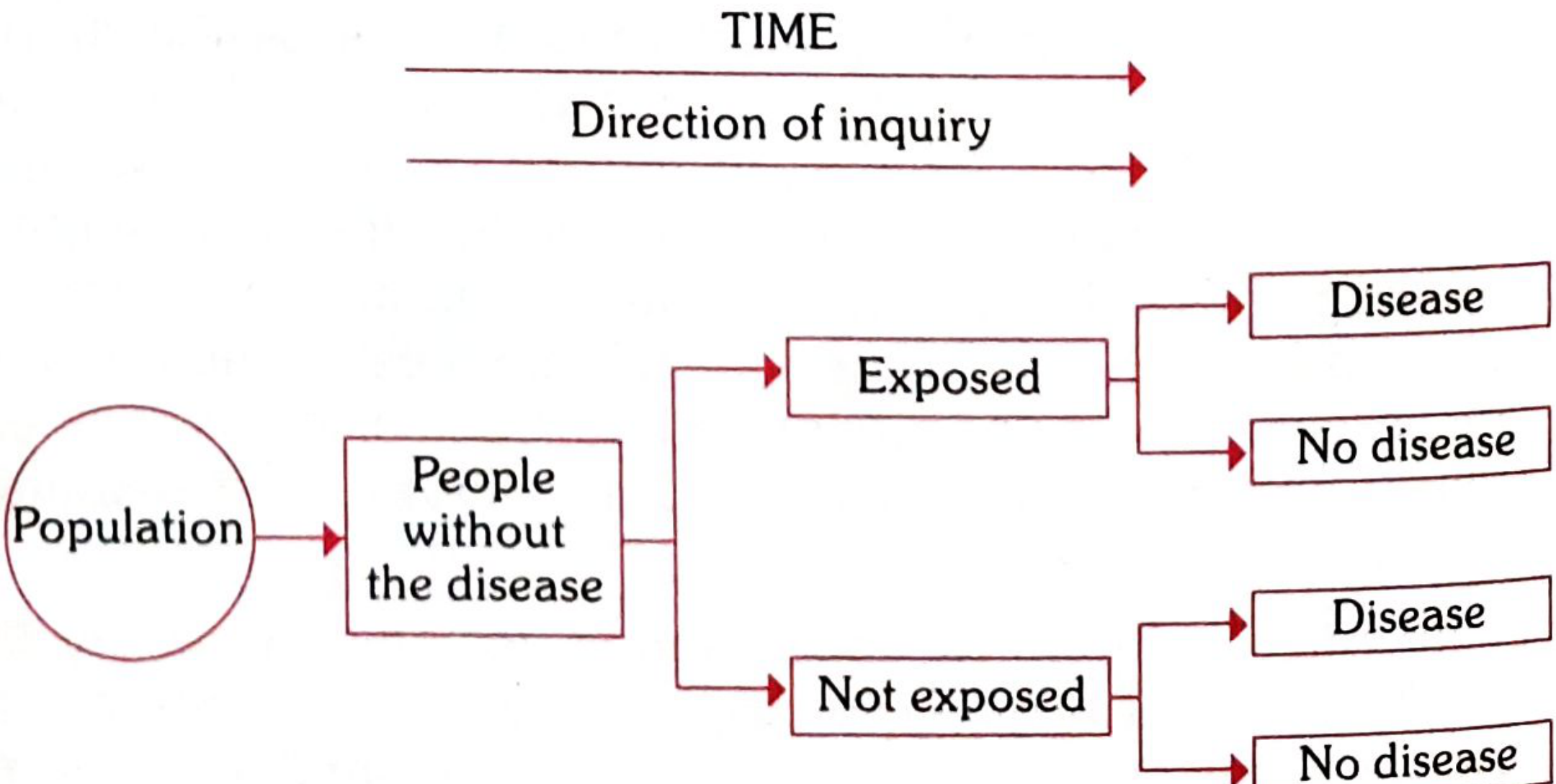
Concept of "Cohort"
- Birth cohort - all persons born in a given year (e.g., birth cohort of 2010)
- Exposure cohort - persons exposed to a common drug, vaccine, or infection in a defined period
- Marriage cohort - persons married in the same period
- Disease cohort - e.g., all who survived a myocardial infarction in a particular year
Distinguishing Features
- Cohorts are identified prior to the appearance of the disease under investigation
- Study groups are observed over time to determine the frequency of disease
- The study proceeds forward from cause to effect
Basic Framework (2x2 Table)
| Cohort | Disease: Yes | Disease: No | Total |
|---|---|---|---|
| Exposed to putative aetiologic factor | a | b | a + b |
| Not exposed | c | d | c + d |
- Study cohort (a+b): exposed group
- Control cohort (c+d): unexposed comparison group
- Incidence in exposed = a/(a+b); in unexposed = c/(c+d)
- Result expressed as Relative Risk (RR) = [a/(a+b)] / [c/(c+d)]
Types of Cohort Studies
1. Prospective Cohort Study
- Identifies exposure status at the start
- Follows subjects forward in time
- Awaits the development of disease
- Exposure and outcome data are collected as events occur
- Temporality is clear (exposure precedes disease)
- Can calculate incidence rates directly
- Less susceptible to recall bias
- Can study multiple outcomes from one exposure
- Very time-consuming and expensive
- Large sample size needed
- Loss to follow-up is a major problem
- Not suitable for rare diseases (would need enormous numbers)
2. Retrospective Cohort Study (Historical Cohort Study)
- Much faster and cheaper than prospective studies
- Useful when the disease has a very long latency period
- Good for occupational or industrial exposure studies
- Dependent on the quality of existing records
- Cannot control what data were collected in the past
- More prone to information bias
3. Ambidirectional (Mixed) Cohort Study
- Identifies a historical cohort from past records (retrospective component)
- Continues to follow that same cohort forward in time (prospective component)
4. Nested Case-Control Study
5. Case-Cohort Study
When Are Cohort Studies Indicated?
- (a) There is already good evidence of an association (from descriptive or case-control studies) and causal proof is now needed
- (b) Exposure is rare but incidence of disease is high among the exposed (e.g., industrial/occupational exposure groups, radiation workers)
- (c) Attrition can be minimized - the cohort is stable, cooperative, and accessible for long-term follow-up
- (d) Adequate funding is available
Elements of a Cohort Study
| Element | Requirement |
|---|---|
| Cohort membership | Must be free of the disease under study at the start |
| Comparability | Both groups equally susceptible to the disease |
| Comparability of variables | Groups matched for age, sex, and other confounders |
| Diagnostic criteria | Must be defined before the study begins |
Advantages vs. Disadvantages Summary
| Advantages | Disadvantages |
|---|---|
| Can calculate incidence and relative risk directly | Expensive and time-consuming |
| Clear temporal sequence (exposure before disease) | Not suitable for rare diseases |
| Can study multiple outcomes of one exposure | Loss to follow-up can introduce bias |
| Less susceptible to recall bias | Very large sample sizes often needed |
| Gold standard for showing association | Ethical issues with known harmful exposures |
Measures of Association
RR = Incidence in exposed / Incidence in unexposed = [a/(a+b)] / [c/(c+d)]
- RR > 1: exposure increases disease risk
- RR < 1: exposure is protective
- RR = 1: no association
Generate a visual summary poster of cohort study types and timing
A clean, professional medical education poster titled "Cohort Study Types & Timing" with a dark navy blue background and white/light text. The poster has the following sections laid out clearly: At the top: Large bold title "COHORT STUDY TYPES & TIMING" with a subtitle "Observational Analytical Study Design" A horizontal TIMELINE arrow spans the full width in the middle of the poster, labeled "PAST ← → PRESENT → → FUTURE", colored in gold/yellow. Below and around this timeline, show 3 main cohort study types as distinct color-coded panels: 1. PROSPECTIVE COHORT STUDY (green panel, right side of timeline): - Arrow pointing RIGHT (forward in time) - Label: "Starts NOW → follows into FUTURE" - Icon: group of people → time passes → disease/no disease outcome - Key points: "Exposure identified at baseline", "Outcome awaited", "Calculates Incidence & RR", "Time-consuming, expensive" 2. RETROSPECTIVE COHORT STUDY (orange/amber panel, left side of timeline): - Arrow pointing LEFT then right (looks back using records) - Label: "Starts NOW → looks BACK using records" - Icon: filing cabinet / medical records → historical exposure → outcome already known - Key points: "Historical records used", "Both exposure & outcome already occurred", "Faster & cheaper", "Dependent on record quality" 3. AMBIDIRECTIONAL COHORT STUDY (purple panel, spanning both sides): - Bidirectional arrow - Label: "Looks BACK + follows FORWARD" - Key points: "Combines both designs", "Historical baseline + prospective follow-up" Below the 3 types, a smaller row showing: 4. NESTED CASE-CONTROL (blue box): "Case-control study embedded within a cohort" 5. CASE-COHORT STUDY (teal box): "Cases vs. random subcohort selected at baseline" At the bottom: A summary comparison table with columns: Type | Direction | Cost | Time | Bias Risk Rows for Prospective, Retrospective, Ambidirectional Footer: "Key Outcome Measure: Relative Risk (RR) = Incidence in Exposed / Incidence in Unexposed" The overall design is clean, well-spaced, uses icons, colored arrows, and is suitable for medical students. High quality infographic style.
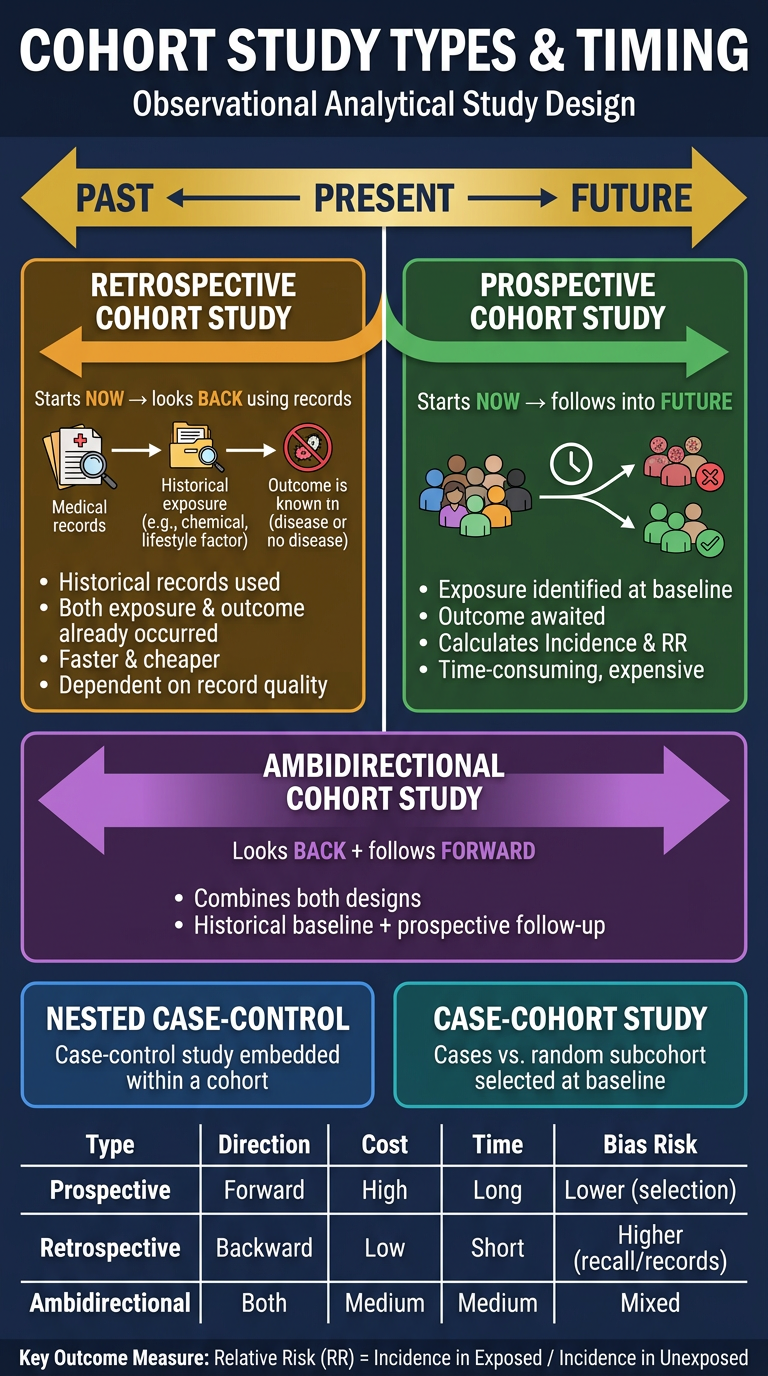
- The central timeline showing Past → Present → Future, which anchors the directionality of each study type
- Prospective (green) - starts now, follows forward
- Retrospective (amber) - starts now, looks back at historical records
- Ambidirectional (purple) - spans both directions
- Nested Case-Control & Case-Cohort as special variants within cohorts
- A comparison table at the bottom with Type, Direction, Cost, Time, and Bias Risk
- The key formula for Relative Risk at the footer
Generate a detailed comparison table: Prospective vs Retrospective cohort studies
Prospective vs Retrospective Cohort Studies - Detailed Comparison
Overview
| Feature | Prospective Cohort Study | Retrospective Cohort Study |
|---|---|---|
| Other names | Current cohort study, longitudinal study, concurrent cohort study, forward-looking study | Historical cohort study, prospective study in retrospect, non-concurrent prospective study |
| Direction | Forward - present into future | Backward - present back to past records, then traces forward |
| Timing of outcome | Outcome has NOT yet occurred when study begins | Outcome has already occurred before study begins |
| Starting point | Begins in the present | Begins by examining past records (10-30 years back) |
| Data collection | Planned and collected prospectively as events happen | Uses existing records (employment, hospital, medical records) |
Design & Methodology
| Feature | Prospective | Retrospective |
|---|---|---|
| Exposure assessment | Measured directly and systematically at baseline | Reconstructed from historical records |
| Outcome assessment | Observed and recorded as they occur over follow-up | Already known before study initiation |
| Investigator control | High - investigator defines what data to collect | Low - limited to what was recorded in the past |
| Standardization | Enrollment criteria and outcome measures can be standardized | Dependent on how data was originally recorded |
| Blinding | Possible | Impossible - outcomes are already known |
| Follow-up period | Long (years to decades, especially for chronic diseases) | Shorter real-time duration (records already exist) |
Strengths
| Prospective | Retrospective |
|---|---|
| Clear temporal sequence - exposure definitively precedes outcome | Faster - results produced much more quickly |
| Less susceptible to recall bias (data collected before disease) | Less expensive and more economical |
| Higher quality, more complete data | Useful for diseases with very long latency periods |
| Can directly calculate incidence rates | Suitable for rare exposures (e.g., occupational groups) |
| Multiple outcomes can be studied from one exposure | Practical when prospective follow-up is not feasible |
| Can study natural history of disease | Good for initial hypothesis testing |
| Stronger evidence for causation | Can study large populations using existing databases |
| Can assess dose-response relationships | Useful when the disease has already peaked |
Limitations
| Prospective | Retrospective |
|---|---|
| Very time-consuming and expensive | Entirely dependent on quality and completeness of existing records |
| Not suitable for rare diseases (huge sample needed) | Cannot control what variables were or were not collected |
| Loss to follow-up introduces bias (attrition bias) | More prone to information bias and selection bias |
| Requires large sample sizes | Missing data cannot be recovered |
| Ethical issues if exposure is known to be harmful | Treatment selection bias difficult to control statistically |
| Changes in diagnostic criteria over time can affect results | Confounding variables may not have been recorded historically |
| Resource-intensive for long-term maintenance | Records may be incomplete, inconsistent, or inaccurate |
Bias Profile
| Type of Bias | Prospective | Retrospective |
|---|---|---|
| Recall bias | Low (data collected prospectively) | Higher (relies on past records/memory) |
| Attrition/loss to follow-up bias | Higher risk (long follow-up) | Lower (cohort already followed) |
| Selection bias | Lower | Higher (who had records kept?) |
| Information bias | Lower | Higher (record quality varies) |
| Confounding | Better controlled (can measure confounders at baseline) | Harder to control (may not have been recorded) |
| Observer bias | Possible (if not blinded) | Less relevant |
Practical Parameters
| Parameter | Prospective | Retrospective |
|---|---|---|
| Cost | High | Low to moderate |
| Time to results | Years to decades | Months to a few years |
| Sample size needed | Very large | Large, but data may already exist |
| Feasibility for rare diseases | Poor | Better (can search large databases) |
| Feasibility for rare exposures | Good | Excellent (occupational records) |
| Evidence hierarchy rank | Higher (stronger causal inference) | Lower (weaker causal inference) |
| Data quality | High (researcher-controlled) | Variable (dependent on record-keeping) |
Classic Examples
| Prospective | Retrospective |
|---|---|
| Framingham Heart Study - followed healthy adults in Framingham, MA to identify risk factors for cardiovascular disease | Boston hospital study (1978) - 17,080 babies born 1969-1975 studied retrospectively for effect of electronic fetal monitoring on neonatal death |
| Doll & Hill (1954) - British doctors followed prospectively; smoking and lung cancer | Uranium miners study - archival employment records used to identify exposure; lung cancer outcomes already known |
| Royal College of GPs study - oral contraceptives and health outcomes | Angiosarcoma of liver & PVC - rare disease detected only because retrospective cohort design was used |
| Nurses' Health Study - ongoing prospective follow-up of US nurses | Occupational arsenic exposure - carcinogenesis studied from historical industrial records |
When to Use Which?
| Use Prospective When... | Use Retrospective When... |
|---|---|
| Causal proof is the goal | Preliminary evidence needed quickly |
| Outcome is common enough to observe prospectively | Outcome has a very long latency (e.g., cancer from occupational exposure) |
| Adequate funding and time are available | Budget and time are limited |
| Data quality is paramount | High-quality historical records already exist |
| The disease is in its early natural history | The disease has already occurred in a known population |
| Long-term follow-up is feasible | The cohort is stable and traceable through records |
Key Outcome Measure (Both Types)
Relative Risk (RR) = [a/(a+b)] / [c/(c+d)]Where: a = exposed who got disease, b = exposed who did not, c = unexposed who got disease, d = unexposed who did not
Explain retrospective cohort study with examples
retrospective cohort study design examples advantages limitations epidemiology
Retrospective Cohort Study
Definition
"The investigator goes back in time sometimes 10 to 30 years, to select his study groups from existing records of past employment, medical or other records and traces them forward through time." - Park's Textbook of Preventive and Social Medicine
How It Works - Step by Step
PAST ─────────────────────────────────────► PRESENT
  │                                              │
[STEP 1]                                    [STEP 5]
Identify cohort                             Analyse outcomes
from old records                            (already known)
  │
[STEP 2]
Classify as
EXPOSED vs UNEXPOSED
  │
[STEP 3]
Trace subjects
forward through records
  │
[STEP 4]
Determine who developed
the disease/outcome
Sources of Historical Data
| Source | Type of information |
|---|---|
| Employment / industry records | Occupational exposure (chemicals, radiation, dust) |
| Hospital / medical records | Drug exposure, surgical history, diagnoses |
| Birth registers | Neonatal outcomes, maternal exposures |
| Death registries | Cause of death, mortality rates |
| Insurance records | Long-term morbidity and health utilisation |
| Military service records | Veteran cohorts, trauma, substance exposure |
| National health databases | NSQIP, SEER, Medicare, NIS (surgical outcomes) |
Classic Real-World Examples
1. Electronic Fetal Monitoring & Neonatal Death (1978)
- Cohort: 17,080 babies born January 1969 - December 1975 at a Boston hospital
- Exposure: Electronic fetal monitoring during labour (yes vs. no)
- Outcome: Neonatal death
- Finding: Neonatal death rate was 1.7 times higher in unmonitored infants
- Why retrospective? All births and deaths had already occurred; researchers used existing hospital birth records
2. Uranium Miners & Lung Cancer
- Cohort: Workers employed in uranium mining (identified from employment records)
- Exposure: Uranium/radon gas inhalation
- Outcome: Development of lung cancer
- Finding: Uranium miners had an excess frequency of lung cancer compared to non-miners
- Why retrospective? Mining employment records and death registries were used; no prospective follow-up needed
3. Arsenic & Human Carcinogenesis
- Cohort: Workers with documented occupational arsenic exposure (from factory/industry records)
- Exposure: Arsenic compounds
- Outcome: Various cancers
- Finding: Established arsenic as a human carcinogen
- Why retrospective? Industrial employment and health records used
4. Physicians & Radiation Exposure
- Cohort: Groups of physicians with probable historical exposure to radiation (from professional registers and work records)
- Outcome: Mortality from radiation-related illness
- Finding: Elevated mortality in radiation-exposed physicians
- Source: Park's cites studies by refs 55, 56, 57
5. Angiosarcoma of the Liver & Polyvinyl Chloride (PVC)
- Cohort: Industrial workers exposed to PVC manufacturing
- Exposure: Vinyl chloride monomer
- Outcome: Angiosarcoma of the liver (a very rare cancer)
- Significance: This rare association was only detectable because the retrospective cohort design could efficiently screen large historical records for a very rare outcome
- Key teaching point: When a disease is too rare for prospective study, retrospective cohort is often the only feasible analytical design
6. Court-Brown & Doll (1957) - Radiation & Leukaemia (Ambidirectional)
- Cohort: 13,352 patients who received radiation therapy for ankylosing spondylitis between 1934 and 1954 (retrospective component)
- Outcome: Death from leukaemia or aplastic anaemia, 1935-1954
- Finding: Death rate from leukaemia/aplastic anaemia substantially higher than in the general population
- Note: A prospective component was later added - making this an ambidirectional design
Advantages
Disadvantages
Bias Profile
| Bias Type | Risk in Retrospective Cohort | Reason |
|---|---|---|
| Recall bias | Low (records used, not memory) | Data from documents, not self-report |
| Information bias | High | Record quality varies; inconsistent recording |
| Selection bias | Moderate-High | Who had records kept? Who is traceable? |
| Confounding | High | Unmeasured confounders not recorded historically |
| Attrition bias | Low | Follow-up already done |
| Observer bias | Low | Outcome already documented |
When Is a Retrospective Cohort Study Appropriate?
| Situation | Reason |
|---|---|
| Long latency period disease (cancer, chronic disease) | Cannot wait decades prospectively |
| Rare disease + rare exposure | Efficient use of existing large databases |
| Limited time or funding | No prospective follow-up cost |
| High-quality historical records exist | Employment registers, hospital systems, national databases |
| Occupational exposure studies | Factory/industry employment records are well-maintained |
| Preliminary evidence needed before a full prospective study | Generates hypothesis for later confirmation |
Calculating Relative Risk
| Disease: Yes | Disease: No | Total | |
|---|---|---|---|
| Exposed | a | b | a+b |
| Not Exposed | c | d | c+d |
RR = [a/(a+b)] / [c/(c+d)]RR > 1 = exposure increases risk | RR < 1 = exposure is protective | RR = 1 = no association
Reporting Standard
Test me now on case control and cohort study
Quiz: Case-Control & Cohort Studies
- A) Prospective cohort study
- B) Retrospective cohort study
- C) Case-control study
- D) Cross-sectional study
- A) Odds Ratio (OR)
- B) Relative Risk (RR)
- C) Prevalence Ratio
- D) Attributable Risk only
- A) Prospective cohort study
- B) Retrospective cohort study
- C) Case-control study
- D) Randomized controlled trial
- A) Prospective cohort study
- B) Retrospective cohort study
- C) Case-control study
- D) Both A and B equally
- Smokers who developed CVD: 400 out of 2,000
- Non-smokers who developed CVD: 300 out of 8,000
- A) Cheaper and faster
- B) Suitable for rare diseases
- C) Less susceptible to recall bias and information bias
- D) Does not require a comparison group
| Study | Design |
|---|---|
| i. Framingham Heart Study | A. Retrospective cohort |
| ii. Doll & Hill asbestos-angiosarcoma PVC study | B. Case-control |
| iii. Identifying lung cancer patients and comparing smoking history with healthy controls | C. Prospective cohort |
1.c 2.b 3.false 4.b 5.d 6.odds ratio 7.5.33 8.c 9.i-c,ii-a,iii-b 10.true
Quiz Results & Feedback
Q1 - ✅ Correct — C) Case-control study
Q2 - ✅ Correct — B) Relative Risk (RR)
Q3 - ✅ Correct — FALSE
Q4 - ✅ Correct — B) Retrospective cohort study
Q5 - ❌ Incorrect — Correct answer: C) Case-control study
| Study | Best for |
|---|---|
| Case-control | Rare diseases |
| Retrospective cohort | Rare exposures |
| Prospective cohort | Common diseases + common exposures |
Q6 - ✅ Correct — Odds Ratio (OR)
Q7 - ❌ Incorrect — Correct answer: RR = 5.33... wait, let's check your working
RR = [Incidence in exposed] / [Incidence in unexposed] = [400/2000] / [300/8000] = 0.20 / 0.0375 = 5.33
- Smokers: 400/2000 = 0.20 (20% incidence)
- Non-smokers: 300/8000 = 0.0375 (3.75% incidence)
- RR = 0.20 / 0.0375 = 5.33
- Interpretation: Smokers are 5.33 times more likely to develop CVD than non-smokers.
Q8 - ✅ Correct — C) Less susceptible to recall bias and information bias
Q9 - ✅ Correct — i-C, ii-A, iii-B
| Study | Design | Why |
|---|---|---|
| Framingham Heart Study | Prospective cohort | Enrolled healthy adults, followed forward for decades |
| PVC-angiosarcoma study | Retrospective cohort | Historical factory records used; rare disease detected from archives |
| Lung cancer vs smoking history in cases/controls | Case-control | Started with lung cancer cases, looked back at smoking |
Q10 - ✅ Correct — TRUE
- Case-control: cases and controls matched on age, sex, etc.
- Cohort: study and control cohorts matched on demographic variables that could affect disease frequency
🏆 Final Score
| Score | 9 / 10 |
| Grade | Excellent |
| Incorrect | Q5 only |
Key Takeaway to Remember
- Rare DISEASE → Case-control (start with cases, work backwards)
- Rare EXPOSURE → Cohort (find the exposed group, follow forward)