
from Guyton and Hall textbook of medical physiology, 4th South Asia edition write a 5 mark short note on Baroreceptor Reflex Mechanism
Reading File
Finding Sources
Finding Sources
Finding Sources
Finding Sources
Reading File
Loading Image
I now have all the content needed from Guyton and Hall. Here is the complete 5-mark short note:
Baroreceptor Reflex Mechanism
(Guyton and Hall Textbook of Medical Physiology, 4th South Asia Edition - Chapter 18)
Definition
The baroreceptor reflex is the best known nervous mechanism for short-term arterial pressure control. It is a negative feedback reflex that rapidly buffers arterial pressure against acute changes, keeping it close to normal levels.
Anatomical Basis - Location of Baroreceptors
Baroreceptors are spray-type nerve endings (stretch receptors) located in the walls of large systemic arteries. They are especially abundant in two regions:
- Carotid sinus - in the wall of each internal carotid artery, just above the carotid bifurcation
- Aortic arch - in the wall of the arch of the aorta
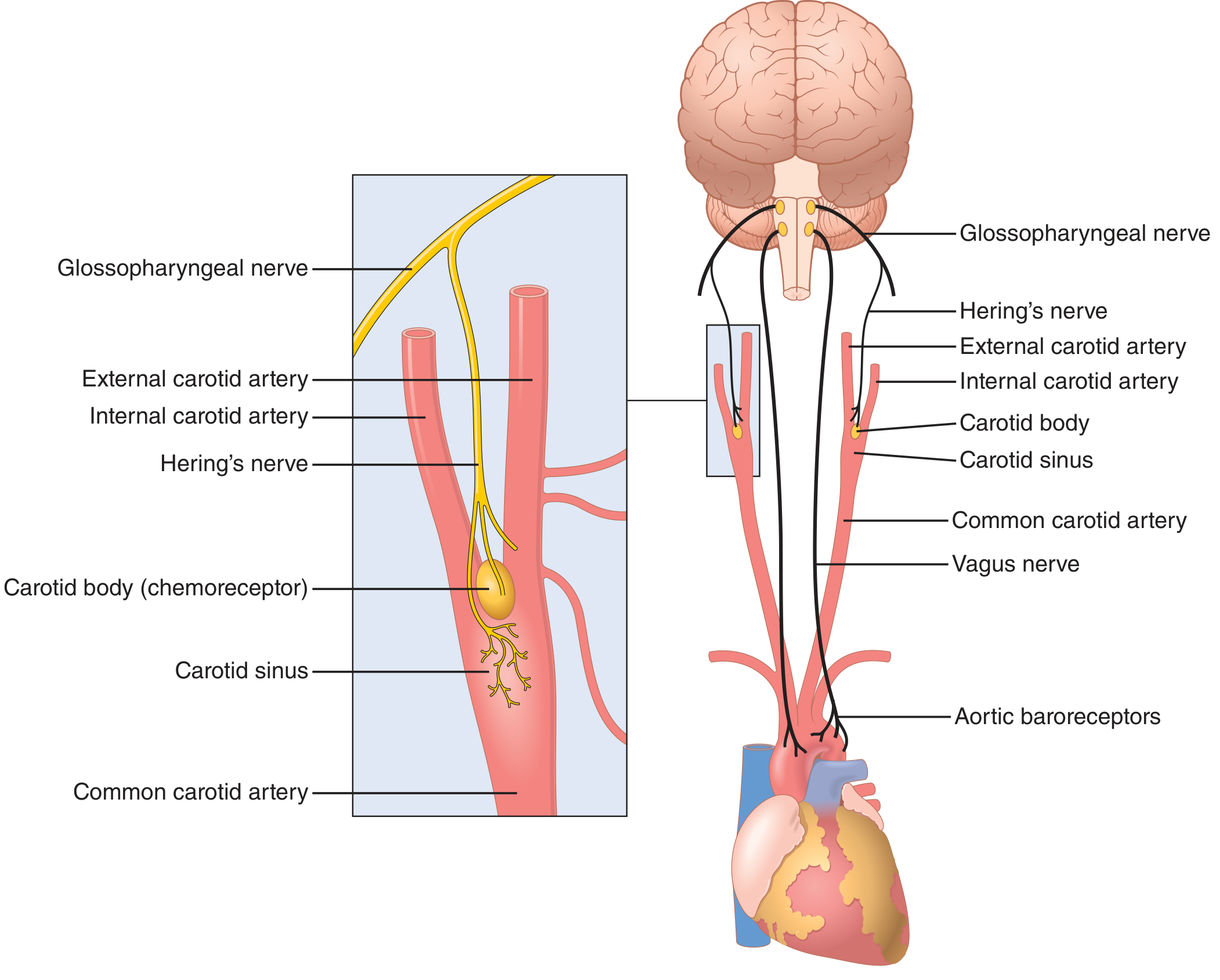
Afferent Pathways
- Signals from carotid sinus baroreceptors travel via Hering's nerve → glossopharyngeal nerve (CN IX) → nucleus tractus solitarius (NTS) in the medulla
- Signals from aortic arch baroreceptors travel via the vagus nerve (CN X) → the same NTS in the medulla
Mechanism of Response
When arterial pressure rises:
Rise in BP → Stretch of baroreceptors → Increased impulse firing → NTS inhibits the vasomotor (vasoconstrictor) center → Increased parasympathetic (vagal) output to the heart + decreased sympathetic output → Heart rate decreases, vasodilation occurs → BP falls back toward normal
When arterial pressure falls:
Fall in BP → Reduced baroreceptor stretch → Decreased firing → Vasomotor center activated → Increased sympathetic outflow → Vasoconstriction, increased heart rate and cardiac contractility → BP rises back toward normal
The net effector responses include: (1) vasodilation or vasoconstriction of blood vessels; (2) changes in heart rate (chronotropy); and (3) changes in cardiac contractility (inotropy).
Response Characteristics
- Carotid baroreceptors are not stimulated by pressures between 0 and 50-60 mmHg
- They respond progressively above this threshold, reaching a maximum near 180 mmHg
- Aortic baroreceptors operate at levels about 30 mmHg higher than carotid receptors
- The reflex is most sensitive around the normal mean arterial pressure (~100 mmHg) - even a slight change here produces a strong corrective signal
- Baroreceptors respond rapidly to dynamic (pulsatile) changes - firing rate is much higher during a rapidly rising pressure than a stationary pressure at the same level
Pressure Buffer Function
The baroreceptor system acts as a "pressure buffer" - it minimizes moment-to-moment swings in arterial pressure (e.g., on postural change, exercise, hemorrhage). For example, when a person suddenly stands up, baroreceptors prevent the drop in cerebral perfusion pressure by reflexly increasing sympathetic tone.
Baroreceptor Resetting in Chronic Hypertension
A key limitation is that baroreceptors reset over 1-2 days to any sustained new pressure level. In chronic hypertension, the receptors reset upward (they now fire maximally at a higher pressure), so the reflex continues to buffer around the new elevated set-point rather than correcting it back to normal. This resetting is primarily due to changes in the mechanical properties of the arterial wall rather than adaptation of the nerve endings themselves.
Clinical Significance
- Baroreceptor dysfunction (e.g., carotid sinus hypersensitivity) can cause syncope
- The reflex is the basis of the Valsalva maneuver response and postural hypotension compensation
- It is an important target in understanding neurogenic hypertension
Source: Guyton and Hall Textbook of Medical Physiology - Chapter 18: Nervous Regulation of the Circulation and Rapid Control of Arterial Pressure, pp. 227-229
This is a shared conversation. Sign in to Orris to start your own chat.