
Classification of muscle
Reading File
Finding Sources
Finding Sources
The Histology textbook has a dedicated section on classification of muscle. Let me read that along with fiber type information from Ganong's physiology and Junqueira's histology.
Reading File
Reading File
Reading File
Now let me read the rest of the histology classification section and get cardiac/smooth muscle details:
Reading File
Loading Image
I now have enough comprehensive information to provide a well-structured answer. Here is the full classification of muscle:
Classification of Muscle
Muscle is classified according to the appearance of the contractile cells (histological structure), location, and functional control. There are two principal categories: striated and smooth muscle.
I. Based on Histological Appearance
1. Striated Muscle
Cells show cross-striations at the light microscope level, produced by the highly ordered parallel arrangement of thick (myosin) and thin (actin) myofilaments.
Striated muscle is further divided by location:
| Feature | Skeletal Muscle | Visceral Striated Muscle | Cardiac Muscle |
|---|---|---|---|
| Location | Attached to bone; extraocular muscles | Tongue, pharynx, upper esophagus, diaphragm | Wall of heart + base of great veins |
| Nuclei | Peripheral, multiple per cell | Peripheral, multiple | Central, 1–2 per cell |
| Cell shape | Long cylindrical syncytium (10–100 µm diameter) | Same as skeletal | Branched, short cells |
| Control | Voluntary | Voluntary | Involuntary |
| Intercalated discs | Absent | Absent | Present |
Visceral striated muscle is morphologically identical to skeletal muscle but is restricted to soft tissues essential for speech, breathing, and swallowing. — Histology: A Text and Atlas (Pawlina), p. 789
2. Smooth Muscle
- Cells do not exhibit cross-striations — myofilaments are not arranged in a regular order, and myosin-containing filaments are highly labile.
- Location: Viscera, vascular walls, arrector pili of skin, intrinsic eye muscles.
- Control: Involuntary (autonomic).
- Cells are spindle-shaped, with a single central nucleus.
II. Based on Functional Control
| Type | Voluntary/Involuntary |
|---|---|
| Skeletal | Voluntary |
| Cardiac | Involuntary |
| Smooth | Involuntary |
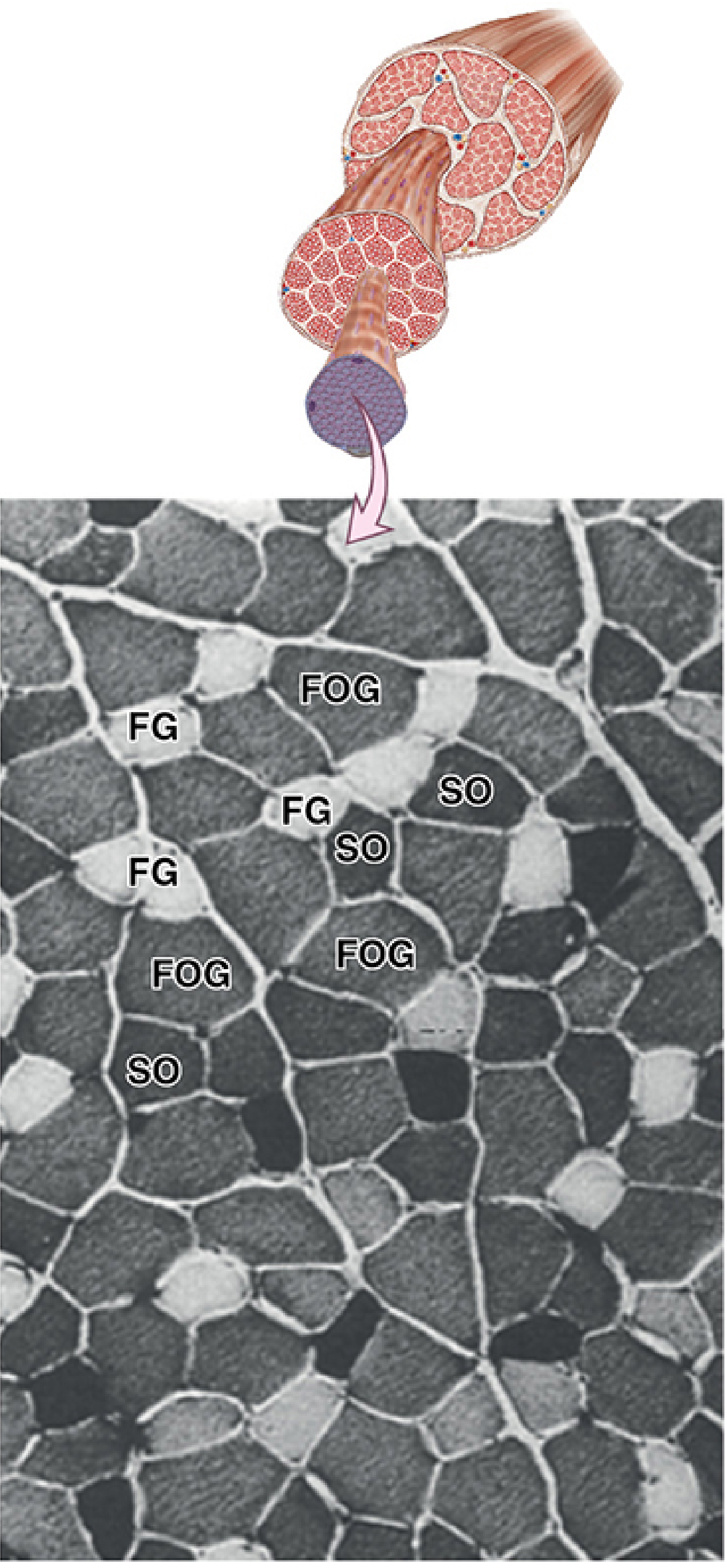
III. Classification of Skeletal Muscle Fiber Types
Skeletal muscle is a heterogeneous tissue. Fibers are classified by:
- Rate of contraction — fast vs. slow (determined by myosin ATPase isoform)
- Primary ATP synthesis pathway — oxidative vs. glycolytic
Three Major Fiber Types
| Property | Type I (SO) | Type IIA (FOG) | Type IIB (FG) |
|---|---|---|---|
| Full name | Slow Oxidative | Fast Oxidative-Glycolytic | Fast Glycolytic |
| Color | Red | Red | White |
| Myosin ATPase | Slow | Fast | Fast |
| Oxidative capacity | High | Moderate | Low |
| Glycolytic capacity | Moderate | High | High |
| Mitochondria | Many | Many | Few |
| Myoglobin | High | Moderate | Low |
| Capillary density | High | Moderate | Low |
| Fatigue resistance | High (fatigue-resistant) | Moderate | Low (fatigable) |
| Diameter | Small | Large | Large |
| Motor unit | Slow (S) | Fast Resistant (FR) | Fast Fatigable (FF) |
| Ca²⁺ SR pumping | Moderate | High | High |
| Typical function | Posture, endurance | Mixed | Short bursts of power |
— Ganong's Review of Medical Physiology, 26th ed., p. Table 5–2; Junqueira's Basic Histology, 17th ed., p. 517
Summary Diagram
MUSCLE
│
├── STRIATED (cross-striations present)
│   ├── Skeletal muscle — voluntary, peripheral nuclei, multinucleated
│   ├── Visceral striated muscle — voluntary (tongue, pharynx, esophagus, diaphragm)
│   └── Cardiac muscle — involuntary, central nuclei, intercalated discs
│
└── SMOOTH (no cross-striations)
    └── Involuntary, viscera, vessels, skin, eye
Key Distinguishing Features at a Glance
| Feature | Skeletal | Cardiac | Smooth |
|---|---|---|---|
| Striations | Yes | Yes | No |
| Nuclei | Multiple, peripheral | 1–2, central | Single, central |
| Intercalated discs | No | Yes | No |
| Autonomic control | No | Yes | Yes |
| Regeneration | Limited (satellite cells) | Very limited | Good |
| T-tubules | Yes (at A-I junction) | Yes (at Z-line) | Absent / rudimentary |
Sources: Histology: A Text and Atlas With Correlated Cell and Molecular Biology (Pawlina), pp. 787–789; Ganong's Review of Medical Physiology, 26th ed.; Junqueira's Basic Histology, 17th ed., pp. 517–519
This is a shared conversation. Sign in to Orris to start your own chat.